Bulgaria's Most Persuasive Hoaxes and False Legends
Bulgaria’s history of hoaxes is not a neat catalogue of practical jokes. Its most revealing cases sit where archaeology meets the black market, folklore meets mass media, and political accusation overwhelms inconvenient evidence.
Page outline Jump by section
Introduction
These episodes worked because they borrowed authority from something people already valued or feared: an ancient national past, supernatural wisdom, military secrecy, Cold War intrigue or a lethal epidemic. Some were deliberate frauds. Others were sincere errors, political constructions or legends enlarged by retelling. The useful question is therefore not simply whether each story was “fake”, but who made it persuasive, what evidence was ignored and why the corrected version has often travelled less widely than the original claim.
When forged antiquities become false history
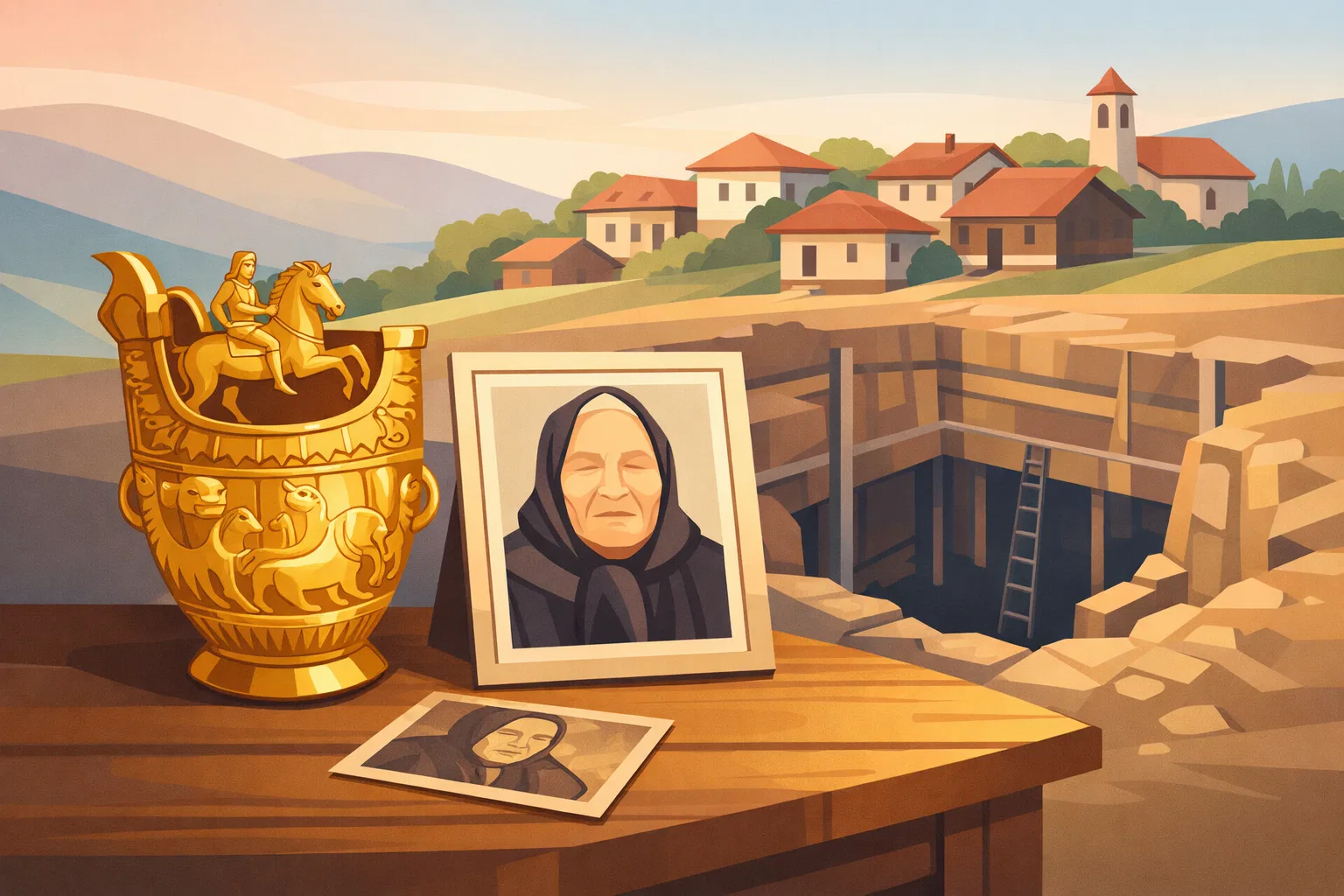
Bulgaria’s archaeological wealth creates unusually fertile conditions for both looting and forgery. Thracian gold, Roman coins, medieval seals and religious objects command high prices, while objects removed illegally from the ground usually arrive on the market without a documented excavation history. That absence of provenance makes it easier to mix genuine finds with modern imitations.
Police and heritage specialists have repeatedly described Bulgarian workshops producing false coins, jewellery, ceramics and supposed Thracian treasures. In one publicly reported 2015 case, investigators said a fabricated Thracian treasure was being offered for €200,000. An academic study citing Bulgarian police estimates stated that between 20 and 50 skilled antiquities forgers were thought to be operating in the country at that time.[archaeologyinbulgaria.com]archaeologyinbulgaria.comJuly 20, 2015 - Archaeology in Bulgaria. and Beyond…
The fraud is more sophisticated than making an obviously new souvenir look old. A convincing forgery may be based on an authentic but inexpensive object, copied from a museum piece or artificially corroded. Genuine and false items can be placed in the same collection, giving the counterfeits borrowed credibility. Dealers may also invent a discovery story, because an alleged find spot can transform a decorative object into supposed evidence about an ancient ruler, cult or settlement.
The immediate beneficiary is usually the seller, but the damage extends beyond the buyer. If a poorly documented object enters a respected collection, appears in a catalogue or is cited in an academic paper, it can distort the historical record. Bulgarian numismatist Ilya Prokopov has warned that counterfeit coins and artefacts “contaminate” scholarship by introducing false data into attempts to reconstruct the past. He has also stressed the linked problem: while fake objects are exported as ancient, genuine objects are being removed from Bulgaria and losing the archaeological context that would have made them scientifically valuable.[BNR News]bnrnews.bgBNR News Forgery of historical and cultural artefacts "contaminates" scienceBNR NewsForgery of historical and cultural artefacts "contaminates" science - Radio Bulgaria in English…
Large seizures illustrate how thoroughly the real and the false can become entangled. In 2018, Spanish authorities displayed tens of thousands of genuine and forged artefacts, many associated with Bulgaria. Reuters reported that Bulgarian authorities were opening more than 100 preliminary proceedings each year concerning illegal excavation and antiquities trading. The central problem was not merely that collectors might receive a counterfeit. It was that looted originals and manufactured substitutes were circulating through the same opaque market.[Reuters]reuters.comRescued from the black market, Bulgarian artefacts go on…November 7, 2018 — 7 Nov 2018 — More than 100 pre-trial proceedings ar…
Authentication can expose a fake through its metallurgy, tool marks, chemical composition, casting method or artificial patina. Yet testing is expensive, and a conclusive result may threaten the financial interests of owners, dealers and institutions. A museum that has celebrated a major acquisition has a reputational incentive not to discover that it is modern. This helps explain why some dubious objects survive for years: belief is supported not only by technical deception, but by prestige, money and reluctance to admit error.
How Baba Vanga acquired predictions she may never have made
Baba Vanga, the blind Bulgarian mystic who died in 1996, is now credited online with foreseeing almost every major crisis: the attacks of 11 September 2001, the Chernobyl disaster, the Covid-19 pandemic, wars in Ukraine and the Middle East, and catastrophes supposedly due decades or millennia in the future. The evidential difficulty is fundamental. No reliable, dated archive establishes that she made most of these statements before the events concerned.
During her lifetime, Vanga was widely consulted about illnesses, missing people, family problems and private anxieties. The later image of a prophet issuing an organised calendar of global events is largely a media construction. Researchers examining her afterlife have found that old witness accounts, memoirs, television programmes, books and websites continually alter one another. Predictions are shortened, translated, reinterpreted and sometimes wholly invented to match current events.[Cambridge University Press & Assessment]cambridge.orgCambridge University Press & AssessmentMediums, Media, and Mediated “Post”-Truth: Baba Vanga in the Russian Imagination | Comparative Stu…
The process is a classic example of retrospective prediction. A vague statement is publicised only after something happens, and ambiguous wording is fitted to the event. Failed predictions are forgotten, while apparent successes are repeated without their original wording, date or source. In other cases, a newly written quotation is simply attributed to Vanga. A supposed warning about the fall of Syria and a coming world war, for example, appeared prominently after political events in Syria but could not be traced in earlier online records.[News.com.au]news.com.auBlind mystic's alleged Syria predictionVanga, who died in 1996, is famous for allegedly predicting numerous major events, including 9/11 and the Covid pandemic. Syrian Islamist…
The story spread internationally because Vanga’s name performs several useful functions at once. For tabloids and social-media accounts, it supplies recurring clickbait that can be updated every New Year or attached to any breaking crisis. For believers, it offers apparent order in a frightening world. For political communicators, her supposed supernatural authority can lend inevitability to preferred narratives.
Academic research has found that Russian-language media played a major role in enlarging this second life. Predictions about Russia’s future greatness became particularly prominent after the invasions of Ukraine in 2014 and 2022. The researchers did not conclude that every such item came from a centrally directed campaign; rather, they described a crowded media environment in which authors, influencers and outlets could filter, modify or invent statements to suit religious, commercial or political purposes.[Cambridge University Press & Assessment]cambridge.orgCambridge University Press & AssessmentMediums, Media, and Mediated “Post”-Truth: Baba Vanga in the Russian Imagination | Comparative Stu…
One influential source was a book by the Russian writer Valentin Sidorov, whose passages about Russia were widely copied online, often without attribution. Later websites combined such material with dream interpretation, occult speculation and unsourced lists extending to the supposed end of the world in 5079. Search results then made these recycled claims appear mutually confirming: dozens of pages repeated the same assertion, although they ultimately depended on no contemporary record at all.[Cambridge University Press & Assessment]cambridge.orgCambridge University Press & AssessmentMediums, Media, and Mediated “Post”-Truth: Baba Vanga in the Russian Imagination | Comparative Stu…
It would be misleading to call Vanga herself the proven author of a single, planned hoax. The better-documented deception lies in the posthumous attribution industry. Her reputation became an open container into which publishers could place whatever prediction the moment required. The absence of a fixed archive, rather than weakening the legend, made it adaptable.
The paranormal excavation that kept changing its objective
One of Bulgaria’s strangest modern legends centres on an excavation at Tsarichina, a village north-west of Sofia. From December 1990 until November 1992, members of the Bulgarian military dug beneath the village in a secretive undertaking commonly associated with the name Operation Lightbeam.
Accounts differ about how the operation began and what its organisers expected to find. Versions have included the treasure of a medieval ruler, an ancient archive and the remains of a non-human or hermaphroditic being that would overturn accepted ideas about human evolution. The alleged target changed as the excavation continued, reportedly under the guidance of psychics. No extraordinary object was publicly produced, and the shaft was eventually sealed.[Wikipedia]WikipediaOpen source on wikipedia.org.
Tsarichina is best treated as a failed paranormal investigation rather than a demonstrated archaeological hoax. There is no firm evidence that all participants knowingly staged a deception. Some appear to have believed that psychic messages were providing genuine directions. The episode nevertheless displays a mechanism common to hoaxes and pseudoscience: when the predicted discovery fails to appear, the claim shifts rather than being abandoned.
Secrecy strengthened the legend. Because the work involved military personnel and was conducted during Bulgaria’s unsettled transition out of communist rule, missing records and contradictory recollections could be interpreted as evidence of a cover-up. The sealed hole became more suggestive than an open, uneventful trench. Later television programmes, paranormal writers and internet retellings added aliens, ancient civilisations and hidden knowledge, often without distinguishing contemporary documentation from later embellishment.
The case also shows why official involvement does not guarantee that a claim has passed an evidence-based test. Institutions can be drawn into extraordinary projects through personal influence, political uncertainty or a desire for a spectacular discovery. Once public money and prestige have been committed, admitting that the original premise was unsupported becomes increasingly difficult.
A related Bulgarian curiosity, the so-called Rhodope skull, followed a similar media path. Photographs of unusual bone fragments found in the Rhodope Mountains were presented in sensational accounts as possible remains of an alien or an engineered creature. Specialist anatomical criticism instead identified features consistent with animal material and objected that dramatic interpretations had raced ahead of secure identification. The surviving story is therefore less a solved extraterrestrial hoax than a lesson in how an ambiguous specimen can acquire an exotic biography before qualified examination catches up.[Gale]go.gale.comOpen source on gale.com.

The “Bulgarian connection” to the shooting of the Pope
After Mehmet Ali Ağca shot Pope John Paul II in Rome on 13 May 1981, the search for a larger conspiracy produced one of the defining Cold War allegations involving Bulgaria. Ağca, an extreme-right Turkish gunman with a history of contradictory statements, eventually claimed that Bulgarian operatives had assisted him.
Sergei Antonov, the Rome representative of Bulgaria’s state airline, was arrested and accused of participation. The theory expanded into a geopolitical narrative: Bulgarian intelligence had supposedly acted for the Soviet Union, which feared the Polish Pope’s influence in Eastern Europe. It was compelling because it fitted existing Western suspicions about covert Soviet operations and because the attack appeared too politically consequential to have been the work of a volatile individual acting without state direction.
The evidential case did not withstand trial. Antonov and the other Bulgarian defendants were acquitted in Italy in 1986 for lack of sufficient evidence. Contemporary diplomatic records show that officials expected such a verdict and noted that anonymous letters sent to the Italian embassy added nothing beyond information already circulating publicly.[Time]time.comitaly a thicket of contradictionsitaly a thicket of contradictions
Acquittal did not prove that every contact or intelligence suspicion was imaginary, and historians continue to debate whether Ağca had assistance from groups outside Bulgaria. What failed was the specific prosecutable case that Antonov and Bulgarian state agents had organised the papal shooting. Pope John Paul II later said during his 2002 visit to Bulgaria that he had never believed in the “Bulgarian connection”.[Archdiocese of Baltimore]archbalt.orgOpen source on archbalt.org.
The affair demonstrates how a conspiracy theory can gain durability from its political usefulness. For anti-Soviet commentators, it offered a vivid example of Kremlin ruthlessness. For the Bulgarian communist authorities, the accusation could be dismissed as anti-Bulgarian propaganda, allowing them to avoid separate questions about genuine intelligence activities. For media organisations, an international plot was more dramatic than a confusing story centred on an unreliable gunman.
Antonov paid the personal cost. He spent years accused of involvement in one of the century’s most notorious attacks and returned to Bulgaria after his acquittal in poor physical and psychological condition. The phrase “Bulgarian connection” nevertheless survived, often repeated more confidently than the court’s actual conclusion.
The fabricated medical conspiracy in Benghazi
The gravest case connected to Bulgaria was not a harmless legend but a miscarriage of justice with death sentences attached. In 1998, hundreds of children at Al-Fateh Children’s Hospital in Benghazi, Libya, were found to have HIV. Libyan authorities arrested foreign medical workers and eventually accused five Bulgarian nurses and a Palestinian doctor of deliberately infecting 426 children.
The accusation transformed a hospital disaster into an intentional foreign plot. It gave the government identifiable culprits and diverted attention from poor infection control, unsafe medical practices and failures of the Libyan health system. The defendants said that confessions had been obtained through electric shocks, beatings, sexual assault and threats. Human Rights Watch documented their torture allegations, while the Parliamentary Assembly of the Council of Europe concluded that there was no proof of guilt and described the medics as scapegoats.[Human Rights Watch]hrw.orgHuman Rights Watch Libya: Foreign Health Workers Describe TortureHuman Rights Watch Libya: Foreign Health Workers Describe Torture
The strongest rebuttal came not from political rhetoric but from molecular epidemiology. Researchers analysed the genetic relationships among HIV and hepatitis C virus samples from the outbreak. Viruses mutate as they spread, allowing scientists to estimate when related infection chains were already present. The resulting study, published in Nature in 2006, found that the strains had been circulating in and around the hospital before the foreign medical workers arrived in March 1998.[PubMed]pubmed.ncbi.nlm.nih.govPub Med Molecular epidemiology: HIV-1 and HCV sequences from Libyan outbreakPub Med Molecular epidemiology: HIV-1 and HCV sequences from Libyan outbreak
Earlier expert assessments had also pointed to hospital transmission through poor hygiene and reused equipment. Yet Libyan courts rejected or sidelined this evidence and imposed death sentences. The invented conspiracy was politically stronger inside Libya than the scientific reconstruction because it provided intention, villains and a simple explanation for grieving families. A systemic failure is difficult to personalise; a claim that foreigners deliberately harmed children is horrifying but easy to understand.
The sentences were eventually commuted after prolonged international negotiations, and the six were released in July 2007. Their freedom did not erase the deaths of the children or identify every individual transmission event. It did, however, expose the central accusation as incompatible with the timing revealed by viral evolution.[Human Rights Watch]hrw.orgHuman Rights Watch Libya: Health Workers Released, but Serious AbusesHuman Rights Watch Libya: Health Workers Released, but Serious Abuses
This case belongs in a history of Bulgarian-related hoaxes because the falsehood was constructed around Bulgarian nationality. The nurses were not merely unfortunate suspects who happened to come from Bulgaria. Their foreignness made them politically usable. The episode shows how fabricated accusations can become embedded in courts and public opinion when a government needs scapegoats more urgently than it needs a scientifically credible account.
Why these stories remain persuasive
The Bulgarian cases differ greatly, but they repeatedly rely on the same weaknesses in how people judge extraordinary claims.
A desirable story comes before reliable provenance. Collectors want a Thracian treasure; publishers want a fresh prophecy; investigators want a conspiracy proportionate to an attempted papal assassination. Once the desired conclusion is established, missing documentation may be treated as a minor inconvenience rather than a warning.
Authority is borrowed rather than earned. A forged object acquires status from a museum or expert. A psychic claim is presented as scientific because someone conducted surveys or measurements. A paranormal excavation looks credible because soldiers participated. A criminal accusation seems established because a court repeats it.
Ambiguity protects the claim. Vague predictions can be matched to many events. An unidentified bone can remain “mysterious”. A sealed excavation can conceal anything in the imagination. A contradictory witness can always produce another version of a conspiracy.
Correction requires more effort than invention. Establishing the age of an artefact, reconstructing the history of a quotation or analysing viral sequences takes specialist work. Producing the false story may require only a confident assertion and an audience ready to repeat it.
National identity raises the stakes. Bulgaria’s genuine archaeological richness makes forged treasures plausible. Vanga’s Bulgarian origins lend local colour to global prophecy stories. Cold War portrayals of Bulgaria as a loyal Soviet satellite made the papal plot believable to foreign audiences. In Benghazi, Bulgarian nationality helped transform medical workers into agents of an alleged external conspiracy.
None of this suggests that Bulgarians are especially prone to deception. The episodes reveal broader patterns found wherever money, fear, institutional prestige and political need outrun verification. Bulgaria’s particular history—rich in antiquities, shaped by communist secrecy and post-communist upheaval, and positioned between competing media and political spheres—gave those patterns distinctive forms.
What separates a hoax from folklore or error
Not every doubtful Bulgarian story should be described as deliberate fraud. The distinctions matter.
A forged coin or invented antiquity is normally produced to deceive. A fabricated Baba Vanga quotation may likewise be deliberate, although the people who later share it may sincerely believe it. Tsarichina appears closer to institutionalised credulity: unsupported paranormal beliefs guided real action, but conscious staging has not been established. The “Bulgarian connection” was an allegation built from unreliable testimony and Cold War interpretation, not a proven coordinated hoax by a single author. The Benghazi prosecution was a politically sustained false accusation contradicted by scientific evidence and accompanied by coerced confessions.
These categories can overlap as stories travel. A deliberate fake becomes an accepted museum object; a sincere rumour becomes clickbait; a failed investigation turns into folklore; political propaganda is remembered as unresolved mystery. That movement is one reason exposure rarely ends the story.
The most dependable questions remain straightforward. Is there a record of the claim from before the supposed fulfilment? Does an artefact have a documented excavation history? Can independent specialists examine the physical evidence? Are witnesses consistent, and do they possess information unavailable from the press? Does the explanation survive when tested against dates, laboratory results and less dramatic alternatives?
Bulgaria’s famous deceptions repeatedly show that the decisive evidence is often mundane: a modern manufacturing technique, an absent contemporary quotation, a witness repeating public information or a viral family tree that predates the accused. The spectacle attracts attention, but chronology and provenance usually solve the mystery.
Amazon book picks
Further Reading
Books and field guides related to Bulgaria's Most Persuasive Hoaxes and False Legends. Use these as the next step if you want deeper reading beyond the article.
The Demon-Haunted World
Rating: 4.5/5 from 43 Google Books ratings
Covers pseudoscience, myths and extraordinary claims.
eBay marketplace picks
Marketplace Samples
Example marketplace items related to this page. Use the search link to explore similar finds on eBay.

Endnotes
1.
Source: archaeologyinbulgaria.com
Link:https://archaeologyinbulgaria.com/2015/07/20/
Source snippet
July 20, 2015 - Archaeology in Bulgaria. and Beyond...
Published: July 20, 2015
2.
Source: reuters.com
Link:https://www.reuters.com/article/business/rescued-from-the-black-market-bulgarian-artefacts-go-on-display-idUSL8N1XI4D7/
Source snippet
Rescued from the black market, Bulgarian artefacts go on...November 7, 2018 — 7 Nov 2018 — More than 100 pre-trial proceedings ar...
Published: November 7, 2018
3.
Source: cambridge.org
Link:https://www.cambridge.org/core/journals/comparative-studies-in-society-and-history/article/mediums-media-and-mediated-posttruth-baba-vanga-in-the-russian-imagination/7EFE9311CFB5908A0C1FBF6CFCA60B9A
Source snippet
Cambridge University Press & AssessmentMediums, Media, and Mediated “Post”-Truth: Baba Vanga in the Russian Imagination | Comparative Stu...
4.
Source: news.com.au
Title: Blind mystic’s alleged Syria prediction
Link:https://www.news.com.au/lifestyle/real-life/news-life/blind-mystic-baba-vangas-alleged-syria-prediction/news-story/fdb3e23063f6d4a5c2cb2af1db14d09e
Source snippet
Vanga, who died in 1996, is famous for allegedly predicting numerous major events, including 9/11 and the Covid pandemic. Syrian Islamist...
5.
Source: Wikipedia
Link:https://en.wikipedia.org/wiki/Tsarichina
6.
Source: go.gale.com
Link:https://go.gale.com/ps/i.do?id=GALE%7CA477640966&issn=10639330&it=r&linkaccess=abs&p=AONE&sid=googleScholar&sw=w&v=2.1
7.
Source: time.com
Title: italy a thicket of contradictions
Link:https://time.com/archive/6705868/italy-a-thicket-of-contradictions/
8.
Source: history.state.gov
Title: Office of the Historian Historical Documents
Link:https://history.state.gov/historicaldocuments/frus1981-88v10/d382
9.
Source: Wikipedia
Title: Unusual articles
Link:https://en.wikipedia.org/wiki/Wikipedia%3AUnusual_articles
10.
Source: Wikipedia
Title: HIV trial in Libya
Link:https://en.wikipedia.org/wiki/HIV_trial_in_Libya
11.
Source: Wikipedia
Title: Sergei Antonov
Link:https://en.wikipedia.org/wiki/Sergei_Antonov
12.
Source: Wikipedia
Title: Baba Vanga
Link:https://en.wikipedia.org/wiki/Baba_Vanga
13.
Source: archaeologyinbulgaria.com
Link:https://archaeologyinbulgaria.com/tag/ebay/
14.
Source: archaeologyinbulgaria.com
Link:https://archaeologyinbulgaria.com/2015/12/14/
15.
Source: archaeologyinbulgaria.com
Link:https://archaeologyinbulgaria.com/tag/afghanistan/
16.
Source: archaeologyinbulgaria.com
Title: burgas bus bombing saraforo airport terrorist attack
Link:https://archaeologyinbulgaria.com/tag/burgas-bus-bombing-saraforo-airport-terrorist-attack/
17.
Source: go.gale.com
Link:https://go.gale.com/ps/i.do?id=GALE%7CA185447772&issn=00280836&it=r&linkaccess=abs&p=HRCA&sid=googleScholar&sw=w&v=2.1
18.
Source: nature.com
Title: news061106 3
Link:https://www.nature.com/news/2006/061106/full/news061106-3.html
19.
Source: news.com.au
Link:https://www.news.com.au/lifestyle/real-life/news-life/experts-shock-claim-about-baba-vangas-predictions/news-story/c3ba4566a446f51de27cb02eb58b8995
20.
Source: history.state.gov
Link:https://history.state.gov/historicaldocuments/frus1981-88v10/d370
21.
Source: reuters.com
Title: new scientific evidence in libyan hiv court case idUSL06832717
Link:https://www.reuters.com/article/business/healthcare-pharmaceuticals/new-scientific-evidence-in-libyan-hiv-court-case-idUSL06832717/
22.
Source: old-news.bnr.bg
Title: pope john paul ii assassination attempt still shrouded in mystery
Link:https://old-news.bnr.bg/en/post/100676228/pope-john-paul-ii-assassination-attempt-still-shrouded-in-mystery
23.
Source: bnrnews.bg
Title: BNR News Forgery of historical and cultural artefacts “contaminates” science
Link:https://bnrnews.bg/en/post/116266/forgery-of-historical-and-cultural-artefacts-contaminates-science
Source snippet
BNR NewsForgery of historical and cultural artefacts "contaminates" science - Radio Bulgaria in English...
24.
Source: archbalt.org
Link:https://www.archbalt.org/bulgarian-absolved-of-involvement-in-plot-to-kill-pope-dies/
25.
Source: hrw.org
Title: Human Rights Watch Libya: Foreign Health Workers Describe Torture
Link:https://www.hrw.org/news/2005/11/13/libya-foreign-health-workers-describe-torture
26.
Source: pubmed.ncbi.nlm.nih.gov
Title: Pub Med Molecular epidemiology: HIV-1 and HCV sequences from Libyan outbreak
Link:https://pubmed.ncbi.nlm.nih.gov/17171825/
27.
Source: hrw.org
Title: Human Rights Watch Libya: Health Workers Released, but Serious Abuses
Link:https://www.hrw.org/news/2007/07/23/libya-health-workers-released-serious-abuses-remain
28.
Source: pubmed.ncbi.nlm.nih.gov
Link:https://pubmed.ncbi.nlm.nih.gov/21121717/
29.
Source: pmc.ncbi.nlm.nih.gov
Link:https://pmc.ncbi.nlm.nih.gov/articles/PMC1764118/
30.
Source: pmc.ncbi.nlm.nih.gov
Link:https://pmc.ncbi.nlm.nih.gov/articles/PMC1950179/
31.
Source: krisp.org.za
Link:https://www.krisp.org.za/manuscripts/HIVLybiapaper.pdf
32.
Source: archbalt.org
Title: bulgarian absolved of involvement in plot to kill pope dies
Link:https://www.archbalt.org/bulgarian-absolved-of-involvement-in-plot-to-kill-pope-dies/?print=print
33.
Source: hrw.org
Link:https://www.hrw.org/world-report/2007/country-chapters/libya
34.
Source: youtube.com
Link:https://www.youtube.com/watch?v=SrnG7Osk5Bk
35.
Source: youtube.com
Link:https://www.youtube.com/watch?v=0zTvAsShaLM
Additional References
36.
Source: albanylawreview.org
Link:https://www.albanylawreview.org/article/69704-official-fakes-the-consequences-of-governmental-treatment-of-forged-antiquities-as-genuine-during-seizures-prosecutions-and-repatriations.pdf
Source snippet
“official fakes”: the consequences ofby EL Thompson · Cited by 9 — in 2015 there were between 20-50 skilled forgeries working on archeolo...
37.
Source: lemonde.fr
Link:https://www.lemonde.fr/en/france/article/2025/01/28/sarkozy-s-trial-revisits-release-of-bulgarian-nurses-held-by-gaddafi_6737524_7.html
Source snippet
The case highlights France’s delicate diplomacy: the nurses were freed after years of EU efforts failed, with Sarkozy claiming no delay w...
38.
Source: theguardian.com
Link:https://www.theguardian.com/world/2026/mar/07/baba-vanga-mystic-prophecies-fuel-online-propaganda-conspiracy-theories
Source snippet
Originally known for helping individuals with personal and health-related insights, Vanga's name and supposed prophecies have been increa...
39.
Source: youtube.com
Link:http://www.youtube.com/watch?v=4HhuvAux9c4
Source snippet
'Everywhere they dig': looters hunt Albanian antiques News of the World · 660 views...
40.
Source: youtube.com
Title: Baba Vanga: The Fake Prophet Everyone Believed | Debunked Myths
Link:http://www.youtube.com/watch?v=v3MGk41jZKQ
Source snippet
Baba Vanga Was 85% Accurate?! | Why Her "Prophecies" Are All Fake...
41.
Source: youtube.com
Title: Baba Vanga Was 85% Accurate?! | Why Her “Prophecies” Are All Fake
Link:http://www.youtube.com/watch?v=9_TViKcqOP0
Source snippet
Operation Sunray | Hunting the Entity in the Tsarichina Hole...
42.
Source: youtube.com
Title: Operation Sunray | Hunting the Entity in the Tsarichina Hole
Link:http://www.youtube.com/watch?v=t1eGM-dTZu0
Source snippet
The Tsarichina Hole What the Military REALLY Found (Final Debunk)...
43.
Source: youtube.com
Title: The Tsarichina Hole What the Military REALLY Found (Final Debunk)
Link:http://www.youtube.com/watch?v=mLOgKWR8IVo
Source snippet
Busts of the Year: These People Need to be STOPPED (2026)...
44.
Source: researchgate.net
Link:https://www.researchgate.net/publication/373769434_Beyond_Forgery_Collecting_Authentication_and_Protection_of_Cultural_Heritage
45.
Source: academia.edu
Link:https://www.academia.edu/100788502/Fake_for_Real_The_Exhibition_Narrative
Topic Tree
Follow this branch
Related pages 192
- Albanian Hoaxes
- Algerian Hoaxes
- Antigua Deceptions
- Argentina Hoaxes
- Armenian Hoaxes
- +187 more in sidebar