Which Slovak Legends Survive a Closer Look?
Slovakia’s best-known stories of deception do not form a neat catalogue of admitted practical jokes.
Page outline Jump by section
Introduction
The important distinction is between deliberate forgery, unsupported testimony, folklore and organised disinformation. The Velestúr inscription is treated by researchers as a forgery. The Moonshaft may be invention, misinterpretation or an embellished memory, but no physical discovery confirms it. Elizabeth Báthory was a real historical figure accused of grave crimes, yet the famous blood-bathing story belongs to later legend. Recent election hoaxes, by contrast, involved identifiable manipulation designed to influence voters.[academia.edu]academia.eduPDF) Fehér SEP SUPP 1 41 52 készAcademia(PDF) Fehér SEP SUPP 1 41 52 készJanuary 1, 2022 — 42 A SPURIOUS INSCRIPTION IN QUADIA Križko deciphered and interpreted the firs…
Velestúr and the ancient inscription Slovakia wanted to believe
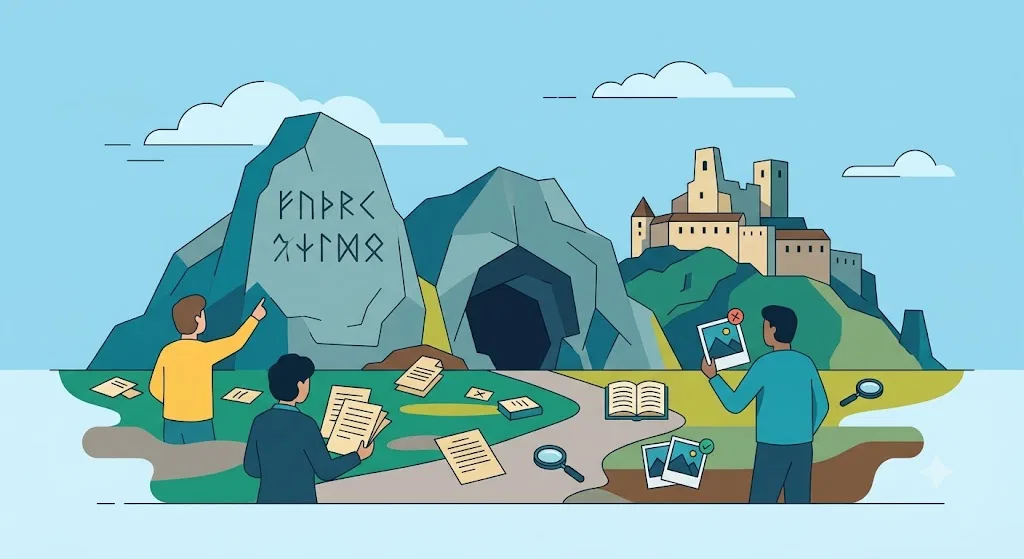
In the 1860s, Pavol Križko, a teacher and later archivist in Kremnica, publicised strange carved signs on rocks in the mountains of central Slovakia. He interpreted the main inscription on Mount Velestúr as an ancient Slovak text recording an invasion and destruction of settlements many centuries before the medieval formation of the Hungarian kingdom. Other supposed inscriptions were read as an altar to a Slavic deity and an early Christian monument. If genuine, they would have provided dramatic material evidence for an ancient literate Slovak presence in the region.[Academia]academia.eduPDF) Fehér SEP SUPP 1 41 52 készAcademia(PDF) Fehér SEP SUPP 1 41 52 készJanuary 1, 2022 — 42 A SPURIOUS INSCRIPTION IN QUADIA Križko deciphered and interpreted the firs…
That claim appeared at a politically useful moment. During the nineteenth-century national revivals of Central Europe, language, folklore and ancient history were not merely scholarly subjects. They helped communities argue that they were historic nations entitled to cultural and political recognition. A previously unknown native script carved into a mountain could seem to settle disputes that ordinary documentary evidence could not.
The inscription’s persuasive force therefore came less from archaeological context than from the story attached to it. Križko supplied a decipherment, a historical episode and an implied national lesson. The signs appeared to say exactly what supporters hoped an ancient Slovak inscription would say: that Slovaks had occupied and defended the land in deep antiquity.
Modern analysis dismantles that interpretation. Bence Fehér’s study describes Križko’s supposed language as largely invented and the signs as an inconsistent mixture influenced by Germanic runes, Etruscan writing and a late published form of Hungarian runic characters. The direction and shapes of the letters do not form a credible ancient writing system. Hungarian archaeologist Tivadar Botka raised doubts soon after publication, while the Kremnica historian Michal Matunák later helped establish the case against authenticity.[Academia]academia.eduPDF) Fehér SEP SUPP 1 41 52 készAcademia(PDF) Fehér SEP SUPP 1 41 52 készJanuary 1, 2022 — 42 A SPURIOUS INSCRIPTION IN QUADIA Križko deciphered and interpreted the firs…
The Velestúr affair became stranger when a more recently “rediscovered” inscribed rock was itself judged to be a modern imitation of Križko’s material. Fehér noted differences in cutting technique and surface condition, describing it in effect as a forgery based on an earlier forgery. This second layer illustrates how famous fakes can generate descendants: once an object becomes part of local historical memory, later copies may be presented as fresh confirmation.[Academia]academia.eduPDF) Fehér SEP SUPP 1 41 52 készAcademia(PDF) Fehér SEP SUPP 1 41 52 készJanuary 1, 2022 — 42 A SPURIOUS INSCRIPTION IN QUADIA Križko deciphered and interpreted the firs…
There is no need to treat everyone who defended the inscription as knowingly dishonest. Some nineteenth-century scholars worked with weak archaeological methods, uncertain comparative linguistics and strong patriotic expectations. The original manufacture and promotion of the carvings may involve deliberate deception, but their wider acceptance also demonstrates confirmation bias: evidence that supports an important identity claim is often examined less harshly than evidence that threatens it.
Velestúr remains significant because it exposes a recurring feature of forged antiquities. The fake object is only half the mechanism. The other half is the interpretive system built around it: the expert decipherment, the historical narrative and the audience already prepared to regard the discovery as overdue recognition.
The Moonshaft: one witness, no location and decades of searching
The Moonshaft story begins with Antonín Horák, who said that during the Slovak National Uprising in 1944 he and other injured fighters were sheltered in a cave. Inside, he claimed to have encountered an extraordinary smooth-walled, crescent-shaped shaft or structure unlike an ordinary natural formation. Horák later emigrated to the United States, and an account attributed to his wartime journal appeared in the March 1965 issue of the National Speleological Society’s news publication. That narrative remains the only first-hand foundation for the mystery.[Moonshaft]moonshaft.netPersons - MoonshaftAntonín T. Horák Antonín. His war journal, published in NSS News in March 1965, is the sole first-hand record…
Later retellings transformed the object into an ancient machine, artificial underground complex or extraterrestrial artefact. The precise interpretation varied, but the basic promotional formula remained stable: a reliable military witness had stumbled upon something technologically impossible in an inaccessible Slovak cave, then history and politics prevented proper investigation.
The story contains features that make legends durable. It is set during war, when incomplete records and chaotic movements are normal. Its location is deliberately or accidentally vague. The witness supposedly wished scientists to investigate but did not produce a recoverable route. The cave is always close enough to inspire another expedition yet elusive enough to survive every failure.
Repeated searches have not established the shaft’s existence. Accounts of subsequent investigations describe unsuccessful efforts to identify the shepherd, family and places in Horák’s narrative, while details of geography, weather and military activity have been questioned. Explorers have proposed possible caves and reported suggestive markings, but no expedition has produced the described structure, independently verified photographs or geological samples.[Wikipedia]WikipediaOpen source on wikipedia.org.
The weakest point is not that the story sounds extraordinary. It is that every later claim depends on Horák’s account. No surviving companion independently confirmed the discovery. No secure coordinates lead to it. The physical object cannot be inspected. Even the photographs and location clues said to have been shown privately have not yielded reproducible evidence.
Calling the Moonshaft a proven hoax would therefore go further than the evidence permits. Horák may have invented it, embellished a genuine cave exploration, misunderstood a geological or mining feature, or converted a confused wartime memory into a mystery narrative. What can be said firmly is that the dramatic interpretations are unsupported.
The story’s continuing appeal comes from the interaction between landscape and secrecy. Slovakia’s mountains, karst regions and caves provide a credible setting for something hidden. The wartime background explains missing documentation. Communist-era travel restrictions can be used to explain why Western investigators did not immediately check the account. Each obstacle that should weaken the story can instead be incorporated into it.
The Moonshaft is therefore a useful example of the boundary between hoax and legend. It may have originated as deception, but its modern life does not require an active deceiver. Enthusiasts, paranormal writers and expedition organisers keep it alive because the absence of proof can be presented not as a conclusion, but as evidence that the correct cave has not yet been found.
Elizabeth Báthory and the manufacture of the Blood Countess
Elizabeth Báthory lived in the Kingdom of Hungary and was associated with Čachtice Castle, in present-day western Slovakia. In the early seventeenth century, she was accused of torturing and killing girls and young women. Her servants were prosecuted and executed, while Báthory herself was confined until her death in 1614. Those proceedings and accusations were real. The popular image of a countess bathing in virgins’ blood to preserve her youth is much less secure.[AP News]apnews.comblood countess legend bathory hungary slovakia e732847066ffe69f91812b57df61bf43AP News400 years later, accounts of Hungarian 'Blood Countess…30 Oct 2024 — Elizabeth Báthory was alleged to have tortured and killed…
The distinction matters because sceptical discussion of the legend is sometimes misrepresented as proof that nothing happened. Contemporary testimony contained allegations of severe abuse and killing, although much was hearsay, obtained under coercive conditions or given by witnesses who had not directly observed the crimes. The exact number of victims is uncertain, and Báthory herself did not receive the kind of open trial that would allow the evidence to be tested in a modern sense.
The blood-bathing motif emerged substantially later. A widely cited written version appeared in the eighteenth century, more than a century after Báthory’s death. When witness material became available in print during the nineteenth century, it contained no account of her bathing in blood. The most famous element of the story was therefore not a detail preserved from the investigation but a later literary and folkloric addition.[Wikipedia]WikipediaElizabeth BáthoryElizabeth Báthory
Political and financial circumstances have also encouraged revisionist interpretations. Báthory was enormously wealthy, controlled extensive estates and occupied an awkward position within aristocratic power struggles. Some modern writers argue that rivals had reasons to remove or discredit her. Others consider the quantity of testimony too substantial to dismiss the abuse allegations entirely. Recent reporting from Čachtice reflects this unresolved divide: the monstrous popular image remains commercially and culturally powerful, while researchers continue to debate how much of it rests on reliable evidence.[AP News]apnews.comOpen source on apnews.com.
The safest conclusion separates three layers:
- Documented history: Báthory was investigated, confined and accused through testimony collected by royal authorities; several servants were convicted.
- Disputed history: the scale of the crimes, the reliability of witnesses and the political motives behind the proceedings remain contested.
- Later legend: bathing in blood for eternal youth, vampiric behaviour and the precise total of 650 victims are not securely established by contemporary evidence.
This is not a straightforward hoax with an identifiable inventor and confession. It is an example of cumulative sensationalism. Rumour, legal accusation, political interest, printed history, Gothic literature, cinema and tourism gradually produced a character more definite than the surviving evidence allows.
Čachtice benefits economically from the story through castle visits, museum displays and dark-tourism interest, but that does not mean modern residents created the myth. Rather, the place demonstrates how communities inherit profitable legends whose historical foundations are mixed. The responsible approach is neither to market every gruesome detail as fact nor to replace one certainty with another unsupported claim that Báthory was wholly innocent.
Election hoaxes built for the social-media age
Slovakia’s recent political hoaxes work differently from older legends because they are designed for rapid distribution, emotional impact and deniability. Instead of planting an inscription in rock, the creator plants a claim in a network. The apparent evidence may be an audio clip, a screenshot or a document-like image, while anonymous and fake accounts create the impression that ordinary citizens are independently discovering and sharing it.
Two days before Slovakia’s September 2023 parliamentary election, an audio recording circulated online purporting to capture Progressive Slovakia leader Michal Šimečka and journalist Monika Tódová discussing electoral manipulation. The recording was synthetic. Analysis identified unnatural diction, timing and vocal features consistent with an artificial intelligence-generated deepfake.[UNESCO]unesco.orgcase study 2Case study: Can we believe what we hear?Two days before the 2023 election in Slovakia an audio recording was posted on social media…
The timing was central to the deception. Material released immediately before voting leaves little opportunity for forensic examination, reporting and correction. Social-media users encounter the emotionally damaging claim first; the technical explanation comes later and is usually less shareable. The fake also exploited the familiar idea of a secret recording, a format audiences associate with authentic leaks.
The deepfake did not have to persuade every listener. It only needed to strengthen existing suspicion about political elites, election integrity or hostile journalists. This is a major difference between an elaborate archaeological forgery and contemporary disinformation. A forged artefact seeks long-term acceptance by experts. An election hoax may succeed if it causes confusion for forty-eight hours.
A related operation appeared during Slovakia’s 2024 presidential election. A viral accusation claimed that candidate Ivan Korčok had collaborated with the communist-era State Security service. An investigation by the Investigative Center of Ján Kuciak found that fake Facebook accounts played a major role in spreading the allegation. The purpose was not simply to publish a false statement but to manufacture social proof: repeated posts from apparently separate users made the story look more widespread and credible than it was.[VSquare.org]vsquare.orgHow Fake Accounts Spread a Hoax in Slovakia's ElectionHow Fake Accounts Spread a Hoax in Slovakia's Election
Research into Slovakia’s broader unreliable-media environment has also found connections between some websites through shared tracking and advertising identifiers, although it cautions against imagining a single centralised network behind every misleading outlet. Many sites appear to have separate administrators and mixed commercial, ideological or political motives.[arXiv]arxiv.orgOpen source on arxiv.org.
These cases show who benefits from modern political hoaxes. Candidates or movements may benefit when opponents are forced to deny explosive allegations. Website operators may gain traffic and advertising revenue. Activists can intensify polarisation. Foreign or domestic influence actors can weaken trust without needing audiences to accept one alternative account; general uncertainty is often enough.
Exposure is correspondingly difficult. A fact-check may prove that an audio clip contains synthetic characteristics, yet it cannot reach every person who heard the original. Platforms may label or remove posts, but copies survive in closed groups and messaging applications. Investigators can demonstrate that accounts are fake, while the underlying accusation continues to circulate detached from its original source.
Why these stories endure
Slovakia’s famous fakes and doubtful legends span very different periods, but they repeatedly exploit the same weaknesses in how people judge evidence.
They provide something emotionally useful. Velestúr offered proof of ancient national continuity. The Moonshaft offered mystery and hidden technology. The Blood Countess offered a perfect Gothic villain. Election deepfakes offer apparent confirmation that political enemies are corrupt.
They borrow authority from a persuasive format. Carved stone looks older than a political pamphlet. A wartime diary appears more intimate than a later adventure story. Court testimony sounds definitive even when witnesses repeat rumours. Audio feels direct because listeners believe they are hearing a person’s real voice.
They explain missing evidence in advance. The inscription’s obscure writing supposedly showed its antiquity. The Moonshaft’s location was concealed by war and inaccessible terrain. Gaps in the Báthory record permit both sensational and exonerating speculation. Political hoaxes often suggest that institutions are suppressing the truth, making official denials seem suspicious.
They survive correction by changing category. A disproved historical claim may be defended as folklore. An unverified cave becomes an “unsolved mystery”. An invented blood bath becomes a symbolic representation of cruelty. A debunked election claim becomes a broader assertion that something similar could have happened.
The most useful question is therefore not merely whether a story is true or false. It is what kind of claim is being made and what evidence would be expected if it were true. Ancient inscriptions require credible dating, linguistic consistency and archaeological context. A hidden cave structure requires a recoverable location and independent physical examination. A historical crime narrative requires attention to contemporary records, witness quality and later additions. A digital recording requires provenance and forensic authentication.

What Slovakia’s hoax history reveals
The Slovak cases do not suggest unusual national gullibility. They reflect pressures found across Europe: nineteenth-century competition over national origins, twentieth-century fascination with hidden wartime secrets, the commercial power of Gothic legend and the speed of twenty-first-century political disinformation.
What changes is the technology of persuasion. Križko’s generation relied on carved symbols and scholarly decipherment. The Moonshaft circulated through specialist publications and paranormal books. The Báthory legend expanded through centuries of retelling. Modern political fabrications can be generated and distributed in hours, with fake accounts simulating a public consensus around them.
Yet exposure still depends on traditional sceptical habits: checking provenance, comparing versions, locating the earliest source, separating eyewitnesses from repetition, testing physical evidence and asking whether the story became more dramatic over time. Velestúr failed linguistic and archaeological scrutiny. The Moonshaft remains unconfirmed because its single-source narrative has never produced a verifiable site. Báthory’s blood bath dissolves when later folklore is separated from contemporary allegations. Election deepfakes can be identified through technical analysis and investigation of the networks that spread them.
The enduring lesson is that a powerful story often arrives already shaped to discourage the right questions. Slovakia’s most memorable cases became persuasive not because evidence was abundant, but because each offered an explanation people were ready to use.
Amazon book picks
Further Reading
No matched book cards were available for Which Slovak Legends Survive a Closer Look?, so this fallback keeps a direct Amazon reading path visible.
Topical books
Slovak folklore guide
Browse books, explainers and reference titles related to this topic.
Search AmazonRelated search
Slovak national revival guide
Browse books, explainers and reference titles related to this topic.
Search AmazonRelated search
Pavol Križko guide
Browse books, explainers and reference titles related to this topic.
Search AmazonEndnotes
1.
Source: academia.edu
Title: (PDF) Fehér SEP SUPP 1 41 52 kész
Link:https://www.academia.edu/89256683/Feh%C3%A9r_SEP_SUPP_1_41_52_k%C3%A9sz
Source snippet
Academia(PDF) Fehér SEP SUPP 1 41 52 készJanuary 1, 2022 — 42 A SPURIOUS INSCRIPTION IN QUADIA Križko deciphered and interpreted the firs...
Published: January 1, 2022
2.
Source: moonshaft.net
Link:https://www.moonshaft.net/persons
Source snippet
Persons - MoonshaftAntonín T. Horák Antonín. His war journal, published in NSS News in March 1965, is the sole first-hand record...
Published: March 1965
3.
Source: unesco.org
Title: case study 2
Link:https://www.unesco.org/mil4teachers/en/toolkit-media/indicator-5/activities/ai-disinformation/case-study-2
Source snippet
Case study: Can we believe what we hear?Two days before the 2023 election in Slovakia an audio recording was posted on social media...
4.
Source: Wikipedia
Link:https://en.wikipedia.org/wiki/Moonshaft
5.
Source: Wikipedia
Title: Elizabeth Báthory
Link:https://en.wikipedia.org/wiki/Elizabeth_B%C3%A1thory
6.
Source: unesco.org
Title: safejournalismsk platform hope journalists
Link:https://www.unesco.org/en/articles/safejournalismsk-platform-hope-journalists
7.
Source: vsquare.org
Title: How Fake Accounts Spread a Hoax in Slovakia’s Election
Link:https://vsquare.org/slovakia-election-ivan-korcok-peter-pellegrini-fake-accounts-facebook-hoax/
8.
Source: arxiv.org
Link:https://arxiv.org/abs/2109.01527
9.
Source: Wikipedia
Title: Archaeological forgery
Link:https://en.wikipedia.org/wiki/Archaeological_forgery
10.
Source: Wikipedia
Title: Venus of Moravany
Link:https://en.wikipedia.org/wiki/Venus_of_Moravany
11.
Source: moonshaft.net
Link:https://www.moonshaft.net/
12.
Source: moonshaft.net
Title: Evidence & Theories
Link:https://www.moonshaft.net/evidence
13.
Source: facebook.com
Link:https://www.facebook.com/groups/RomanLegacy/posts/919606678865601/
14.
Source: facebook.com
Link:https://www.facebook.com/groups/1508789132952429/posts/1856693468161992/
15.
Source: facebook.com
Link:https://www.facebook.com/groups/ancientarchaeology/posts/913455536471002/
16.
Source: facebook.com
Link:https://www.facebook.com/groups/thearchaeologynewsnetwork/posts/4691720397509468/
17.
Source: facebook.com
Link:https://www.facebook.com/learnpaladin/posts/history-calls-her-the-blood-countess-who-killed-650-girls-to-bathe-in-their-bloo/122210752778537831/
18.
Source: unesdoc.unesco.org
Link:https://unesdoc.unesco.org/ark%3A/48223/pf0000396638.locale%3Den
19.
Source: unesdoc.unesco.org
Link:https://unesdoc.unesco.org/ark%3A/48223/pf0000397330
20.
Source: unesco.org
Link:https://www.unesco.org/sites/default/files/medias/fichiers/2025/06/gmdf_annual_report_june2024_april2025.pdf
21.
Source: unesdoc.unesco.org
Link:https://unesdoc.unesco.org/ark%3A/48223/pf0000379015
22.
Source: unesdoc.unesco.org
Link:https://unesdoc.unesco.org/ark%3A/48223/pf0000396788
23.
Source: academia.edu
Link:https://www.academia.edu/2385082/Identification_of_a_possible_engraved_Venus_from_Predmost%C3%AC_Czech_Republic
24.
Source: vsquare.org
Title: slovak election targeted by pro kremlin deepfake hoax
Link:https://vsquare.org/slovak-election-targeted-by-pro-kremlin-deepfake-hoax/
25.
Source: apnews.com
Title: blood countess legend [bathory]({{ ‘bathory/’ | relative_url }}) hungary slovakia e732847066ffe69f91812b57df61bf43
Link:https://apnews.com/article/blood-countess-legend-bathory-hungary-slovakia-e732847066ffe69f91812b57df61bf43
Source snippet
AP News400 years later, accounts of Hungarian 'Blood Countess...30 Oct 2024 — Elizabeth Báthory was alleged to have tortured and killed...
26.
Source: en.everybodywiki.com
Link:https://en.everybodywiki.com/Moonshaft
Source snippet
EverybodyWiki Bios & WikiMoonshaft - EverybodyWiki Bios & Wiki18 May 2025 — In 1965, Horak published an excerpt from his diary in the Nat...
Published: May 2025
27.
Source: apnews.com
Link:https://apnews.com/article/e732847066ffe69f91812b57df61bf43
28.
Source: soul-guidance.com
Title: The Moonshaft
Link:https://www.soul-guidance.com/houseofthesun/moonshaft.html
Additional References
29.
Source: assets.vacilando.org
Title: TH E MYSTERIOUS MOONSHAFT
Link:https://assets.vacilando.org/19930102%20Zahadna%20mesacna%20sachta/used/the_mysterious_moonshaft.pdf
Source snippet
THE MYSTERIOUS MOONSHAFT - VacilandoDr. Antonin T. Horak-now a linguist-has attempted for years to persuade speleologists to investigate...
30.
Source: youtube.com
Title: Mysterious Slovakian Tale of The Moon Cave
Link:https://www.youtube.com/watch?v=V7QdKL7yUr4
Source snippet
Election info changes quickly. Verify responses with official sources...
31.
Source: youtube.com
Title: Pro-Russian deepfakes: Slovakia fears election interference
Link:https://www.youtube.com/watch?v=EPbOCcJ_S9s
Source snippet
Elizabeth Bathory – The 'Blood Countess'...
32.
Source: youtube.com
Title: Elizabeth Bathory | Full Biography | Human Voiced, No Ads
Link:https://www.youtube.com/watch?v=6ZJkWvsuzdg
Source snippet
Mysterious Slovakian Tale of The Moon Cave...
33.
Source: historysnob.com
Link:https://www.historysnob.com/historical-figures/20-famous-relics-that-turned-out-to-be-fakes
34.
Source: duncancaldwell.com
Link:https://www.duncancaldwell.com/ewExternalFiles/ARTICLE%202011%20Predmosti%20Venus%2C%20Journal%20of%20Archaeological%20Science%2C%20DErrico%2C%20Laznickova-Galetova%2C%20Caldwell%2C%20Vol%2038%20pp%20672-683.pdf
35.
Source: caving-library.org.uk
Link:https://caving-library.org.uk/catalogue/BCL/code/php/library.php?action=search&lib=&search=author&search_string=Antonin+T.Horak&type=any
36.
Source: reddit.com
Link:https://www.reddit.com/r/Archaeology/comments/10fjksu/can_archaeological_evidence_be_trusted/
37.
Source: instagram.com
Link:https://www.instagram.com/p/DQMuXtHDDQJ/
38.
Source: reddit.com
Link:https://www.reddit.com/r/AskHistorians/comments/168m2zo/how_credible_is_the_story_of_elizabeth_b%C3%A1thory_of/
Amazon book picks
Further Reading
Books and field guides related to Which Slovak Legends Survive a Closer Look?. Use these as the next step if you want deeper reading beyond the article.
Extraordinary Popular Delusions and the Madness of Crowds
Rating: 4.0/5 from 5 Google Books ratings
Explores why communities embrace dubious claims and narratives.
The Demon-Haunted World
Rating: 4.5/5 from 43 Google Books ratings
Directly helps readers understand how legends, hoaxes and unsupported stories gain credibility.
Myths and Symbols in Pagan Europe
Provides context for the persistence and transformation of European folk traditions.
Topic Tree
Follow this branch
Related pages 192
- Albanian Hoaxes
- Algerian Hoaxes
- Antigua Deceptions
- Argentina Hoaxes
- Armenian Hoaxes
- +187 more in sidebar