Within Spain's Great Hoaxes
How Fake Inscriptions Nearly Rewrote Basque History
Ancient pottery gained false authority from modern carvings that appeared to rewrite Basque language and Christian history.
On this page
- The discoveries announced in 2006
- The anachronisms experts found
- The investigation, trial and wider lessons
Page outline Jump by section
Introduction
In 2006, archaeologists working at the Roman site of Iruña-Veleia in the Basque Country announced discoveries that seemed capable of transforming several fields at once. Pottery fragments and other objects supposedly dating from the Roman period appeared to contain some of the earliest written Basque ever found, unusually early Christian imagery, and even references to ancient Egypt. If genuine, the inscriptions would have pushed back important parts of Basque linguistic history by centuries and provided remarkable evidence of cultural life in Roman Spain. Within a few years, however, the finds became one of the most notorious archaeological scandals in modern Spain. Expert reviews concluded that many of the inscriptions contained obvious anachronisms, and a court later ruled that ancient artefacts had been altered with modern engravings.[archaeology.org]archive.archaeology.orgMagazine The Veleia AffairArchaeology MagazineThe Veleia Affair - Archaeology Magazine ArchiveIn the end, what explained everything was that they were fakes." [ima…
The Iruña-Veleia affair remains important because the underlying objects were largely genuine archaeological finds. The controversy centred on the inscriptions carved onto them. It was therefore not a case of counterfeit artefacts being planted in the ground, but of authentic ancient materials allegedly being given a false historical significance through modern additions.[The Guardian]theguardian.comspanish archaeologist sentenced for faking basque findsIt ruled that the finds…
The Discoveries Announced in 2006
Iruña-Veleia, near modern Vitoria-Gasteiz, was already known as an important Roman settlement. The excavation team led by archaeologist Eliseo Gil announced a series of “exceptional finds” recovered during excavations in 2005 and 2006. The claims attracted enormous attention because they appeared to answer long-standing historical questions.[Wikipedia]WikipediaOpen source on wikipedia.org.
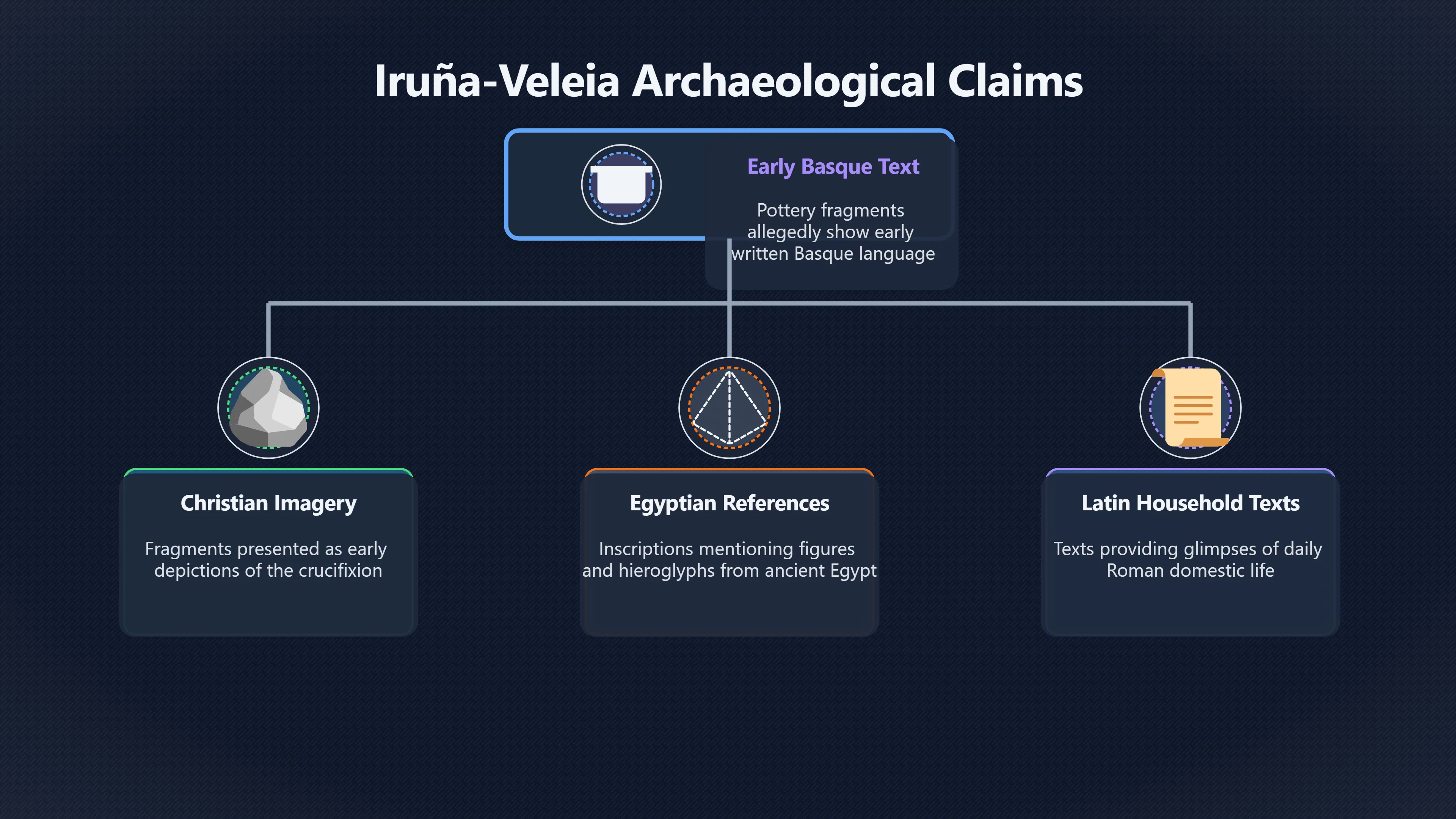
Among the most celebrated discoveries were:
- Pottery fragments bearing words and short phrases interpreted as early written Basque.
- Christian drawings, including what was presented as an exceptionally early depiction of the crucifixion.
- Inscriptions referring to figures from Egyptian history and examples said to resemble Egyptian hieroglyphs.
- Latin texts that appeared to provide glimpses of education and daily life in a Roman household.[Wikipedia]WikipediaOpen source on wikipedia.org.
The Basque-language material was especially significant. Written evidence for the language is scarce in antiquity, and the new inscriptions appeared to provide direct proof of written Basque centuries earlier than previously known examples. For some observers, the finds seemed capable of settling debates about the antiquity and geographical continuity of Basque-speaking communities.[Wikipedia]WikipediaOpen source on wikipedia.org.
The Christian material generated similar excitement. One engraved fragment appeared to show a crucifixion scene that, if authentic and correctly dated, would have been among the earliest known visual representations of Christ’s execution.[Wikipedia]WikipediaOpen source on wikipedia.org.
The discoveries spread rapidly through the media. Comparisons were made with famous Roman sites such as Vindolanda and Pompeii, and public interest quickly outpaced the slow publication and review process normally expected in archaeology.[Wikipedia]WikipediaOpen source on wikipedia.org.
Why the Claims Seemed Convincing
The story did not succeed merely because the inscriptions were dramatic. It was persuasive because the artefacts came from a real archaeological site with a legitimate excavation history. The objects themselves were ancient, and the inscriptions were said to have been recovered from securely dated Roman layers.[Wikipedia]WikipediaOpen source on wikipedia.org.
To many non-specialists, the existence of archaeological context appeared to settle the matter. If a pottery fragment came from a third-century layer, then the writing on it seemed likely to be third-century as well. This assumption gave the inscriptions a powerful aura of authenticity before specialists had fully examined the texts.[Archaeology Magazine]archive.archaeology.orgMagazine The Veleia AffairArchaeology MagazineThe Veleia Affair - Archaeology Magazine ArchiveIn the end, what explained everything was that they were fakes." [ima…
The claims also appealed to existing hopes and interests. Historians of the Basque language wanted more evidence from antiquity. Scholars of early Christianity were interested in unusually early Christian imagery. The possibility that one excavation might revolutionise several fields at once made the discoveries difficult to ignore.[Artnet News]news.artnet.comArtnet NewsAn Archaeologist Who 'Discovered' One of the Earliest…12 Jun 2020 — Eliseo Gil claimed to have found the earliest written e…

The Anachronisms Experts Found
Doubts emerged almost immediately among linguists, epigraphers and historians. As became available, critics argued that many inscriptions looked less like products of Roman antiquity and more like modern attempts to imitate it.[Archaeology Magazine]archive.archaeology.orgMagazine The Veleia AffairArchaeology MagazineThe Veleia Affair - Archaeology Magazine ArchiveIn the end, what explained everything was that they were fakes." [ima…
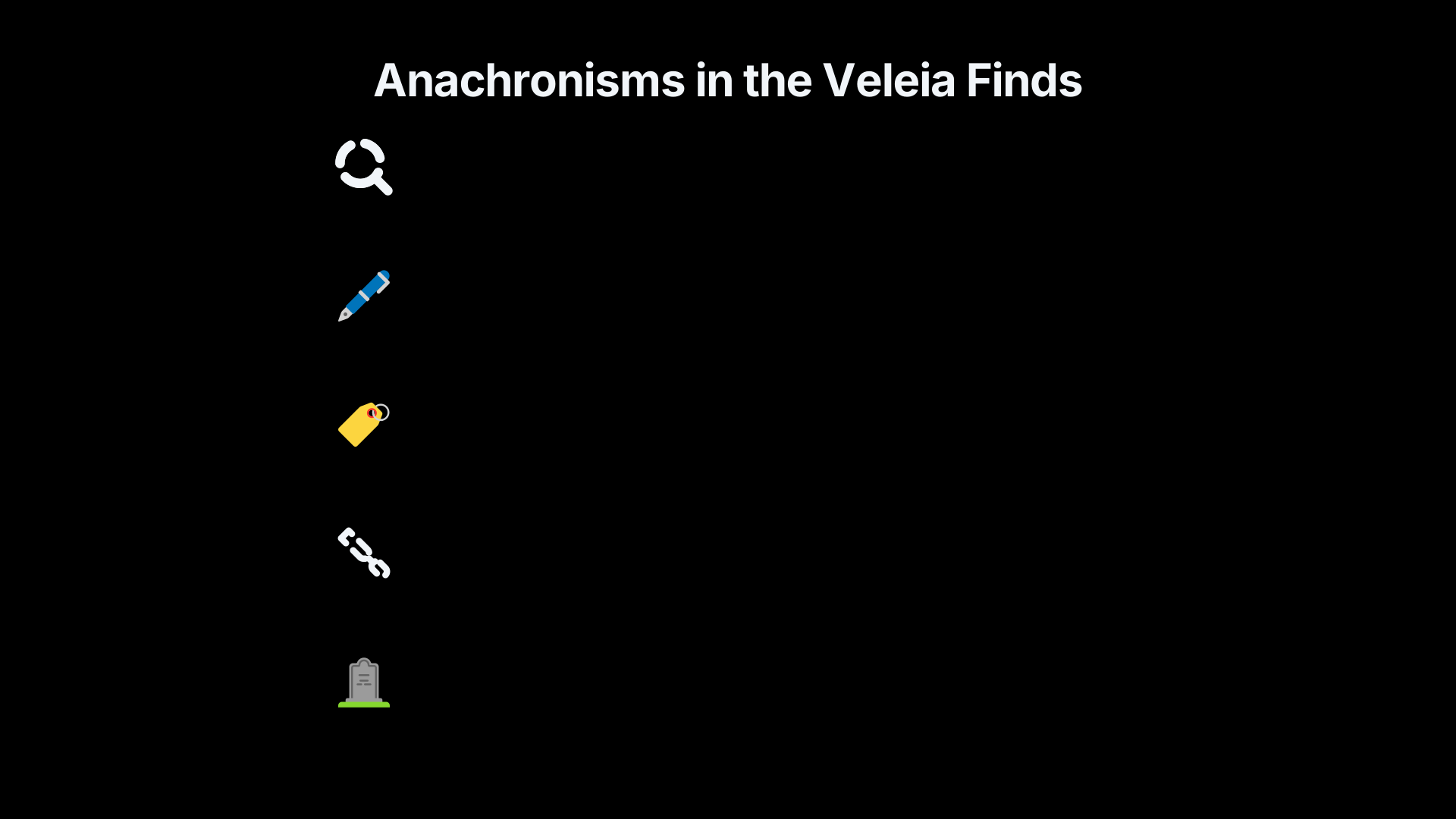
One major problem involved language. Specialists noted that some supposedly ancient Basque words and forms appeared strikingly similar to modern Basque. While ancient languages can resemble their modern descendants, critics argued that the overall pattern looked suspiciously contemporary rather than Roman.[Archaeology Magazine]archive.archaeology.orgMagazine The Veleia AffairArchaeology MagazineThe Veleia Affair - Archaeology Magazine ArchiveIn the end, what explained everything was that they were fakes." [ima…
The Latin inscriptions also raised concerns. Scholars pointed to spellings, punctuation and formulations that seemed out of place for the period. According to critics, some texts made more sense when interpreted through modern Spanish conventions than through known Roman epigraphic practice.[Archaeology Magazine]archive.archaeology.orgMagazine The Veleia AffairArchaeology MagazineThe Veleia Affair - Archaeology Magazine ArchiveIn the end, what explained everything was that they were fakes." [ima…
The Egyptian material became another focal point. Some inscriptions referred to figures such as Nefertiti, but experts noted that the form of the name appeared to reflect modern scholarly conventions rather than knowledge available in Roman Spain. Critics argued that references of this kind looked impossible in a genuine third-century context.[divagacionesbabelicas.eu]divagacionesbabelicas.euiruna veleia fake cradle of basqueinscriptions were also a fake. One of the reasons why experts indicated that the finding was not authentic is that Nefertiti appears writ…
The alleged hieroglyphs attracted similar scepticism. Egyptologists reported that many signs did not function like authentic Egyptian hieroglyphic writing and appeared instead to be modern imitations inspired by popular images of ancient Egypt.[Wikipedia]WikipediaSupuestos jeroglíficos egipcios del siglo III de ÁlavaSupuestos jeroglíficos egipcios del siglo III de Álava
Christian imagery provided further warning signs. Critics highlighted details in the crucifixion scene and associated inscriptions that appeared inconsistent with what is known about early Christian iconography and terminology. One frequently discussed feature was the appearance of “RIP”, an abbreviation associated with much later Christian usage.[Wikipedia]WikipediaFraude arqueológico de Iruña-VeleiaFraude arqueológico de Iruña-Veleia
Taken individually, some anomalies might have been explained away. What convinced many experts was the cumulative effect. The finds seemed to contain not one surprise but dozens of them, all pointing in the same direction: a collection of discoveries that looked remarkably tailored to modern historical interests.[Archaeology Magazine]archive.archaeology.orgMagazine The Veleia AffairArchaeology MagazineThe Veleia Affair - Archaeology Magazine ArchiveIn the end, what explained everything was that they were fakes." [ima…
The Investigation and Trial
Growing controversy led the provincial authorities of Álava to establish a scientific advisory commission composed of specialists from several disciplines. Their task was to evaluate the inscriptions and determine whether the extraordinary claims could withstand scrutiny.[Wikipedia]WikipediaOpen source on wikipedia.org.
The commission’s conclusions were devastating for the discoveries. Experts from fields including linguistics, epigraphy and Egyptology argued that many inscriptions contained features incompatible with the proposed Roman dates. The authorities eventually declared hundreds of pieces manipulated or false.[Ancient Origins]ancient-origins.netiru veleia artifacts 0013266iru veleia artifacts 0013266
The dispute then moved beyond academic debate into the legal system. After years of investigation and litigation, a court in Vitoria ruled in 2020 that the artefacts had been altered through modern incisions designed to make the inscriptions appear ancient. Archaeologist Eliseo Gil and collaborator Rubén Cerdán were convicted of fraud-related offences. The court concluded that the objects had been modified to simulate historical value that they did not genuinely possess.[theguardian.com]theguardian.comspanish archaeologist sentenced for faking basque findsIt ruled that the finds…
Although a small number of supporters continued to defend the authenticity of the finds and challenged aspects of the official interpretation, the court ruling and the broad scholarly consensus effectively ended the inscriptions’ credibility within mainstream archaeology.[Wikipedia]WikipediaOpen source on wikipedia.org.
The wider consequences of Iruña Veleia
The Iruña-Veleia affair is often remembered as a forgery case, but its wider significance lies in how closely it was tied to real archaeological evidence. The pottery, bones and other objects were not simply fabricated from scratch. Genuine ancient artefacts acquired false authority through inscriptions that appeared to offer spectacular new historical insights.[Wikipedia]WikipediaFraude arqueológico de Iruña-VeleiaFraude arqueológico de Iruña-Veleia
The case also illustrates a recurring pattern in the history of historical frauds. Successful deceptions often tell people something they are already eager to hear. In this instance, the inscriptions seemed to provide dramatic confirmation of cherished ideas about the antiquity of the Basque language, the spread of Christianity and the cultural sophistication of Roman Spain.[Artnet News]news.artnet.comArtnet NewsAn Archaeologist Who 'Discovered' One of the Earliest…12 Jun 2020 — Eliseo Gil claimed to have found the earliest written e…
For archaeologists, Iruña-Veleia became a cautionary example of why context alone is not enough. Excavation records, linguistic analysis, epigraphy, iconography and independent specialist review all have to point in the same direction. When extraordinary discoveries appear to solve several historical mysteries simultaneously, the strongest lesson of Iruña-Veleia is that excitement must be matched by rigorous scepticism.[archaeology.org]archive.archaeology.orgMagazine The Veleia AffairArchaeology MagazineThe Veleia Affair - Archaeology Magazine ArchiveIn the end, what explained everything was that they were fakes." [ima…
Amazon book picks
Further Reading
Books and field guides related to How Fake Inscriptions Nearly Rewrote Basque History. Use these as the next step if you want deeper reading beyond the article.
Frauds, Myths, and Mysteries: Science and Pseudoscience in Ar...
Directly addresses forged evidence and pseudoarchaeology.
The Demon-Haunted World
Rating: 4.5/5 from 43 Google Books ratings
Useful for understanding critical evaluation of extraordinary discoveries.
Archaeology from Space
Highlights rigorous methods used to investigate historical claims.
Archaeology : theories, methods, and practice
Explains how authentic archaeological evidence is assessed.
eBay marketplace picks
Marketplace Samples
Live-tested eBay searches with available results related to this page.
Endnotes
1.
Source: archive.archaeology.org
Title: Magazine The Veleia Affair
Link:https://archive.archaeology.org/0909/insider/
Source snippet
Archaeology MagazineThe Veleia Affair - Archaeology Magazine ArchiveIn the end, what explained everything was that they were fakes." [ima...
2.
Source: Wikipedia
Link:https://en.wikipedia.org/wiki/Iru%C3%B1a-Veleia
3.
Source: Wikipedia
Title: Fraude arqueológico de Iruña-Veleia
Link:https://es.wikipedia.org/wiki/Fraude_arqueol%C3%B3gico_de_Iru%C3%B1a-Veleia
4.
Source: Wikipedia
Link:https://es.wikipedia.org/wiki/Iru%C3%B1a-Veleia
5.
Source: news.artnet.com
Link:https://news.artnet.com/art-world/spanish-archaeologists-fake-discoveries-1885953
Source snippet
Artnet NewsAn Archaeologist Who 'Discovered' One of the Earliest...12 Jun 2020 — Eliseo Gil claimed to have found the earliest written e...
6.
Source: go.gale.com
Link:https://go.gale.com/ps/i.do?id=GALE%7CA530233223&issn=05147336&it=r&linkaccess=abs&p=IFME&sid=googleScholar&sw=w&v=2.1
Source snippet
archaeological heritage in the province, deemed the finds false (3). However... hoax's initial success in the Iruña-Veleia case. This la...
7.
Source: divagacionesbabelicas.eu
Title: iruna veleia fake cradle of basque
Link:https://www.divagacionesbabelicas.eu/2014/11/iruna-veleia-fake-cradle-of-basque.html
Source snippet
inscriptions were also a fake. One of the reasons why experts indicated that the finding was not authentic is that Nefertiti appears writ...
8.
Source: Wikipedia
Title: Supuestos jeroglíficos egipcios del siglo III de Álava
Link:https://es.wikipedia.org/wiki/Supuestos_jerogl%C3%ADficos_egipcios_del_siglo_III_de_%C3%81lava
9.
Source: ancient-origins.net
Title: iru veleia artifacts 0013266
Link:https://www.ancient-origins.net/news-history-archaeology/iru-veleia-artifacts-0013266
10.
Source: theguardian.com
Title: spanish archaeologist sentenced for faking basque finds
Link:https://www.theguardian.com/science/2020/jun/11/spanish-archaeologist-sentenced-for-faking-basque-finds
Source snippet
It ruled that the finds...
11.
Source: allthatsinteresting.com
Title: eliseo gil
Link:https://allthatsinteresting.com/eliseo-gil
Additional References
12.
Source: researchgate.net
Link:https://www.researchgate.net/publication/317866079Los%27hallazgos_excepcionales%27_de_Iruna-Veleia_Alava_sintaxis_de_una_falsificacion_arqueologica
Source snippet
The 'Iruña-Veleia case', as it has come to be known, has been the subject of several partial...
13.
Source: youtube.com
Title: Al-Shabaab exploits Kenya’s divisions to wage war
Link:https://www.youtube.com/watch?v=j13wvZND5zk
Source snippet
Election info changes quickly. Verify responses with official sources...
14.
Source: youtube.com
Title: Inside Al Shabaab: The extremist group trying to seize Somalia
Link:https://www.youtube.com/watch?v=KVSw0E9Y1RI
Source snippet
How Al-Shabab is recruiting young men from Kenya...
15.
Source: youtube.com
Title: Somalia: Govt bans Al Shabaab ‘propaganda’ contents
Link:https://www.youtube.com/watch?v=Vean7jaorHc
Source snippet
Inside Al Shabaab: The extremist group trying to seize Somalia...
16.
Source: youtube.com
Link:https://www.youtube.com/watch?v=5hKAyQIc5rk
Source snippet
Al-Shabaab exploits Kenya's divisions to wage war...
17.
Source: youtube.com
Title: How Al-Shabab is recruiting young men from Kenya
Link:https://www.youtube.com/watch?v=xc6wfF9sV90
Source snippet
Inside Al Shabaab (2017): Terror group tackles drought...
18.
Source: academia.edu
Link:https://www.academia.edu/68679982/Considerations_on_the_Judgement_of_Criminal_Court_No_1_of_Vitoria_Gasteiz_on_the_Iru%C3%B1a_Veleia_Case
19.
Source: reddit.com
Link:https://www.reddit.com/r/history/comments/yvpreu/irulegui_hand_researchers_claim_to_have_found/
20.
Source: academia.edu
Link:https://www.academia.edu/Documents/in/Public_Archaeology/TopPapers
21.
Source: facebook.com
Link:https://www.facebook.com/BioDivLibrary/posts/rivalries-deception-and-fake-fossils-paleontological-history-is-full-of-fossil-d/10156240459586566/
Topic Tree