Within Zimbabwe Hoaxes
Who Really Built Great Zimbabwe?
Colonial writers denied African authorship of Great Zimbabwe even as archaeology steadily proved the city was built by local societies.
On this page
- How the foreign builder story began
- What archaeology revealed
- Why colonial authorities resisted the evidence
Page outline Jump by section
Introduction
Who really built Great Zimbabwe? Modern archaeology gives a clear answer: the vast stone city was built by the ancestors of Shona-speaking peoples between roughly the eleventh and fifteenth centuries. Yet for more than a century many colonial writers, explorers and officials insisted that the monument must have been the work of outsiders—Phoenicians, Arabs, biblical Israelites, Egyptians, or other supposedly more “civilised” foreign builders. The resulting foreign-builder myth became one of the most influential false historical narratives in southern Africa. It was not simply an academic mistake. It shaped archaeology, heritage policy and colonial politics, and it survived long after excavations had disproved it.[unesco.org]whc.unesco.orgUNESCO World Heritage CentreGreat Zimbabwe National MonumentThe property, built between 1100 and 1450 AD, extends over almost 800 ha and…
Great Zimbabwe occupies a special place in the history of debunked claims because the evidence against the myth accumulated steadily over decades. The dispute reveals how deeply prejudice can influence interpretations of the past, even when physical evidence points elsewhere.[worldhistory.org]worldhistory.orgthe impact of prejudice on the history of great ziWorld History EncyclopediaThe Impact of Prejudice on the History of Great Zimbabweby J Liew · 2019 — While Robinson and Caton-Thompson's…
How the Foreign-Builder Story Began
When European explorers reached the ruins in the nineteenth century, they encountered a city unlike anything they expected to find in the interior of southern Africa. Massive dry-stone walls, some more than ten metres high, enclosed a complex urban centre linked to long-distance trade networks. Instead of asking whether local societies had created it, many observers began from the assumption that Africans could not have done so.[unesco.org]whc.unesco.orgUNESCO World Heritage CentreGreat Zimbabwe National MonumentThe property, built between 1100 and 1450 AD, extends over almost 800 ha and…
One of the most influential early figures was the German explorer Karl Mauch, who visited in 1871. Convinced that the ruins must be connected to the biblical world, he associated them with King Solomon and the Queen of Sheba. Other writers proposed Phoenician merchants, Arabs, Jews, Egyptians or various “lost races” as the builders. These theories differed in detail but shared a central claim: Great Zimbabwe could not have been an indigenous African achievement.[trowelblazers.com]trowelblazers.comgertrude caton thompson9 May 2014 —… Great Zimbabwe to this day because her accepted theory is a dry bone. I think she was seeking popular attention like Dav…
The argument often relied on circular reasoning. Imported objects found at the site—such as Chinese ceramics, glass beads and goods connected to Indian Ocean trade—were treated as proof that foreigners had built the city. In reality, these finds demonstrated commercial connections, not foreign authorship. Medieval African states across eastern and southern Africa participated in extensive trade networks without surrendering their cultural identity or political independence.[springer.com]link.springer.comNew Perspectives on the Political Economy of Great Zimbabweby S Chirikure · 2020 · Cited by 49 — This review draws from old and n…
The foreign-builder story was therefore less a single hoax than a persistent pseudoarchaeological narrative. Some promoters may have genuinely believed it, but the theory rested on assumptions about race and civilisation rather than on convincing archaeological evidence.[phrontistery.info]phrontistery.infoa04 saundershastingsLost Races, Found Histories:14 May 2007 — The fundamental tenets underpinning the misrepresentations of Mound Builder sites and Great Zim…
What Archaeology Revealed
The collapse of the myth did not happen all at once. It emerged through decades of increasingly systematic archaeological work.
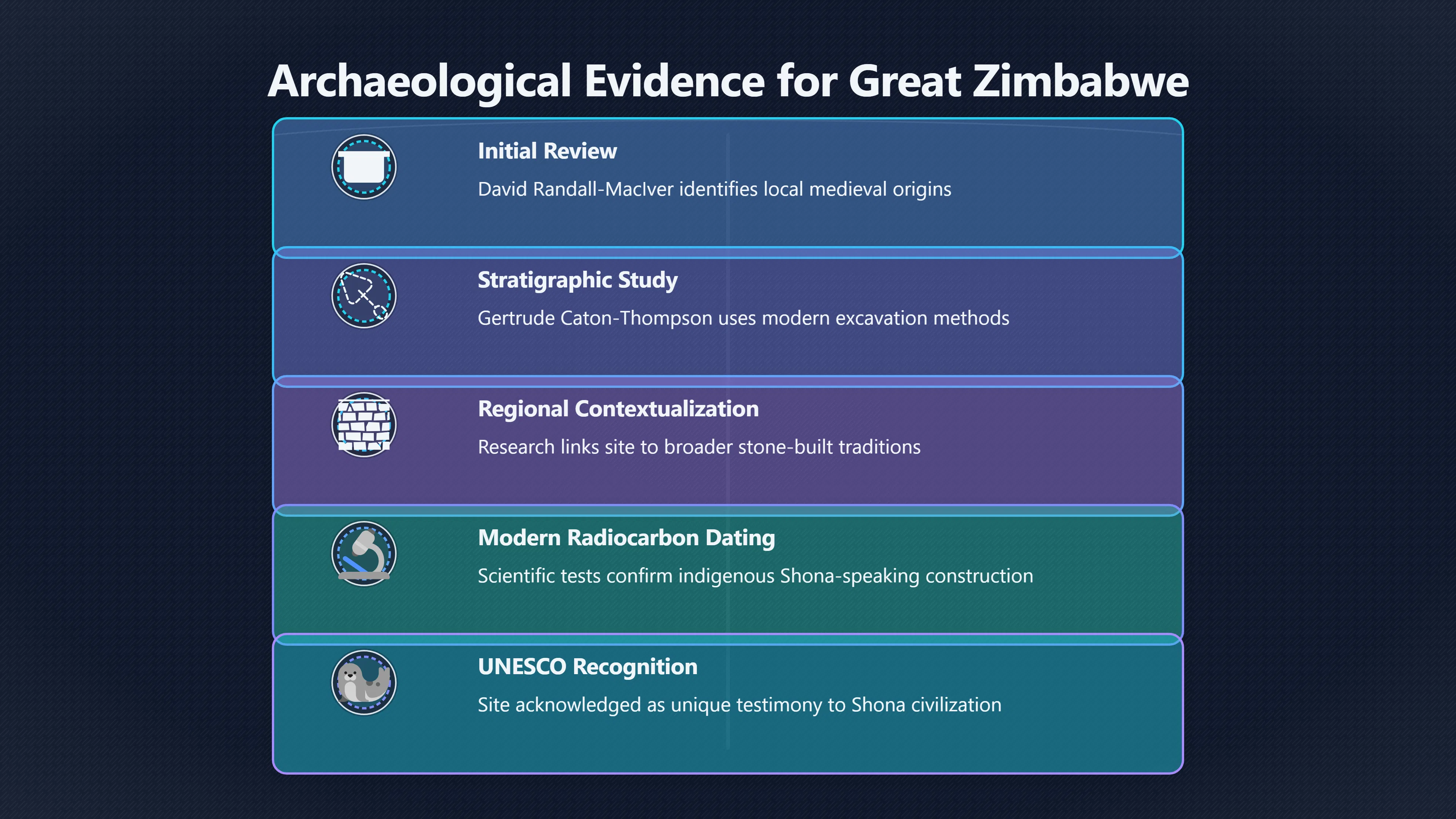
David Randall-MacIver’s investigations in 1905 were among the first major challenges to the foreign-builder theory. Examining pottery, artefacts and building remains, he concluded that the site was of African and relatively recent medieval origin rather than an ancient colony from the Mediterranean or Middle East.[Archaeology Magazine]archive.archaeology.orgMagazine Riddle of Great ZimbabweRandall-MacIver and Gertrude Caton-Thompson early in this century, which confirmed that the ruins were of African origin. The largest anc…
The decisive turning point came in 1929 with the work of British archaeologist Gertrude Caton-Thompson. Using modern excavation methods and stratigraphic analysis—the careful study of layers of occupation—she found evidence that linked the site directly to indigenous African communities. Her team uncovered local pottery, iron objects and other material remains that fit a medieval African context. She concluded that Great Zimbabwe was built by local African peoples rather than foreign settlers.[johnhawks.net]johnhawks.netgertrude caton thompson within the history of archaeology in africagertrude caton thompson within the history of archaeology in africa
Subsequent research strengthened the case. Archaeologists connected Great Zimbabwe to a broader regional tradition of stone-built centres and to the development of societies associated with Shona-speaking populations. Radiocarbon dating, studies of settlement patterns, analyses of pottery traditions and comparisons with related sites all pointed in the same direction. Great Zimbabwe was part of a local historical trajectory, not an isolated foreign colony.[springer.com]link.springer.comNew Perspectives on the Political Economy of Great Zimbabweby S Chirikure · 2020 · Cited by 49 — This review draws from old and n…
Today the site’s status as an indigenous African city is accepted by mainstream archaeology. UNESCO describes Great Zimbabwe as a unique testimony to the civilisation of the region’s Shona peoples and recognises it as one of Africa’s most important archaeological monuments.[UNESCO World Heritage Centre]whc.unesco.orgUNESCO World Heritage CentreGreat Zimbabwe National MonumentThe property, built between 1100 and 1450 AD, extends over almost 800 ha and…
Why Colonial Authorities Resisted the Evidence
If the archaeological evidence became increasingly clear, why did the myth survive?
Part of the answer lies in the political context of colonial southern Africa. European settlers often portrayed African societies as historically static and incapable of creating large states or complex architecture. Great Zimbabwe contradicted that worldview. Acknowledging that Africans had built a major urban and political centre centuries before colonial rule undermined claims about European superiority and the supposed civilising mission of empire.[phrontistery.info]phrontistery.infoa04 saundershastingsLost Races, Found Histories:14 May 2007 — The fundamental tenets underpinning the misrepresentations of Mound Builder sites and Great Zim…
As a result, evidence supporting African authorship was frequently resisted. In colonial Rhodesia, interpretations of Great Zimbabwe became politically sensitive. Archaeologists who challenged preferred colonial narratives encountered official hostility, while alternative theories continued to receive attention despite weak evidential foundations. Historians of archaeology have documented periods when researchers faced pressure to avoid conclusions that credited indigenous Africans with the site’s construction.[Wikipedia]WikipediaGreat ZimbabweGreat Zimbabwe
The controversy therefore became about more than ruins. It became a struggle over who could legitimately claim a sophisticated past. The question of authorship carried implications for land, identity and political authority in the present.[thebritishacademy.ac.uk]thebritishacademy.ac.ukOpen source on thebritishacademy.ac.uk.
Why the Myth Seemed Plausible to Many People
The foreign-builder myth did not spread solely because of official support. It also drew strength from broader intellectual trends of the nineteenth and early twentieth centuries.
At the time, many scholars embraced diffusionist theories that explained major cultural achievements as the work of migrating “civilising” peoples. When confronted with impressive monuments outside Europe and the Mediterranean world, some researchers instinctively searched for external origins. Similar claims appeared elsewhere, including theories that North America’s earthworks had been built by a vanished race rather than Indigenous peoples.[phrontistery.info]phrontistery.infoa04 saundershastingsLost Races, Found Histories:14 May 2007 — The fundamental tenets underpinning the misrepresentations of Mound Builder sites and Great Zim…
Great Zimbabwe also appealed to romantic imagination. Stories linking the ruins to biblical kingdoms, lost civilisations and ancient treasure routes were more dramatic than the reality of a powerful medieval African state. Such narratives attracted public attention, travel writers and newspaper coverage, helping the myth survive long after specialists had begun rejecting it.[Zimbabwe Field Guide]zimfieldguide.comZimbabwe Field GuideGreat Zimbabwe – early written descriptions and…Peter Garlake has argued that Great Zimbabwe's 'foreign origins' t…

The Legacy of the Debate
The exposure of the foreign-builder myth transformed the understanding of southern African history. Great Zimbabwe became evidence that complex states, monumental architecture and extensive trade networks developed within the region through local historical processes. The site’s importance extends far beyond architecture; it reshaped interpretations of Africa’s past.[Springer]link.springer.comNew Perspectives on the Political Economy of Great Zimbabweby S Chirikure · 2020 · Cited by 49 — This review draws from old and n…
The debate also became a cautionary tale in archaeology. It demonstrated how preconceptions can distort interpretation and how evidence can be ignored when it conflicts with political or ideological interests. Great Zimbabwe is therefore remembered not only for its stone walls but also for the long campaign to deny who built them.[worldhistory.org]worldhistory.orgthe impact of prejudice on the history of great ziWorld History EncyclopediaThe Impact of Prejudice on the History of Great Zimbabweby J Liew · 2019 — While Robinson and Caton-Thompson's…
When Zimbabwe gained internationally recognised independence in 1980, the new nation took its name from the monument. The choice reflected the symbolic power of reclaiming a history that earlier generations of colonial writers had tried to explain away. The ruins had become more than an archaeological site: they had become a powerful rebuttal to one of the most persistent false narratives in African history.[Wikipedia]WikipediaGreat ZimbabweGreat Zimbabwe
Amazon book picks
Further Reading
Books and field guides related to Who Really Built Great Zimbabwe?. Use these as the next step if you want deeper reading beyond the article.
Africa
Explains the development of African societies often underestimated by colonial writers.
The Archaeology of Africa
Places Great Zimbabwe within wider African archaeological achievements.
1491: New Revelations of the Americas Before Columbus
Illustrates how entrenched assumptions can distort understanding of precolonial civilizations.
eBay marketplace picks
Marketplace Samples
Live-tested eBay searches with available results related to this page.



Endnotes
1.
Source: whc.unesco.org
Link:https://whc.unesco.org/en/list/364/
Source snippet
UNESCO World Heritage CentreGreat Zimbabwe National MonumentThe property, built between 1100 and 1450 AD, extends over almost 800 ha and...
2.
Source: Wikipedia
Title: Great Zimbabwe
Link:https://en.wikipedia.org/wiki/Great_Zimbabwe
3.
Source: phrontistery.info
Title: a04 saundershastings
Link:https://phrontistery.info/para/a04-saundershastings.html
Source snippet
Lost Races, Found Histories:14 May 2007 — The fundamental tenets underpinning the misrepresentations of Mound Builder sites and Great Zim...
Published: May 2007
4.
Source: trowelblazers.com
Title: gertrude caton thompson
Link:https://trowelblazers.com/2014/05/09/gertrude-caton-thompson/
Source snippet
9 May 2014 —... Great Zimbabwe to this day because her accepted theory is a dry bone. I think she was seeking popular attention like Dav...
Published: May 2014
5.
Source: link.springer.com
Link:https://link.springer.com/article/10.1007/s10814-019-09133-w
Source snippet
New Perspectives on the Political Economy of Great Zimbabweby S Chirikure · 2020 · Cited by 49 — This review draws from old and n...
6.
Source: archive.archaeology.org
Title: Magazine Riddle of Great Zimbabwe
Link:https://archive.archaeology.org/9807/abstracts/africa.html
Source snippet
Randall-MacIver and Gertrude Caton-Thompson early in this century, which confirmed that the ruins were of African origin. The largest anc...
7.
Source: researchgate.net
Link:https://www.researchgate.net/publication/271812286_The_Chronology_of_Great_Zimbabwe
8.
Source: whc.unesco.org
Link:https://whc.unesco.org/document/151741
9.
Source: whc.unesco.org
Link:https://whc.unesco.org/uploads/nominations/306rev.pdf
10.
Source: Wikipedia
Title: Gertrude Caton Thompson
Link:https://en.wikipedia.org/wiki/Gertrude_Caton_Thompson
11.
Source: Wikipedia
Link:https://en.wikipedia.org/wiki/Great
12.
Source: link.springer.com
Link:https://link.springer.com/article/10.1007/s10437-021-09454-6
13.
Source: youtube.com
Title: Who built Great Zimbabwe? And why?
Link:https://www.youtube.com/watch?v=quzjmZ-7s6w
Source snippet
Great Zimbabwe - The Lost City of Gold (History Documentary)...
14.
Source: youtube.com
Title: Great Zimbabwe
Link:https://www.youtube.com/watch?v=lRzsceSgTrQ
Source snippet
Zimbabwe's Stolen History: Looting of a Lost Empire...
15.
Source: metmuseum.org
Title: Built by ancestors of the Shona people.Read more
Link:https://www.metmuseum.org/perspectives/great-zimbabwe
Source snippet
The Metropolitan Museum of ArtGreat Zimbabwe, ZimbabweMay 31, 2025 — Explore the impressive stone wall ruins of the largest man-made stru...
Published: May 31, 2025
16.
Source: worldhistory.org
Title: the impact of prejudice on the history of great zi
Link:https://www.worldhistory.org/article/1429/the-impact-of-prejudice-on-the-history-of-great-zi/
Source snippet
World History EncyclopediaThe Impact of Prejudice on the History of Great Zimbabweby J Liew · 2019 — While Robinson and Caton-Thompson's...
17.
Source: zimfieldguide.com
Link:https://zimfieldguide.com/masvingo/great-zimbabwe-%E2%80%93-early-written-descriptions-and-photographs
Source snippet
Zimbabwe Field GuideGreat Zimbabwe – early written descriptions and...Peter Garlake has argued that Great Zimbabwe's 'foreign origins' t...
18.
Source: johnhawks.net
Title: gertrude caton thompson within the history of archaeology in africa
Link:https://www.johnhawks.net/p/gertrude-caton-thompson-within-the-history-of-archaeology-in-africa
19.
Source: thebritishacademy.ac.uk
Link:https://www.thebritishacademy.ac.uk/blog/reclaiming-great-zimbabwes-past-to-learn-lessons-for-the-future/
20.
Source: dictionary.cambridge.org
Link:https://dictionary.cambridge.org/dictionary/english/great
21.
Source: vocabulary.com
Link:https://www.vocabulary.com/dictionary/great
Additional References
22.
Source: youtube.com
Title: Great Zimbabwe – The Mysterious City of Gold (History Documentary)
Link:https://www.youtube.com/watch?v=jjc73iBvlE0
Source snippet
Was King Solomon's Lost Treasure Ever Really Found? | Myth Hunters...
23.
Source: youtube.com
Title: Zimbabwe’s Stolen History: Looting of a Lost Empire
Link:https://www.youtube.com/watch?v=3cRNix8dtXU
Source snippet
Great Zimbabwe – The Mysterious City of Gold (History Documentary)...
24.
Source: scirp.org
Link:https://www.scirp.org/journal/paperinformation?paperid=135506
25.
Source: dictionary.com
Link:https://www.dictionary.com/browse/great
26.
Source: merriam-webster.com
Link:https://www.merriam-webster.com/dictionary/great
27.
Source: collinsdictionary.com
Link:https://www.collinsdictionary.com/dictionary/english/great
28.
Source: msu-anthropology.github.io
Link:https://msu-anthropology.github.io/deoa-ss16/caton-thompson/caton-thompson.html
29.
Source: dokumen.pub
Link:https://dokumen.pub/download/great-zimbabwe-9780815303985.html
30.
Source: smarthistory.org
Link:https://smarthistory.org/great-zimbabwe/
31.
Source: wmf.org
Link:https://www.wmf.org/projects/great-zimbabwe
Topic Tree