Within Angola Hoaxes
Did Angola Really Ban Islam?
A restrictive registration dispute was transformed online into the false claim that Angola had outlawed Islam and destroyed every mosque.
On this page
- How the worldwide claim began
- The real restrictions behind the rumour
- Recycled images and repeated debunking
Page outline Jump by section
Introduction
In late 2013, a dramatic claim raced around the world: Angola had supposedly become the first country to ban Islam, close every mosque and outlaw Muslim worship. The story spread through newspapers, blogs, social media posts and political commentary, often accompanied by photographs of demolished religious buildings. It was a powerful narrative, but it was not true.
The reality was more complicated. Angola did have a long-running dispute over the legal recognition of Islamic organisations, and some mosques had been closed or demolished by local authorities. Yet the government repeatedly denied that Islam itself had been outlawed, and no law banning the religion was ever enacted. The episode became a classic example of how a genuine policy controversy can be transformed into a much larger and more sensational falsehood.[reuters.com]reuters.comangola defends barring islamic groups denies persecution id USBRE9AS0JKAngola defends barring Islamic groups, denies persecutionNov 29, 2013 — LUANDA (Reuters) - Angola said on Friday it had refused re…
How the Worldwide Claim Began
The rumour exploded in November 2013 after reports emerged that Angolan authorities had closed some mosques and that officials were discussing the legal status of religious groups. Headlines soon appeared claiming that Angola had “banned Islam” and was destroying all mosques across the country.
Several factors made the story seem believable. Angola had not formally recognised Islamic organisations under its religious registration system, and officials had spoken publicly about problems with unregistered religious groups. Statements about the failure of Islam’s legal recognition process were sometimes reported as if they were declarations that the religion itself was illegal. As the story spread from one outlet to another, distinctions between “not legally recognised”, “restricted”, and “banned” largely disappeared.[reuters.com]reuters.comangola defends barring islamic groups denies persecution id USBRE9AS0JKAngola defends barring Islamic groups, denies persecutionNov 29, 2013 — LUANDA (Reuters) - Angola said on Friday it had refused re…
The claim quickly gained international attention because it appeared to describe something unprecedented. Many reports asserted that Angola had become the first modern state to outlaw Islam entirely. The dramatic framing ensured that the story travelled far faster than the more complicated reality.[International Business Times UK]ibtimes.co.ukangola islam ban deny africa muslim christian 525306International Business Times UKAngola Retreats on Islam Ban Reports26 Nov 2013 — Angolan officials deny ban on Muslim faith and claims th…
The Real Restrictions Behind the Rumour
The falsehood survived because it was built around a real dispute.
At the time, Angola required religious groups seeking official recognition to meet demanding legal criteria, including large membership thresholds and a presence across much of the country. Islamic organisations argued that these requirements effectively prevented them from obtaining legal status. Government officials maintained that Muslim groups had simply not completed the registration process required by law.[reuters.com]reuters.comangola defends barring islamic groups denies persecution id USBRE9AS0JKAngola defends barring Islamic groups, denies persecutionNov 29, 2013 — LUANDA (Reuters) - Angola said on Friday it had refused re…
There were also documented cases of mosque closures, demolitions and disputes over planning permission. Some mosques were reportedly shut because authorities claimed they lacked proper licences, land titles or official approval. Muslim leaders complained that the measures were discriminatory and that obtaining permission was unusually difficult.[afp.com]factcheck.afp.comFact Check AFPNo, these pictures are not evidence of Angola banning IslamFact Check AFPNo, these pictures are not evidence of Angola banning Islam
These genuine restrictions provided the raw material for the myth. However, a restrictive regulatory environment is not the same thing as a nationwide ban on a religion. As the controversy intensified, Angolan officials publicly denied that Islam had been outlawed. The government stated that there was “no war” against Islam and rejected claims that it had adopted a policy of banning Muslim worship.[arabnews.com]arabnews.comArab NewsAngola denies banning IslamNov 27, 2013 — Angola's government on Tuesday denied it had banned Islam and closed mosques in the co…
Reuters reported that Angola had refused registration to certain Islamic groups and had closed some illegal mosques, but officials explicitly denied persecuting Muslims or banning the religion.[Reuters]reuters.comangola defends barring islamic groups denies persecution id USBRE9AS0JKAngola defends barring Islamic groups, denies persecutionNov 29, 2013 — LUANDA (Reuters) - Angola said on Friday it had refused re…

Why So Many People Believed It
The rumour succeeded because it simplified a confusing legal dispute into a single dramatic claim.
For readers unfamiliar with Angola’s religious laws, reports of mosque closures appeared to confirm that a ban must already exist. News stories often mixed together separate issues:
- The lack of official recognition for Islamic organisations.
- Local disputes over mosque construction and licensing.
- Reports of mosque closures.[amabhungane.org]amabhungane.organgola govt denies islam ban despite mosque closures attacksangola govt denies islam ban despite mosque closures attacks
- Claims that Islam itself had become illegal.
Once those elements were combined, the resulting narrative seemed straightforward even though it was inaccurate.[Daily Maverick]dailymaverick.co.zaDaily Maverick No, Angola has not 'banned IslamIt's a little more…Nov 26, 2013 — Although government officials asserted the government protected religious groups without legal statu…
The story also benefited from the tendency of international media ecosystems to amplify extraordinary claims. A headline stating that a country had “banned Islam” was far more likely to be shared than a detailed explanation of religious registration law.
Recycled Images and Repeated Debunking
The rumour did not disappear after 2013. Instead, it evolved into a recurring internet myth.
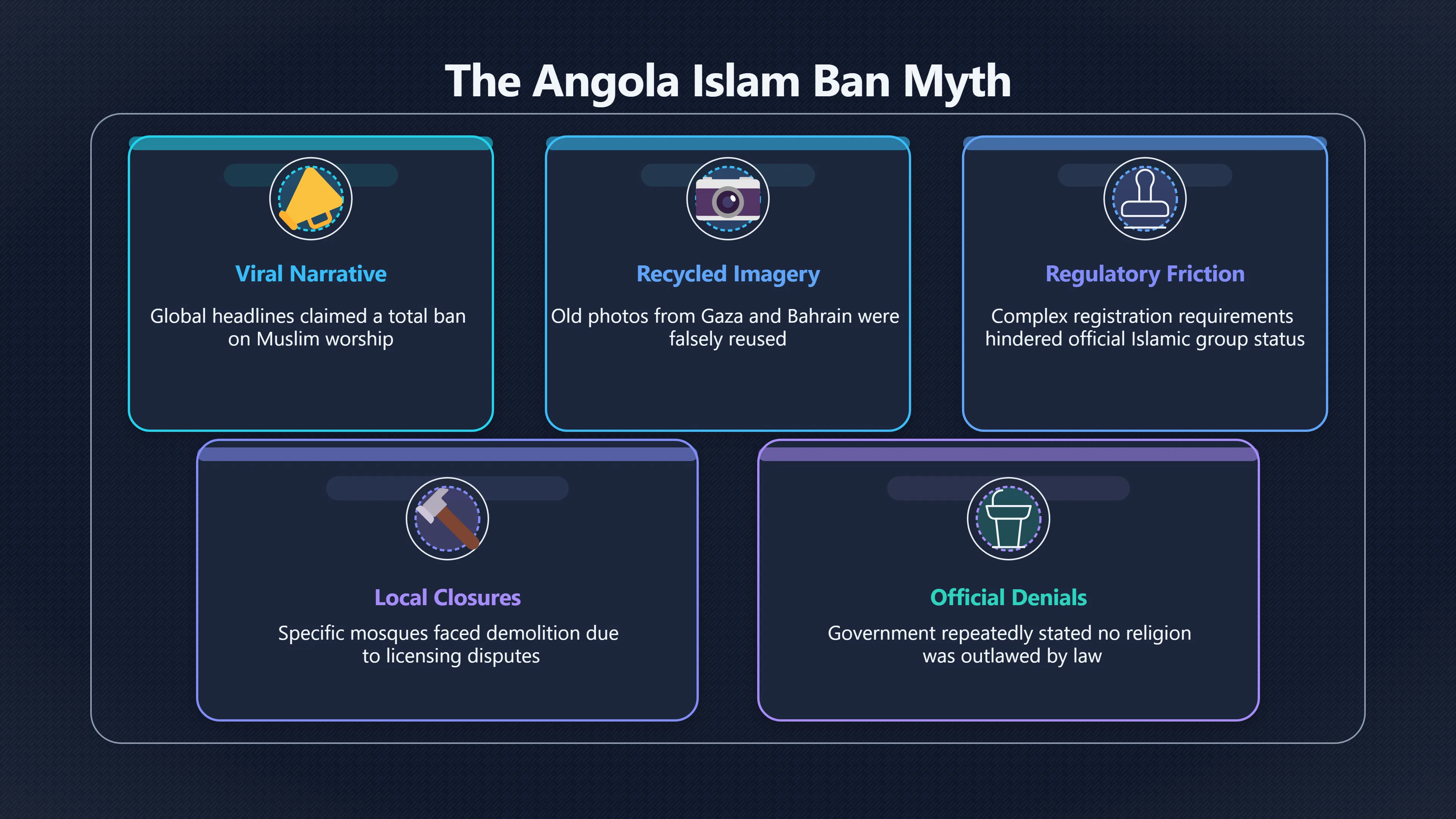
Years later, social media posts continued to claim that Angola had outlawed Islam and demolished mosques. Many of these posts relied on dramatic photographs that were not actually connected to Angola. Fact-checkers traced some widely shared images to entirely different events in other countries, including a mosque destroyed in Gaza and another demolished in Bahrain years before the Angolan controversy.[Africa Check]africacheck.orgno angola has not banned islamno angola has not banned islam
Fact-checking organisations repeatedly reviewed the claim and reached the same conclusion: Angola had not banned Islam. While disputes over recognition and mosque closures were real, the viral claims exaggerated those events into a nationwide prohibition that never existed.[pesacheck.org]pesacheck.orgfalse angola has not banned islamfalse angola has not banned islam
The persistence of the story demonstrates a common feature of modern misinformation. Once a dramatic narrative becomes established, later corrections rarely travel as far as the original claim. Old photographs are reused, headlines are copied without context, and the myth acquires a life of its own.

What the Episode Reveals About Misinformation
The “Islam ban” story is not a pure hoax in the sense of a completely invented event. Its endurance comes from the fact that it contained a kernel of truth. Angola did have controversial policies affecting Muslim organisations, and some mosques were indeed closed. Those facts gave credibility to a much broader claim that could not be supported.
The episode illustrates how misinformation often grows from exaggeration rather than fabrication. A complicated dispute over registration requirements and religious recognition was gradually transformed into a simple but inaccurate story about a country outlawing an entire faith. By the time official denials, journalistic investigations and later fact-checks appeared, the more dramatic version had already spread worldwide.[reuters.com]reuters.comangola defends barring islamic groups denies persecution id USBRE9AS0JKAngola defends barring Islamic groups, denies persecutionNov 29, 2013 — LUANDA (Reuters) - Angola said on Friday it had refused re…
Within Angola’s wider history of contested truths and misleading narratives, the myth stands as a notable example of how real events can be stretched beyond recognition. The lesson is not that nothing happened, but that what happened was far more complex than the viral headline suggested.
Amazon book picks
Further Reading
Books and field guides related to Did Angola Really Ban Islam?. Use these as the next step if you want deeper reading beyond the article.
The Demon-Haunted World
Rating: 4.5/5 from 43 Google Books ratings
Useful for evaluating sensational claims and debunking myths.
eBay marketplace picks
Marketplace Samples
Live-tested eBay searches with available results related to this page.
Endnotes
1.
Source: reuters.com
Title: angola defends barring islamic groups denies persecution id USBRE9AS0JK
Link:https://www.reuters.com/article/world/angola-defends-barring-islamic-groups-denies-persecution-idUSBRE9AS0JK/
Source snippet
Angola defends barring Islamic groups, denies persecutionNov 29, 2013 — LUANDA (Reuters) - Angola said on Friday it had refused re...
2.
Source: ibtimes.co.uk
Title: angola islam ban deny africa muslim christian 525306
Link:https://www.ibtimes.co.uk/angola-islam-ban-deny-africa-muslim-christian-525306
Source snippet
International Business Times UKAngola Retreats on Islam Ban Reports26 Nov 2013 — Angolan officials deny ban on Muslim faith and claims th...
3.
Source: Wikipedia
Title: Islam in Angola
Link:https://en.wikipedia.org/wiki/Islam_in_Angola
4.
Source: Wikipedia
Title: Human rights in Angola
Link:https://en.wikipedia.org/wiki/Human_rights_in_Angola
5.
Source: factcheck.afp.com
Title: Fact Check AFPNo, these pictures are not evidence of Angola banning Islam
Link:https://factcheck.afp.com/no-these-pictures-are-not-evidence-angola-banning-islam
6.
Source: amabhungane.org
Title: angola govt denies islam ban despite mosque closures attacks
Link:https://amabhungane.org/angola-govt-denies-islam-ban-despite-mosque-closures-attacks/
7.
Source: pesacheck.org
Title: false angola has not banned islam
Link:https://pesacheck.org/false-angola-has-not-banned-islam/
8.
Source: state.gov
Link:https://www.state.gov/report/custom/2d5f13558c
9.
Source: arabnews.com
Link:https://www.arabnews.com/node/483811/amp
Source snippet
Arab NewsAngola denies banning IslamNov 27, 2013 — Angola's government on Tuesday denied it had banned Islam and closed mosques in the co...
10.
Source: aljazeera.com
Title: angola denies it has banned islam
Link:https://www.aljazeera.com/news/2013/11/27/angola-denies-it-has-banned-islam
Source snippet
Al JazeeraAngola denies it has banned Islam | NewsNov 27, 2013 — Angola's government has denied it had banned Islam and closed mosques in...
11.
Source: dailymaverick.co.za
Title: Daily Maverick No, Angola has not ‘banned Islam’
Link:https://www.dailymaverick.co.za/article/2013-11-26-no-angola-has-not-banned-islam-its-a-little-more-complicated-than-that/
Source snippet
It's a little more...Nov 26, 2013 — Although government officials asserted the government protected religious groups without legal statu...
12.
Source: hurriyetdailynews.com
Title: Hürriyet Daily News Angola denies Islam ban after speculation
Link:https://www.hurriyetdailynews.com/angola-denies-islam-ban-after-speculation-58606
13.
Source: africacheck.org
Title: no angola has not banned islam
Link:https://africacheck.org/fact-checks/meta-programme-fact-checks/no-angola-has-not-banned-islam
Additional References
14.
Source: newageislam.com
Title: New Age Islam Has Angola Banned Islam?
Link:https://www.newageislam.com/islam-politics/eric-owens-others/-angola-banned-islam/d/34626
Source snippet
Eric Owens and OthersRelated Articles: No, Angola has not 'banned Islam'. It's a little more complicated than that. By Khadija Patel. R...
15.
Source: theguardian.com
Title: angola accused banning islam mosques
Link:https://www.theguardian.com/world/2013/nov/28/angola-accused-banning-islam-mosques
Source snippet
"There is no war in Angola against Islam or any other religion," Manuel Fernando...Read more...
16.
Source: facebook.com
Link:https://www.facebook.com/thenewvision/posts/angolan-justice-ministry-spokesman-tells-the-bbc-that-islam-has-not-been-officia/10152084084989078/
17.
Source: afghanistan.factcrescendo.com
Link:https://afghanistan.factcrescendo.com/english/is-this-an-image-of-a-destroyed-mosque-in-angola-has-angola-banned-islam-in-the-country-know-the-truth/
18.
Source: africlaw.com
Link:https://africlaw.com/2017/10/06/the-unclear-relation-between-angola-and-its-muslim-citizens-and-migrants-is-angola-discriminating-against-them/
19.
Source: youtube.com
Link:https://www.youtube.com/watch?v=1LgdRBWWV3M
20.
Source: aa.com.tr
Title: muslims in angola deny mosques closure urge islam recognition
Link:https://www.aa.com.tr/en/politics/muslims-in-angola-deny-mosques-closure-urge-islam-recognition/201807
21.
Source: youtube.com
Link:https://www.youtube.com/watch?v=LmG-aSMTXAg
22.
Source: youtube.com
Link:https://www.youtube.com/watch?v=oqBAcjAO6og
Topic Tree