Within Benin
Were Dahomey's Women Soldiers Really Amazons?
The real female regiments of Dahomey were recast first as exotic Amazons and later as uncomplicated liberation heroes.
On this page
- Who the women soldiers were
- How the Amazon label changed their story
- What modern retellings simplify
Page outline Jump by section
Introduction
The women soldiers of the Kingdom of Dahomey, in what is now Benin, were real. They were not a legend, a traveller’s fantasy or a colonial invention. For roughly two centuries, Dahomey maintained a female military corps that fought in wars, guarded the royal court and became one of the kingdom’s most distinctive institutions. Yet the story most people know today is often filtered through two layers of myth. First, nineteenth-century European observers transformed them into exotic “Amazons”, comparing them to figures from Greek mythology. More recently, films, popular histories and social media have sometimes recast them as uncomplicated symbols of female liberation. Neither image fully matches the historical record. The women soldiers were extraordinary, but they also belonged to a militarised state deeply involved in warfare, slave raiding and the Atlantic slave trade. Understanding them means separating documented history from the stories later generations wanted to tell about them.[smithsonianmag.com]smithsonianmag.comreal warriors woman king dahomey agojie amazons 180980750Smithsonian MagazineThe Real Warriors Behind 'The Woman King'15 Sept 2022 — The Woman King, a new movie starring Viola Davis as a fiction…
Who the women soldiers were
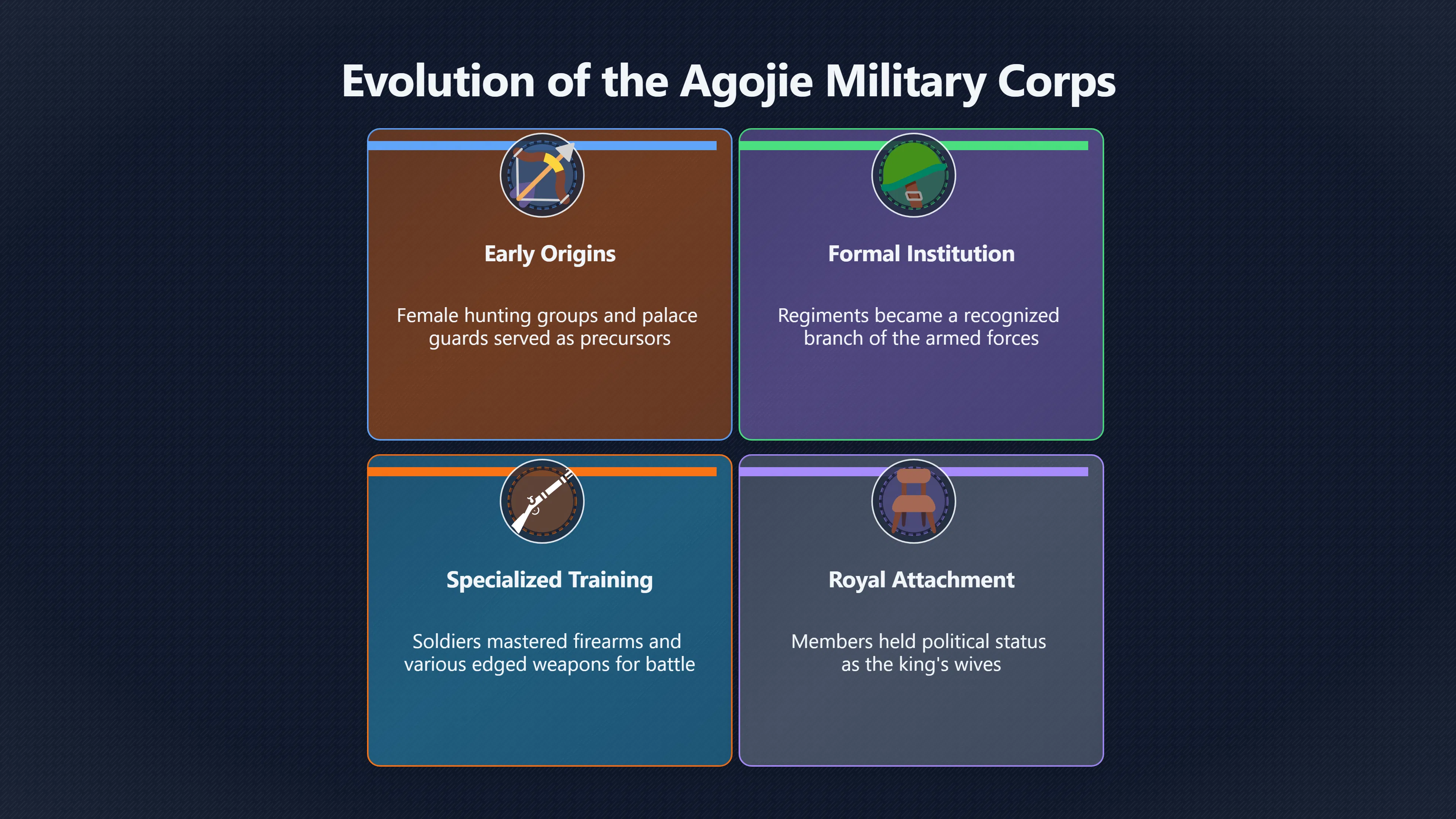
The female regiments of Dahomey, often called the Agojie or Mino, formed a recognised branch of the kingdom’s armed forces. European visitors encountered them in large numbers during the nineteenth century, but their origins probably stretched back earlier through palace guards, female hunting groups and royal attendants who gradually acquired military roles. Historians disagree on some details of their beginnings, yet there is broad agreement that by the reign of King Ghezo in the early nineteenth century they had become a formal military institution.[wikipedia.org]WikipediaDahomey AmazonsDahomey Amazons
These women were not merely ceremonial guards. Contemporary accounts describe military training, battlefield service and specialised units equipped with firearms and edged weapons. Recruitment came from several sources, including royal households, captives and free women. Membership brought status and influence unavailable to many women elsewhere in the region, though it also involved strict discipline and service to the king. The soldiers were formally attached to the royal household and were often described as the king’s wives, a political and institutional status rather than a conventional marriage.[wikipedia.org]WikipediaDahomey AmazonsDahomey Amazons
One reason the corps attracted so much attention was its scale. European observers reported thousands of women under arms at certain points in the nineteenth century. Whether every estimate was accurate is debated, but there is little doubt that Dahomey fielded one of the most significant female military organisations documented in the modern era.[Wikipedia]WikipediaDahomey AmazonsDahomey Amazons
How the Amazon label changed their story
The best-known misunderstanding begins with the very name by which they became famous. The women did not call themselves “Amazons”. That label came from European visitors who compared them to the mythical warrior women of Greek tradition. The comparison made sense to foreign audiences because it linked an unfamiliar African institution to a story readers already knew. It also immediately shifted attention away from Dahomey’s own political and cultural context.[wikipedia.org]WikipediaDahomey AmazonsDahomey Amazons
The Amazon label carried several distortions.
First, it encouraged people to treat the women as a curiosity rather than as part of a functioning state. Newspaper readers and travellers were fascinated by the apparent reversal of expected gender roles. Reports often emphasised spectacle, appearance and supposed exotic customs over military organisation or political realities. The result was a narrative in which the women seemed almost mythical even when observers were describing real soldiers.[Smithsonian Magazine]smithsonianmag.comdahomeys women warriors 88286072Smithsonian MagazineDahomey's Women Warriors23 Sept 2011 — One theory traces their origins to teams of female hunters known as gbeto, and…
Second, the label fed wider colonial portrayals of Dahomey as a place of extremes. European accounts that already stressed warfare, sacrifice and royal absolutism often presented the female regiments as further evidence that the kingdom was strange, dramatic or outside normal history. The women became part of a larger colonial spectacle in which African societies were explained through exoticism rather than careful analysis.[Smithsonian Magazine]smithsonianmag.comdahomeys women warriors 88286072Smithsonian MagazineDahomey's Women Warriors23 Sept 2011 — One theory traces their origins to teams of female hunters known as gbeto, and…
Third, the Amazon comparison encouraged exaggeration. Some accounts celebrated the women as superhuman fighters. Others portrayed them as terrifying curiosities. Both approaches obscured the reality that they were trained soldiers operating within the strengths and limitations of a nineteenth-century West African army.[Smithsonian Magazine]smithsonianmag.comreal warriors woman king dahomey agojie amazons 180980750Smithsonian MagazineThe Real Warriors Behind 'The Woman King'15 Sept 2022 — The Woman King, a new movie starring Viola Davis as a fiction…
The important point is that the distortion was not a straightforward hoax. The women existed. The error lay in the framework used to explain them. A real institution was transformed into a mythic one because mythology proved more marketable and memorable than history.

The forgotten complication: warfare and slavery
Modern audiences often encounter the women soldiers through stories of resistance to colonial conquest. They did indeed fight French forces during the wars that ended Dahomean independence in the 1890s. Their determination in those conflicts helped cement their reputation as formidable warriors.[National Geographic]nationalgeographic.comthe true story of the women warriors of dahomeyNational GeographicThe true story of the women warriors of Dahomey14 Sept 2022 — From the late 1600s to the early 1900s, the West African…
However, another part of the story is frequently softened or omitted. Dahomey was heavily involved in warfare against neighbouring states and participated in the Atlantic slave trade. Historical evidence shows that military campaigns produced captives who could be enslaved and sold. The women soldiers were members of the kingdom’s military apparatus and therefore part of this broader system. Accounts from descendants of enslaved people and historical research both connect Dahomey’s armies, including female regiments, to campaigns that generated captives for trade.[wikipedia.org]WikipediaDahomey AmazonsDahomey Amazons
This does not erase their significance as women who occupied unusual military roles. It does mean that any attempt to portray them solely as freedom fighters risks replacing one simplification with another. The historical reality is more uncomfortable: a remarkable female military corps existed within a state that could be both innovative and violent.[The New Yorker]newyorker.comIt follows General Nanisca, played by Viola Davis, leading an all-female unit of warriors called the Agojie in a mission of liberation. T…
What modern retellings simplify
Recent interest in the women soldiers has been driven by popular culture, especially after renewed global attention from films, documentaries and comparisons with fictional warrior groups such as Wakanda’s Dora Milaje. These retellings have corrected one older distortion by emphasising that the women were real historical figures rather than colonial fantasy.[Teen Vogue]teenvogue.comTeen Vogue If You Loved Black Panther's Dora Milaje, Meet the Dahomey AmazonsOriginating from West Africa dating back to the 17th century, the Dahomey Amazons were also an all-female military regiment known for the…
Yet new simplifications have appeared.
A common modern narrative presents the Agojie as symbols of female empowerment in a contemporary sense. There is some truth here. Service could bring prestige, authority and opportunities unavailable to many other women. Historians note that military membership allowed some women to achieve influence and status inside Dahomey’s political system.[Wikipedia]WikipediaDahomey AmazonsDahomey Amazons
The problem arises when modern values are projected backwards without qualification. The women soldiers did not belong to a modern democratic movement for gender equality. They served a monarchy, operated within a hierarchical society and participated in military campaigns directed by royal authority. Their lives cannot be reduced either to oppression or liberation.[Wikipedia]WikipediaDahomey AmazonsDahomey Amazons
The debate surrounding the 2022 film The Woman King illustrates the tension. Supporters welcomed a long-overdue portrayal of African women as historical actors rather than passive victims. Critics argued that some versions of the story understated Dahomey’s role in the slave trade. The controversy itself revealed how historical figures can become symbols in present-day cultural arguments, with different audiences emphasising different parts of the record.[newyorker.com]newyorker.comIt follows General Nanisca, played by Viola Davis, leading an all-female unit of warriors called the Agojie in a mission of liberation. T…
Why the story still attracts myths
The women soldiers of Dahomey sit at the intersection of several powerful narratives: warrior legends, colonial encounters, gender history and African statehood. That combination almost guarantees retellings that drift toward myth.
For nineteenth-century Europeans, they were evidence of an exotic and supposedly astonishing Africa. For twentieth-century popular culture, they became romantic Amazons. For some twenty-first-century audiences, they have become icons of empowerment and resistance. Each version contains elements of truth while leaving out inconvenient details.[Smithsonian Magazine]smithsonianmag.comreal warriors woman king dahomey agojie amazons 180980750Smithsonian MagazineThe Real Warriors Behind 'The Woman King'15 Sept 2022 — The Woman King, a new movie starring Viola Davis as a fiction…
The most historically grounded view is also the most interesting. Dahomey’s women soldiers were neither mythical Amazons nor flawless heroines. They were members of a genuine military institution whose existence challenged many assumptions about gender and warfare. At the same time, they served a kingdom engaged in conquest, state-building and slave trading. Their story endures because it resists easy categorisation, revealing how real history is often more complex than either colonial fantasy or modern mythmaking.[nationalgeographic.com]nationalgeographic.comthe true story of the women warriors of dahomeyNational GeographicThe true story of the women warriors of Dahomey14 Sept 2022 — From the late 1600s to the early 1900s, the West African…
Amazon book picks
Further Reading
Books and field guides related to Were Dahomey's Women Soldiers Really Amazons?. Use these as the next step if you want deeper reading beyond the article.
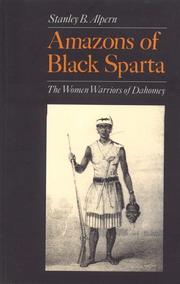
Amazons of black Sparta
First published 1998. Subjects: Military History, History, Military, Fon Women, Women soldiers, History.
Population Statistics in the Kingdom of Dahomey
Discusses Dahomey's institutions and military culture.
eBay marketplace picks
Marketplace Samples
Live-tested eBay searches with available results related to this page.
Endnotes
1.
Source: unesdoc.unesco.org
Link:https://unesdoc.unesco.org/ark%3A/48223/pf0000230934
Source snippet
UNESCO Document RepositoryThe Women soldiers of DahomeyTitle. The Women soldiers of Dahomey; Collation. 42 pages: illustrations; Mater...
2.
Source: Wikipedia
Title: Dahomey Amazons
Link:https://en.wikipedia.org/wiki/Dahomey_Amazons
3.
Source: time.com
Link:https://time.com/6214291/the-woman-king-true-story/
Source snippet
Viola Davis stars as General Nanisca, leading her army against various adversities. The story, though dramatized, is based on historical...
4.
Source: time.com
Title: There’s a True Story BehindBlack Panther’s Strong Women
Link:https://time.com/5171219/black-panther-women-true-history/
Source snippet
Here's Why That MattersThe movie *Black Panther* not only achieved record-breaking success but also featured strong female characters tha...
5.
Source: Wikipedia
Link:https://en.wikipedia.org/wiki/Dahomey
6.
Source: Wikipedia
Link:https://en.wikipedia.org/wiki/Matriarchy
7.
Source: history.com
Title: african female warriors
Link:https://www.history.com/articles/african-female-warriors
8.
Source: smithsonianmag.com
Title: real warriors woman king dahomey agojie amazons 180980750
Link:https://www.smithsonianmag.com/history/real-warriors-woman-king-dahomey-agojie-amazons-180980750/
Source snippet
Smithsonian MagazineThe Real Warriors Behind 'The Woman King'15 Sept 2022 — The Woman King, a new movie starring Viola Davis as a fiction...
9.
Source: nationalgeographic.com
Title: the true story of the women warriors of dahomey
Link:https://www.nationalgeographic.com/history/article/the-true-story-of-the-women-warriors-of-dahomey
Source snippet
National GeographicThe true story of the women warriors of Dahomey14 Sept 2022 — From the late 1600s to the early 1900s, the West African...
10.
Source: smithsonianmag.com
Title: dahomeys women warriors 88286072
Link:https://www.smithsonianmag.com/history/dahomeys-women-warriors-88286072/
Source snippet
Smithsonian MagazineDahomey's Women Warriors23 Sept 2011 — One theory traces their origins to teams of female hunters known as gbeto, and...
11.
Source: newyorker.com
Link:https://www.newyorker.com/culture/cultural-comment/sisterhood-and-slavery-in-the-woman-king
Source snippet
It follows General Nanisca, played by Viola Davis, leading an all-female unit of warriors called the Agojie in a mission of liberation. T...
12.
Source: teenvogue.com
Title: Teen Vogue If You Loved Black Panther’s Dora Milaje, Meet the Dahomey Amazons
Link:https://www.teenvogue.com/story/black-panther-dora-milaje-dahomey-amazons
Source snippet
Originating from West Africa dating back to the 17th century, the Dahomey Amazons were also an all-female military regiment known for the...
13.
Source: policycommons.net
Title: the women soldiers of dahomey
Link:https://policycommons.net/artifacts/8201455/the-women-soldiers-of-dahomey/9111832/
Additional References
14.
Source: youtube.com
Title: THE WOMAN KING AND THE REPRESENTATION OF HISTORICAL TRANSITION
Link:https://www.youtube.com/watch?v=slm0y0S1OoE
Source snippet
Dahomey's Fierce Women Warriors The Untold Story...
15.
Source: youtube.com
Link:https://www.youtube.com/watch?v=DHWIzYzrsvc
Source snippet
Legendary Warriors: The Dahomey Amazons...
16.
Source: facebook.com
Link:https://www.facebook.com/groups/2413757252123955/posts/3423502891149381/
17.
Source: study.com
Link:https://study.com/academy/lesson/agojie-history-significance-facts-dahomey-amazons.html
18.
Source: talesandwhispers.com
Link:https://talesandwhispers.com/story/agojie-the-legendary-amazon-women-warriors-of-dahomey-1
19.
Source: facebook.com
Link:https://www.facebook.com/BBCnewsafrica/posts/benins-four-time-presidential-candidate-marie-elise-gbedo-traces-the-story-of-th/10160817269275229/
20.
Source: instagram.com
Link:https://www.instagram.com/reel/DVrRVJAjZf5/?hl=en
21.
Source: instagram.com
Link:https://www.instagram.com/p/DNgCeZmsOWv/?hl=en
22.
Source: reddit.com
Link:https://www.reddit.com/r/badhistory/comments/w8mku6/the_woman_kings_history_problem_how_accurate/
23.
Source: youngpioneertours.com
Link:https://www.youngpioneertours.com/incredible-dahomey-amazons-coolest-statue-cotonou-benin/
Topic Tree