Within Turkmenistan
How the Ruhnama Became Compulsory Truth
The Ruhnama became compulsory public truth by blending folklore, autobiography and unsupported history with presidential authority.
On this page
- What the Ruhnama claimed about Turkmen history
- How schools, offices and ceremonies enforced belief
- Why foreign companies helped legitimise the book
Page outline Jump by section
Introduction
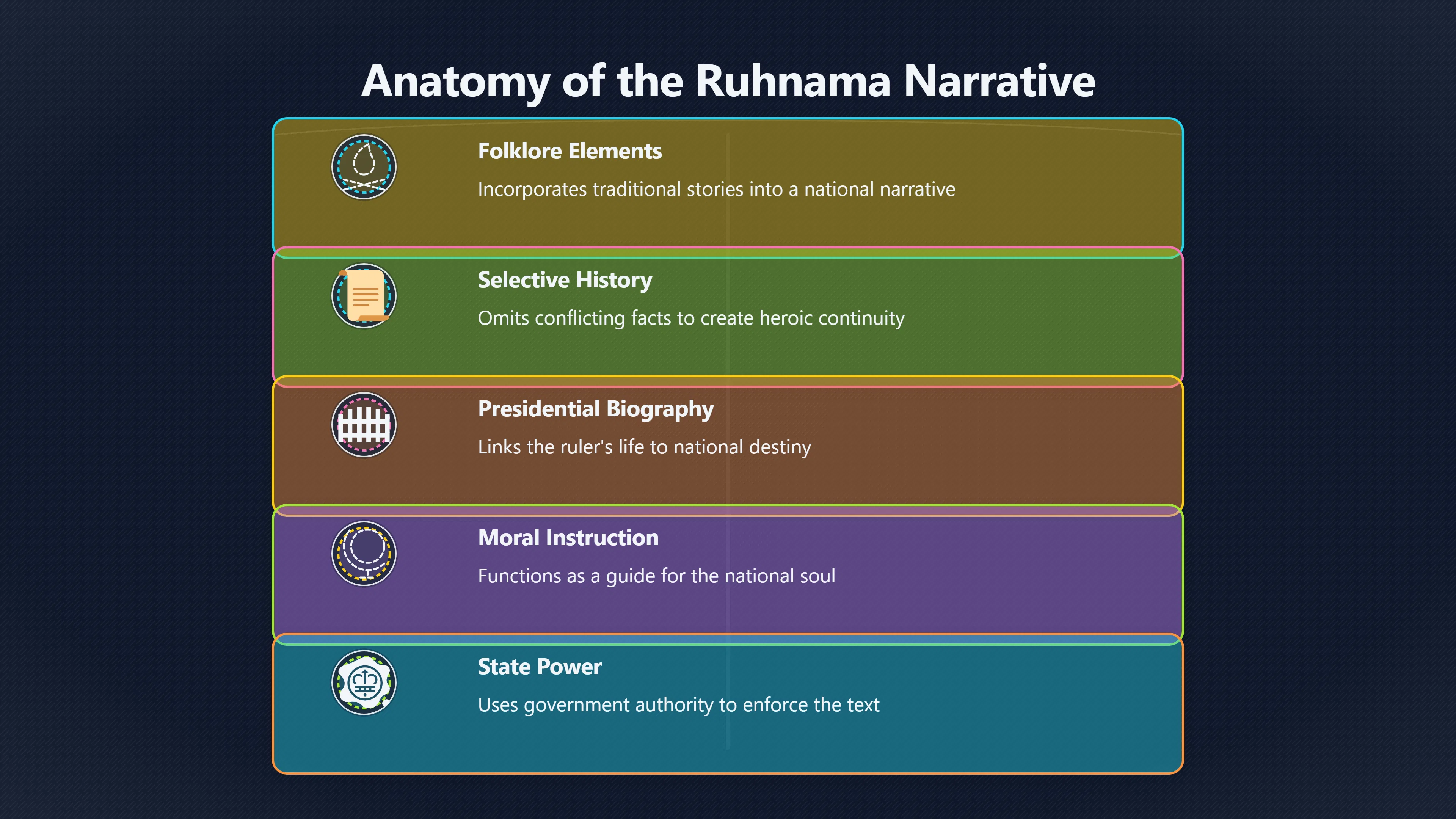
The Ruhnama was not a forged manuscript or a fabricated archaeological discovery. Its significance lies elsewhere. Written by Turkmenistan’s first president, Saparmurat Niyazov, it blended folklore, autobiography, moral instruction and highly selective history into a single national narrative, then used the power of the state to make that narrative effectively compulsory. In the early years after independence, the book became one of the most ambitious attempts anywhere in the post-Soviet world to manufacture a usable national past and present it as unquestionable truth. Rather than persuading readers through evidence, it gained authority through schools, examinations, public rituals, state employment requirements and the president’s personality cult.[Wikipedia]WikipediaOpen source on wikipedia.org.
For a project concerned with famous deceptions, the Ruhnama is important because it shows how national mythology can be constructed without a single dramatic forgery. Instead, genuine folklore, fragments of history and unsupported assertions were woven together into a politically useful story about who the Turkmen were, where they came from and why the existing regime represented the fulfilment of their destiny.[wikipedia.org]WikipediaOpen source on wikipedia.org.
What the Ruhnama Claimed About Turkmen History
The Ruhnama presented itself as a guide to the soul of the Turkmen nation, but it also functioned as an alternative national history. Its account of the past was expansive and often difficult to reconcile with mainstream historical scholarship. The book portrayed the Turkmen people as founders of numerous great civilisations and states across vast stretches of history, while giving little attention to evidence that complicated this narrative.[Wikipedia]WikipediaOpen source on wikipedia.org.
A recurring pattern was the selective treatment of historical periods. Influences that did not fit the desired story were reduced or omitted, while figures and events that could be incorporated into a heroic national narrative were elevated. Scholars have described this approach as an example of “invented tradition”: a process in which modern political needs are projected backwards into the past to create a sense of ancient continuity and legitimacy.[academia.edu]academia.eduBy 2002, it became mandatory in education, overshadowing other…Read more…
The book did not simply glorify the nation. It also positioned Niyazov himself within the historical story. Accounts of his childhood, personal struggles and leadership appeared alongside descriptions of national development, creating the impression that the president’s life formed part of a larger historical destiny. In effect, the narrative linked the history of Turkmenistan to the biography of its ruler.[Wikipedia]WikipediaOpen source on wikipedia.org.
This was not a conventional historical argument. Academic history depends on evidence, competing interpretations and debate. The Ruhnama largely bypassed those processes. Claims were presented with the certainty of revealed truth rather than the caution of scholarship, making the book a notable example of state-sponsored pseudo-history rather than a normal national history text.[Wikipedia]WikipediaOpen source on wikipedia.org.
How Schools, Offices and Ceremonies Enforced Belief
The remarkable feature of the Ruhnama was not merely what it said but how thoroughly it was embedded in public life.
Knowledge of the book became a practical requirement for success. Students studied it in schools and universities. University entrance examinations included questions based on its contents. Government employees were tested on their familiarity with it, and even driving licence applicants were reportedly required to complete courses or answer questions related to the text.[Wikipedia]WikipediaOpen source on wikipedia.org.
The educational commitment was substantial. Schools and universities devoted regular teaching hours to the book, sometimes at the expense of other subjects. Entire academic departments and research programmes were organised around Ruhnama studies. Historical and cultural institutions were encouraged to produce work that reinforced its themes rather than challenge them.[Wikipedia]WikipediaOpen source on wikipedia.org.
The result was a feedback loop. The state treated the book as authoritative, educational institutions taught it as authoritative, examinations rewarded mastery of it, and public ceremonies celebrated it as authoritative. A historical narrative that might otherwise have remained a political manifesto acquired the appearance of accepted knowledge simply because every major institution repeated it.[Wikipedia]WikipediaOpen source on wikipedia.org.
This process illustrates an important distinction in the history of manufactured beliefs. Many hoaxes spread because people are fooled by apparently convincing evidence. The Ruhnama spread primarily because institutional power made public agreement advantageous and public disagreement difficult. The system did not require universal private belief. It required compliance.[centralasiaforum.org]centralasiaforum.orgThe Age of Maturity for the Turkmen Spirit': The Ruhnama…5 Nov 2023 — Riccardo Nicolosi's article 'The Invention of Turkmenistan' nea…
When Political Text Became Sacred Text
One of the most striking aspects of the Ruhnama project was its quasi-religious presentation.
Niyazov claimed that reading the book repeatedly could help secure entry to heaven, a statement that elevated it far beyond ordinary political literature. Mosques and churches were encouraged or required to display the book alongside sacred texts, and religious figures were expected to reference it. Public monuments celebrated the work, including a giant mechanical version that opened ceremonially.[Wikipedia]WikipediaOpen source on wikipedia.org.
The purpose was not necessarily to replace religion outright. Rather, it blurred the boundaries between patriotism, spirituality and loyalty to the president. By presenting the Ruhnama as a source of moral truth as well as historical truth, the regime increased its symbolic authority and made criticism appear not merely political but almost sacrilegious.[Wikipedia]WikipediaOpen source on wikipedia.org.
Why Foreign Companies Helped Legitimatise the Book
The Ruhnama was not only a domestic project. It also gained visibility through the participation of foreign businesses seeking access to Turkmenistan’s energy wealth and construction contracts.
The book was translated into dozens of languages, far more than would normally be expected for a national ideological text. Investigations and documentaries examining the phenomenon argued that a number of international companies sponsored translations or publicly praised the work while pursuing commercial opportunities in Turkmenistan.[substack.com]kathleenmccook.substack.comRuhnama -“Book of the Spirit”by Kathleen McCookThe Ruhnama was translated into over 40 languages, Familiarity with this quasi-religious text was necessary to gain ent…
The documentary Shadow of the Holy Book became particularly influential in highlighting these relationships. It argued that multinational firms were willing to participate in symbolic gestures supporting the Ruhnama because maintaining good relations with the regime could help secure lucrative contracts. Companies were not necessarily endorsing the book’s historical claims; they were participating in a political environment where public displays of respect carried commercial value.[opensocietyfoundations.org]opensocietyfoundations.orgOpen Society FoundationsThe Dictatorship of Saparmurat NiyazovThe documentary Shadow of the Holy Book reveals the secretive and repressiv…
This international dimension mattered because it gave the project an appearance of external recognition. A book promoted only by its author can be dismissed as propaganda. A book translated, displayed and ceremonially celebrated with foreign assistance can appear to possess broader legitimacy. In that sense, commercial incentives helped reinforce a manufactured national narrative.[The Guardian]theguardian.comdictator lit berdymukhamedovdictator lit berdymukhamedov
Why the Narrative Eventually Lost Its Grip
The death of Niyazov in 2006 changed the political environment. His successor, Gurbanguly Berdimuhamedow, initially retained some elements of the Ruhnama system, but over time the book’s dominance declined. Requirements tied to examinations and educational advancement were gradually reduced, and its central place in the curriculum weakened.[Eurasianet]eurasianet.orgturkmen government removes ruhnama as required subjectturkmen government removes ruhnama as required subject
The decline revealed something important about the nature of the project. The authority of the Ruhnama depended heavily on the authority of the individual who created it. Once that personal cult weakened, the historical narrative lost much of the institutional force that had sustained it. Unlike genuine historical traditions that survive through broad cultural acceptance, the Ruhnama relied on continuous political enforcement.[Eurasianet]eurasianet.orgturkmen government removes ruhnama as required subjectturkmen government removes ruhnama as required subject
Yet the book remains historically significant because it demonstrates how a state can attempt to create national memory from above. It shows that the manufacture of history does not always involve forged documents or fabricated artefacts. Sometimes it involves taking fragments of real history, rearranging them into a politically useful story and using the machinery of government to make that story appear self-evidently true.[academia.edu]academia.eduBy 2002, it became mandatory in education, overshadowing other…Read more…
What the Ruhnama Reveals About Manufactured Truth
The Ruhnama occupies an unusual place in the history of deception. It was not a secret fraud later exposed by investigators. Its claims were published openly and promoted publicly. What makes it relevant is the mechanism through which those claims acquired authority.
The book transformed selective history into official history by combining folklore, nationalism, presidential autobiography and state power. Schools taught it, examinations rewarded it, religious institutions displayed it and foreign businesses sometimes helped publicise it. Through repetition and ritual, a political narrative came to resemble a shared historical reality.[wikipedia.org]WikipediaOpen source on wikipedia.org.
For students of hoaxes, propaganda and invented traditions, the lesson is clear. False or unsupported claims do not always spread because they are persuasive on their own merits. Sometimes they spread because institutions make them difficult to avoid, socially costly to challenge and materially useful to repeat. The history of the Ruhnama is one of the clearest examples of that process in post-Soviet Central Asia.[academia.edu]academia.eduBy 2002, it became mandatory in education, overshadowing other…Read more…
Amazon book picks
Further Reading
Books and field guides related to How the Ruhnama Became Compulsory Truth. Use these as the next step if you want deeper reading beyond the article.
Turkmenistan: Power, Politics and Petro-Authoritarianism
Explains how the Ruhnama became institutionally enforced.
eBay marketplace picks
Marketplace Samples
Live-tested eBay searches with available results related to this page.
Endnotes
1.
Source: Wikipedia
Link:https://en.wikipedia.org/wiki/Ruhnama
2.
Source: academia.edu
Link:https://www.academia.edu/8751864/Articulating_National_Identity_in_Turkmenistan_inventing_tradition_through_myth_cult_and_language
Source snippet
By 2002, it became mandatory in education, overshadowing other...Read more...
3.
Source: centralasiaforum.org
Link:https://centralasiaforum.org/2023/11/05/the-age-of-maturity-for-the-turkmen-spirit-the-ruhnama-and-identity-production-in-post-soviet-turkmenistan/
Source snippet
'The Age of Maturity for the Turkmen Spirit': The Ruhnama...5 Nov 2023 — Riccardo Nicolosi's article 'The Invention of Turkmenistan' nea...
4.
Source: researchgate.net
Link:https://www.researchgate.net/publication/264792900_Articulating_national_identity_in_Turkmenistan_Inventing_tradition_through_myth_cult_and_language
Source snippet
Inventing tradition through myth, cult and languageNiyazov, used Turkmen ethnolinguistic nationalism to consolidate his power...
5.
Source: kathleenmccook.substack.com
Title: Ruhnama -“Book of the Spirit”
Link:https://kathleenmccook.substack.com/p/ruhnama-book-of-the-spirit
Source snippet
by Kathleen McCookThe Ruhnama was translated into over 40 languages, Familiarity with this quasi-religious text was necessary to gain ent...
6.
Source: imdb.com
Link:https://www.imdb.com/title/tt1139618/
7.
Source: eurasianet.org
Title: turkmen government removes ruhnama as required subject
Link:https://eurasianet.org/turkmen-government-removes-ruhnama-as-required-subject
8.
Source: eurasianet.org
Title: turkmenistan a true believer in the ruhnama resides in wisconsin
Link:https://eurasianet.org/turkmenistan-a-true-believer-in-the-ruhnama-resides-in-wisconsin
9.
Source: opensocietyfoundations.org
Link:https://www.opensocietyfoundations.org/voices/the-dictatorship-of-saparmurat-niyazov
Source snippet
Open Society FoundationsThe Dictatorship of Saparmurat NiyazovThe documentary Shadow of the Holy Book reveals the secretive and repressiv...
10.
Source: theguardian.com
Title: dictator lit berdymukhamedov
Link:https://www.theguardian.com/books/booksblog/2009/jul/02/dictator-lit-berdymukhamedov
11.
Source: enic-naric.net
Link:https://www.enic-naric.net/page-turkmenistan
Additional References
12.
Source: uscirf.gov
Link:https://www.uscirf.gov/node?Itemid=1&id=1300&option=com_content&page=1560&task=view
Source snippet
USCIRFA generation of Turkmen schoolchildren was forced to study the Ruhnama at the expense of genuine education. "Shadow of the...
13.
Source: youtube.com
Link:https://www.youtube.com/watch?v=se3PZ5R328k
Source snippet
President for Life: Turkmenbashi's Reign of Terror...
14.
Source: arxiv.org
Link:https://arxiv.org/abs/2304.04835
15.
Source: youtube.com
Title: Inside the Bizarre World of Türkmenbaşy’s Turkmenistan
Link:https://www.youtube.com/watch?v=nvXsywnwRqM
Source snippet
Mad Dictators: Turkmen Leader for Life Saparmurat Niyazov...
16.
Source: youtube.com
Title: President for Life: Turkmenbashi’s Reign of Terror
Link:https://www.youtube.com/watch?v=KNJS2-Zv-Tc
Source snippet
Inside the Bizarre World of Türkmenbaşy's Turkmenistan...
17.
Source: idaoffice.org
Link:https://idaoffice.org/travel-guide/en-to-tk/
18.
Source: reddit.com
Link:https://www.reddit.com/r/todayilearned/comments/lc4bx0/til_former_president_of_turkmenistan_saparmurat/
19.
Source: youtube.com
Title: Mad Dictators: Turkmen Leader for Life Saparmurat Niyazov
Link:https://www.youtube.com/watch?v=PTad56B2A4g
Source snippet
Ruhnama Statue Opening-Turkmenistan...
20.
Source: brewminate.com
Title: turkmenbashi personality cult saparmurat niyazov turkmenistan
Link:https://brewminate.com/turkmenbashi-personality-cult-saparmurat-niyazov-turkmenistan/
21.
Source: dvfilm.ch
Title: DSCHOINT VENTSCHR FILMPRODUKTIONSHADOW OF THE HOLY BOOK
Link:https://www.dvfilm.ch/en/movies/documentaries/shadow-of-the-holy-book
Topic Tree