Why Did These Argentine Hoaxes Seem So Believable?
Argentina’s history of hoaxes is not a simple catalogue of people being fooled. Its most revealing cases emerged where evidence was difficult to inspect and authority was easy to borrow: remote Patagonia, prehistoric excavation sites, secret laboratories, private collections and grainy mobile-phone footage. Some were deliberate frauds.
Page outline Jump by section
Introduction
The best-known examples range from European tales of Patagonian giants and suspicious archaeological discoveries at Miramar to the unverified lake monster known as Nahuelito, Ronald Richter’s failed claim to have achieved controlled nuclear fusion, a supposed cache of Nazi relics later judged largely fake, and the viral “gnome” of General Güemes. Together they show why it is important to distinguish a manufactured deception from folklore, exaggeration and scientific error. A claim may begin in uncertainty, acquire impressive witnesses or official backing, and continue circulating long after the original evidence has collapsed.
Why Patagonia became a landscape of marvels
For early European readers, Patagonia was almost designed to produce extraordinary stories. It was distant, poorly mapped and known mainly through the accounts of sailors whose audiences could not independently check what they reported. Unfamiliar people, animals and fossils could therefore be converted into giants and monsters as observations passed from journals into edited travel books, newspapers and popular prints.
The “giants” of Patagonia
The legend began with accounts associated with Ferdinand Magellan’s voyage through the region in 1520. The expedition’s chronicler, Antonio Pigafetta, described an exceptionally tall Indigenous man, and later versions transformed encounters with tall inhabitants of southern Patagonia into reports of a race of enormous people. European maps and illustrations repeated the idea for more than two centuries, sometimes depicting Patagonians as twice the height of ordinary Europeans.[static-prod.lib.princeton.edu]static-prod.lib.princeton.eduPatagonian GiantsThe myth of the Patagonian Giants, like other stories about remote, exotic places, captured the European imagination for…
The people encountered were probably members of groups whose average height impressed relatively short sixteenth-century sailors. Heavy footwear and animal-skin clothing may have made them appear still larger. Repetition did the rest: each retelling tended to preserve the marvel rather than the uncertainties of the original observation.
The story became more clearly deceptive during the eighteenth century. A widely read account of Commodore John Byron’s voyage, published in 1766, revived “giant fever” by describing Patagonians of extravagant height. The fuller official account, released several years later, did not support the most dramatic claims. This suggests a mixture of genuine cross-cultural misperception and commercial exaggeration rather than one continuous, centrally organised hoax.[hoaxes.org]hoaxes.orgthe patagonian giants1766)The rumor of Patagonian giants was only definitively proven to be fictitious when the official account of Byron's voyage appeared i…
The legend endured because it served several purposes at once. Publishers gained an exciting travel story; European readers received confirmation that remote lands contained human marvels; and imperial expansion could be framed as exploration of an almost mythological wilderness. Even after ordinary measurements replaced travellers’ hyperbole, images of Patagonian giants remained attractive as curiosities.
When scientific ambition outran the evidence
Scientific claims can become hoax-like without beginning as deliberate lies. Argentina’s disputes over ancient human remains and nuclear fusion show two different failure modes. In one, questionable discoveries reinforced a theory already favoured by influential researchers. In the other, secrecy and political sponsorship protected an inadequately tested claim from normal scientific scrutiny.
Miramar and the search for extremely ancient Argentines
Florentino Ameghino was a major figure in Argentine palaeontology and archaeology. During the late nineteenth and early twentieth centuries, he argued that humans had inhabited the Pampas at an extraordinarily early geological date and, at times, advanced broader ideas about South America’s place in human evolution. His collections contained animal bones said to show human modification and to come from very ancient deposits. The claims won international attention because they appeared capable of rewriting human prehistory.[MDPI]mdpi.comHis first collections were shown in the book La antigüedad del…
The most troubling discoveries came from the coastal area around Miramar. Stone implements and marked bones were reportedly recovered from deposits considered far older than accepted evidence for humans in the Americas. Visiting commissions were shown objects apparently embedded in geological layers, lending the finds institutional credibility.
Later assessments concluded that important Miramar material had been introduced into the deposits rather than genuinely excavated from them. A historical review presented through the International Geological Congress archive describes the episode as scientific fraud and notes that the remarkable finds ceased after the museum employee associated with their discovery was transferred away from the site.[American Geosciences Institute]information.americangeosciences.orgAmerican Geosciences InstituteSearching for our ancestors: a time ripe for forgeriesNo more important findings were reported from Miramar…
That conclusion should not be expanded into the claim that Ameghino’s entire career was fraudulent. Modern curatorial research continues to regard his collections as historically and scientifically important, even though many of his chronological interpretations were wrong. The evidence fits a more complicated picture: authentic research, outdated geological assumptions and national scientific ambition became entangled with material whose archaeological context was unreliable or manipulated.[MDPI]mdpi.comHis first collections were shown in the book La antigüedad del…
The case remains instructive because archaeological evidence depends not only on what an object looks like but on exactly where and how it was found. A convincing artefact without a secure excavation record can prove very little. Once a dramatic discovery has been removed from the ground, later investigators may be unable to reconstruct whether it was genuinely embedded, accidentally displaced or deliberately planted.
The Huemul fusion announcement
Argentina’s most spectacular scientific fiasco began after the Second World War, when Austrian-born Ronald Richter persuaded President Juan Perón that he could produce controlled thermonuclear reactions. Perón authorised a secret and expensive laboratory on Huemul Island in Lake Nahuel Huapi, near Bariloche. The promise was politically irresistible: Argentina might leap ahead of the major powers and obtain a virtually limitless source of energy.[ITER - the way to new energy]iter.orgthe way to new energy"Proyecto Huemul:" the prank that started it allOctober 26, 2011 — 26 Oct 2011 — Perón's claim was based on t…
On 24 March 1951, Perón announced that controlled thermonuclear reactions had been achieved on a technical scale. The declaration generated international headlines, but Richter had not published the measurements or experimental detail needed for other physicists to evaluate or reproduce the supposed result. Scientists abroad quickly expressed scepticism.[arXiv]arxiv.orgOpen source on arxiv.org.
The decisive investigation came from Argentine scientists appointed to inspect the project. Their reports found that Richter’s apparatus and observations did not demonstrate fusion; the experimental temperatures were far too low. The project was terminated in 1952.[ITER - the way to new energy]iter.orgthe way to new energy"Proyecto Huemul:" the prank that started it allOctober 26, 2011 — 26 Oct 2011 — Perón's claim was based on t…
Whether Richter was a conscious swindler, a self-deceiving experimenter or some combination of the two remains debated. Accounts that call the affair a straightforward fraud risk oversimplifying his behaviour, while descriptions of it as an innocent failure understate his secrecy, resistance to oversight and unsupported certainty. The central deception was the presentation of an unverified experimental signal as a world-changing achievement.
Huemul also produced an unexpected institutional legacy. Equipment and technical momentum from the failed project contributed to the development of serious research around Bariloche, including the institutions that became the Bariloche Atomic Centre and the Balseiro Institute. The affair therefore illustrates a strange historical possibility: a false scientific announcement can waste public money and damage trust while inadvertently helping to create the infrastructure for genuine science.[WIRED]wired.comOpen source on wired.com.

Nahuelito: monster, publicity stunt or living folklore?
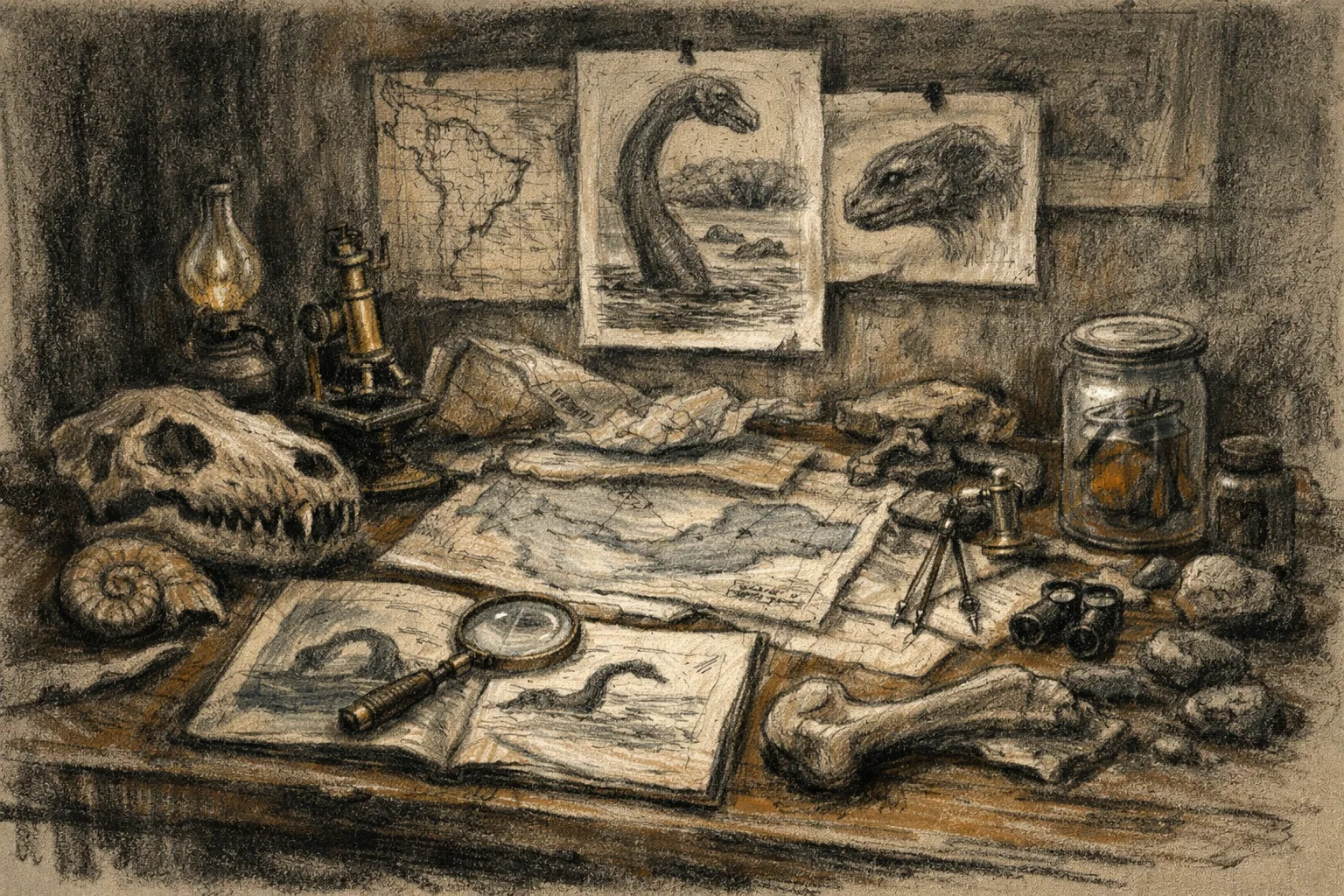
Nahuelito, the supposed creature of Lake Nahuel Huapi, is often described as Argentina’s answer to the Loch Ness monster. Reports have variously portrayed it as a huge serpent, a dark series of humps or a surviving marine reptile. No specimen, clear photograph or reproducible biological evidence has established that an unknown large animal inhabits the lake.[Wikipedia]WikipediaOpen source on wikipedia.org.
The modern legend crystallised in 1922. Clemente Onelli, director of the Buenos Aires Zoo, supported an expedition after receiving reports of a strange creature in a Patagonian lake. The search attracted international press attention but produced no convincing result. It arrived at a moment when popular reconstructions of prehistoric reptiles made the idea of a surviving plesiosaur especially vivid.
A local businessman, Primo Capraro, then built a plesiosaur figure for a carnival float in Bariloche. Photographs of the model helped connect the scientific expedition with publicity and humour. This episode was a definite stunt, but it does not prove that every reported sighting was deliberately fabricated. Later witnesses could have mistaken logs, wakes, swimming animals or unusual wave patterns for something alive.[Wikipedia]WikipediaOpen source on wikipedia.org.
The distinction matters. Nahuelito is better understood as a folklore system that occasionally contains hoaxes than as one continuous hoax. An anonymous batch of photographs sent to a regional newspaper in 1988, for example, was accompanied by an emphatic claim that the object was neither a log nor a wave. Anonymity prevented meaningful investigation, and the photographs did not supply enough information to exclude ordinary explanations.[Wikipedia]WikipediaOpen source on wikipedia.org.
Tourism helps keep the creature culturally useful. Bariloche already possesses dramatic scenery and a strong visitor economy; a mysterious lake animal gives the landscape a memorable story without requiring official belief in it. Nahuelito can consequently operate as local folklore, affectionate branding and fortean mystery at the same time.
The legend also demonstrates how old stories absorb new media. A vague sighting becomes a newspaper item; a photograph gives it apparent physical form; television retellings add dramatic reconstructions; and social media detaches a new clip from its location, date and original witness. The absence of decisive evidence does not end the story because uncertainty is the feature that allows each generation to remake it.
The Nazi collection that looked too perfect
In June 2017, Argentine police and Interpol officers raided a collector’s property near Buenos Aires and discovered about 75 objects decorated with Nazi symbols. They included busts, magnifying glasses, measuring instruments and an elaborate device resembling an occult board. Officials initially presented the cache as probably authentic, and reports suggested that it might provide evidence connecting high-ranking Nazis to Argentina after the war.[Reuters]reuters.comArgentina police seize cache of hidden Nazi artefactsArgentina police seize cache of hidden Nazi artefacts
The setting made the claim persuasive. Argentina really did receive Nazi fugitives after 1945, so a concealed room filled with German memorabilia appeared to fit an established historical narrative. Some objects were reportedly displayed beside old photographs that seemed to show similar items in use by Adolf Hitler, creating an impression of documented provenance.
Specialists subsequently challenged that interpretation. German art historian Meike Hopp and other experts concluded that most of the objects were modern forgeries or ordinary pieces modified by adding swastikas and other Nazi decoration. Stylistic errors, implausible combinations of symbols and manufacturing details undermined the proposed wartime origin.[theguardian.com]theguardian.comThe Guardian Haul of Nazi artefacts on display in Argentina mostly fake,The Guardian Haul of Nazi artefacts on display in Argentina mostly fake,
This was not merely a dispute over whether memorabilia was genuine. Authenticating the pieces as Hitler’s possessions would have increased their financial and historical value enormously. The fabricated or embellished objects were therefore designed to exploit both the collectors’ market and Argentina’s genuine association with escaped war criminals.
The episode also warns against treating dramatic discovery circumstances as proof. Hidden passages, secret rooms and official raids create a compelling narrative, but none establishes an object’s date or ownership. Provenance requires a documented chain of custody, material analysis and comparison with securely authenticated examples. A theatrical hiding place can itself become part of the sales pitch.

The viral gnome of General Güemes
In 2008, low-resolution mobile-phone footage from General Güemes in Salta province appeared to show a short, pointed-hatted figure walking sideways across a street. Teenagers could be heard shouting and fleeing. International tabloids reported that a “creepy gnome” was frightening the town, turning a local clip into an early global viral mystery.[Snopes]snopes.comcreepy gnome videocreepy gnome video
The video succeeded because it contained the basic components of persuasive found footage: darkness, poor image quality, apparently spontaneous fear and an abrupt ending. Its defects made verification difficult but also invited viewers to supply missing detail. A small indistinct shape could be interpreted as a costumed person, a puppet, an animal or a supernatural being.
No independent evidence established that an unknown creature had appeared. Contemporary sceptical analysis noted the staged quality of the encounter and the absence of corroboration strong enough to support the tabloid account. The safest classification is a probable prank or manufactured viral clip rather than a conclusively exposed mechanism: the public evidence does not demonstrate exactly how the figure was made.[Snopes]snopes.comcreepy gnome videocreepy gnome video
Its cultural setting was nevertheless important. Stories about small supernatural beings were already familiar in regional folklore, so the video did not need to invent a completely new creature. It converted an existing imaginative figure into the visual language of the camera phone. Foreign reporting then simplified that figure into a “gnome”, making it instantly recognisable to audiences unfamiliar with the local traditions behind the story.
The case marks a shift from newspaper-age hoaxes to platform-age ambiguity. Older deceptions often required a publisher, museum or government office to confer authority. A viral video needs only enough emotional impact to be copied. By the time careful questions are asked about the original file, witnesses and location, millions of viewers may already know the headline version.
What these cases reveal about belief and exposure
Argentina’s famous deceptions did not all work in the same way, but several recurring mechanisms connect them.
Distance protected the claim. Patagonia’s giants and lake monsters flourished because few readers could visit the relevant places. Huemul’s island laboratory achieved a similar isolation through official secrecy rather than geography alone.
Authority substituted for open evidence. Museum affiliations strengthened the Miramar finds; presidential endorsement amplified Richter; police presentation made the Nazi collection appear authenticated. In each case, institutional confidence arrived before adequate verification.
The claim matched an existing desire. Europeans wanted wonders from Patagonia. Argentine leaders wanted technological independence. Collectors wanted relics connected to Hitler. Tabloids wanted a supernatural video with frightened witnesses. A story spreads more readily when it satisfies expectations already present in its audience.
Images created certainty without providing proof. A carnival plesiosaur, anonymous lake photographs, Nazi objects covered in symbols and a blurry street video all offered something visible. Yet none supplied the contextual information needed to establish origin, scale, date or authenticity.
Exposure rarely erased the memorable version. Corrections are normally more complicated than the original claim. “An unknown monster lives in the lake” is easier to retell than a discussion of wave patterns and photographic provenance. “Argentina achieved fusion” is more striking than an inspection report explaining inadequate temperatures and faulty interpretation.
The practical lesson is not that unusual claims should be dismissed automatically. It is that the strength of a claim depends on how freely its evidence can be inspected. Secure excavation records, reproducible experiments, documented provenance, identifiable witnesses and original media files matter precisely because impressive stories are easy to manufacture after those safeguards are removed.
Argentina’s hoax history is therefore also a history of improving methods of doubt. Scientific commissions investigated Huemul; later archaeological work reassessed Miramar; provenance specialists challenged the Nazi collection; and digital fact-checkers examined viral footage. The most useful scepticism does not ridicule belief or assume fraud in advance. It asks who controlled the evidence, what independent checks were possible, what incentives shaped the story and whether the explanation survives once its dramatic presentation is stripped away.
Amazon book picks
Further Reading
Books and field guides related to Why Did These Argentine Hoaxes Seem So Believable?. Use these as the next step if you want deeper reading beyond the article.
The Demon-Haunted World
Rating: 4.5/5 from 43 Google Books ratings
Directly helps readers understand why hoaxes, myths and dubious evidence gain credibility.
Extraordinary Popular Delusions and the Madness of Crowds
Rating: 4.0/5 from 5 Google Books ratings
Explores how societies become convinced by weak or false claims.
Bad Science
Shows how evidence can be distorted by media, authority and wishful thinking.
Fingerprints of the Gods
Useful as a comparison point for understanding how extraordinary historical claims spread.
eBay marketplace picks
Marketplace Samples
Live-tested eBay searches with available results related to this page.




Endnotes
1.
Source: static-prod.lib.princeton.edu
Link:https://static-prod.lib.princeton.edu/visual_materials/maps/websites/pacific/magellan-strait/patgonian-giants.html
Source snippet
Patagonian GiantsThe myth of the Patagonian Giants, like other stories about remote, exotic places, captured the European imagination for...
2.
Source: hoaxes.org
Title: the patagonian giants
Link:https://hoaxes.org/archive/permalink/the_patagonian_giants
Source snippet
(1766)The rumor of Patagonian giants was only definitively proven to be fictitious when the official account of Byron's voyage appeared i...
3.
Source: mdpi.com
Link:https://www.mdpi.com/2571-9408/6/2/86
Source snippet
His first collections were shown in the book La antigüedad del...
4.
Source: iter.org
Link:https://www.iter.org/node/20687/proyecto-huemul-prank-started-it-all
Source snippet
the way to new energy"Proyecto Huemul:" the prank that started it allOctober 26, 2011 — 26 Oct 2011 — Perón's claim was based on t...
Published: October 26, 2011
5.
Source: arxiv.org
Link:https://arxiv.org/abs/2103.10551
6.
Source: wired.com
Link:https://www.wired.com/story/nuclear-island
7.
Source: Wikipedia
Title: Huemul Project
Link:https://en.wikipedia.org/wiki/Huemul_Project
8.
Source: Wikipedia
Link:https://en.wikipedia.org/wiki/Nahuelito
9.
Source: Wikipedia
Link:https://es.wikipedia.org/wiki/Nahuelito
10.
Source: reuters.com
Title: Argentina police seize cache of hidden Nazi artefacts
Link:https://www.reuters.com/article/world/argentina-police-seize-cache-of-hidden-nazi-artefacts-idUSKBN19B2RG/
11.
Source: time.com
Link:https://time.com/4824777/adolf-hitler-nazi-artifacts-found/
12.
Source: hyperallergic.com
Title: nazi memorabilia slated for exhibition are mostly modern forgeries experts say
Link:https://hyperallergic.com/nazi-memorabilia-slated-for-exhibition-are-mostly-modern-forgeries-experts-say/
13.
Source: snopes.com
Title: creepy gnome video
Link:https://www.snopes.com/fact-check/creepy-gnome-video/
14.
Source: Wikipedia
Title: Media prank
Link:https://en.wikipedia.org/wiki/Media_prank
15.
Source: Wikipedia
Title: April Fools’ Day
Link:https://en.wikipedia.org/wiki/April_Fools%27_Day
16.
Source: Wikipedia
Link:https://en.wikipedia.org/wiki/Patagons
17.
Source: mdpi.com
Link:https://www.mdpi.com/2078-2489/14/7/390
18.
Source: hoaxes.org
Link:https://hoaxes.org/
19.
Source: hoaxes.org
Link:https://hoaxes.org/af_database/display/category/newspapers
20.
Source: information.americangeosciences.org
Link:https://information.americangeosciences.org/open-collections/igc/652/
Source snippet
American Geosciences InstituteSearching for our ancestors: a time ripe for forgeriesNo more important findings were reported from Miramar...
21.
Source: theguardian.com
Title: The Guardian Haul of Nazi artefacts on display in Argentina mostly fake,
Link:https://www.theguardian.com/world/2019/nov/01/nazi-artefacts-argentina-forgeries-art-historian
22.
Source: cryptidz.fandom.com
Link:https://cryptidz.fandom.com/wiki/Nahuelito
23.
Source: paleonerdish.wordpress.com
Link:https://paleonerdish.wordpress.com/tag/nahuelito/
24.
Source: kids.kiddle.co
Link:https://kids.kiddle.co/Nahuelito
Additional References
25.
Source: youtube.com
Title: THE GREAT ARGENTINE NUCLEAR SCAM: Ronald Richter and his Huemul Project
Link:https://www.youtube.com/watch?v=Xr1Pm26-uIA
Source snippet
Argentina's Loch Ness Monster: The Elusive Nahuelito...
26.
Source: patlibros.org
Title: why the continued
Link:https://patlibros.org/frm/index.php?fun=myth
Source snippet
Patagonian Giants in the work of Dom Pernety, 1769-1771in 18th century Britain this fascination was used to stir up a wave of Giant Fever...
27.
Source: youtube.com
Title: Patagonia: the myth of the giants that never existed
Link:https://www.youtube.com/watch?v=QlHd46AyiG0
Source snippet
The Mad Scientist Who Fooled Perón with an Impossible Nuclear Project...
28.
Source: youtube.com
Title: Argentina’s Loch Ness Monster: The Elusive Nahuelito!
Link:https://www.youtube.com/watch?v=BUzFxmAp3JM
Source snippet
Patagonia: the myth of the giants that never existed...
29.
Source: academia.edu
Link:https://www.academia.edu/45206272/Kap_Dwa_The_Two_Headed_Giant_of_Patagonia
30.
Source: historysnob.com
Link:https://www.historysnob.com/historical-figures/20-historical-hoaxes-that-fooled-everyone
31.
Source: researchgate.net
Link:https://www.researchgate.net/publication/367966884_Materiality_and_Images_Ameghino%27s_Collection_of_La_Antiguedad_del_Hombre_en_el_Plata_in_the_La_Plata_Museum
32.
Source: icfj.org
Link:https://www.icfj.org/sites/default/files/2018-07/Short%20Guide%20to%20History%20of%20Fake%20News%20and%20Disinformation_ICFJ.pdf
33.
Source: facebook.com
Link:https://www.facebook.com/groups/1132164400480178/posts/2810339982662603/
34.
Source: facebook.com
Link:https://www.facebook.com/100089633154398/posts/nahuelito-revealed-shocking-anonymous-photos-claim-to-capture-argentinas-legenda/778819505115814/
Topic Tree
Follow this branch
Related pages 192
- Albanian Hoaxes
- Algerian Hoaxes
- Antigua Deceptions
- Armenian Hoaxes
- Austria Hoaxes
- +187 more in sidebar