Which Armenian Legends Survive the Evidence?
Armenia does not have one universally famous national hoax comparable with the Piltdown Man or the Cottingley Fairies.
Page outline Jump by section
The “Armenian Stonehenge” claim
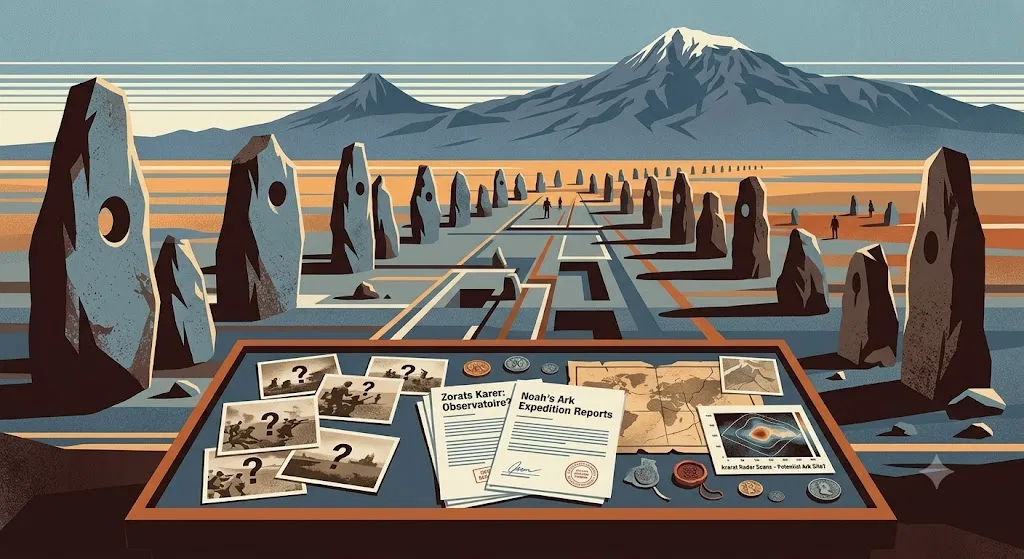
The prehistoric stone complex at Zorats Karer in southern Armenia is real, ancient and archaeologically important. The disputed part is the popular claim that it was the world’s oldest astronomical observatory, sometimes dated to about 5500 BC and presented as several millennia older than Stonehenge. The site contains standing stones, burial structures and numerous stones pierced with circular holes. From the 1980s onwards, several Armenian researchers proposed that some alignments and holes had been used to observe the Sun, Moon or stars. The idea gained wider publicity through the work of physicist Paris Herouni and through the memorable tourist label “Armenian Stonehenge”.[smithsonianmag.com]smithsonianmag.comSmithsonian Magazine Unraveling the Mystery of the "Armenian StonehengeSmithsonian MagazineUnraveling the Mystery of the "Armenian Stonehenge"July 27, 2017 — 27 Jul 2017 — Soviet archaeologist Onnik Khnkikyan…
The claim was persuasive because it joined visible mystery to scientific-sounding precision. Visitors could see the holes for themselves, while diagrams of stellar alignments appeared to turn a ruined landscape into an observatory. It also offered a satisfying national first: not merely an old monument, but the oldest example of sophisticated astronomy. Tourism amplified the comparison with Stonehenge because it instantly explained the site to outsiders.
Archaeological work has produced a more cautious picture. A University of Munich survey identified much of the complex as a necropolis dating mainly from the Middle Bronze Age to the Iron Age and suggested that some stone lines may have belonged to later walls. Archaeoastronomers have also noted that proposed alignments vary between studies, that the holes are too broad for the precision sometimes claimed, and that some are less weathered than the stones around them, raising questions about when they were cut. Specialist assessments therefore treat the observatory interpretation as unproved rather than established fact.[Wikipedia]WikipediaOpen source on wikipedia.org.
This is better described as contested pseudoarchaeology than as a demonstrated fraud. There is no clear evidence that the first researchers knowingly fabricated observations. The problem arose when a hypothesis was repackaged as certainty, then repeated in travel writing, heritage promotion and popular history without the qualifications found in archaeological discussion. The monument’s genuine importance became attached to a much weaker claim about its age and purpose.
Noah’s Ark and the pull of Mount Ararat
Mount Ararat lies in present-day Turkey, but it is central to Armenian historical memory and appears on Armenia’s coat of arms. Claims to have found Noah’s Ark there therefore belong naturally within Armenia’s wider culture of legends and contested evidence, even though most expeditions operated outside the modern republic.
Ark stories have repeatedly followed the same pattern. An explorer announces wood, a boat-shaped formation, aerial photographs or radar anomalies; supporters link the discovery to the dimensions in Genesis; dramatic press coverage follows; independent examination then fails to confirm an ancient vessel. The inaccessible terrain, restricted border zone and religious importance of the mountain make decisive inspection difficult, allowing failed claims to return in altered form.
One of the best-known supposed sites is the Durupınar formation south of Ararat. It resembles a large boat from the air and has repeatedly been promoted as the Ark. Yet geologists Lorence Collins and David Fasold concluded in a peer-reviewed study that it was a natural geological structure, not a ship or a human-made model. Fasold’s rejection was especially significant because he had previously been one of the site’s most enthusiastic advocates.[Wikipedia]WikipediaSearches for Noah's ArkSearches for Noah's Ark
Other announcements have involved alleged wooden chambers high on the mountain. A Hong Kong-based evangelical group claimed in the 2000s that it had found structures associated with the Ark, but supplied little independently verifiable evidence beyond photographs, video and samples whose provenance could not be securely established. Similar stories continue to reappear whenever radar patterns, soil chemistry or pottery from the broader region can be presented as “new clues”, although none has produced accepted archaeological proof of a preserved vessel.[wikipedia.org]WikipediaSearches for Noah's ArkSearches for Noah's Ark
Some Ark claims may involve deliberate staging or unreliable provenance; others are examples of confirmation bias. Researchers begin with the conviction that the Ark must exist and then interpret ordinary geology as ship timbers, decks or corridors. Armenia’s connection to the story helps explain its endurance, but does not validate the evidence. The legend survives because every inconclusive result can be blamed on ice, earthquakes, inaccessible terrain or official obstruction, leaving the central belief untouched.

When war turns old images into new “proof”
Conflict between Armenia and Azerbaijan has produced a dense information battlefield in which genuine atrocities, unverified reports, propaganda and accidental misinformation circulate together. The problem is not confined to one side. False captions and recycled images work because audiences already expect the worst from an adversary, while the urgency of war discourages careful checking.
During the 2020 Nagorno-Karabakh war, false claims circulated that Syrian fighters and Turkish weapons were being transported to Azerbaijan through Georgia. Reports that Syrian mercenaries had been deployed to Azerbaijan were separately investigated by major news organisations, but the specific allegation that Georgia was serving as their transit route lacked supporting evidence. Georgian authorities said military transit permits had been suspended for both Armenia and Azerbaijan, and Armenia’s embassy in Georgia rejected a circulating video that purported to show equipment destined for Azerbaijan. The rumour nevertheless contributed to protests and road blockages, demonstrating how an unverified logistical claim could produce real-world action.[Factcheck.ge]factcheck.geOpen source on factcheck.ge.
Political image manipulation also operates inside Armenian public life. In 2021, social-media posts claimed that former Armenian president Robert Kocharyan’s father was Azerbaijani. The story included a detailed family narrative and a supposed photograph of Kocharyan’s mother. Fact-checkers traced the woman’s image not to a family archive but to a 1927 Soviet film. The invented biographical detail made the claim seem documented, while the borrowed picture supplied visual “proof”.[Factcheck.ge]factcheck.ge39607 disinformation kocharyan s father is azerbaijani39607 disinformation kocharyan s father is azerbaijani
These examples reveal why wartime and election hoaxes are difficult to correct. They combine a small number of real facts with invented routes, identities or motives. A photograph does not need to be digitally altered; an authentic picture from another time or place can be more effective because forensic inspection confirms that the image itself is genuine. The deception lies in the caption.
A Freedom House study found that Armenia’s information environment became particularly vulnerable during the COVID-19 pandemic and the 2020 war. It distinguished deliberate disinformation from misinformation spread by people who do not realise a claim is false, while stressing that both can amplify the same narrative. The report also warned against treating falsehood as the monopoly of one political camp or foreign actor.[Freedom House]freedomhouse.orgFreedom House
Forged authority: documents, news pages and miracle cures
Some Armenian frauds are less spectacular than lost arks or ancient observatories but more immediately harmful. In 2018, Armenia’s National Security Service reported uncovering a group producing and selling forged driving licences, birth and marriage certificates, educational records, residence papers and vehicle documents. Investigators said equipment and records connected with more than 140 people were seized. The scheme worked by reproducing the appearance of official authority: seals, formats and bureaucratic language that most citizens cannot easily verify for themselves.[Armenpress]armenpress.amArmenian national security uncovers counterfeitingArmenian national security uncovers counterfeiting
Online health scams use the same principle. Instead of copying a government certificate, fraudsters imitate trusted news organisations and public figures. CivilNet documented fabricated pages resembling established Armenian media, edited or artificially generated videos, and false reports that recognised doctors or journalists had revealed suppressed “miracle” treatments. One campaign claimed that a well-known doctor had been killed after exposing an extraordinary medicine. The story was invented, but its structure was commercially efficient: conspiracy supplied urgency, a familiar face supplied trust, and the supposed attempt at suppression made ordinary medical scepticism appear to confirm the product’s effectiveness.[CIVILNET]civilnet.amOpen source on civilnet.am.
The beneficiaries are easier to identify here than in archaeological controversies. Sellers gain money from unregistered or ineffective products, while impersonated doctors and media outlets bear the reputational cost. These scams also blur the distinction between fake news and advertising fraud. The false article is not primarily designed to change a political opinion; it is a sales funnel disguised as investigative journalism.
Armenia is not unique in facing deepfake health advertising, but local language, familiar broadcasters and copied Armenian news branding make the deception more convincing to local audiences. International medical reporting has documented the same method elsewhere: public figures’ faces and voices are cloned to endorse products they have never used.[BMJ Group]bmjgroup.comBMJ Group Trusted TV doctors “deepfaked” to promote health scamsBMJ Group Trusted TV doctors “deepfaked” to promote health scams

Art, antiquities and the problem of provenance
Armenian art and antiquities attract collectors in the republic and across a large diaspora market. That creates opportunities for legitimate cultural exchange, but also for copies, misattributions and outright forgeries. The essential weakness is provenance: the documented chain showing who owned an object, where it was found and how it entered the market.
A forged painting can be accompanied by a family story, an invented exhibition history or a questionable expert certificate. An allegedly ancient coin or figurine sold in a market may be genuine, recently manufactured or illegally excavated. Without reliable records and independent technical examination, a buyer is often purchasing a narrative as much as an object.
Recent Armenian commentary on art forgery has described conflicting expert opinions and institutional reluctance to discuss disputed works openly. Such reports raise legitimate concerns, although individual accusations require caution when court findings or complete technical reports are unavailable. The broader lesson is firmer: secrecy benefits forgers. When catalogues, pigment analysis, ownership records and expert reasoning remain inaccessible, reputation can substitute for evidence.[thecaliforniacourier.com]thecaliforniacourier.coma cautionary tale for the armenian diaspora art forgery and silencea cautionary tale for the armenian diaspora art forgery and silence
Scientific testing can expose anachronistic pigments, modern binders, machine-cut marks or recently aged surfaces, but laboratory results are only one part of authentication. Forgers may use old canvases or genuine ancient materials, while a convincing ownership history can be fabricated with false documents. The strongest assessments combine technical analysis, stylistic expertise and traceable provenance.
Why these stories remain believable
Armenia’s best-known doubtful claims do not share a single mastermind or method. What unites them is the setting in which they spread.
They attach themselves to something genuine. Zorats Karer is an authentic ancient site; Ararat is a real and culturally powerful mountain; wartime photographs often show real weapons or casualties; forged paintings imitate artists whose work is genuinely valuable.
They answer emotional needs. An ancient observatory offers national prestige. An Ark discovery promises religious confirmation. A wartime rumour explains fear and betrayal. A miracle cure offers hope when ordinary treatment feels slow or expensive.
They borrow authority. Measurements, radar scans, official-looking certificates, copied news layouts and familiar television faces make a claim appear independently verified even when all the “evidence” comes from the promoter.
Corrections are less memorable than claims. “World’s oldest observatory” is easier to repeat than a technical dispute about dating and alignment. A dramatic fake photograph travels faster than a later explanation of its source.
Political polarisation turns verification into loyalty. Evidence that challenges a favoured story may be treated as hostile propaganda, especially during war or elections. This makes corrections seem partisan even when they rely on traceable images, documents or geological analysis.
Armenian institutions and civil-society groups have responded with fact-checking, media-literacy programmes and proposals for a broader national strategy. Freedom House has recommended clearer definitions, support for independent verification and faster official responses, while the Council of Europe has backed efforts to strengthen media resilience without treating censorship as the solution.[Freedom House]freedomhouse.orgFreedom HouseFreedom House
What the Armenian cases teach
The most useful question is not simply whether a story is true or false, but what kind of doubtful claim it is. A forged certificate is deliberate fraud. A fake doctor endorsement is commercial impersonation. A recycled war photograph is propaganda or reckless misinformation, depending on who captioned it and why. The astronomical interpretation of Zorats Karer is a disputed hypothesis that became over-promoted. Noah’s Ark claims range from sincere religious archaeology to episodes in which evidence or provenance appears unreliable.
Keeping those categories separate makes the history more accurate and more humane. Armenia’s record is not a story of national credulity. It is a study of how uncertainty is exploited: by sellers who imitate authority, political actors who weaponise identity, enthusiasts who mistake possibility for proof, and media systems that reward the most dramatic version of an unresolved story. The recurring safeguard is not cynicism but traceability—finding the original image, the excavation report, the geological study, the laboratory result or the documented chain of ownership before accepting the tale built around it.
Amazon book picks
Further Reading
Books and field guides related to Which Armenian Legends Survive the Evidence?. Use these as the next step if you want deeper reading beyond the article.
Frauds, Myths, and Mysteries: Science and Pseudoscience in Ar...
Relevant to monument, artifact and ancient-history controversies.
Extraordinary Popular Delusions and the Madness of Crowds
Rating: 4.0/5 from 5 Google Books ratings
Explores how attractive stories survive despite weak evidence.
The Demon-Haunted World
Rating: 4.5/5 from 43 Google Books ratings
Fits the page's theme of testing extraordinary claims and evidence.
eBay marketplace picks
Marketplace Samples
Live-tested eBay searches with available results related to this page.



Endnotes
1.
Source: Wikipedia
Link:https://en.wikipedia.org/wiki/Carahunge
2.
Source: archaeology.org
Title: Magazine News
Link:https://archaeology.org/news/2020/08/10/200811-armenia-carahunge-survey/
Source snippet
Archaeology MagazineNews - Researchers Survey “Armenian Stonehenge”30 previously undocumented stones were discovered at a prehistoric mon...
3.
Source: Wikipedia
Title: Searches for Noah’s Ark
Link:https://en.wikipedia.org/wiki/Searches_for_Noah%27s_Ark
4.
Source: factcheck.ge
Link:https://factcheck.ge/en/story/38651-disinformation-syrian-fighters-and-weapons-are-transported-to-azerbaijan-through-georgia
5.
Source: factcheck.ge
Title: 39607 disinformation kocharyan s father is azerbaijani
Link:https://factcheck.ge/en/story/39607-disinformation-kocharyan-s-father-is-azerbaijani
6.
Source: freedomhouse.org
Title: Freedom House
Link:https://freedomhouse.org/sites/default/files/2021-06/Disinformation-in-Armenia_En-v3.pdf
7.
Source: armenpress.am
Title: Armenian national security uncovers counterfeiting
Link:https://armenpress.am/en/article/925078
8.
Source: civilnet.am
Link:https://civilnet.am/en/news/980242
9.
Source: thecaliforniacourier.com
Title: a cautionary tale for the armenian diaspora art forgery and silence
Link:https://www.thecaliforniacourier.com/a-cautionary-tale-for-the-armenian-diaspora-art-forgery-and-silence/
10.
Source: freedomhouse.org
Title: Freedom House
Link:https://freedomhouse.org/sites/default/files/2023-11/Armenia%E2%80%99s-Fight-Against-Disinformation_EN.pdf
11.
Source: Wikipedia
Link:https://en.wikipedia.org/wiki/Pseudoarchaeology
12.
Source: Wikipedia
Title: List of fake news websites
Link:https://en.wikipedia.org/wiki/List_of_fake_news_websites
13.
Source: Wikipedia
Title: List of fact checking websites
Link:https://en.wikipedia.org/wiki/List_of_fact-checking_websites
14.
Source: civilnet.am
Link:https://civilnet.am/en/news/1011917
15.
Source: armenpress.am
Link:https://armenpress.am/en/article/983268
16.
Source: smithsonianmag.com
Title: Smithsonian Magazine Unraveling the Mystery of the “Armenian Stonehenge”
Link:https://www.smithsonianmag.com/travel/unraveling-mystery-armenian-stonehenge-180964207/
Source snippet
Smithsonian MagazineUnraveling the Mystery of the "Armenian Stonehenge"July 27, 2017 — 27 Jul 2017 — Soviet archaeologist Onnik Khnkikyan...
Published: July 27, 2017
17.
Source: mirrorspectator.com
Title: definitive answers sought to identify purpose of armenian stonehenge
Link:https://mirrorspectator.com/2019/08/01/definitive-answers-sought-to-identify-purpose-of-armenian-stonehenge/
Source snippet
The Armenian Mirror-SpectatorDefinitive Answers Sought to Identify Purpose of Armenian...1 Aug 2019 — We think Carahunge, where more tha...
18.
Source: carahunge.org
Link:https://carahunge.org/en/observatory/
Source snippet
MysiteCarahunge Ancient ObservatoryHeruni compares the names Carahunge and Stonehenge and finds similarities in semantic components: Ston...
19.
Source: thesun.co.uk
Title: The Sun Is this mountain the REAL Noah’s Ark?
Link:https://www.thesun.co.uk/tech/33776986/noah-ark-flood-fossil-found/
Source snippet
Bible researchers find 'trace of 5,000-year-old flood' around 'giant boat fossil'Researchers from the Mount Ararat and Noah's Ark Researc...
20.
Source: bmjgroup.com
Title: BMJ Group Trusted TV doctors “deepfaked” to promote health scams
Link:https://bmjgroup.com/trusted-tv-doctors-deepfaked-to-promote-health-scams-on-social-media/
21.
Source: freedomhouse.org
Title: freedom net
Link:https://freedomhouse.org/country/armenia/freedom-net/2024
22.
Source: freedomhouse.org
Title: English Text
Link:https://freedomhouse.org/sites/default/files/2021-07/English%20Text.pdf
23.
Source: freedomhouse.org
Title: freedom net
Link:https://freedomhouse.org/country/armenia/freedom-net/2019
24.
Source: freedomhouse.org
Link:https://freedomhouse.org/Human-Rights-Based-Approaches-to-Media-Work-in-Armenia
25.
Source: freedomhouse.org
Title: nations transit
Link:https://freedomhouse.org/country/armenia/nations-transit/2022
26.
Source: facebook.com
Link:https://www.facebook.com/groups/401527916682645/posts/847445842090848/
27.
Source: facebook.com
Link:https://www.facebook.com/groups/45982415395/posts/10159209147070396/
28.
Source: caravanistan.com
Title: zorats karer
Link:https://caravanistan.com/trip-reports/zorats-karer/
Additional References
29.
Source: nypost.com
Link:https://nypost.com/2025/05/13/science/noahs-ark-sites-fully-preserved-secrets-discovered-by-scientists/
Source snippet
This boat-shaped formation measures 538 feet, aligning with biblical specifications from Genesis. The radar scans revealed a 13-foot tunn...
30.
Source: youtube.com
Title: Unexplained Archaeological Sites Hidden in Armenia’s Mountains
Link:https://www.youtube.com/watch?v=hsKlGsouVS8
Source snippet
Zorats Karer.4500 Years Older Than Stonehenge.The Secret Hidden for 9000 Years...
31.
Source: youtube.com
Link:https://www.youtube.com/watch?v=-QvCXSlNsZs
Source snippet
Proof of Noah's Ark? We Went to See It Ourselves...
32.
Source: thekeyholeheartclinic.com
Link:https://www.thekeyholeheartclinic.com/blog/the-rise-of-ai-deepfake-medicine/
33.
Source: instagram.com
Link:https://www.instagram.com/reel/DXdJOhHjj6P/
34.
Source: irex.org
Link:https://www.irex.org/files/vibrant-information-barometer-2023-armenia.pdf
35.
Source: facebook.com
Link:https://www.facebook.com/groups/ArmeniaTravelTrip/posts/3451437255146336/
36.
Source: facebook.com
Link:https://www.facebook.com/groups/401527916682645/posts/3356849627817111/
37.
Source: tovima.com
Link:https://www.tovima.com/society/art-fraud-ring-busted-over-fake-works-and-antiquities/
38.
Source: researchgate.net
Link:https://www.researchgate.net/publication/354606520_Art_and_Archaeological_Fakes_on_Display_Forty_Years_of_Temporary_Exhibitions
Topic Tree
Follow this branch
Related pages 192
- Albanian Hoaxes
- Algerian Hoaxes
- Antigua Deceptions
- Argentina Hoaxes
- Austria Hoaxes
- +187 more in sidebar