Within Serbian Hoaxes
How Did One Unsolved Injury Become National Myth?
A disputed injury in Kosovo became a national symbol because its political meaning spread faster than the uncertain forensic evidence.
On this page
- Conflicting Accounts of the 1985 Incident
- How Newspapers and Artists Reframed the Case
- Why Political Symbols Outlast Forensic Doubt
Page outline Jump by section
Introduction
The Đorđe Martinović case is remembered not because investigators ever reached a definitive answer, but because uncertainty itself became politically powerful. In May 1985, Martinović, a Serbian farmer from Kosovo, arrived at hospital with severe injuries caused by a broken glass bottle. He claimed that two Albanian men had attacked him. Some investigators and medical experts concluded that the injury was self-inflicted during a sexual act, while others argued that the wound was unlikely to have been caused by Martinović alone. The disagreement was never fully resolved. Yet long before the forensic debate ended, the incident had been transformed into a symbol of Serbian victimhood in Kosovo and a rallying point in the growing nationalist politics of late Yugoslavia.[Wikipedia]WikipediaĐorđe Martinović incidentĐorđe Martinović incident

For a history of contested truth in Serbia, the Martinović affair is significant because it demonstrates how a disputed event can acquire a political meaning far larger than the available evidence. The case was not a classic hoax with a clear perpetrator and later exposure. Instead, it became a political myth: a story whose symbolic value eventually mattered more than establishing exactly what happened.
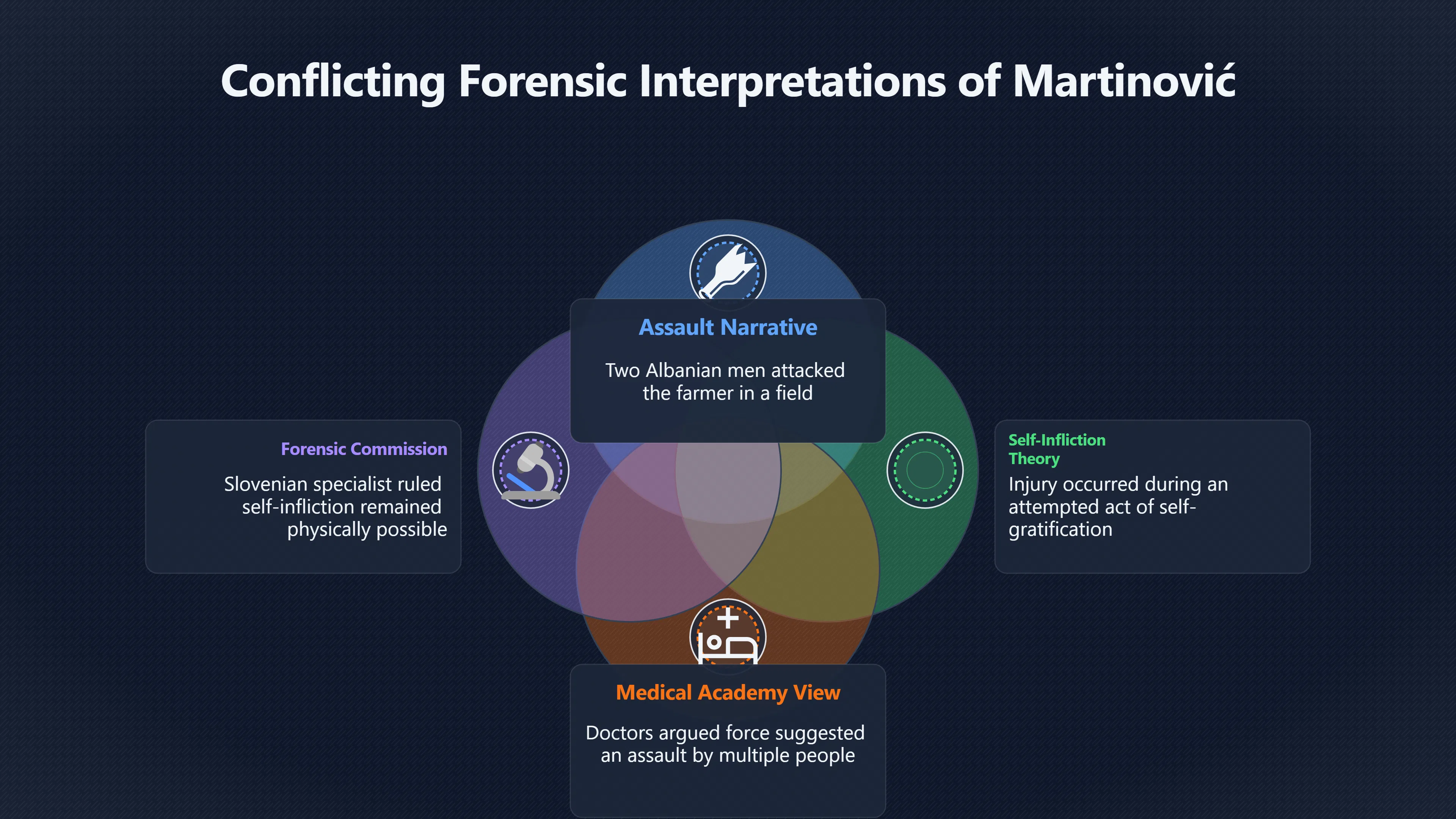
Conflicting Accounts of the 1985 Incident
The basic facts are simple. On 1 May 1985, the 56-year-old Martinović was treated for injuries involving a broken bottle lodged in his rectum. What happened beforehand became the subject of fierce dispute.[Wikipedia]WikipediaĐorđe Martinović incidentĐorđe Martinović incident
Martinović initially claimed that two Albanian men had assaulted him while he was working in a field. According to reports from the investigation, he later gave an account suggesting that the injury had occurred during an attempted act of self-gratification involving a bottle mounted on a stick. Local authorities and some investigators accepted this explanation.[Wikipedia]WikipediaĐorđe Martinović incidentĐorđe Martinović incident
The controversy deepened when a medical team at Belgrade’s Military Medical Academy examined the case and concluded that the injuries appeared inconsistent with accidental self-infliction. The doctors argued that the force involved suggested an assault by more than one person. However, a later forensic commission headed by Slovenian specialist Janez Milčinski reviewed the evidence and concluded that self-infliction remained physically possible. Yugoslav security services reportedly accepted that conclusion.[Wikipedia]WikipediaĐorđe Martinović incidentĐorđe Martinović incident
What made the case unusual was that neither side could completely eliminate the other explanation. No attackers were identified or convicted. No conclusive forensic finding settled the matter. The result was an unresolved incident suspended between competing narratives.[Wikipedia]WikipediaĐorđe Martinović incidentĐorđe Martinović incident
In many criminal investigations, uncertainty reduces public interest. In the Martinović affair, uncertainty increased political usefulness. Different groups could select the expert opinions that supported their preferred interpretation and dismiss the rest.
How Newspapers and Artists Reframed the Case
The transformation of the incident into a national symbol occurred largely through media coverage and cultural interpretation rather than through new evidence. Serbian newspapers, most notably Politika, presented the affair as part of a broader pattern of alleged anti-Serb intimidation in Kosovo. Some reports linked the supposed attack to disputes over land ownership and to claims that Serbs were being pressured to leave the province.[Wikipedia]WikipediaĐorđe Martinović incidentĐorđe Martinović incident
The story quickly escaped the boundaries of a criminal investigation. Intellectuals, writers and political activists began discussing the case as a symbol of collective suffering. A petition signed by Serbian intellectuals declared that Martinović’s case had become the case of the Serbian nation in Kosovo. The Serbian Writers’ Association devoted major attention to the affair, while prominent nationalist-minded figures such as Dobrica Ćosić became involved in supporting Martinović and challenging official conclusions.[Wikipedia]WikipediaĐorđe Martinović incidentĐorđe Martinović incident
Artists reinforced this symbolic transformation. Painter Mića Popović produced a striking work depicting Martinović in imagery associated with martyrdom, presenting him not as an individual involved in a disputed incident but as a representative victim of national persecution. Such artistic representations encouraged audiences to interpret the affair emotionally and collectively rather than as an unresolved forensic question.[Wikipedia]WikipediaĐorđe Martinović incidentĐorđe Martinović incident
The language surrounding the case also changed. Instead of focusing on medical evidence, public discussion increasingly centred on humiliation, victimhood, ethnic conflict and historical memory. Comparisons were drawn with earlier periods of Serbian suffering under foreign rule. By the time these symbolic meanings became established, the original question of what had happened in the field mattered less than what the incident seemed to represent.[Wikipedia]WikipediaĐorđe Martinović incidentĐorđe Martinović incident

Why Political Symbols Outlast Forensic Doubt
Political myths often survive because they answer emotional questions rather than factual ones. The Martinović case emerged during a period of worsening Serbian-Albanian relations in Kosovo. Many Serbian observers already feared demographic decline, discrimination and loss of influence in the province. The affair appeared to provide a dramatic, concrete example that confirmed those anxieties.[Wikipedia]WikipediaĐorđe Martinović incidentĐorđe Martinović incident
Whether the attack occurred exactly as described became secondary to the broader narrative. Supporters of the assault interpretation argued that official institutions were concealing the truth. Supporters of the self-infliction explanation argued that nationalists were exploiting an embarrassing accident for political purposes. Because both sides viewed the case through wider political concerns, contradictory evidence rarely settled the argument.[Wikipedia]WikipediaĐorđe Martinović incidentĐorđe Martinović incident
This dynamic helps explain why the Martinović affair is often discussed in histories of Yugoslavia’s disintegration. Few scholars argue that the incident alone caused later events. Rather, it became a powerful illustration of how competing national narratives were hardening during the 1980s. The case showed how media coverage, cultural symbolism and political mobilisation could transform an ambiguous event into evidence for much larger claims about identity and power.[Wikipedia]WikipediaĐorđe Martinović incidentĐorđe Martinović incident
The affair also demonstrates a recurring feature of political myth-making: ambiguity can be an advantage. A completely disproved story may collapse. A completely proven story may become routine. An unresolved story allows believers to continue arguing that decisive proof exists somewhere beyond public reach. The lack of a final answer can become part of the myth’s durability.
What the Martinović Case Reveals About Contested Truth
From the perspective of Serbia’s history of disputed claims and politically charged narratives, the Martinović affair occupies a distinctive place. It was not a forged document, a fabricated photograph or a deliberate media stunt. The injury itself was real. The uncertainty concerned its cause.[Wikipedia]WikipediaĐorđe Martinović incidentĐorđe Martinović incident
What turned the incident into a lasting historical episode was the speed with which political meaning overtook forensic investigation. Medical commissions disagreed. Investigators reached conflicting conclusions. Yet newspapers, intellectuals, artists and activists rapidly converted the event into a national symbol. Once that happened, the story acquired a life independent of the evidence.[Wikipedia]WikipediaĐorđe Martinović incidentĐorđe Martinović incident
The Martinović case therefore stands as a reminder that political myths do not always emerge from outright invention. Sometimes they grow from genuine events whose details remain uncertain. In such cases, the most influential question is no longer what happened, but what people believe the event proves.[Wikipedia]WikipediaĐorđe Martinović incidentĐorđe Martinović incident

Amazon book picks
Further Reading
No matched book cards were available for How Did One Unsolved Injury Become National Myth?, so this fallback keeps a direct Amazon reading path visible.
Topical books
Political Myth Making guide
Browse books, explainers and reference titles related to this topic.
Search AmazonRelated search
Đorđe Martinović myth guide
Browse books, explainers and reference titles related to this topic.
Search AmazonRelated search
Yugoslavian ethnic strife guide
Browse books, explainers and reference titles related to this topic.
Search AmazonAmazon book picks
Further Reading
Books and field guides related to How Did One Unsolved Injury Become National Myth?. Use these as the next step if you want deeper reading beyond the article.
Imagined Communities
Explains how collective identities are built through shared stories.
eBay marketplace picks
Marketplace Samples
Live-tested eBay searches with available results related to this page.

Endnotes
1.
Source: Wikipedia
Title: Đorđe Martinović incident
Link:https://en.wikipedia.org/wiki/%C4%90or%C4%91e_Martinovi%C4%87_incident
2.
Source: Wikipedia
Title: Incidente de Đorđe Martinović
Link:https://es.wikipedia.org/wiki/Incidente_de_%C4%90or%C4%91e_Martinovi%C4%87
3.
Source: Wikipedia
Title: Caso Đorđe Martinović
Link:https://it.wikipedia.org/wiki/Caso_%C4%90or%C4%91e_Martinovi%C4%87
Additional References
4.
Source: meer.com
Title: 88156 the martinovic case a symbol of yugoslavias ethnic strife
Link:https://www.meer.com/en/88156-the-martinovic-case-a-symbol-of-yugoslavias-ethnic-strife
Source snippet
The Martinović case: a symbol of Yugoslavia's ethnic strife11 Jun 2025 — In May 1985, a 56-year-old Serbian farmer named Djordje Mart...
Published: May 1985
5.
Source: youtube.com
Title: Understanding the Yugoslav War | SLICE HISTORY | FULL DOCUMENTARY
Link:https://www.youtube.com/watch?v=MjLp6dbpFGs
Source snippet
"Dorde Martinovic" OR "Djordje Martinovic" incident OR case OR Kosovo Yugoslavia destroyed by a broken bottle the Djordje Martinovic inci...
6.
Source: academia.edu
Title: The Martinovic Affair ms
Link:https://www.academia.edu/19831424/The_Martinovic_Affair_ms
Source snippet
Academia(DOC) The Martinovic Affair msThe outbreak of ethnic cleansing and genocide in the former Republic of Yugoslavia in the 1980s and...
7.
Source: reddit.com
Link:https://www.reddit.com/r/kosovo/comments/18ddkcs/information_on_djordje_martinovic/
Source snippet
s the story of Djordje...
8.
Source: reddit.com
Link:https://www.reddit.com/r/HistoryWhatIf/comments/1kz3pt1/if_serbian_farmer_%C4%91or%C4%91e_martinovi%C4%87_didnt_break_a/
Source snippet
Within a few...
9.
Source: jstor.org
Link:https://www.jstor.org/stable/42896851
Source snippet
Martinovič was a homosexual who had suffered an accident while in the act of self-gratification … decided to invent the alleged attack. "...
10.
Source: instagram.com
Link:https://www.instagram.com/p/C5odSaguZj5/?hl=en
11.
Source: amnesty.org
Link:https://www.amnesty.org/en/wp-content/uploads/2021/06/eur480181992en.pdf
12.
Source: melmagazine.com
Title: dorde martinovic
Link:https://melmagazine.com/en-us/story/dorde-martinovic
Source snippet
He was 56, living in a small village outside the Kosovan city of Gjilan, and was in...Read more...
13.
Source: youtube.com
Title: Đorđe Martinović Incident
Link:https://www.youtube.com/watch?v=jGYvrrkJDec
Source snippet
Understanding the Yugoslav War | SLICE HISTORY | FULL DOCUMENTARY...
Topic Tree