Within Albanian Hoaxes
Did Otto Witte Really Become Albania's King?
A German circus performer turned Albania's unsettled royal succession into a supposed five-day reign unsupported by contemporary records.
On this page
- The royal adventure Witte claimed
- Why Albania's political crisis made it plausible
- The missing records and changing story
Page outline Jump by section
Introduction
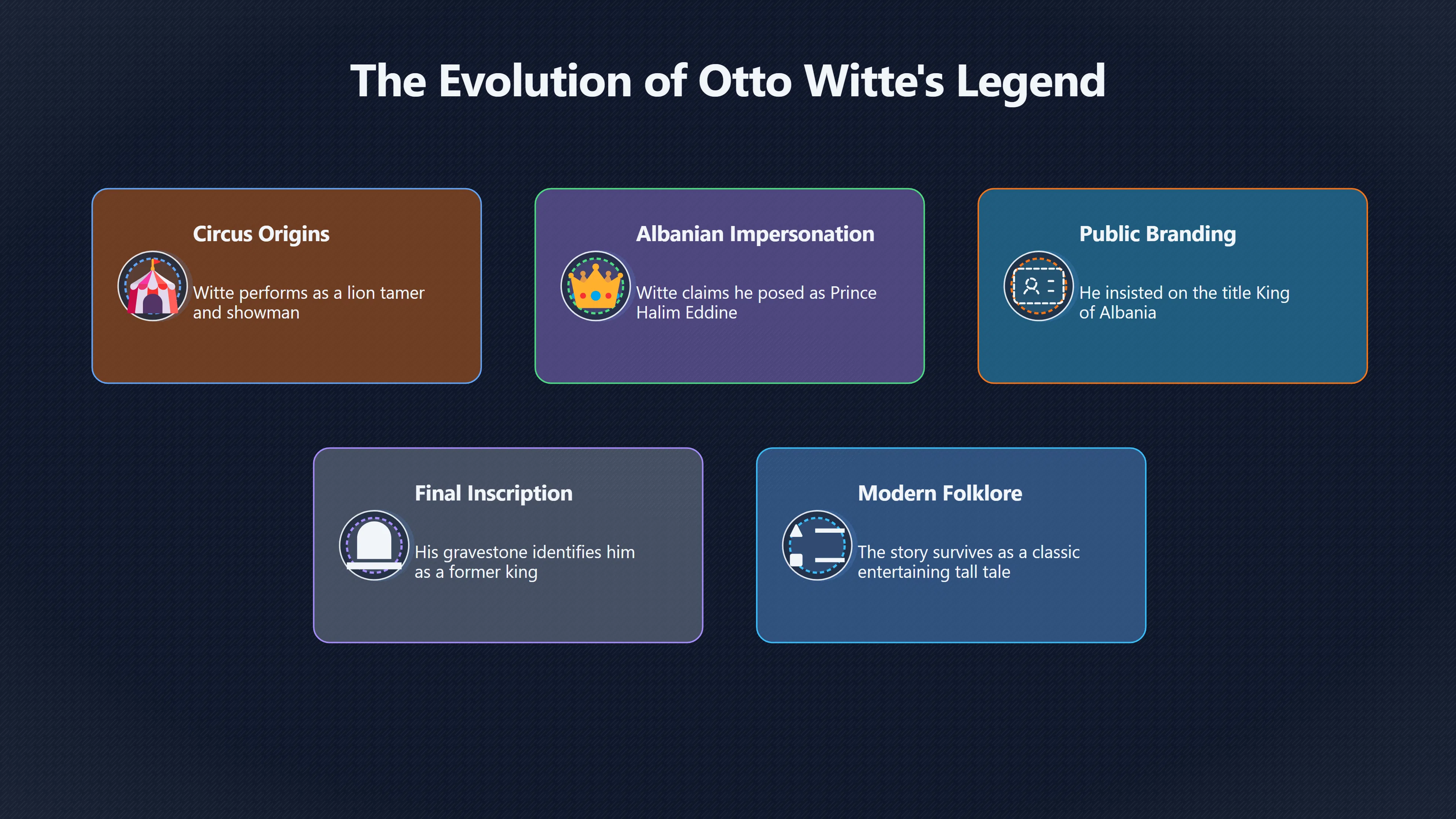
Did Otto Witte really become Albania’s king? The short answer is almost certainly no. Witte, a German circus performer and showman, spent decades claiming that he had briefly ruled Albania in 1913 after impersonating an Ottoman prince and being mistaken for a legitimate candidate for the throne. According to his story, he enjoyed five days of royal power before fleeing when the deception was uncovered. The tale became famous across Europe and was repeated in newspapers, magazines and later books. Yet historians have found no convincing contemporary evidence that the episode happened, while several key details conflict with the known political situation in Albania at the time. Today the story survives less as a forgotten royal adventure than as a classic example of how an entertaining imposture can become accepted folklore.[Wikipedia]WikipediaOtto WitteOtto Witte
The Royal Adventure Witte Claimed
Witte’s version of events was dramatic enough to sound like a novel. He claimed that, during the chaotic period following Albania’s break from Ottoman rule, some Albanian Muslims wanted an Ottoman prince named “Halim Eddine” to become king. Because Witte supposedly resembled the prince, he and a companion, the sword-swallower Max Schlepsig, travelled to Albania and presented him as the royal candidate. Witte later said that local authorities accepted him, crowned him king in Durrës, and allowed him to rule for five days. During this brief reign he claimed to have appointed officials, enjoyed palace life, handled state affairs and even contemplated military action before the fraud was exposed. He then allegedly escaped with part of the royal treasury.[Wikipedia]WikipediaOtto WitteOtto Witte
The story contains all the ingredients of a successful tall tale: mistaken identity, political confusion, exotic settings, sudden power, romance and a narrow escape. It also echoed popular adventure fiction of the era, especially stories in which an ordinary man is mistaken for royalty and temporarily assumes a throne. Commentators have long noted similarities between Witte’s account and fictional works such as The Prisoner of Zenda, which were widely known in Europe by the early twentieth century.[Wikipedia]WikipediaThe Prisoner of ZendaAugust 25, 2002 — In a popular but very questionable account, a German circus acrobat named Otto Witte claimed he had been briefly mistak…
What made the claim especially memorable was Witte’s commitment to it. He continued presenting himself publicly as the “former King of Albania” for the rest of his life and insisted that others address him by that title. German authorities even permitted the phrase to appear as an artistic pseudonym on his identity documents, helping to give the legend an appearance of official recognition despite the absence of historical proof.[Wikipedia]WikipediaOtto WitteOtto Witte
Why Albania’s Political Crisis Made It Plausible
The success of Witte’s story depended on a real historical circumstance. Albania had declared independence in 1912 and its future government remained unsettled. Great Power diplomacy, competing local factions and uncertainty about who should rule the new state created a confusing political landscape that many foreign readers barely understood.[Wikipedia]WikipediaOtto WitteOtto Witte
In such an environment, the idea of an unexpected foreign prince arriving to claim authority did not sound entirely impossible. European newspapers frequently discussed potential candidates for the Albanian throne, and the eventual ruler, Prince Wilhelm of Wied, was himself a foreign aristocrat selected through international negotiations. Wilhelm genuinely arrived and ruled briefly in 1914 before political turmoil forced him out. That real episode helped make Witte’s invented one seem more believable to audiences who knew only fragments of Albanian history.[Wikipedia]WikipediaWilhelm, Prince of AlbaniaWilhelm, Prince of Albania
The story also benefited from distance. Most Germans reading about Albania in the 1920s or 1930s had little way to verify details from a small Balkan country that had recently emerged from imperial rule and conflict. A colourful account from a charismatic performer could spread more easily than careful historical correction.[Time]time.comALBANIA: The Man Who Was KingOtto Witte, a lifelong circus performer who made his first public appearance as a lion tamer at the age…

The Missing Records and Changing Story
The strongest argument against Witte’s claim is not the existence of contrary evidence but the absence of supporting evidence. Historians have found no reliable Albanian government records, diplomatic reports, newspaper coverage or eyewitness documentation confirming that a German circus performer was crowned king or exercised authority in Albania. For an event supposedly involving a royal accession, the documentary silence is striking.[Wikipedia]WikipediaOtto WitteOtto Witte
Problems also appear within Witte’s own narrative. Researchers have noted that the original chronology he offered placed the episode in February 1913, a period when central Albania was still affected by military occupation and political instability that makes the story difficult to reconcile with known events. Later versions shifted the date to August 1913, suggesting that details were adjusted over time.[Wikipedia]WikipediaOtto Witte (SchaustellerOtto Witte (Schausteller
Another difficulty concerns the supposed prince whom Witte claimed to impersonate. Historians have struggled to identify a genuine candidate matching Witte’s description. The “Halim Eddine” figure central to the tale appears problematic, and some scholars suspect Witte confused or borrowed details from discussions surrounding other Ottoman-connected candidates who were mentioned in debates about Albania’s future.[Wikipedia]WikipediaOtto WitteOtto Witte
These inconsistencies do not merely leave gaps in the story; they undermine its central mechanism. If the prince being impersonated cannot be clearly identified and the dates do not align with known events, the narrative becomes increasingly difficult to defend as historical fact.[Wikipedia]WikipediaOtto WitteOtto Witte
How the Legend Outlived the Evidence
Although the historical case is weak, the legend proved remarkably durable. Witte published and repeated the story for decades, turning it into his personal brand. Newspapers often preferred the entertaining version to the sceptical one, especially when presenting human-interest stories about colourful eccentrics. Even respected publications occasionally retold the adventure, helping it reach audiences far beyond Germany.[Time]time.comALBANIA: The Man Who Was KingOtto Witte, a lifelong circus performer who made his first public appearance as a lion tamer at the age…
By the time of Witte’s death in 1958, the tale had become inseparable from his public identity. His gravestone in Hamburg carried the inscription identifying him as a former King of Albania, ensuring that the claim survived physically as well as in print. Later writers, novelists and collectors of unusual historical anecdotes continued to repeat the story, often noting its doubtful status but finding it too entertaining to abandon entirely.[theretrospectors.com]theretrospectors.comThe Fake King of AlbaniaGerman circus performer Otto Witte went to his death-bed claiming he had been crowned King of Albania on 13th Aug…
This persistence illustrates an important feature of famous imposture stories. Once a narrative becomes memorable enough, repetition itself can create an illusion of authenticity. Readers encounter the same claim in multiple places and assume it must rest on solid evidence, even when those retellings ultimately trace back to a single source: the claimant.[New Books in German]new-books-in-german.comNew Books in GermanKing of Albania König von AlbanienThere never was a King Otto I of Albania, but there very much was an Otto Witte, who…

What the Otto Witte Story Reveals
Otto Witte’s alleged five-day reign is best understood as a legend built around a real historical opening rather than a documented episode in Albanian political history. The political uncertainty of newly independent Albania supplied a believable setting, while Witte’s skills as a performer supplied the narrative. What is missing is the contemporary evidence that would transform a good story into a historical fact.[Wikipedia]WikipediaOtto WitteOtto Witte
For the history of hoaxes and impostures connected to Albania, the case is revealing because the deception was aimed largely at later audiences rather than at Albanians themselves. The story spread through repetition, publicity and the appeal of an extraordinary anecdote. More than a century later, Otto Witte remains famous not because historians confirmed that he became king, but because he convinced generations of people that the possibility was worth retelling.[time.com]time.comALBANIA: The Man Who Was KingOtto Witte, a lifelong circus performer who made his first public appearance as a lion tamer at the age…
Amazon book picks
Further Reading
Books and field guides related to Did Otto Witte Really Become Albania's King?. Use these as the next step if you want deeper reading beyond the article.
Modern Albania
Helps readers understand Albania beyond the folklore surrounding Witte.
eBay marketplace picks
Marketplace Samples
Live-tested eBay searches with available results related to this page.




Endnotes
1.
Source: Wikipedia
Title: Otto Witte
Link:https://en.wikipedia.org/wiki/Otto_Witte
2.
Source: time.com
Link:https://time.com/archive/6806317/albania-the-man-who-was-king/
Source snippet
ALBANIA: The Man Who Was KingOtto Witte, a lifelong circus performer who made his first public appearance as a lion tamer at the age...
3.
Source: Wikipedia
Title: The Prisoner of Zenda
Link:https://en.wikipedia.org/wiki/The_Prisoner_of_Zenda
Source snippet
August 25, 2002 — In a popular but very questionable account, a German circus acrobat named Otto Witte claimed he had been briefly mistak...
Published: August 25, 2002
4.
Source: theretrospectors.com
Link:https://theretrospectors.com/on-this-day-the-fake-king-of-albania/
Source snippet
The Fake King of AlbaniaGerman circus performer Otto Witte went to his death-bed claiming he had been crowned King of Albania on 13th Aug...
5.
Source: Wikipedia
Title: Otto Witte
Link:https://it.wikipedia.org/wiki/Otto_Witte
6.
Source: Wikipedia
Title: Wilhelm, Prince of Albania
Link:https://en.wikipedia.org/wiki/Wilhelm%2C_Prince_of_Albania
7.
Source: new-books-in-german.com
Link:https://www.new-books-in-german.com/recommendations/king-of-albania/
Source snippet
New Books in GermanKing of Albania König von AlbanienThere never was a King Otto I of Albania, but there very much was an Otto Witte, who...
8.
Source: Wikipedia
Title: Otto Witte (Schausteller)
Link:https://de.wikipedia.org/wiki/Otto_Witte_%28Schausteller%29
9.
Source: content.time.com
Link:https://content.time.com/time/subscriber/article/0%2C33009%2C868723-2%2C00.html
Source snippet
ALBANIA: The Man Who Was KingLast week Otto Witte, 87, onetime King, died of cirrhosis of the liver in a Hamburg home for the aged. P...
Additional References
10.
Source: youtube.com
Link:https://www.youtube.com/watch?v=82hb9BNhPis
11.
Source: youtube.com
Link:https://www.youtube.com/watch?v=BUU2IzKrBR0
12.
Source: youtube.com
Link:https://www.youtube.com/watch?v=OJMsg_d_EiY
13.
Source: youtube.com
Link:https://www.youtube.com/watch?v=R3tYa39qIZ8
14.
Source: youtube.com
Link:https://www.youtube.com/watch?v=S7XeuO31SrQ
15.
Source: youtube.com
Link:https://www.youtube.com/watch?v=lqE7-Ty60Sk
Topic Tree