When Cyprus Stories Became More Convincing Than Evidence
Cyprus does not have one universally recognised “great hoax” comparable with Piltdown Man or the Cottingley Fairies. Its most revealing stories instead sit along the border between fraud, restoration, folklore, religious belief, political manipulation and the antiquities trade.
Page outline Jump by section
Introduction
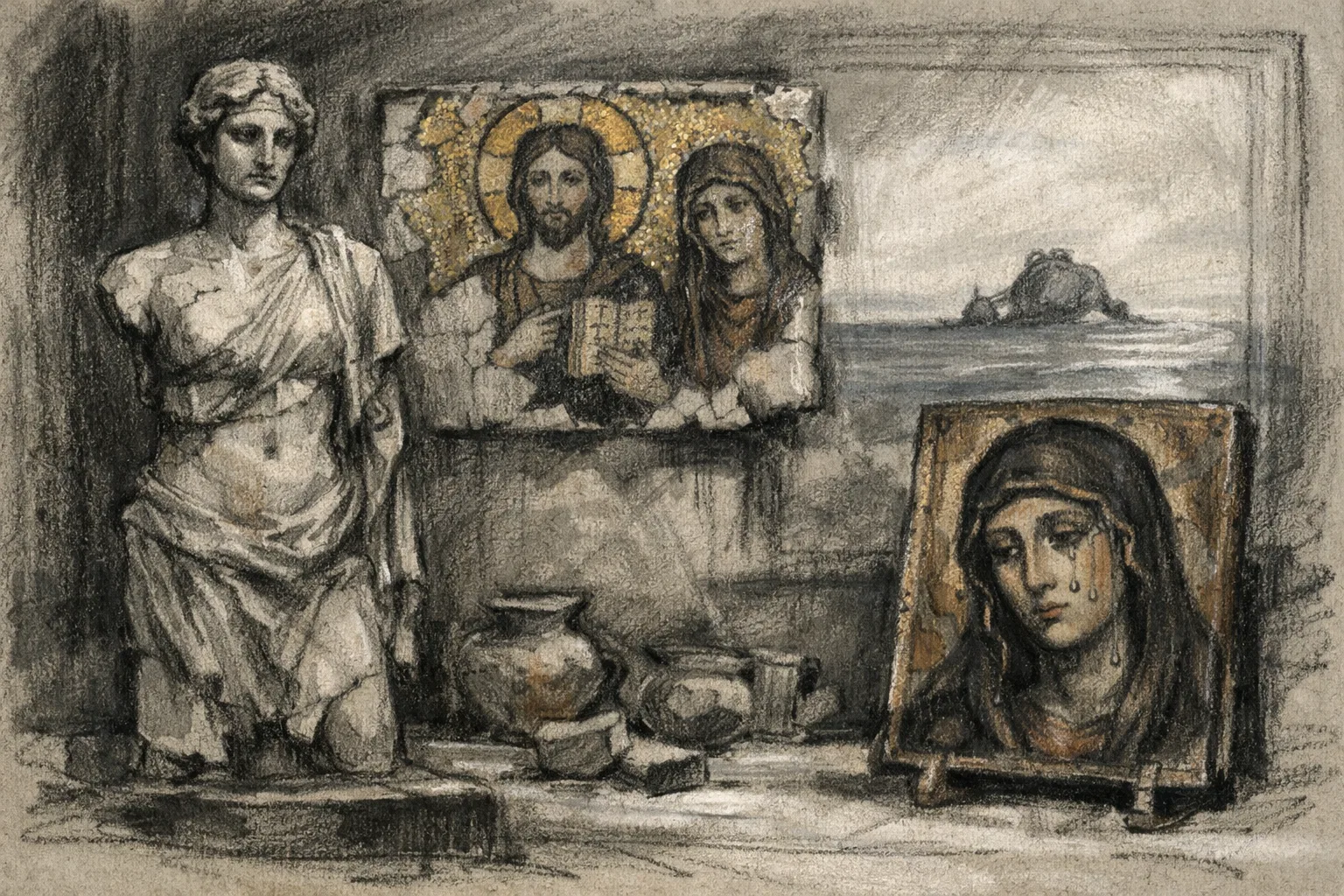
The strongest examples include nineteenth-century restorations that made ancient statues appear more complete than they really were, false ownership histories used to market looted Byzantine art, alleged weeping icons, tourist-friendly sea-monster stories and modern online impersonation scams. Together they show how deception prospers when an appealing narrative — ancient treasure, divine warning, mysterious creature or authoritative endorsement — reaches the public before careful verification does.
When restoration turned into deception
The most important Cypriot authenticity controversy began with Luigi Palma di Cesnola, an Italian-born former American army officer who served as United States consul in Cyprus from 1865 to 1876. During those years he amassed an enormous collection of Cypriot antiquities. The Metropolitan Museum of Art bought major portions of it in the 1870s, and Cesnola later became the museum’s first director. The collection was so large and influential that it helped define how generations of visitors understood ancient Cypriot art.[The Metropolitan Museum of Art]metmuseum.orgThe Metropolitan Museum of ArtAncient Art from Cyprus: The Cesnola Collection in The…The Cesnola Collection in The Metropolitan Museum…
The controversy was not chiefly that every object was a modern counterfeit. It concerned excavation records, claims about where objects had been found and, most famously, aggressive restoration. Broken statues could be assembled with unrelated fragments, while missing areas might be completed in ways that made an object look substantially more intact and coherent than the surviving ancient material justified. Nineteenth-century critics accused Cesnola of presenting such reconstructions misleadingly and of falsifying aspects of his archaeological results. Modern scholarship treats the accusations carefully rather than assuming that every charge was proved, but confirms that the scandal was real and that some heads in the collection do not belong to the bodies on which they were mounted.[victorianvoices.net]victorianvoices.netOpen source on victorianvoices.net.
Why was this persuasive? Early museums competed for spectacular displays, and a complete monumental figure made a stronger impression than a tray of unidentified fragments. Archaeological standards were also less developed: documentation was inconsistent, restoration was often more interventionist, and wealthy collectors prized visual impact. The museum label and the authority of a consul-explorer could make a questionable reconstruction appear settled.
The Cesnola affair is therefore best described as a crisis of presentation and provenance rather than a simple workshop-forgery case. Ancient fragments may be genuine while the “complete” object created from them tells a false story. That distinction remains important today: authenticity applies not only to materials, but also to an artefact’s assembly, find spot, ownership history and interpretation.

How looted mosaics acquired a respectable story
The trafficking of the Kanakaria mosaics demonstrates a different kind of deception. These rare sixth-century Christian mosaics came from the Church of Panagia Kanakaria in northern Cyprus. They survived for centuries, including periods when religious images elsewhere in the Byzantine world were destroyed, but were cut from the church after the island’s division in the 1970s and broken into saleable sections.[reuters.com]reuters.comCyprus museum showcases rare religious treasures recovered after lootingMany of these pieces, including mosaics, icons, and wall frescoes, were retrieved after being looted from northern churches following the…
In 1988, Indianapolis art dealer Peg Goldberg acquired four pieces through intermediaries. She later maintained that she had bought them in good faith. The mosaics were nevertheless accompanied by serious warning signs, including a hurried transaction, an uncertain chain of ownership and a story that they had come from an abandoned church. When efforts were made to place them with a major museum, their identity became known to the Church and Republic of Cyprus, which sued for their return. A United States federal court awarded the mosaics to the Cypriot plaintiffs, and the decision survived appeal.[unodc.org]unodc.orgOpen source on unodc.org.
The mosaics themselves were genuine. The deceptive element was the attempt to create a marketable history around stolen property. In the antiquities trade, this is sometimes called laundering provenance: gaps are filled with vague owners, unverifiable collections or stories designed to move an object’s appearance on the market back before modern export restrictions.
The case mattered because it challenged the idea that a buyer could remain deliberately incurious. A convincing object, an impressive price and a plausible-sounding seller were not enough. The court considered whether reasonable enquiries had been made into an artwork whose cultural importance and troubled history should have prompted greater caution.
Cyprus continues to recover objects dispersed after the events of 1974. In 2024, 60 antiquities were formally returned from Germany following a long-running case involving material found at properties used by an art dealer. Cypriot specialists now examine auctions and online listings for objects lacking evidence of lawful export. Such work is difficult because stolen originals, innocent private purchases, false paperwork and outright fakes can all pass through the same market.[Reuters]reuters.comLooted after a war, priceless antiquities brought back to CyprusLooted after a war, priceless antiquities brought back to Cyprus
Weeping icons: miracle, material effect or performance?
Reports of icons shedding tears occupy a more delicate category. They should not automatically be called frauds, because a strange physical effect may be sincerely interpreted as miraculous and because deception is not proved merely by the absence of a scientific explanation.
In February 1997, monks at Kykkos Monastery reported that liquid resembling tears had appeared on an icon depicting the Virgin Mary and Jesus. Thousands of people visited, while some believers interpreted the phenomenon as a warning of approaching calamity. Contemporary reporting recorded the strength of the religious response but did not establish that the icon had been deliberately manipulated.[Spokesman-Review]spokesman.comReview Weeping Icon Draws Thousands Tears Seen As Miracle,Review Weeping Icon Draws Thousands Tears Seen As Miracle,
Another reported crying icon attracted attention in Cyprus in 2000. Sceptics suggested that moisture was coming from the wooden support, although the apparent alignment of the marks with the figure’s eyes encouraged continued belief. The available reporting did not document a conclusive controlled examination.[archive.cyprus-mail.com]archive.cyprus-mail.comweeping skies keep the faithful away from crying iconweeping skies keep the faithful away from crying icon
Comparable cases elsewhere have been explained by condensation, capillary action, leaking oil, surface coatings or concealed mechanisms. Some have been deliberate tricks, while others appear to involve ordinary moisture interpreted through a religious framework. That wider history shows why an examination must control access to the object, analyse the liquid, inspect the backing and observe whether the phenomenon continues under monitored conditions. It does not, by itself, settle any particular Cypriot case.[centerforinquiry.org]centerforinquiry.orgsomething to cry about investigating a miraculous eye consomething to cry about investigating a miraculous eye con
The most accurate conclusion is therefore limited. Cyprus has experienced highly publicised weeping-icon claims, but the best-known reports are not securely documented as exposed hoaxes. They illustrate how belief, expectation and media attention can transform an unexplained mark into a national story before investigators establish its cause.

The friendly monster of Cape Greco
Stories of a sea creature off Ayia Napa and Cape Greco are often promoted as Cyprus’s answer to the Loch Ness Monster. Accounts describe something large moving through the water, occasionally interfering with fishing nets but generally behaving as a “friendly” monster. Tourist retellings have given the creature a stable identity despite the absence of dependable physical evidence.[Cryptid Wiki]cryptidz.fandom.comCryptid Wiki Ayia Napa sea monsterCryptid Wiki Ayia Napa sea monster
There is no well-documented exposure showing that one named person invented the monster as a deliberate hoax. Nor is there a verified photograph, specimen or consistent series of observations supporting an unknown large animal. The story is better classified as modern folklore fed by sightings, repetition and tourism.
The waters around Cape Greco offer many ordinary sources of confusion: dolphins, seals, large fish, floating debris, waves and partially submerged objects may all look unfamiliar when seen briefly or at a distance. Once a monster story is established, ambiguous experiences are more likely to be described through it. Tour boats, hotels and travel writing also benefit from a harmless local mystery that adds atmosphere without frightening visitors away.
This commercial dimension does not prove that witnesses are lying. It explains why the legend survives without decisive evidence. A pleasant monster is a useful tourism symbol: memorable enough to market, vague enough to resist disproof and safe enough to become part of a family excursion.
Ancient legend is not the same as historical fact
Cyprus’s association with Aphrodite presents another boundary problem. Ancient literary and religious traditions strongly connected the goddess with Cyprus, particularly Paphos. Modern tourism commonly identifies Petra tou Romiou as the exact place where she rose from the sea, sometimes adding promises that swimming around the rock will bring beauty, fertility or true love.
These are legends and tourist customs, not archaeological propositions that can be tested in the same manner as an allegedly ancient statue. The error occurs when a poetic tradition is converted into a precise historical event or when a recent visitor ritual is presented as an unchanged practice from antiquity.
Tourism promotion naturally favours memorable locations and simple stories. A diffuse body of ancient myth becomes easier to sell when attached to one dramatic rock, one photograph and one ritual. The result may be an invented or embellished tradition without a single identifiable inventor. Such stories are not necessarily malicious, but their repetition can obscure the difference between ancient worship, later folklore and modern marketing.
From false authority to deepfake scams
Cyprus’s contemporary deception problem increasingly resembles that of other connected European societies. Fraudulent advertisements imitate newspapers, public authorities or familiar figures to make investment schemes and malicious links appear trustworthy. Fact Check Cyprus has documented advertisements designed to resemble genuine media articles while promoting dubious financial platforms. A separate fraudulent social-media post falsely presented itself as an announcement from the Cyprus Police and directed users towards a malicious link.[factcheckcyprus.org]factcheckcyprus.orgOpen source on factcheckcyprus.org.
The mechanism is more important than any single advert. Scammers borrow authority in layers: a recognisable logo, a fabricated news page, a public figure’s face and a supposedly urgent opportunity. Artificially generated audio or video can add another layer, but many successful deceptions still rely on ordinary editing, copied branding and paid social-media promotion.
Research into misinformation in Cyprus identifies social media, political division and weaknesses in media literacy as important parts of the environment in which misleading material spreads. Cyprus’s divided information landscape adds a further difficulty: Greek-language, Turkish-language and international media communities may circulate different claims, while fact-checkers cannot always reach all audiences equally.[poynter.org]poynter.orgdivisions in cyprus amplify fact checking challengesdivisions in cyprus amplify fact checking challenges
A politically explosive video released in January 2026 demonstrated why the word “deepfake” must also be used cautiously. Cypriot officials characterised the video as a likely organised disinformation operation, arguing that selective editing and narration created unsupported implications of corruption. Fact Check Cyprus, however, reported no strong evidence that the footage itself had been generated or altered using artificial intelligence, while emphasising that its source and context remained uncertain. The dispute showed that authentic-looking footage can mislead through omission, sequencing and anonymous distribution even when it is not technically synthetic.[apnews.com]apnews.comThe video emerged just after Cyprus assumed the rotating EU presidency and hosted Ukrainian President Volodymyr Zelenskyy, reinforcing su…
This is the digital equivalent of attaching the wrong head to an ancient statue. The individual pieces may be real; the assembled story can still be deceptive.

What Cyprus’s cases have in common
Cyprus’s history of disputed truth is dominated by five recurring techniques:
- Manufactured completeness: fragments or partial evidence are assembled into a more satisfying story than the material supports.
- Borrowed authority: museums, churches, newspapers, police branding or political figures make a claim appear trustworthy.
- Missing provenance: inconvenient gaps in an object’s or image’s history are concealed behind vague but respectable-sounding explanations.
- Ambiguous evidence: moisture, distant animals, edited recordings or incomplete archaeological records allow several interpretations.
- Narrative advantage: dealers, institutions, tourist businesses, campaigners and online scammers all gain when the most dramatic interpretation spreads first.
The lesson is not that Cypriots were unusually susceptible to deception. The same forces operate wherever institutions want impressive exhibits, buyers want rare treasures, communities seek meaningful signs, resorts cultivate legends and social-media systems reward urgency. Cyprus makes these patterns unusually visible because ancient heritage, religious tradition, political division and international commerce overlap so closely.
The most reliable response is to ask what remains when the attractive story is removed. For an antiquity, that means documented excavation, lawful export and scientific examination. For a miracle claim, it means controlled observation and material analysis. For a monster sighting, it means reproducible evidence rather than accumulated anecdotes. For online content, it means tracing the original source, checking the full context and separating artificial generation from misleading editing.
In Cyprus, as elsewhere, the enduring deception is often not a wholly invented object or event. It is the confident story built around something real, incomplete and insufficiently checked.
Amazon book picks
Further Reading
Books and field guides related to When Cyprus Stories Became More Convincing Than Evidence. Use these as the next step if you want deeper reading beyond the article.
Frauds, Myths, and Mysteries: Science and Pseudoscience in Ar...
Addresses how archaeology and extraordinary claims can be misunderstood.
The Medici Conspiracy
Explains antiquities trafficking, provenance fraud and cultural-property disputes.
From the Holy Mountain
Explores Eastern Mediterranean religious heritage including Cyprus.
eBay marketplace picks
Marketplace Samples
Live-tested eBay searches with available results related to this page.

Endnotes
1.
Source: victorianvoices.net
Link:https://www.victorianvoices.net/ARTICLES/CENTURY/Century1882B/C1882B-Metropolitan.pdf
2.
Source: scribd.com
Link:https://www.scribd.com/document/672585427/The-Cesnola-Collection-of-Cypriot-Stone-Sculpture-1
Source snippet
The Cesnola Collection of Cypriot Stone Sculpture | PDFAs noted in the catalogue, there are galleries publication of an several sta...
3.
Source: reuters.com
Title: Cyprus museum showcases rare religious treasures recovered after looting
Link:https://www.reuters.com/lifestyle/cyprus-museum-showcases-rare-religious-treasures-recovered-after-looting-2025-03-20/
Source snippet
Many of these pieces, including mosaics, icons, and wall frescoes, were retrieved after being looted from northern churches following the...
4.
Source: plone.unige.ch
Link:https://plone.unige.ch/art-adr/cases-affaires/kanakaria-mosaics-2013-autocephalous-greek-orthodox-church-of-cyprus-and-cyprus-v-goldberg
Source snippet
in Lythrankomi, following the Turkish military intervention in Cyprus of 1974...
5.
Source: unodc.org
Link:https://www.unodc.org/cld/fr/case-law-doc/traffickingculturalpropertycrimetype/usa/1990/case_kanakaria_mosaics.html
6.
Source: dipublico.org
Link:https://www.dipublico.org/1949/autocephalous-greek-orthodox-church-of-cyprus-and-the-republic-of-cyprus-v-goldberg-and-feldman-fine-arts-inc/
7.
Source: unodc.org
Link:https://www.unodc.org/cld/uploads/res/case-law-doc/traffickingculturalpropertycrimetype/usa/1990/case_kanakaria_mosaics_html/Autocephalous_Church_v._Goldberg_Feldman_Arts_917_F.pdf
8.
Source: via.library.depaul.edu
Link:https://via.library.depaul.edu/cgi/viewcontent.cgi?article=1524&context=jatip&httpsredir=1&referer=
9.
Source: reuters.com
Title: Looted after a war, priceless antiquities brought back to Cyprus
Link:https://www.reuters.com/world/europe/looted-after-war-priceless-antiquities-brought-back-cyprus-2024-07-22/
10.
Source: spokesman.com
Title: Review Weeping Icon Draws Thousands Tears Seen As Miracle,
Link:https://www.spokesman.com/stories/1997/feb/10/weeping-icon-draws-thousands-tears-seen-as/
11.
Source: archive.cyprus-mail.com
Title: weeping skies keep the faithful away from crying icon
Link:https://archive.cyprus-mail.com/2000/12/31/weeping-skies-keep-the-faithful-away-from-crying-icon/
12.
Source: centerforinquiry.org
Title: something to cry about investigating a miraculous eye con
Link:https://centerforinquiry.org/blog/something-to-cry-about-investigating-a-miraculous-eye-con/
13.
Source: factcheckcyprus.org
Link:https://factcheckcyprus.org/
14.
Source: poynter.org
Title: divisions in cyprus amplify fact checking challenges
Link:https://www.poynter.org/fact-checking/2023/divisions-in-cyprus-amplify-fact-checking-challenges/
15.
Source: mdpi.com
Link:https://www.mdpi.com/2673-5172/5/4/99
16.
Source: cyprus-mail.com
Title: fact check cyprus leaked video not ai generated but source is dubious
Link:https://cyprus-mail.com/2026/01/09/fact-check-cyprus-leaked-video-not-ai-generated-but-source-is-dubious
17.
Source: plone.unige.ch
Link:https://plone.unige.ch/art-adr/cases-affaires/cypriot-icon-boy-george-and-the-greek-orthodox-church-in-cyprus
18.
Source: ia902808.us.archive.org
Title: bub gb La Un Oztbk P4C
Link:https://ia902808.us.archive.org/24/items/bub_gb_LaUnOztbkP4C/bub_gb_LaUnOztbkP4C.pdf
19.
Source: metmuseum.org
Link:https://www.metmuseum.org/met-publications/ancient-art-from-cyprus-the-cesnola-collection-in-the-metropolitan-museum-of-art
Source snippet
The Metropolitan Museum of ArtAncient Art from Cyprus: The Cesnola Collection in The...The Cesnola Collection in The Metropolitan Museum...
20.
Source: vtechworks.lib.vt.edu
Link:https://vtechworks.lib.vt.edu/items/7d447312-93dd-46d3-8baa-9714970f03c3
Source snippet
The two collections amounted to around twenty thousand objects, all finds Cesnola red...
21.
Source: cryptidz.fandom.com
Title: Cryptid Wiki Ayia Napa sea monster
Link:https://cryptidz.fandom.com/wiki/Ayia_Napa_sea_monster
22.
Source: knews.kathimerini.com.cy
Title: fake cyprus police post circulating online public urged to stay alert
Link:https://knews.kathimerini.com.cy/en/news/fake-cyprus-police-post-circulating-online-public-urged-to-stay-alert
23.
Source: apnews.com
Link:https://apnews.com/article/8de4f13769252b5a89a5b0fa5079e4a0
Source snippet
The video emerged just after Cyprus assumed the rotating EU presidency and hosted Ukrainian President Volodymyr Zelenskyy, reinforcing su...
24.
Source: knews.kathimerini.com.cy
Title: no clear signs of ai in leaked video but who made it and why is still unclear
Link:https://knews.kathimerini.com.cy/en/news/no-clear-signs-of-ai-in-leaked-video-but-who-made-it-and-why-is-still-unclear
25.
Source: resources.metmuseum.org
Title: The Department of Greek and Roman Art The Metropolitan Museum Journal v 3 1970
Link:https://resources.metmuseum.org/resources/metpublications/pdf/The_Department_of_Greek_and_Roman_Art_The_Metropolitan_Museum_Journal_v_3_1970.pdf
26.
Source: resources.metmuseum.org
Title: Roman Portraits Sculptures in Stone and Bronze
Link:https://resources.metmuseum.org/resources/metpublications/pdf/Roman_Portraits_Sculptures_in_Stone_and_Bronze.pdf
27.
Source: resources.metmuseum.org
Link:https://resources.metmuseum.org/resources/metpublications/pdf/The_Etruscan_Chariot_from_Monteleone_di_Spoleto_The_Metropolitan_Museum_Journal_v_46_2011.pdf
28.
Source: resources.metmuseum.org
Title: Pergamon and the Hellenistic Kingdoms of the Ancient World
Link:https://resources.metmuseum.org/resources/metpublications/pdf/Pergamon_and_the_Hellenistic_Kingdoms_of_the_Ancient_World.pdf
29.
Source: resources.metmuseum.org
Title: Metropolitan Museum Journal v 56 2021
Link:https://resources.metmuseum.org/resources/metpublications/pdf/Metropolitan_Museum_Journal_v_56_2021.pdf
30.
Source: erhantamur.com
Link:https://www.erhantamur.com/project/cesnola/
31.
Source: reutersinstitute.politics.ox.ac.uk
Title: dnr executive
Link:https://reutersinstitute.politics.ox.ac.uk/digital-news-report/2025/dnr-executive-summary
32.
Source: toolbox.google.com
Link:https://toolbox.google.com/factcheck
33.
Source: ancientcyprus.com
Title: The Metropolitan Museum
Link:https://www.ancientcyprus.com/collections/met-museum/about
Additional References
34.
Source: youtube.com
Link:https://www.youtube.com/watch?v=z89Uxm44hGg
Source snippet
Looted Cyprus antiquities mosaics Rare 4th Century Mosaic Floor Unearthed in Cyprus Offbeat Stories...
35.
Source: youtube.com
Title: Rare 6th century mosaic to join other repatriated pieces in Cyprus
Link:https://www.youtube.com/watch?v=yXzHftvdiZU
Source snippet
Autocephalous Greek-Orthodox Church of Cyprus v. Goldberg and Feldman Fine Arts, Inc. Case Summary...
36.
Source: youtube.com
Title: the arrest and trial of Alessandro Palma di Cesnola for illicit excavation
Link:https://www.youtube.com/watch?v=IVJWdsh2JDs
Source snippet
From Plunder to Partnership: American Adventures in the Archaeology of Cyprus...
37.
Source: youtube.com
Title: From Plunder to Partnership: American Adventures in the Archaeology of Cyprus
Link:https://www.youtube.com/watch?v=qOvm3OoLOYc
Source snippet
MUNICH CASE - Looted Art From Cypriot Churches Is Returned by Germany...
38.
Source: youtube.com
Title: MUNICH CASE
Link:https://www.youtube.com/watch?v=QNUXFZ5Ysnc
Source snippet
Rare 6th century mosaic to join other repatriated pieces in Cyprus...
39.
Source: oecd.org
Link:https://www.oecd.org/en/topics/sub-issues/disinformation-and-misinformation.html
40.
Source: bmcr.brynmawr.edu
Title: He was
Link:https://bmcr.brynmawr.edu/2016/2016.02.15/
Source snippet
Bryn Mawr Classical ReviewThe Cesnola Collection of Cypriot Art: Stone Sculpture15 Feb 2016 — This treatment provides the reader with cle...
41.
Source: facebook.com
Link:https://www.facebook.com/groups/cyprus.info/posts/10164251146394668/
42.
Source: academia.edu
Link:https://www.academia.edu/43758501/Ancient_clay_treasures_are_fake_say_museum
43.
Source: academia.edu
Link:https://www.academia.edu/59639622/Archaeological_fakes_and_forgeries_Falsifica%C3%A7%C3%B5es_arqueol%C3%B3gicas_na_Turquia
Topic Tree
Follow this branch
Related pages 192
- Albanian Hoaxes
- Algerian Hoaxes
- Antigua Deceptions
- Argentina Hoaxes
- Armenian Hoaxes
- +187 more in sidebar