Within Slovak Hoaxes
How Did Bathory Become the Blood Countess?
Bathory faced real accusations of cruelty, but the famous tale that she bathed in blood emerged long after her death.
On this page
- What the original accusations actually alleged
- When the blood bathing story appeared
- How folklore transformed a criminal case
Page outline Jump by section
Introduction
Elizabeth Báthory is one of the most famous historical figures associated with present-day Slovakia, where her residence at Čachtice Castle still dominates local legend. She is widely remembered as the “Blood Countess”, a noblewoman who supposedly murdered young women and bathed in their blood to preserve her youth. Yet the most famous part of that story—the blood-bathing itself—does not appear in the original accusations made against her. Modern historians generally distinguish between two separate questions: whether Báthory was involved in serious acts of cruelty, and how a later, far more sensational legend transformed her into a near-vampiric monster. The Blood Countess story is therefore a revealing example of how a real criminal case, political controversy and folklore can merge into a durable national legend.[Wikipedia]WikipediaElizabeth BáthoryElizabeth Báthory
What the Original Accusations Actually Alleged
Elizabeth Báthory (1560–1614) was a Hungarian aristocrat whose estates lay in what is now western Slovakia. In 1610, investigations ordered by the authorities gathered testimony alleging that girls and young women employed in her households had been beaten, tortured and, in some cases, killed. Several servants were tried and executed, while Báthory herself was confined in her castle until her death four years later.[Wikipedia]WikipediaElizabeth BáthoryElizabeth Báthory
The surviving records are grim enough without later embellishments. Witnesses described physical abuse, injuries and deaths among servants. Historians continue to debate the reliability of some testimony because much of it was collected through legal procedures that differed greatly from modern standards, and some statements were second-hand rather than eyewitness accounts. Nonetheless, the original investigation focused on cruelty, torture and murder allegations—not on supernatural practices or blood rituals.[Wikipedia]WikipediaElizabeth BáthoryElizabeth Báthory
This distinction matters because popular culture often treats the blood-bathing tale as the central accusation. In reality, the contemporary records associated with the case do not contain the famous image of Báthory immersing herself in virgins’ blood to remain young.[Wikipedia]WikipediaElizabeth BáthoryElizabeth Báthory
When the Blood-Bathing Story Appeared
The legend most people know today emerged long after Báthory’s death. Historians have traced the first printed version of the blood-bathing story to 1729, more than a century after the events themselves, in a work by the Jesuit scholar László Turóczi. By that point, the historical case had already entered folklore and had become vulnerable to dramatic embellishment.[Wikipedia]WikipediaElizabeth BáthoryElizabeth Báthory
An important clue came when witness materials connected with the original investigation were later published. Those documents contained no reference to blood baths or a quest for eternal youth. The absence of such a striking allegation from the contemporary evidence has led most modern historians to treat the blood-bathing story as a later invention rather than an authentic part of the case.[Wikipedia]WikipediaElizabeth BáthoryElizabeth Báthory
The transformation followed a familiar pattern in the history of legends. A story that begins with documented wrongdoing gradually acquires more dramatic elements. Cruelty becomes sadism, sadism becomes obsession, and obsession becomes a supernatural quest for youth. By the eighteenth and nineteenth centuries, writers were repeating the tale as if it were established fact, helping to fix the image of the Blood Countess in the public imagination.[Wikipedia]WikipediaElizabeth BáthoryElizabeth Báthory
Why People Believed the Legend
The blood-bathing story succeeded because it fit several powerful cultural themes at once.
First, it provided a memorable explanation for alleged crimes that were already shocking. Ordinary brutality was horrifying, but the idea of using blood as a beauty treatment was uniquely grotesque and unforgettable.
Second, the legend emerged in a European cultural environment fascinated by witchcraft, aristocratic excess and stories of moral corruption among the powerful. Báthory’s status as a wealthy noblewoman made her an ideal subject for tales that combined privilege, cruelty and decadence.[AP News]apnews.comHowever, centuries later, her true story remains controversial and debated. Following a royal inquiry into the allegations, Báthory's ser…
Third, the story anticipated later vampire traditions. Although there is no evidence that Bram Stoker directly based Dracula on Báthory, the association between blood, nobility and immortality made the connection irresistible to later writers and filmmakers. Over time, Báthory was recast less as a historical figure and more as a gothic villain.[Wikipedia]WikipediaElizabeth BáthoryElizabeth Báthory
How Folklore Transformed a Criminal Case
The evolution of the Báthory story illustrates how folklore often reshapes real events. Historical records rarely survive in popular memory in their original form. Instead, stories are simplified, dramatised and adapted to changing cultural tastes.
In Báthory’s case, several layers accumulated over the centuries:
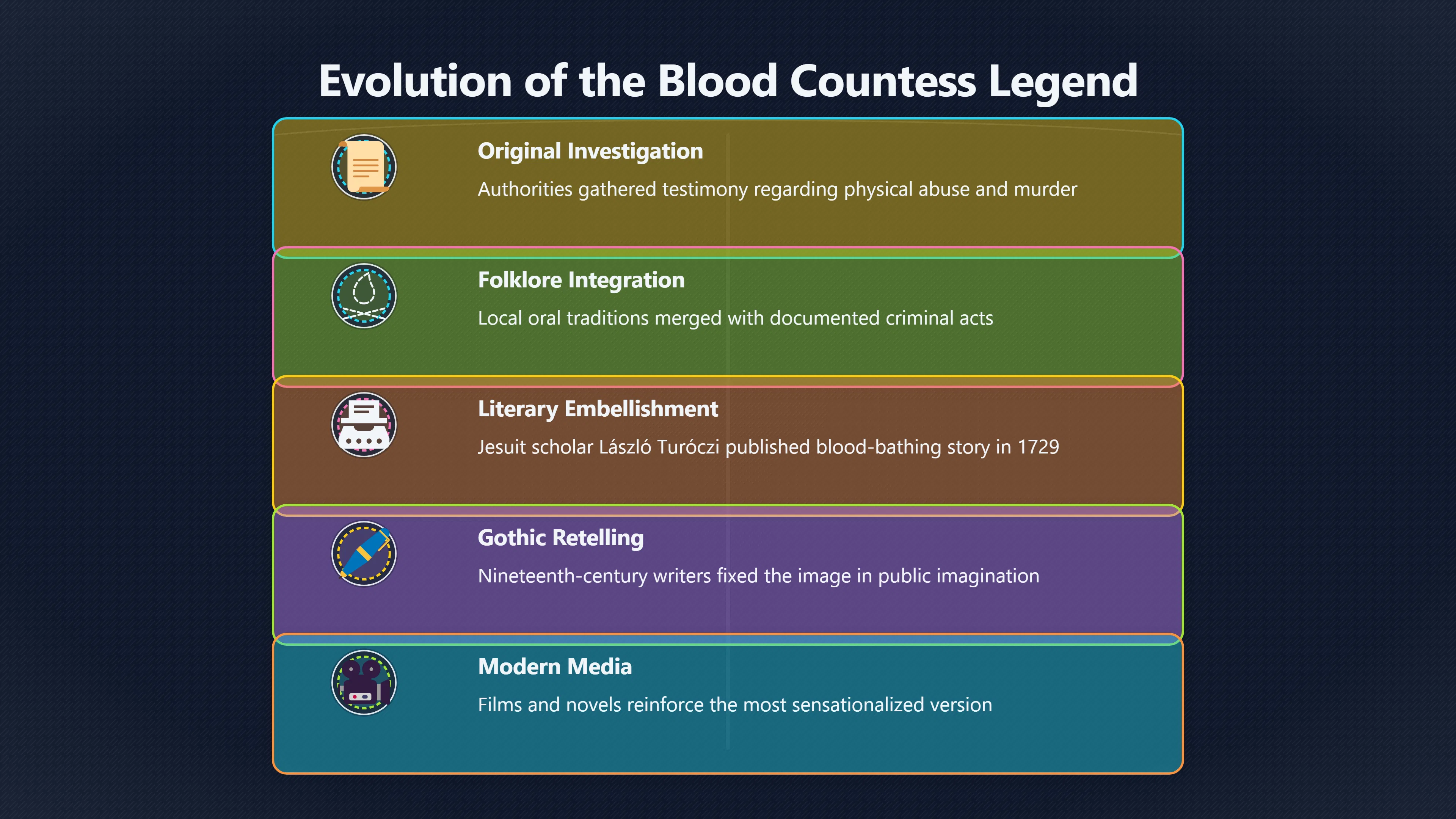
- A documented investigation into alleged abuse and murder.
- Rumours and local oral traditions surrounding a notorious noblewoman.
- Eighteenth-century literary embellishments introducing blood-bathing.
- Nineteenth-century gothic retellings.
- Twentieth- and twenty-first-century films, novels and popular histories that reinforced the most sensational version of the tale.[Wikipedia]WikipediaElizabeth BáthoryElizabeth Báthory
The result is that many people today know the legend but not its history. The image of a countess bathing in blood has become more famous than the evidence from the original case.
Was Báthory Guilty, Framed, or Something in Between?
Debate continues over the broader question of Báthory’s guilt. Some historians argue that the volume of testimony and reports of injured victims make it difficult to dismiss the accusations entirely. Others suggest that political and financial motives may have influenced the proceedings against a wealthy widow who controlled extensive lands and resources.[wikipedia.org]WikipediaElizabeth BáthoryElizabeth Báthory
What is notable is that this debate concerns the murder accusations themselves, not the blood-bathing legend. Even scholars who disagree about the extent of Báthory’s crimes generally regard the famous blood ritual as a later addition unsupported by contemporary evidence.[Wikipedia]WikipediaElizabeth BáthoryElizabeth Báthory
For readers interested in Slovakia’s history of famous deceptions, contested stories and legendary embellishments, the Báthory case occupies a distinctive place. It is not a straightforward hoax in the sense of a forged object or fabricated photograph. Instead, it demonstrates how a real historical scandal can be transformed by folklore until the invented elements become more famous than the original events.
Why the Blood Countess Still Endures
More than four centuries after Báthory’s death, the ruins of Čachtice Castle remain closely associated with her legend, attracting visitors interested in one of Central Europe’s most notorious historical mysteries. The story persists because it combines several elements that folklore rarely abandons: aristocratic power, violence, beauty, blood, mystery and uncertainty.[AP News]apnews.comHowever, centuries later, her true story remains controversial and debated. Following a royal inquiry into the allegations, Báthory's ser…
Yet the most important historical lesson is not whether every accusation against Báthory was true or false. It is that the defining image of the “Blood Countess” was not part of the original case. The tale that she bathed in virgins’ blood emerged more than a century later, showing how easily a genuine controversy can evolve into a legend far more dramatic than the evidence allows.[Wikipedia]WikipediaElizabeth BáthoryElizabeth Báthory
Amazon book picks
Further Reading
No matched book cards were available for How Did Bathory Become the Blood Countess?, so this fallback keeps a direct Amazon reading path visible.
Topical books
Blood Bath Myth guide
Browse books, explainers and reference titles related to this topic.
Search AmazonRelated search
Elizabeth Báthory folklore guide
Browse books, explainers and reference titles related to this topic.
Search AmazonRelated search
Čachtice Castle history
Browse books, explainers and reference titles related to this topic.
Search AmazonEndnotes
1.
Source: Wikipedia
Title: Elizabeth Báthory
Link:https://en.wikipedia.org/wiki/Elizabeth_B%C3%A1thory
2.
Source: Wikipedia
Title: Elizabeth I
Link:https://en.wikipedia.org/wiki/Elizabeth_I
Source snippet
Elizabeth IQueen of England and Ireland from 17 November 1558 until her death in 1603. She was the last and longest reigning monarch o...
Published: November 1558
3.
Source: Wikipedia
Title: Elizabeth II
Link:https://en.wikipedia.org/wiki/Elizabeth_II
Source snippet
Elizabeth IIElizabeth II (Elizabeth Alexandra Mary; 21 April 1926 – 8 September 2022) was Queen of the United Kingdom and other Common...
Published: April 1926
4.
Source: Wikipedia
Link:https://en.wikipedia.org/wiki/%C4%8Cachtice_Castle
Source snippet
Čachtice CastleThe castle was a residence and later the prison of the Countess and alleged serial killer Elizabeth Báthory. Čachtice C...
5.
Source: Wikipedia
Title: Elizabeth (film)
Link:https://en.wikipedia.org/wiki/Elizabeth_%28film%29
6.
Source: history.com
Link:https://www.history.com/this-day-in-history/december-29/bathorys-torturous-escapades-are-exposed
7.
Source: apnews.com
Link:https://apnews.com/article/e732847066ffe69f91812b57df61bf43
Source snippet
However, centuries later, her true story remains controversial and debated. Following a royal inquiry into the allegations, Báthory's ser...
8.
Source: ebsco.com
Link:https://www.ebsco.com/research-starters/history/elizabeth-bathory
Additional References
9.
Source: reddit.com
Link:https://www.reddit.com/r/AskHistorians/comments/12yio7f/was_elizabeth_bathory_a_serial_killer_or_her/
Source snippet
Was Elizabeth Bathory a serial killer or her trial was a plot...The short answer is: Yes, Elizabeth Bathory was probably a serial...
10.
Source: historiamag.com
Title: Vampire or victim? The real Countess Báthory
Link:https://historiamag.com/vampire-or-victim-the-real-countess-bathory/
Source snippet
May 2, 2024 — Countess Báthory was a 17th-century Hungarian noblewoman who lived in Čachtice Castle, situated in what is now western Slov...
Published: May 2, 2024
11.
Source: nationalgeographic.com
Title: Instead, it assured she lived long in infamy.Read more
Link:https://www.nationalgeographic.com/history/article/the-bloody-legend-of-hungarys-serial-killer-countess
Source snippet
National GeographicThe bloody legend of Hungary's serial killer countess21 Oct 2022 — According to legend, she believed bathing in their...
12.
Source: youtube.com
Title: Elizabeth Bathory – The ‘Blood Countess’
Link:https://www.youtube.com/watch?v=3N3TSPZoY1o
Source snippet
THE BLOOD COUNTESS Elizabeth Báthory: What'sHerName Podcast 2023 Halloween Special - Episode 124...
13.
Source: youtube.com
Link:https://www.youtube.com/watch?v=HeE3EeZgtJE
Source snippet
The Trial of Elizabeth Bathory...
14.
Source: facebook.com
Link:https://www.facebook.com/MORKOFFICIAL/posts/bathorywe-visited-the-ruins-of-%C4%8Dachtice-castle-in-slovakia-once-the-home-and-lat/1314170146743302/
15.
Source: medium.com
Link:https://medium.com/never-stop-writing/countess-elizabeth-bathory-real-life-vampire-or-scapegoat-of-history-dd70322adb03
16.
Source: instagram.com
Link:https://www.instagram.com/p/DTdAELijoeY/
17.
Source: hrp.org.uk
Link:https://www.hrp.org.uk/hampton-court-palace/history-and-stories/elizabeth-i/
18.
Source: reddit.com
Link:https://www.reddit.com/r/AskHistorians/comments/168m2zo/how_credible_is_the_story_of_elizabeth_b%C3%A1thory_of/
Amazon book picks
Further Reading
Books and field guides related to How Did Bathory Become the Blood Countess?. Use these as the next step if you want deeper reading beyond the article.
The Private Letters of Countess Erzsébet Báthory
Focuses on the historical figure behind the Blood Countess legend.
The Demon-Haunted World
Rating: 4.5/5 from 43 Google Books ratings
Helps explain how sensational legends persist despite weak evidence.
Dracula
Readers interested in blood legends and Central European folklore often cross-shop it.
Topic Tree