Who Controlled the Truth About Grenada?
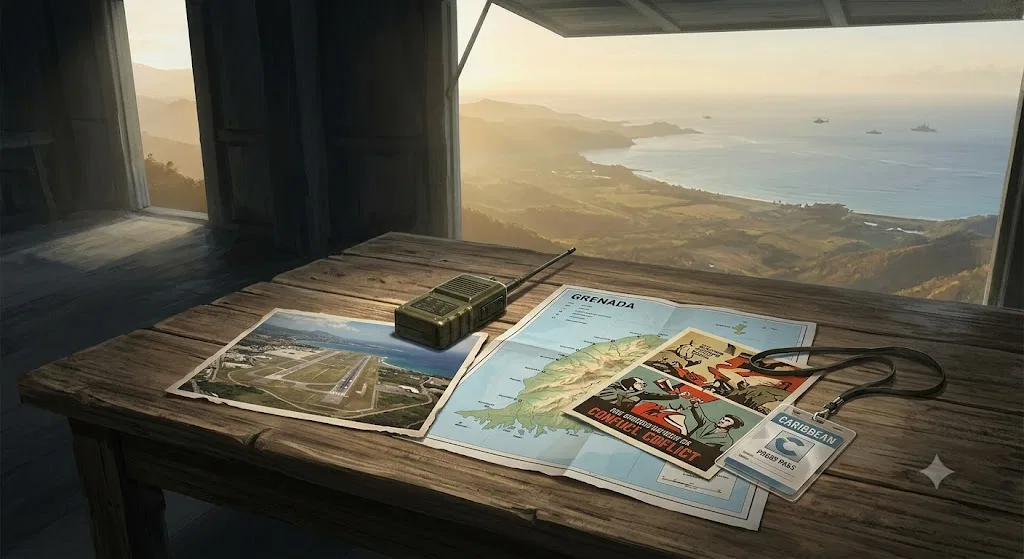
Grenada’s best-documented history of contested truth is not a catalogue of playful newspaper hoaxes or forged monsters. It is more politically charged: Cold War propaganda surrounding the 1983 United States-led invasion, followed by the remarkable attempt of Prime Minister Eric Gairy to place unidentified flying objects on the United Nations agenda.
Page outline Jump by section
Introduction
Neither episode fits the simplest definition of a hoax. The invasion story mixed genuine danger, selective evidence, exaggeration and claims that remain disputed. Gairy’s UFO campaign appears to have reflected sincere belief rather than a deliberate fraud. Yet both show how extraordinary assertions gain authority. Political leaders used official speeches, photographs, diplomatic forums, restricted news access and emotionally powerful stories to make uncertain claims appear settled. In Grenada, the most revealing question is therefore not merely “Was this fake?” but “Who controlled the evidence, what alternatives were suppressed, and how did a disputed account become the version remembered abroad?”
The invasion story that travelled around the world
On 25 October 1983, United States forces, accompanied by troops from several Caribbean states, invaded Grenada after an internal power struggle had ended with the detention and execution of Prime Minister Maurice Bishop and several supporters. The new Revolutionary Military Council imposed a severe curfew, and the island was in a genuine political and security crisis. These facts provided the foundation for a much larger public narrative: that American medical students faced imminent danger, that Grenada had become a Soviet-Cuban military colony, and that a new airport was intended to serve communist military expansion.[reaganlibrary.gov]reaganlibrary.govOctober 27, 1983. My fellow Americans: Some 2 months ago we were shocked by the brutal…Read more…
The strongest misleading accounts were effective because they were not invented from nothing. Bishop and seven others had indeed been killed. Cuban personnel were present, some were armed, and Grenada had received military equipment and assistance from communist governments. The uncertainty concerns what those facts proved. Evidence of political violence and foreign involvement was repeatedly presented as proof of a much broader plan for Cuban occupation, regional terrorism and the likely seizure of American hostages.[Ronald Reagan Presidential Library]reaganlibrary.govOctober 27, 1983. My fellow Americans: Some 2 months ago we were shocked by the brutal…Read more…
Were the American students really hostages?
President Ronald Reagan described the military operation as necessary to protect hundreds of Americans, most of them students at St George’s University School of Medicine. The recent Iranian hostage crisis gave this argument exceptional emotional force: the possibility that Americans might again be trapped by a hostile revolutionary government was politically potent even before firm evidence of a hostage plan had emerged. Official military history likewise records concern for the students as a central reason for the hurried operation.[Ronald Reagan Presidential Library]reaganlibrary.govOctober 27, 1983. My fellow Americans: Some 2 months ago we were shocked by the brutal…Read more…
Contemporary reports, however, revealed a less clear-cut situation. Some students contacted before or during the landing said that they had been safe and did not believe their lives were in immediate peril. Others experienced gunfire nearby, feared that conditions might deteriorate and later expressed gratitude to the soldiers who evacuated them. These accounts are not necessarily contradictory: people on different campuses could reasonably have judged the risk differently, while opinions also changed once fighting began. What the evidence does not establish is that the students had already become hostages or that a concrete plan existed to seize them.[The Washington Post]washingtonpost.comThe Washington Post Americans in Grenada, Calling Home, Say They Were SafeThe Washington PostAmericans in Grenada, Calling Home, Say They Were Safe…October 26, 1983 — 25 Oct 1983 — All 650 medical students, w…
The word “rescue” therefore did important political work. It transformed a contested military intervention into a familiar moral story with obvious villains, innocent captives and decisive liberators. The uncertainty of the students’ original situation was largely lost as successful evacuation became retrospective proof that rescue had been necessary.
The airport that became a symbol
Point Salines airport was the most visually persuasive element of the pre-invasion case. In March 1983, Reagan displayed aerial photographs and warned that its long runway could support Soviet and Cuban military operations. Because large military transport aircraft could use such a runway, the construction was presented as evidence that Grenada was becoming a strategic base rather than merely improving its tourist infrastructure.[The New Yorker]newyorker.coma political journal 6invaded Grenada. President Reagan justified the invasion by stating its primary purpose was to rescue approximately 650 American students…
The difficulty was that a runway’s possible military use did not prove its intended purpose. Grenada’s existing Pearls airport could not easily accommodate large passenger jets, restricting direct tourism. The Point Salines project had international commercial involvement, including British-backed work, while the airport itself had been discussed before the revolutionary government came to power. British parliamentary debate soon highlighted the awkward fact that British commercial and government-linked interests had participated in a project being depicted in Washington as a communist military installation.[Parliament API]api.parliament.ukOpen source on parliament.uk.
There were nevertheless legitimate reasons for suspicion. Cuba supplied substantial labour, Soviet-bloc states supported Grenada militarily, and captured material suggested that Grenadian officials understood the airport’s strategic usefulness as well as its civilian value. The fairest conclusion is not that every military concern was fabricated, but that capability, intention and worst-case prediction were blurred together. A dual-use airport became, in public rhetoric, proof of a planned military bastion.[Ronald Reagan Presidential Library]reaganlibrary.govRonald Reagan Presidential LibraryFiles Folder…
How propaganda hardened disputed claims
The invasion created unusually favourable conditions for official storytelling. American reporters were initially kept away from Grenada, while journalists who reached the island independently faced detention and restrictions on filing reports. For roughly the first two and a half days, much of the information available to international audiences came from governments, radio amateurs and Cuban broadcasting rather than independent observation at the scene. The official justification was operational safety, but the result was an information vacuum in which military briefings enjoyed exceptional power.[The New Yorker]newyorker.comThe New Yorker CommentThe New Yorker Comment
This mattered because several dramatic claims appeared before they could be checked. Among the most notorious was an early report of a mass grave supposedly containing around 100 victims of Grenadian communist forces. The story circulated as evidence of large-scale revolutionary terror but was not substantiated. A real and still painful mystery lay behind the confusion—the missing remains of Maurice Bishop and those killed with him—but that was very different from proof of a newly discovered grave containing scores of political victims.[wikipedia.org]WikipediaUnited States invasion of GrenadaUnited States invasion of Grenada
Casualty figures also shifted considerably. Initial military estimates for Grenadian and Cuban deaths exceeded figures later assembled in the official United States joint-service history. In wartime, early numbers are frequently wrong without being deliberately falsified, but the discrepancies demonstrate why immediate official statements should not automatically be treated as verified facts.[Wikipedia]WikipediaUnited States invasion of GrenadaUnited States invasion of Grenada
The absence of journalists did not make every American claim false, just as Cuban or Grenadian revolutionary sources were not neutral alternatives. It meant that audiences could not readily distinguish battlefield confusion from political exaggeration. By the time fuller reporting became possible, the most memorable phrases—“rescue mission”, “Soviet-Cuban colony” and “military bastion”—had already framed the event.
The comic book with a hidden sponsor
One of the clearest artefacts of the campaign is Grenada: Rescued from Rape and Slavery, a brightly illustrated anti-communist comic associated with the Central Intelligence Agency. It purported to come from an organisation called Victims of International Communist Emissaries, or “V.O.I.C.E.”, rather than openly identifying the American state as its sponsor. Copies are preserved in archival collections as examples of covert propaganda aimed at Grenadian readers.[mediacommons.unl.edu]mediacommons.unl.eduUNL~113~113~632~1519045:Grenada rescued from rape and slavUNL~113~113~632~1519045:Grenada rescued from rape and slav
The comic’s importance lies less in whether every incident it portrayed was false than in its method. It reduced Grenada’s complicated revolutionary period—economic ambitions, popular mobilisation, authoritarian rule, factional conflict and murder—to a simple progression towards foreign enslavement. The anonymous or disguised sponsorship encouraged readers to receive a strategic American message as though it came from an independent victims’ organisation.
This is closer to a conventional deception than the broader political arguments about the invasion. The source of the message was concealed, the emotional language was extreme, and the political conclusion was built into the format. Comics offered an especially effective vehicle because images could turn abstractions such as “communist penetration” into vivid scenes of threat, cruelty and liberation.
The production also shows how propaganda can outlive the campaign that created it. The comic is now circulated online as an exotic Cold War curiosity, often detached from the Grenadian deaths, political divisions and unresolved questions that gave it meaning. A document made to persuade becomes a collectible, then a meme, while its hidden sponsorship becomes part of the entertainment.
Eric Gairy’s bid for a United Nations UFO investigation
Grenada’s other great episode of extraordinary claims began before the revolution. During the 1970s, Prime Minister Eric Gairy repeatedly urged the United Nations to organise international research into unidentified flying objects and related phenomena. Grenada submitted formal proposals, circulated Gairy’s speeches and helped secure discussion in the UN Special Political Committee. One version sought an international research body, a world UFO congress in Grenada and the designation of 1978 as an international year devoted to the subject.[United Nations Digital Library System]digitallibrary.un.orgOpen source on un.org.
This was not an internet legend invented long afterwards. UN records, official photographs and United States diplomatic documents confirm that the campaign occurred. Gairy raised the subject directly in a meeting with President Jimmy Carter and Secretary of State Cyrus Vance, referring to reported sightings in Grenada and asking for support for an international study. Carter’s response was courteous but non-committal; he asked that an existing United States Air Force report be made available if it had been declassified.[UN Media]media.un.orgOpen source on un.org.
The episode is often retold as though Grenada persuaded the UN to create a UFO agency or declare a “Year of the UFO”. It did neither. Proposals were debated and modified, but the ambitious institution Gairy advocated was not established. This distinction matters because online retellings frequently turn “the UN considered a Grenadian proposal” into “the UN officially recognised extraterrestrial visitation”. The documentary record supports the first statement, not the second.[United Nations Digital Library System]digitallibrary.un.orgited Nations Digital Library System GENERAL ASSEMBLYited Nations Digital Library System GENERAL ASSEMBLY
Nor is there good evidence that Gairy’s campaign was a calculated hoax. His interest appears to have been genuine and formed part of a wider fascination with psychic, spiritual and cosmic subjects. Contemporary opponents and foreign journalists often portrayed this interest mockingly, sometimes combining it with lurid stories about magic or superstition. Such coverage could itself function as political caricature, making it difficult to separate legitimate criticism of Gairy’s authoritarian government from ridicule of his beliefs.[Office of the Historian]history.state.govOffice of the Historian Historical DocumentsOffice of the Historian Historical Documents
Modern government use of the term “unidentified anomalous phenomena” has occasionally been presented as Gairy’s vindication. It vindicates only the limited proposition that unexplained observations can merit investigation. “Unidentified” means that available evidence has not produced a confident identification; it does not by itself establish alien spacecraft, supernatural forces or any preferred extraordinary explanation.
Why these stories remain persuasive
Grenada’s contested stories endured because each contained a memorable image that simplified a difficult political reality: endangered students, a runway long enough for Soviet aircraft, an alleged mass grave, a secretive communist takeover, or a small Caribbean nation demanding that the world investigate visitors from the sky.
Several recurring mechanisms made the claims powerful:
- Real events supported larger inferences. Political executions, armed Cubans and unidentified aerial reports all existed. The disputed step was what those facts were said to prove.
- Authority substituted for verification. Presidential broadcasts, military briefings and UN proceedings gave claims importance before their evidential status was clear.
- Restricted access favoured the first account. During the invasion, independent journalists could not immediately test official assertions on the ground.
- Emotional narratives travelled better than qualifications. “Students rescued from communists” was easier to remember than a debate about fluctuating risk, legal authority and regional security.
- Later retellings removed uncertainty. Claims originally phrased as possibilities or suspicions hardened into statements that an airport was a Soviet base or that the UN had endorsed alien visitation.
The lesson is not that Grenada was unusually susceptible to deception. The most influential narratives were largely produced or amplified by powerful institutions outside the island, while Grenadians themselves held sharply differing memories of revolution, intervention and liberation. Even the national meaning of 25 October remains politically charged: for some it marks release from violent revolutionary rule; for others it recalls an unlawful invasion accompanied by propaganda.
What can responsibly be called a hoax?
The Grenadian record rewards careful labels. The hidden sponsorship of an anti-communist comic is a documented act of propaganda and source deception. The unsupported mass-grave report was false, although its precise origin and whether it resulted from fabrication, rumour or battlefield confusion require caution. The claim that Point Salines was simply a predetermined Soviet-Cuban military base overstated disputed evidence, but genuine security concerns prevent it from being dismissed as a wholly invented fantasy.
The danger to the medical students was possible and sincerely feared by some, yet claims of an established hostage crisis ran ahead of what had been demonstrated publicly. Gairy’s UFO initiative, meanwhile, belongs to the history of extraordinary belief and institutional pseudoscience rather than proven fraud.
These distinctions make the history more interesting, not less. Grenada shows that influential falsehoods rarely arrive as pure inventions. They are more often constructed from selected truths, ambiguous evidence, concealed sponsorship and stories designed to make one interpretation feel inevitable. The decisive exposure may therefore be not a single confession or laboratory test, but the slow reopening of archives, comparison of contemporary testimony and recovery of facts that the first dramatic version left out.
Amazon book picks
Further Reading
Books and field guides related to Who Controlled the Truth About Grenada?. Use these as the next step if you want deeper reading beyond the article.
Legacy of Ashes
Explores covert influence, information control and US foreign-policy operations.
The Cold War
Places the Grenada invasion and competing truth claims in wider Cold War strategy.
The Shock Doctrine
Provides context on intervention, power and contested public narratives.
eBay marketplace picks
Marketplace Samples
Live-tested eBay searches with available results related to this page.
Endnotes
1.
Source: Wikipedia
Title: United States invasion of Grenada
Link:https://en.wikipedia.org/wiki/United_States_invasion_of_Grenada
2.
Source: api.parliament.uk
Link:https://api.parliament.uk/historic-hansard/lords/1983/nov/01/grenada
3.
Source: hmcwordpress.humanities.mcmaster.ca
Title: Grenada TRC 2001 Vol 1
Link:https://hmcwordpress.humanities.mcmaster.ca/Truthcommissions/wp-content/uploads/2019/05/Grenada-TRC-2001-Vol-1.pdf
4.
Source: mediacommons.unl.edu
Title: UNL~113~113~632~1519045:Grenada rescued from rape and slav
Link:https://mediacommons.unl.edu/luna/servlet/detail/UNL~113~113~632~1519045%3AGrenada–rescued-from-rape-and-slav
5.
Source: history.state.gov
Title: Office of the Historian Historical Documents
Link:https://history.state.gov/historicaldocuments/frus1977-80v23/d304
6.
Source: hansard.parliament.uk
Title: Hansard Unidentified Flying Objects
Link:https://hansard.parliament.uk/lords/1979-01-18/debates/31155733-007e-46ad-b513-80f1c726a4a3/UnidentifiedFlyingObjects
7.
Source: time.com
Title: grenada the fall of a warlock
Link:https://time.com/archive/6850486/grenada-the-fall-of-a-warlock/
8.
Source: api.parliament.uk
Title: grenada invasion
Link:https://api.parliament.uk/historic-hansard/commons/1983/oct/26/grenada-invasion
9.
Source: reaganlibrary.gov
Link:https://www.reaganlibrary.gov/archives/speech/address-nation-events-lebanon-and-grenada
Source snippet
October 27, 1983. My fellow Americans: Some 2 months ago we were shocked by the brutal...Read more...
Published: October 27, 1983
10.
Source: jcs.mil
Link:https://www.jcs.mil/portals/36/documents/history/monographs/urgent_fury.pdf
Source snippet
Joint Chiefs of StaffOperation Urgent Fury: The planning and execution of...by RH Cole · 1983 · Cited by 139 — Anxious to avoid a simila...
11.
Source: reaganlibrary.gov
Link:https://www.reaganlibrary.gov/public/digitallibrary/smof/legislativeaffairs/addington/box-016/40-004-7452054-016-004-2017.pdf
Source snippet
Ronald Reagan Presidential LibraryFiles Folder...
12.
Source: newyorker.com
Title: a political journal 6
Link:https://www.newyorker.com/magazine/1983/11/07/a-political-journal-6
Source snippet
invaded Grenada. President Reagan justified the invasion by stating its primary purpose was to rescue approximately 650 American students...
13.
Source: washingtonpost.com
Title: The Washington Post Americans in Grenada, Calling Home, Say They Were Safe
Link:https://www.washingtonpost.com/archive/politics/1983/10/26/americans-in-grenada-calling-home-say-they-were-safe-before-invasion/7cf1186e-a7de-43f2-94bb-3c19c83da565/
Source snippet
The Washington PostAmericans in Grenada, Calling Home, Say They Were Safe...October 26, 1983 — 25 Oct 1983 — All 650 medical students, w...
Published: October 26, 1983
14.
Source: reaganlibrary.gov
Link:https://www.reaganlibrary.gov/public/digitallibrary/smof/nsclatinamericanaffairs/tillman/R3/40-564-56020916-R3-038-2019.pdf
15.
Source: newyorker.com
Title: The New Yorker Comment
Link:https://www.newyorker.com/magazine/1983/11/07/comment-6096
16.
Source: washingtonpost.com
Title: grenada maurice bishop missing remains
Link:https://www.washingtonpost.com/investigations/2023/12/08/grenada-maurice-bishop-missing-remains/
17.
Source: digitallibrary.un.org
Link:https://digitallibrary.un.org/record/660850/files/A_32_142_Add.1-EN.pdf
18.
Source: digitallibrary.un.org
Title: ited Nations Digital Library System GENERAL ASSEMBLY
Link:https://digitallibrary.un.org/record/655326/files/A_32_430-EN.pdf?ln=zh_CN
19.
Source: media.un.org
Link:https://media.un.org/photo/en/asset/oun7/oun7603835
20.
Source: washingtonpost.com
Title: empty grave comrade bishop podcast guide
Link:https://www.washingtonpost.com/investigations/2023/10/23/empty-grave-comrade-bishop-podcast-guide/
21.
Source: washingtonpost.com
Link:https://www.washingtonpost.com/archive/politics/1983/11/09/us-team-believed-to-find-body-of-ex-premier-bishop/7c294c3f-d074-40ec-859e-e8b156887fa3/
22.
Source: washingtonpost.com
Link:https://www.washingtonpost.com/archive/lifestyle/magazine/1998/11/01/the-defenders/997edb43-eae2-40cb-9631-eb946ce32a12/
23.
Source: washingtonpost.com
Title: archive 8.xml
Link:https://www.washingtonpost.com/wp-stat/sitemaps/archive-8.xml
24.
Source: reaganlibrary.gov
Link:https://www.reaganlibrary.gov/public/digitallibrary/smof/publicliaison/kojelis/oa16007/40-302-12010044-OA16007-002-2019.pdf
25.
Source: reaganlibrary.gov
Link:https://www.reaganlibrary.gov/public/2021-06/40-322-209378400-R04-061-2021.pdf
26.
Source: reaganlibrary.gov
Link:https://www.reaganlibrary.gov/public/2021-06/40-322-209378401-R04-062-2021.pdf
27.
Source: reaganlibrary.gov
Link:https://www.reaganlibrary.gov/public/digitallibrary/smof/execseccablefiles/box-042/40-767-12025073-042-006-2019.pdf
28.
Source: reaganlibrary.gov
Title: remarks and question and answer session university virginia charlottesville
Link:https://www.reaganlibrary.gov/archives/speech/remarks-and-question-and-answer-session-university-virginia-charlottesville
29.
Source: reaganlibrary.gov
Link:https://www.reaganlibrary.gov/public/2023-10/40-219-6927378-007-004-2023.pdf
30.
Source: chestfieldparishcouncil.gov.uk
Link:https://chestfieldparishcouncil.gov.uk/wp-content/uploads/2020/11/Dont-Get-Scammed-Get-Savvy.pdf
31.
Source: webapi.lsgkerala.gov.in
Link:https://webapi.lsgkerala.gov.in/uono/2026-03-rummy-yes-hack-48123t1.shtml
32.
Source: library.cqpress.com
Link:https://library.cqpress.com/cqalmanac/document.php?id=cqal83-1198476
Additional References
33.
Source: ials.sas.ac.uk
Title: legal narratives invasion grenada 1983
Link:https://ials.sas.ac.uk/news-events/blogs/legal-narratives-invasion-grenada-1983
Source snippet
Institute of Advanced Legal StudiesLegal narratives of the invasion of Grenada, 198322 Oct 2024 — That the military action was lawful und...
34.
Source: youtube.com
Title: US Invasion of Grenada
Link:https://www.youtube.com/watch?v=G73NBQgwNf8
Source snippet
Grenada 1983: Reagan's Cold War Gamble | Operation Urgent Fury...
35.
Source: youtube.com
Link:https://www.youtube.com/watch?v=m8bvgQkSQd8
Source snippet
US Invasion of Grenada - Operation Urgent Fury | Rare Cold War News Footage (1983)...
36.
Source: cia.gov
Link:https://www.cia.gov/readingroom/docs/CIA-RDP90-00845R000100180002-6.pdf
37.
Source: youtube.com
Title: 10 High Ranking Officials Who Talked Frankly About Extraterrestrials
Link:https://www.youtube.com/watch?v=Vvc9Pudov3I
Source snippet
Forward Ever: The Killing Of A Revolution...
38.
Source: academia.edu
Link:https://www.academia.edu/39004213/Deception_and_Deceptive_Communication
39.
Source: sojo.net
Link:https://sojo.net/magazine/december-1983/tottering-structure-lies
40.
Source: facebook.com
Link:https://www.facebook.com/WAFF48/posts/authorities-say-the-bodies-were-found-in-the-huasteca-region-which-is-popular-wi/10160411828449653/
41.
Source: facebook.com
Link:https://www.facebook.com/groups/668061303250857/posts/1222440784479570/
42.
Source: academia.edu
Link:https://www.academia.edu/7567823/Fakes_Hoaxes_Counterfeits_and_Deception_in_Early_Modern_Science_Marco_Beretta_Maria_Conforti_eds
Topic Tree
Follow this branch
Related pages 192
- Albanian Hoaxes
- Algerian Hoaxes
- Antigua Deceptions
- Argentina Hoaxes
- Armenian Hoaxes
- +187 more in sidebar