When State Authority Became a Tool of Deception
Nauru does not have a well-documented tradition of famous monsters, forged antiquities or spectacular newspaper hoaxes.
Page outline Jump by section
Introduction
These episodes matter because they show how credibility can be manufactured through the symbols of state authority. A banking licence, passport or official statement carries weight even when outsiders cannot easily inspect what lies behind it. Nauru’s small size, economic vulnerability and restricted media access made that problem unusually acute. The result was not a story about an unusually gullible population, but about governments, intermediaries and foreign clients exploiting gaps between legal appearance and practical oversight.
The evidence is uneven, especially where secrecy limits independent checking. The clearest cases are therefore financial and documentary frauds, while the detention-centre controversy is better understood as a struggle over disputed evidence, denial and access rather than a simple hoax.
The banks that existed mainly on paper
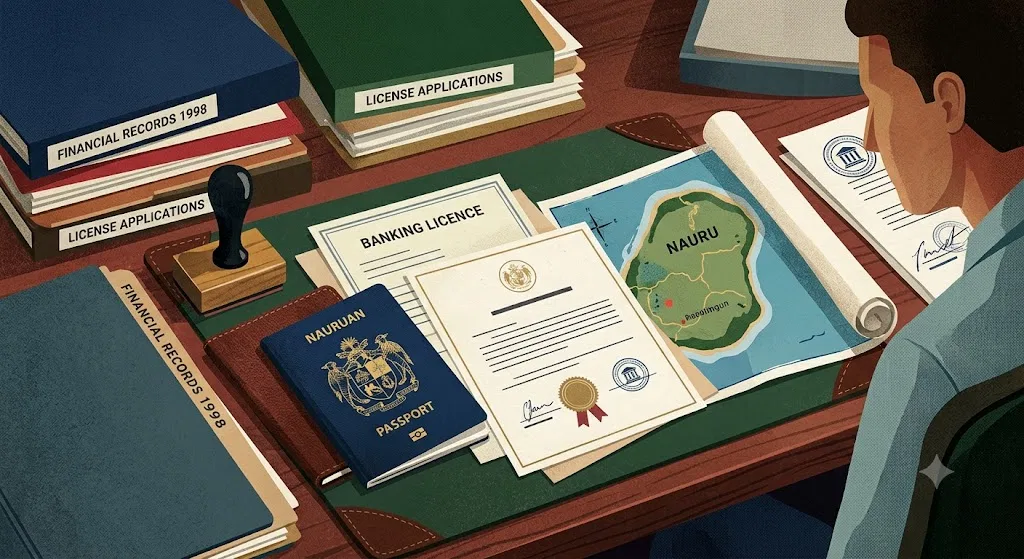
The most notorious deception associated with Nauru was its late twentieth-century offshore banking industry. After phosphate income declined, the country sought replacement revenue by selling banking licences to foreign operators. Hundreds of institutions became registered in Nauru even though many had no meaningful physical presence there.
These were “shell banks”: institutions with legal paperwork and an impressive name, but no real office, ordinary customer base or substantial management in the jurisdiction that licensed them. Their apparent legitimacy came from Nauru’s sovereign power to authorise banks. To someone receiving a transfer instruction or viewing formal registration documents, the institution could look like a conventional international bank.
That appearance concealed an extraordinary lack of scrutiny. A United States Treasury proposal concerning Nauru reported that about 400 offshore banks had received licences. It also described serious weaknesses: money laundering was not adequately criminalised, banks were not obliged to keep proper customer or transaction records, suspicious transactions did not have to be reported, and strict secrecy rules impeded investigation.[U.S. Department of the Treasury]home.treasury.govU.S. Department of the Treasury311 Nauru NPRMFinCEN reported that 400 offshore banks had been granted licenses by Nauru. Nauruan financia…
The system became especially attractive to people seeking to move money without questions being asked. In 1999, a senior Russian central-bank official said roughly US$70 billion had been transferred from Russia through Nauruan banks during the previous year. The exact composition of that money was difficult to establish, but the figure became a powerful symbol of how a country with a tiny domestic economy could serve as a legal façade for enormous international flows.[Sage Journals]journals.sagepub.comSage Journals Off-Shore Banking: Clean Beaches, Dirty MoneySage JournalsOff-Shore Banking: Clean Beaches, Dirty MoneyAugust 5, 2024 — by C Woodard · 2000 · Cited by 1 — Every year, hundreds of bil…
How the illusion worked
The deception did not necessarily depend on forging a banking licence. The licence itself could be genuine. What was misleading was the impression that it represented a properly supervised financial institution.
A shell bank could exploit several layers of borrowed credibility:
- A sovereign licence made the institution appear officially recognised.
- Correspondent accounts at larger foreign banks could provide access to the international payment system.
- Corporate agents and nominee officers separated the real controllers from the bank’s public identity.
- Bank secrecy made it difficult for victims, investigators or foreign regulators to discover who controlled an account.
- Remote operation allowed an institution registered in Nauru to be managed from another country.
This distinction is important. The central deception was not that Nauru itself was imaginary or that every licensed bank was necessarily criminal. It was that the formal trappings of banking could be obtained without the substance that customers and other banks normally assumed those trappings represented.
International regulators eventually treated the arrangement as a systemic money-laundering risk. The Financial Action Task Force, the intergovernmental body that sets anti-money-laundering standards, placed Nauru among jurisdictions considered uncooperative. The United States then restricted dealings between American financial institutions and Nauru-licensed banks. Even after those restrictions, the International Chamber of Commerce warned in 2005 that some blacklisted Nauruan institutions still appeared to be operating.[ICC - International Chamber of Commerce]iccwbo.orgblack listed nauru banks re emergingICC - International Chamber of CommerceBlack-listed Nauru banks re-emerging - ICCJune 5, 2005 — ICC's Financial Investigation Bureau (FIB…
Nauru later abolished its approximately 400 shell banks and introduced reforms. The Financial Action Task Force removed it from its blacklist in October 2005, explicitly linking the decision to the elimination of the shell-bank sector and the resulting reduction in money-laundering risk.[FATF]fatf-gafi.orgFATFFinancial Action Task Force Groupe d'action financièreAugust 8, 2024 — 23 Jun 2006 — At its June 2006 Plenary meeting, the FATF de-listed Nigeria, recognising the progress that that country h…
The episode remains Nauru’s clearest large-scale fraud story because it demonstrates how legal reality can be used to create a false practical impression. The banks were not counterfeit institutions in the simplest sense. They were genuine registrations being used to imitate the credibility of genuine banking.
Passports sold as products
Nauru also experimented with selling citizenship and passports to foreigners. Such programmes are not inherently fraudulent: several countries legally grant citizenship in exchange for investment or a contribution to public funds. The risk arises when commercial pressure overrides checks on identity, criminal history and the source of an applicant’s money.
Nauru’s earlier passport-selling programme began in the late 1990s, when several Pacific island governments were searching for new sources of income. Researchers examining the industry describe these schemes as attractive to small states because citizenship is an asset that can be sold without constructing factories, mines or tourist resorts. The costs to the issuing country may initially appear low, while the buyer obtains mobility, anonymity or an alternative legal identity.[lowyinstitute.org]lowyinstitute.orgpassports convenience pacific islandsThe Lowy InstitutePassports of convenience from the Pacific islands21 Dec 2017 — Later schemes appeared in the 1990s in other offshore ta…
The programme’s reputation collapsed after Nauruan citizenship was reportedly issued to individuals linked to al-Qaeda who were later arrested in Asia. This claim has been repeated by the Australian Broadcasting Corporation and other reputable news organisations when reporting on Nauru’s newer citizenship scheme. Publicly accessible accounts, however, provide limited detail about precisely who authorised the documents, what checks were conducted and whether officials knowingly dealt with extremists. The safest conclusion is that the episode exposed gravely inadequate vetting, rather than proving that the Nauruan state deliberately assisted terrorism.[euronews.com]euronews.combuy a passport naurus unique plan to fight climate changebuy a passport naurus unique plan to fight climate change
Why a passport is such a powerful instrument
A passport does more than permit travel. It asserts that a government has verified the holder’s identity and accepts that person as one of its citizens. Other states, airlines and banks ordinarily rely on that assertion.
A poorly controlled citizenship scheme can therefore create several misleading impressions at once. A purchaser may appear to have a settled connection to a country they have never visited. A new name or nationality may complicate police checks. Visa-free access may allow movement through borders that would otherwise require closer examination. Financial institutions may treat the passport as reliable evidence even when the process behind it was largely commercial.
The fraud potential lies in converting state authority into a purchasable form of trust. The document itself may be authentic, yet the identity story it appears to tell can be incomplete or strategically constructed.
Nauru launched a new Economic and Climate Resilience Citizenship Program in the 2020s, presenting passport revenue as a way to finance climate adaptation and the relocation of infrastructure away from vulnerable coastal areas. The government says applications are subject to police, financial-intelligence and independent background checks. Its official programme describes a multi-stage process and frames the contribution as support for national resilience.[ecrcp.gov.nr]ecrcp.gov.nrOpen source on ecrcp.gov.nr.
The first citizenships under the renewed programme were granted in 2025. Officials argued that modern vetting would prevent a repetition of the earlier scandal, while critics warned that citizenship-by-investment schemes remain attractive to money launderers, fugitives and people seeking to conceal their identity.[theguardian.com]theguardian.comnauru climate citizenship golden passportnauru climate citizenship golden passport
It would be misleading to describe every new Nauruan passport as fraudulent. The unresolved question is whether a small administration can consistently perform the extensive international due diligence required when each successful applicant generates substantial revenue. That tension—between rigorous refusal and financial incentive—is built into the business model.
The battle over truth in the detention system
Nauru’s most politically charged disputes about truth concern the offshore processing system operated there for Australia. From 2013 onwards, asylum seekers arriving by boat were transferred to Nauru, where conditions became the subject of allegations involving assault, sexual abuse, inadequate medical care, self-harm and mistreatment of children.
This is not properly classified as a single hoax. It is a documented conflict in which governments, contractors, refugees, medical workers, journalists and human-rights organisations made competing claims under conditions of severe information restriction.
The sharpest confrontation followed publication of the “Nauru Files” in 2016. The cache contained more than 2,000 internal incident reports from the detention system, covering alleged assaults, sexual violence, threats, self-harm and child-protection concerns. More than half of the reports involved children, although children formed a much smaller share of the detained population during the period covered.[The Guardian]theguardian.comOpen source on theguardian.com.
Nauru’s government rejected the reporting as politically motivated and said some children had been coached. Australian officials also suggested that certain allegations or acts of self-harm were calculated to secure transfer to Australia. The Australian Broadcasting Corporation defended its reporting, while Nauru described critical coverage as biased propaganda.[Time]time.comNauru Rejects Claims of Refugee Abuse in Australian Detention CampsNauru Rejects Claims of Refugee Abuse in Australian Detention Camps
Those denials did not make every allegation automatically true. An incident report records that a claim or event was reported; it is not, by itself, a completed criminal investigation. Some entries lacked independent witnesses, and the leaked files did not establish the final outcome of every complaint.
Nevertheless, several independent sources made a blanket fabrication theory difficult to sustain. Amnesty International said the leaked material was consistent with its own research. An Australian government-commissioned review led by former integrity commissioner Philip Moss found evidence supporting reports of rape and other sexual violence and concluded that such incidents were probably under-reported.[homeaffairs.gov.au]homeaffairs.gov.auDepartment of Home Affairs Websitereview-conditions-circumstances-nauru.pdfDepartment of Home Affairs Websitereview-conditions-circumstances-nauru.pdf
The important deception-related issue is therefore not whether every statement from one side was false. It is how uncertainty was used rhetorically. Critics could sometimes present unverified reports as settled fact, while officials could point to the uncertainty surrounding individual allegations to cast suspicion on an entire body of evidence.

Secrecy made competing stories harder to test
The detention controversy became unusually vulnerable to propaganda because independent access to Nauru was restricted. In 2014, the cost of a journalist visa rose from A$200 to A$8,000, with no refund if the application was rejected. Reporters Without Borders described the increase as effectively a prohibition on foreign reporting.[theguardian.com]theguardian.comnauru visa to cost 8000nauru visa to cost 8000
The fee was later reported at US$6,000, still prohibitively high for many journalists. International media organisations also reported that applications were frequently refused.[Civicus Monitor]monitor.civicus.orgun human rights council calls nauru remove barriers foreign journalists and ngosun human rights council calls nauru remove barriers foreign journalists and ngos
This matters because restricting access does not merely reduce the amount of news. It changes the way disputed claims are judged. When reporters cannot inspect facilities, interview witnesses freely or compare official statements with conditions on the ground, audiences are pushed towards two unreliable extremes: accepting government assurances because they sound authoritative, or accepting every leaked allegation because secrecy itself creates suspicion.
The policy also allowed each side to accuse the other of manufacturing appearances. Officials argued that campaigners and media organisations selected the worst accounts to discredit Nauru and Australia’s border policy. Refugee advocates argued that official tours and controlled statements concealed routine harm. The lack of open inspection prevented many readers from distinguishing a representative pattern from an exceptional incident.
The most credible assessment comes from comparing independent reviews, internal records, medical evidence and repeated testimony rather than relying on a single dramatic account. On that broader record, serious mistreatment was not invented, even though the exact circumstances of individual allegations sometimes remained unresolved.
Climate myths and the danger of oversimplification
Nauru is often presented in popular articles as a morality tale: an island that became fantastically rich from phosphate, squandered everything through greed and corruption, and was then left as an ecological ruin. Much of the underlying history is true, but the familiar version can become a misleading national legend.
Phosphate mining did generate exceptional income, and poorly judged investments, corruption, weak oversight and extravagant spending contributed to the collapse of public wealth. Yet the simplified story often removes the colonial structure that preceded independence. Foreign powers and companies had extracted Nauru’s phosphate for decades, profoundly altering the island’s interior and tying the economy to a finite resource. Later Nauruan governments inherited money, but also a damaged landscape and an economic system designed around depletion.
The distinction matters because the exaggerated version turns structural exploitation into a parable about a small country’s irresponsibility. Nauruan decision-makers made damaging choices, but they did not create the original extractive model or its environmental consequences.
A related misconception is that rising seas alone are about to submerge the entire island. Nauru does face serious climate risks, especially coastal erosion, water insecurity, heat and damage to settlements concentrated near the shore. However, much of its central plateau lies above immediate inundation levels. The more difficult problem is that phosphate mining left large parts of that higher ground degraded and costly to rehabilitate.
The renewed citizenship programme uses this reality in its marketing: passport contributions are presented as finance for moving homes and infrastructure inland. That does not make the climate threat fictional, but it does create an incentive to package a complicated environmental problem into a simple sales story. Official promotion emphasises rescue and resilience; critics focus on passport risk. Both framings can obscure the practical questions of land restoration, governance, expenditure and long-term accountability.[ecrcp.gov.nr]ecrcp.gov.nrOpen source on ecrcp.gov.nr.
What Nauru’s deception history reveals
Nauru’s most important fraud and contested-truth episodes share a common mechanism: the use of official form to produce confidence.
A shell bank borrowed the authority of a banking licence. A purchased passport borrowed the authority of citizenship. Statements about detention borrowed the authority of governments, medical professionals, leaked records or human-rights organisations. In every case, outsiders had difficulty checking what the formal label represented in practice.
The people who benefited were not confined to Nauru. Foreign bankers, money launderers, citizenship brokers, contractors and Australian political leaders all gained from arrangements in which responsibility could be dispersed. Nauru provided jurisdiction, territory or documentation; larger international actors supplied clients, capital and policy incentives.
Exposure generally came only when information crossed borders. Financial regulators compared Nauruan licences with the physical reality of the banks. Police and immigration authorities discovered troubling passport holders. Whistleblowers and journalists released internal detention records. International organisations gathered testimony that could not easily be collected through ordinary local reporting.
That pattern explains why these stories continue to circulate. They combine genuine wrongdoing with incomplete records, and incomplete records invite embellishment. Claims about hundreds of phantom banks are well supported; claims that every offshore transaction was criminal are not. The earlier passport scheme suffered a catastrophic vetting failure; that does not prove every citizenship sold by Nauru was fraudulent. Extensive evidence supports serious abuse in the detention system; that does not establish every reported allegation beyond dispute.
The strongest lesson is not that Nauru was uniquely deceptive. It is that small jurisdictions can become useful stages for much larger systems of deception. When a legal document, distant island and restricted flow of information stand between an appearance and its underlying reality, even thin institutions can generate remarkably convincing illusions.
Amazon book picks
Further Reading
Books and field guides related to When State Authority Became a Tool of Deception. Use these as the next step if you want deeper reading beyond the article.
Treasure Islands
Directly relates to shell banks, financial opacity and state-enabled deception.
The Dictator's Handbook
Provides insight into incentives facing small states and political institutions.
eBay marketplace picks
Marketplace Samples
Example marketplace items related to this page. Use the search link to explore similar finds on eBay.

Endnotes
1.
Source: home.treasury.gov
Link:https://home.treasury.gov/system/files/246/js1941.pdf
Source snippet
U.S. Department of the Treasury311 Nauru NPRMFinCEN reported that 400 offshore banks had been granted licenses by Nauru. Nauruan financia...
2.
Source: iccwbo.org
Title: black listed nauru banks re emerging
Link:https://iccwbo.org/news-publications/news/black-listed-nauru-banks-re-emerging/
Source snippet
ICC - International Chamber of CommerceBlack-listed Nauru banks re-emerging - ICCJune 5, 2005 — ICC's Financial Investigation Bureau (FIB...
Published: June 5, 2005
3.
Source: fatf-gafi.org
Title: FATFFinancial Action Task Force Groupe d’action financière
Link:https://www.fatf-gafi.org/content/dam/fatf-gafi/annual-reports/2005%202006%20NCCT%20ENG.pdf
Source snippet
August 8, 2024 — 23 Jun 2006 — At its June 2006 Plenary meeting, the FATF de-listed Nigeria, recognising the progress that that country h...
Published: August 8, 2024
4.
Source: fatf-gafi.org
Title: 2006 2007 NCCT ENG
Link:https://www.fatf-gafi.org/content/dam/fatf-gafi/annual-reports/2006%202007%20NCCT%20ENG.pdf
Source snippet
FATFEighth NCCT Review12 Oct 2007 — Nauru is a member of the Asia Pacific Group on Money. Laundering (APG), an FSRB, which has mechanisms...
5.
Source: euronews.com
Title: buy a passport naurus unique plan to fight climate change
Link:https://www.euronews.com/2025/02/26/buy-a-passport-naurus-unique-plan-to-fight-climate-change
6.
Source: ecrcp.gov.nr
Link:https://www.ecrcp.gov.nr/
7.
Source: time.com
Title: Nauru Rejects Claims of Refugee Abuse in Australian Detention Camps
Link:https://time.com/4453670/nauru-files-refugee-abuse-australia/
8.
Source: homeaffairs.gov.au
Title: Department of Home Affairs Websitereview-conditions-circumstances-nauru.pdf
Link:https://www.homeaffairs.gov.au/reports-and-pubs/files/review-conditions-circumstances-nauru.pdf
9.
Source: amnesty.org
Title: australia reaction to the guardian s damning nauru files on refugee abuse
Link:https://www.amnesty.org/en/latest/press-release/2016/08/australia-reaction-to-the-guardian-s-damning-nauru-files-on-refugee-abuse/
10.
Source: monitor.civicus.org
Title: un human rights council calls nauru remove barriers foreign journalists and ngos
Link:https://monitor.civicus.org/explore/un-human-rights-council-calls-nauru-remove-barriers-foreign-journalists-and-ngos/
11.
Source: amnesty.org
Link:https://www.amnesty.org/en/wp-content/uploads/2021/05/ASA4222792015ENGLISH.pdf
12.
Source: journals.sagepub.com
Title: Sage Journals Off-Shore Banking: Clean Beaches, Dirty Money
Link:https://journals.sagepub.com/doi/pdf/10.2968/056003006
Source snippet
Sage JournalsOff-Shore Banking: Clean Beaches, Dirty MoneyAugust 5, 2024 — by C Woodard · 2000 · Cited by 1 — Every year, hundreds of bil...
Published: August 5, 2024
13.
Source: lowyinstitute.org
Title: passports convenience pacific islands
Link:https://www.lowyinstitute.org/the-interpreter/passports-convenience-pacific-islands
Source snippet
The Lowy InstitutePassports of convenience from the Pacific islands21 Dec 2017 — Later schemes appeared in the 1990s in other offshore ta...
14.
Source: eastasiaforum.org
Title: passports a ticket to corruption in the pacific islands
Link:https://eastasiaforum.org/2018/10/13/passports-a-ticket-to-corruption-in-the-pacific-islands/
15.
Source: abc.net.au
Title: nauru sells first passports to fund climate action
Link:https://www.abc.net.au/news/2025-08-07/nauru-sells-first-passports-to-fund-climate-action/105624728
16.
Source: theguardian.com
Title: nauru climate citizenship golden passport
Link:https://www.theguardian.com/world/2025/feb/26/nauru-climate-citizenship-golden-passport
17.
Source: theguardian.com
Link:https://www.theguardian.com/australia-news/2016/aug/10/the-nauru-files-2000-leaked-reports-reveal-scale-of-abuse-of-children-in-australian-offshore-detention
18.
Source: theguardian.com
Link:https://www.theguardian.com/australia-news/2025/jun/08/scott-morrison-sought-advice-to-obstruct-nauru-asylum-seekers-from-accessing-abortions-documents-reveal-ntwnfb
Source snippet
Medical professionals had advised transferring one unidentified woman to Victoria for a timely abortion; instead, she was sent to Brisban...
19.
Source: abc.net.au
Title: nauru dismisses four corners report biased political propoganda
Link:https://www.abc.net.au/news/2016-10-18/nauru-dismisses-four-corners-report-biased-political-propoganda/7941964
20.
Source: theguardian.com
Title: nauru visa to cost 8000
Link:https://www.theguardian.com/world/2014/jan/09/nauru-visa-to-cost-8000
21.
Source: rsf.org
Title: unacceptable increase journalist visa fee 8000 dollars
Link:https://rsf.org/en/unacceptable-increase-journalist-visa-fee-8000-dollars
22.
Source: abc.net.au
Title: an nauru visa price hike for journalists
Link:https://www.abc.net.au/news/2014-02-10/an-nauru-visa-price-hike-for-journalists/5250568
23.
Source: fatf-gafi.org
Title: Nauru MER APG November 2024.pdf.coredownload.inline
Link:https://www.fatf-gafi.org/content/dam/fatf-gafi/fsrb-mer/Nauru-MER-APG-November-2024.pdf.coredownload.inline.pdf
Published: November 2024
24.
Source: fatf-gafi.org
Link:https://www.fatf-gafi.org/content/dam/fatf-gafi/mer/MER%20UK%20FULL.pdf.coredownload.pdf
25.
Source: fatf-gafi.org
Title: 1997 1998 ENG
Link:https://www.fatf-gafi.org/content/dam/fatf-gafi/annual-reports/1997%201998%20ENG.pdf
26.
Source: fatf-gafi.org
Link:https://www.fatf-gafi.org/en/the-fatf/news.html
27.
Source: fatf-gafi.org
Title: MER Norway full.pdf.coredownload
Link:https://www.fatf-gafi.org/content/dam/fatf-gafi/mer/MER%20Norway%20full.pdf.coredownload.pdf
28.
Source: fatf-gafi.org
Link:https://www.fatf-gafi.org/content/dam/fatf-gafi/publications/Comprehensive-Update-on-Terrorist-Financing-Risks-2025.pdf.coredownload.inline.pdf
29.
Source: fatf-gafi.org
Title: MER US full.pdf.coredownload
Link:https://www.fatf-gafi.org/content/dam/fatf-gafi/mer/MER%20US%20full.pdf.coredownload.pdf
30.
Source: fatf-gafi.org
Title: MER United States 2016
Link:https://www.fatf-gafi.org/content/dam/fatf-gafi/mer/MER-United-States-2016.pdf
31.
Source: reachimmigration.com
Title: economic and climate resilience citizenship program
Link:https://reachimmigration.com/en/program/economic-and-climate-resilience-citizenship-program/
32.
Source: asyluminsight.com
Title: nauru files
Link:https://www.asyluminsight.com/nauru-files
33.
Source: theguardian.com
Title: abc and nauru government clash over four corners expose of offshore detention
Link:https://www.theguardian.com/world/2016/oct/18/abc-and-nauru-government-clash-over-four-corners-expose-of-offshore-detention
34.
Source: passportindex.org
Link:https://www.passportindex.org/passport/nauru/
Additional References
35.
Source: icc-ccs.org
Title: black listed nauru banks re emerging
Link:https://icc-ccs.org/black-listed-nauru-banks-re-emerging/
Source snippet
Black-listed Nauru banks re-emerging4 Jun 2005 — A number of amendments were made to the anti-money laundering provisions of the Bank Sec...
36.
Source: youtube.com
Title: How Australia got rid of illegal immigrants | 60 Minutes Australia
Link:https://www.youtube.com/watch?v=9hvxVzX0NDI
Source snippet
Why is Australia deporting people to one of the world's smallest countries?...
37.
Source: youtube.com
Title: Why is Australia deporting people to one of the world’s smallest countries?
Link:https://www.youtube.com/watch?v=QcTax3vh3S0
Source snippet
How the World's Richest Country Lost 90% of its GDP...
38.
Source: youtube.com
Title: How the World’s Richest Country Lost 90% of its GDP
Link:https://www.youtube.com/watch?v=Fe88ckTWyTU
Source snippet
From Riches to Rags: The Economic Collapse of Nauru...
39.
Source: islandstudiesjournal.org
Link:https://islandstudiesjournal.org/article/83952-[passport-sales
40.
Source: facebook.com
Link:https://www.facebook.com/naurunews/posts/a-fake-nauru-football-association-has-appeared-online-with-officials-confirming-/821541198585289/
41.
Source: apgml.org
Link:https://www.apgml.org/sites/default/files/documents//APG_Typologies_Report_on_Fraud_Money_Laundering_in_the_Pacific.pdf
42.
Source: instagram.com
Link:https://www.instagram.com/p/DahaR2noNqi/
43.
Source: facebook.com
Link:https://www.facebook.com/islandtimespw/posts/%EF%B8%8F-warning-crypto-scam-alert-in-nauruthe-fiu-is-warning-the-public-about-a-fraudu/1451037557041027/
44.
Source: reddit.com
Link:https://www.reddit.com/r/911archive/comments/1md8mm9/genuine_questions_about_the_911_hijackers_identity/
Topic Tree
Follow this branch
Related pages 192
- Albanian Hoaxes
- Algerian Hoaxes
- Antigua Deceptions
- Argentina Hoaxes
- Armenian Hoaxes
- +187 more in sidebar