Within Senegal Hoaxes
How Propaganda Demonised Senegalese Soldiers in Europe
Post-war campaigners turned colonial soldiers into a racial menace through repeated atrocity claims and inflammatory imagery.
On this page
- What the campaign claimed
- How race and national humiliation shaped the story
- What contemporary inquiries and later historians found
Page outline Jump by section
Introduction
The “Black Horror on the Rhine” was one of the most influential propaganda campaigns of the early twentieth century. After the First World War, France stationed occupation troops in Germany’s Rhineland, including colonial soldiers from West Africa. Many of these men were known in European discourse as “Senegalese” troops, even though they came from several parts of French West Africa and served in the famous Tirailleurs Sénégalais units. German nationalist activists, sympathetic foreign campaigners and sections of the press then spread alarming stories claiming that these soldiers were carrying out widespread rape, mutilation and terror against German civilians. Historians now regard the campaign as a major example of racist propaganda that relied on exaggeration, fabrication and moral panic rather than verified evidence.[1914-1918-Online (WW1) Encyclopedia]encyclopedia.1914-1918-online.netWW1) Encyclopedia Schwarze Schmach1914-1918-Online (WW1) EncyclopediaSchwarze SchmachMay 28, 2015 — African troops; atrocity propaganda; black horror; colonialism; German…
The episode matters not only because it targeted African soldiers, but because it shows how propaganda can transform existing fears and prejudices into a powerful political weapon. The campaign helped opponents of the post-war settlement attack France, stirred international outrage, and left a legacy that later fed into broader racist and nationalist narratives in Europe.[1914-1918-online.net]encyclopedia.1914-1918-online.netWW1) Encyclopedia Schwarze Schmach1914-1918-Online (WW1) EncyclopediaSchwarze SchmachMay 28, 2015 — African troops; atrocity propaganda; black horror; colonialism; German…
What the campaign claimed
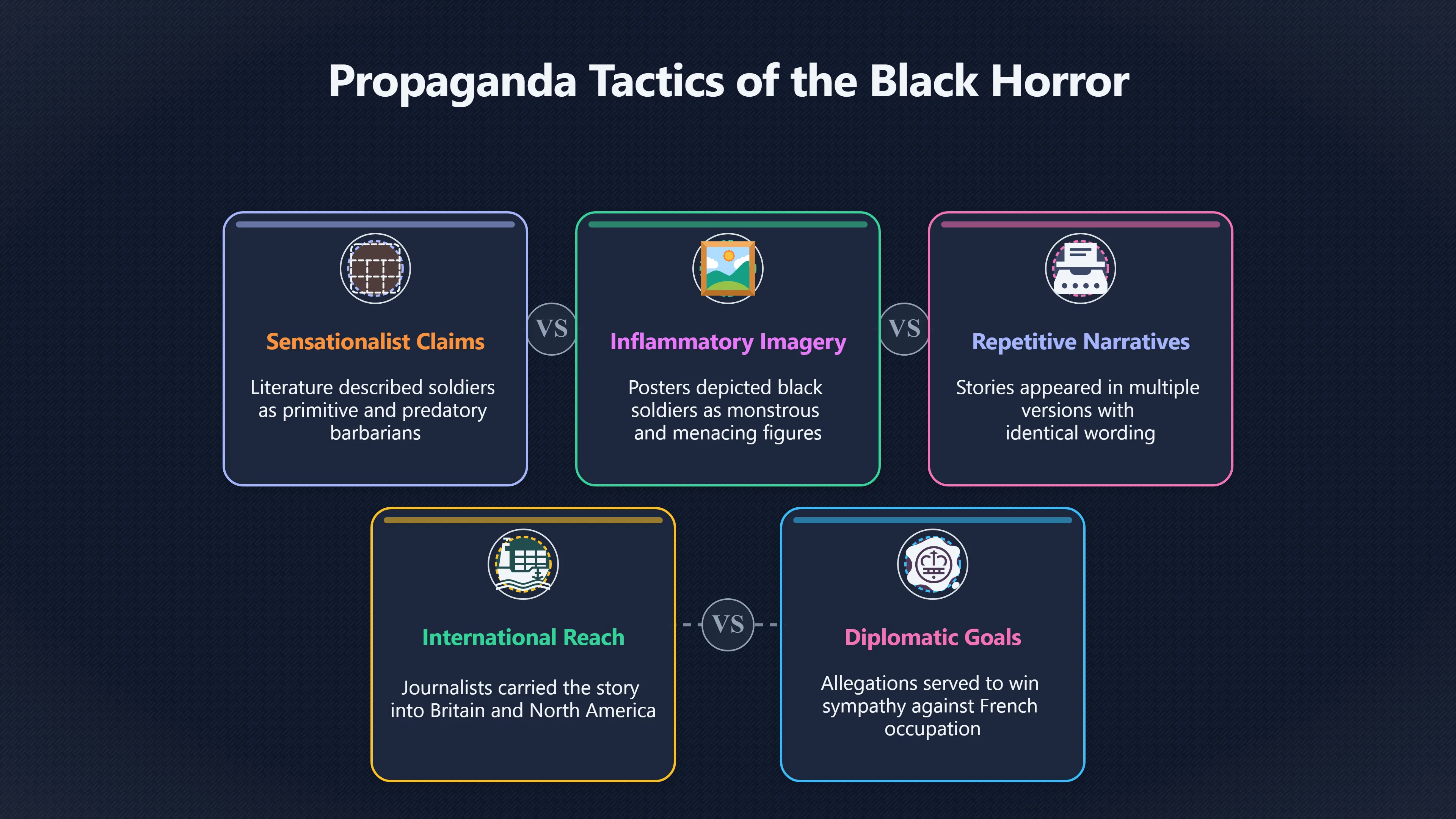
The campaign emerged after France occupied parts of western Germany following the Treaty of Versailles. Colonial troops formed only a minority of the occupation force, but they became the focus of intense attention. German nationalist organisations and newspapers portrayed African soldiers as inherently violent and sexually predatory. Posters, pamphlets, speeches and newspaper articles warned of a supposed “black scourge” threatening German women and civilisation itself.[Wikipedia]WikipediaBlack Horror on the RhineBlack Horror on the Rhine
Many of the most sensational claims centred on alleged mass rape. Campaign literature described African troops as primitive “barbarians” who were supposedly incapable of controlling their sexual urges. Stories circulated about widespread assaults, murders, mutilations and the spread of disease. Some publications claimed that entire communities lived in fear of African occupation forces. These accusations were often accompanied by inflammatory illustrations depicting black soldiers as monstrous figures menacing white women.[cambridge.org]cambridge.orgUniversity Press & Assessment Racialism on the Left E.DMorel and the “Black Horror on…by RC Reinders · 1968 · Cited by 109 — The “barely restrainable beastiality of the black troops” has le…
The accusations spread beyond Germany. British activist and journalist E. D. Morel became one of the campaign’s most prominent international advocates. He repeated many of the atrocity allegations in English-language publications, helping carry the story into Britain, North America and other countries. The phrase “Black Horror on the Rhine” itself became widely known through these efforts.[Wikipedia]WikipediaBlack Horror on the RhineBlack Horror on the Rhine
How race and national humiliation shaped the story
The propaganda succeeded because it tapped into several anxieties at once. Germany had suffered military defeat, territorial losses and foreign occupation. For many nationalists, the presence of non-European soldiers on German soil became a powerful symbol of humiliation. The campaign therefore framed occupation not merely as a political issue but as a racial insult.[1914-1918-Online (WW1) Encyclopedia]encyclopedia.1914-1918-online.netWW1) Encyclopedia Schwarze Schmach1914-1918-Online (WW1) EncyclopediaSchwarze SchmachMay 28, 2015 — African troops; atrocity propaganda; black horror; colonialism; German…
Race was central to the message. Propagandists portrayed African troops as fundamentally different from and inferior to Europeans. Their arguments relied on long-established colonial stereotypes that depicted black men as violent, hypersexual and uncivilised. Historians have shown that the campaign’s imagery repeatedly focused on imagined threats to white womanhood, turning sexual fear into a political tool.[oup.com]academic.oup.comOUP AcademicWeimar Germany, Race and Occupation after World War Iby J Roos · 2014 — These soldiers became the target of a vicious campaig…
The campaign also reflected concerns about masculinity and national pride. Propaganda often suggested that German men had been rendered powerless while foreign soldiers occupied their territory. According to modern scholarship, these themes of racial danger, female victimhood and male humiliation helped explain why the campaign resonated with audiences far beyond the Rhineland itself.[1914-1918-Online (WW1) Encyclopedia]encyclopedia.1914-1918-online.netWW1) Encyclopedia Schwarze Schmach1914-1918-Online (WW1) EncyclopediaSchwarze SchmachMay 28, 2015 — African troops; atrocity propaganda; black horror; colonialism; German…
An additional element was fear of racial mixing. Relationships between occupation troops and local women became the subject of intense scrutiny. Propagandists treated the birth of mixed-race children as evidence of national decline, transforming private relationships into political symbols.[Wikipedia]WikipediaBlack Horror on the RhineBlack Horror on the Rhine

What contemporary inquiries found
The dramatic accusations generated enough attention that officials outside Germany investigated them. In the United States, public concern led President Woodrow Wilson’s administration to seek information about the allegations. American military and diplomatic representatives examined the claims and reported that most of the atrocity stories were unsupported. General Henry T. Allen, commander of American occupation forces in the region, praised the discipline of the Senegalese troops and concluded that the campaign was largely intended to influence international opinion.[Wikipedia]WikipediaBlack Horror on the RhineBlack Horror on the Rhine
French authorities also mounted a defence of the colonial soldiers. Official publications challenged the numerical claims made by campaigners, disputed allegations about disease and highlighted positive reports from German observers who had not witnessed the alleged reign of terror. French officials argued that the propaganda depended on racial prejudice rather than verified facts.[Wikipedia]WikipediaBlack Horror on the RhineBlack Horror on the Rhine
This did not mean that every individual soldier behaved perfectly. Historians generally acknowledge that, as with any large military force, some crimes occurred. However, modern research has found no evidence supporting the campaign’s central claim that African occupation troops were carrying out systematic or exceptionally widespread atrocities. The sensational picture promoted by propagandists was not borne out by contemporary investigations or later historical scholarship.[Wikipedia]WikipediaBlack Horror on the RhineBlack Horror on the Rhine
What later historians concluded
Modern historians treat the Black Horror campaign as a classic case of racialised atrocity propaganda. Research has shown that many accusations relied on rumour, repetition and emotionally charged imagery rather than documented evidence. Some stories appeared in multiple versions with strikingly similar wording, suggesting that they were being reproduced and embellished rather than independently verified.[Wikipedia]WikipediaBlack Horror on the RhineBlack Horror on the Rhine
Scholars have also emphasised the campaign’s political purpose. German officials recognised that criticism of France’s use of colonial troops could win sympathy abroad, particularly in countries where racial prejudice was already widespread. The allegations therefore served diplomatic as well as domestic goals.[Wikipedia]WikipediaBlack Horror on the RhineBlack Horror on the Rhine
Recent studies describe the campaign as one of the most significant propaganda efforts of the Weimar era. It linked anti-colonial rhetoric, nationalism, racism and gender politics into a single narrative that proved remarkably adaptable. Its imagery and assumptions survived long after the occupation itself ended.[OUP Academic]academic.oup.comarmy of occupation in the Rhineland. The campaign against these troops… black horror and subsequent Nazi propaganda. Issue Section: Ar…
Why claims about Black Horror remained persuasive
The Black Horror campaign occupies an unusual place in the history of deception. Unlike a forged document or a fabricated photograph, it was a broad propaganda system built from exaggeration, selective reporting, stereotypes and repeated atrocity stories. Its power came not from one false claim but from the cumulative effect of hundreds of similar claims presented as unquestionable truth.[1914-1918-Online (WW1) Encyclopedia]encyclopedia.1914-1918-online.netWW1) Encyclopedia Schwarze Schmach1914-1918-Online (WW1) EncyclopediaSchwarze SchmachMay 28, 2015 — African troops; atrocity propaganda; black horror; colonialism; German…
For Senegal and the wider history of African soldiers in European armies, the episode reveals how colonial troops could be simultaneously celebrated for military service and demonised through racial myths. The men targeted by the campaign had fought for France during the First World War, yet were later portrayed as existential threats when deployed in Europe itself.[Wikipedia]WikipediaBlack Horror on the RhineBlack Horror on the Rhine
The Black Horror campaign remains a revealing example of how fear, prejudice and political resentment can transform isolated incidents and rumours into a widely believed narrative. Its history illustrates the enduring ability of propaganda to create moral panics, shape international opinion and leave a lasting mark on public memory long after the underlying claims have been challenged.[1914-1918-online.net]encyclopedia.1914-1918-online.netWW1) Encyclopedia Schwarze Schmach1914-1918-Online (WW1) EncyclopediaSchwarze SchmachMay 28, 2015 — African troops; atrocity propaganda; black horror; colonialism; German…
Amazon book picks
Further Reading
Books and field guides related to How Propaganda Demonised Senegalese Soldiers in Europe. Use these as the next step if you want deeper reading beyond the article.
The 'Black Horror on the Rhine'
Focused study of the Black Horror on the Rhine narrative.
eBay marketplace picks
Marketplace Samples
Live-tested eBay searches with available results related to this page.

Endnotes
1.
Source: encyclopedia.1914-1918-online.net
Title: (WW1) Encyclopedia Schwarze Schmach
Link:https://encyclopedia.1914-1918-online.net/article/schwarze-schmach/
Source snippet
1914-1918-Online (WW1) EncyclopediaSchwarze SchmachMay 28, 2015 — African troops; atrocity propaganda; black horror; colonialism; German...
Published: May 28, 2015
2.
Source: academic.oup.com
Link:https://academic.oup.com/gh/article-abstract/30/1/45/621900
Source snippet
army of occupation in the Rhineland. The campaign against these troops... black horror and subsequent Nazi propaganda. Issue Section: Ar...
3.
Source: academic.oup.com
Link:https://academic.oup.com/gh/article-abstract/32/1/145/572208
Source snippet
OUP AcademicWeimar Germany, Race and Occupation after World War Iby J Roos · 2014 — These soldiers became the target of a vicious campaig...
4.
Source: cambridge.org
Link:https://www.cambridge.org/core/journals/leiden-journal-of-international-law/article/phoenix-of-colonial-war-race-the-laws-of-war-and-the-horror-on-the-rhine/8E6D897ED510BBBA24B92F801C637668
Source snippet
Cambridge University Press & AssessmentThe Phoenix of Colonial War: Race, the Laws...by R GILADI · 2017 · Cited by 8 — It then records t...
5.
Source: Wikipedia
Title: Black Horror on the Rhine
Link:https://en.wikipedia.org/wiki/Black_Horror_on_the_Rhine
6.
Source: cambridge.org
Title: University Press & Assessment Racialism on the Left E.D
Link:https://www.cambridge.org/core/journals/international-review-of-social-history/article/racialism-on-the-left-ed-morel-and-the-black-horror-on-the-rhine/526496DF3C9361865EF88E197FB63656
Source snippet
Morel and the “Black Horror on...by RC Reinders · 1968 · Cited by 109 — The “barely restrainable beastiality of the black troops” has le...
7.
Source: cambridge.org
Link:https://www.cambridge.org/core/journals/central-european-history/article/womens-rights-nationalist-anxiety-and-the-moral-agenda-in-the-early-weimar-republic-revisiting-the-black-horror-campaign-against-frances-african-occupation-troops/2E78514BF0242B95A233DC4EB92449BF
Source snippet
black shame propaganda of themes of female sexual victimization. Real and reputed rapes of German women by African French soldiers became...
Additional References
8.
Source: reddit.com
Link:https://www.reddit.com/r/AskHistorians/comments/17uct0l/was_the_black_horror_on_the_rhine_over/
Source snippet
Was the black horror on the Rhine over exaggerated? Or...The novel Die Schwarze Schmach (The Black Shame) was quickly turned into...
9.
Source: theguardian.com
Title: claude mckay radical jamaican journalist in 1920s london
Link:https://www.theguardian.com/news/2025/oct/16/claude-mckay-radical-jamaican-journalist-in-1920s-london
Source snippet
In London, McKay aligned with Sylvia Pankhurst and contributed prolifically to her radical newspaper, the Workers’ Dreadnought, becoming...
10.
Source: youtube.com
Link:https://www.youtube.com/watch?v=8yo3rA61Wrs
Source snippet
Nazi prejudice and propaganda – the racist crimes against the "children of shame" | DW Documentary...
11.
Source: youtube.com
Link:https://www.youtube.com/watch?v=J26kgGn5TdQ
Source snippet
Die Kampagne der "Schwarzen Schmach" - Aus der Geschichte lernen...
12.
Source: youtube.com
Title: Die Kampagne der “Schwarzen Schmach”
Link:https://www.youtube.com/watch?v=rkzLxd3Cx94
Source snippet
Julia Roos, No Second “Black Horror on the Rhine”?...
13.
Source: researchgate.net
Link:https://www.researchgate.net/publication/223134816Nationalism_Racism_and_Propaganda_in_Early_Weimar_Germany_Contradictions_in_the_Campaign_against_the%27Black_Horror_on_the_Rhine%27
14.
Source: semanticscholar.org
Link:https://www.semanticscholar.org/paper/The-%22Black-Horror-on-the-Rhine%22%3A-Race-as-a-Factor-I-Nelson/b1561626a6cd614a9eaf63c85f69f7b779517760
15.
Source: lemonde.fr
Link:https://www.lemonde.fr/en/le-monde-africa/article/2024/08/15/after-the-provence-landings-whitewashing-of-french-troops-made-africans-invisible_6716113_124.html
16.
Source: interminablerambling.com
Title: the black horror on the rhine jim crow and the holocaust
Link:https://interminablerambling.com/2023/02/21/the-black-horror-on-the-rhine-jim-crow-and-the-holocaust/
17.
Source: colab.ws
Title: The “Black Horror on the Rhine”: Race as a Factor
Link:https://colab.ws/articles/10.1086%2F244041
Topic Tree