How False Claims Gained Power in South Sudan
South Sudan has no well-documented national tradition of elaborate monster hoaxes, forged antiquities or theatrical newspaper pranks comparable with the best-known cases from older media markets.
Page outline Jump by section
Introduction
These stories matter because falsehoods in South Sudan rarely remain harmless curiosities. A fake grant notice can exploit people desperate for capital; a forged presidential order can unlock public money; and a miscaptioned image can reinforce ethnic hostility or provoke violence. The evidence also demands careful distinctions. Some cases were deliberate frauds. Others were propaganda, opportunistic clickbait or sincere mistakes amplified before anyone checked them. Taken together, they show how official-looking symbols, emotional photographs and trusted personal networks can make weak claims appear authoritative.
Why classic hoax history is thin
South Sudan became independent only in 2011, after decades in which journalism, archives and public institutions were repeatedly disrupted by war. Much of the country’s earlier documentary history therefore belongs to the wider histories of Sudan, colonial administration and the southern liberation movements rather than to an independent South Sudanese media sphere.
The available record is strongest from the civil-war period beginning in 2013 and from the later expansion of Facebook, WhatsApp and local online news pages. Even with relatively limited domestic internet access, information could move through urban users, refugee communities and the large South Sudanese diaspora. Researchers observed that messages originating abroad could quickly return to South Sudan through social media, telephone calls and family networks.[undp.org]undp.orgtackling misinformation hatefreesouthsudan during covid 19Tackling Misinformation for a #HateFreeSouthSudan…24 Feb 2021 — South Sudan Misinformation, incitement to violence and other chall…
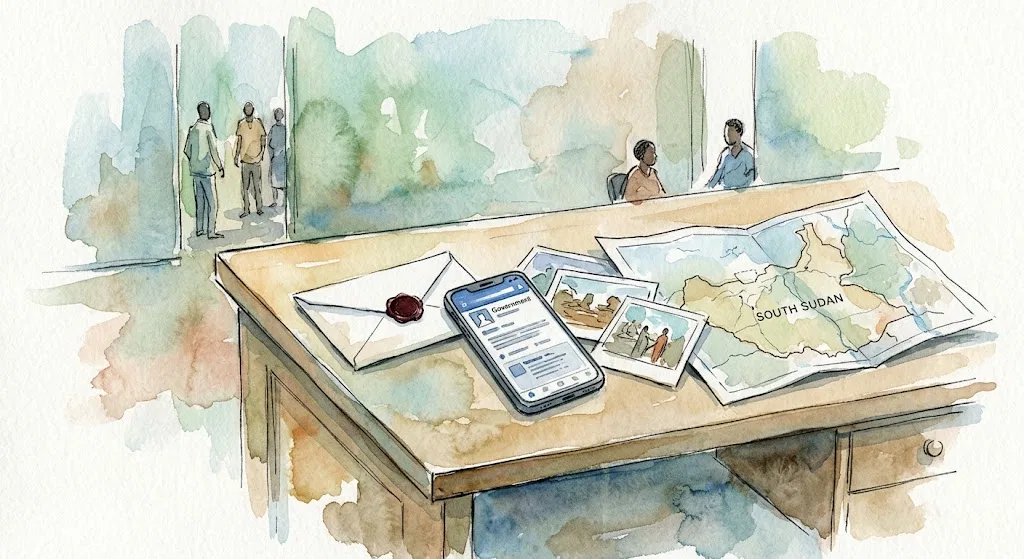
That context helps explain why the country’s best-documented “hoaxes” often look different from a traditional newspaper stunt. They are usually small pieces of persuasive content: a letter carrying a seal, a Facebook page using a ministry’s name, a photograph borrowed from another country or an unverified message claiming that a community is preparing an attack. Each item may be simple, but the surrounding conditions give it power.
Forging the president’s authority
One of South Sudan’s most consequential deception cases involved accusations that officials used President Salva Kiir’s signature and presidential symbols to obtain money from the state.
In 2015, Kiir suspended senior aides while investigators examined claims that his signature and the presidential seal had been forged on documents presented to the central bank. Reports said the purported presidential orders authorised large payments. By early 2016, prosecutors were preparing a case against officials accused of withdrawing millions of dollars using forged documentation.[Voice of America]voaafrica.comVoice of AmericaSouth Sudan Presidential Aides Suspended Over Missing…July 1, 2015 — 1 Jul 2015 — Two of President Salva Kiir's aides…
This was not merely a rumour about corruption. The alleged mechanism depended on impersonating the highest authority in the country:
- documents appeared to carry presidential approval;
- the president’s signature supposedly authenticated the request;
- the official seal made the paperwork look routine;
- bank staff were asked to treat the order as an instruction from the head of state.
The case illustrates why documentary fraud can flourish where institutional decisions are highly centralised. When a president’s personal authorisation carries exceptional weight, reproducing its visible signs may be more useful to a fraudster than inventing a complicated commercial identity.
Allegations involving forged presidential authority have continued to surface. In May 2026, South Sudan’s parliament removed the immunity of two lawmakers accused of forging Kiir’s signature and unlawfully using presidential symbols, allowing a criminal investigation to proceed. These remained allegations rather than proof of guilt, but their recurrence shows that presidential letters and insignia are still treated as valuable instruments of apparent authority.[Radio Tamazuj]radiotamazuj.orgRadio Tamazuj Two MPs lose immunity over alleged Kiir signature forgeryRadio TamazujTwo MPs lose immunity over alleged Kiir signature forgeryMay 15, 2026 — 15 May 2026 — South Sudan's parliament on Friday lif…
The broader lesson is not that every disputed government document is fraudulent. South Sudan’s politics generates genuine confidential orders, sudden appointments and abrupt reversals. That uncertainty can itself assist forgers: an extraordinary letter may look plausible because genuine political decisions are not always announced through clear, predictable channels.
The fake government grant
A more recognisable internet scam appeared in 2020, when a Facebook page impersonating South Sudan’s Ministry of Finance and Planning announced that the government and the World Bank were supposedly offering grants worth US$41.4 million to entrepreneurs.
The ministry denied the programme and identified the page as bogus. AFP’s investigation found that the imitation account had copied the ministry’s name and branding, while Facebook’s page-transparency information indicated that it was being managed from Kenya. The fake page had accumulated hundreds of followers and likes, enough to appear credible to a casual visitor.[Fact Check AFP]factcheck.afp.comsouth sudan dismisses claim it giving grants worth 414 million entrepreneurssouth sudan dismisses claim it giving grants worth 414 million entrepreneurs
The claim succeeded by combining several persuasive elements. South Sudan badly needed business investment, the World Bank was a familiar development institution, and the sum was large enough to attract attention without seeming completely impossible. Most importantly, the announcement appeared on a page presented as an official ministry account.
The scam demonstrates a common form of digital impersonation: fraudsters do not need to duplicate an entire government website. A logo, an official photograph and a convincing page name can create a superficial resemblance strong enough to catch people scrolling quickly. The intended benefit may be the collection of personal data, advance fees or traffic, although the available reporting did not conclusively establish what the page operators planned to do with prospective applicants.
It also shows why corrections often travel less effectively than the original deception. The fake announcement offered money and opportunity. The debunk merely warned that the opportunity did not exist.
Fake letters and diplomatic drama
In April 2025, a supposed official letter circulated online claiming that South Sudan had expelled the United States ambassador and closed the US embassy amid a dispute over visas and deportations. South Sudanese authorities said the document was inauthentic and confirmed that diplomatic relations remained intact.[Africa Check]africacheck.orgignore fake letter claiming south sudan expelled usignore fake letter claiming south sudan expelled us
The forgery was effective because it was attached to a real political dispute. The United States had announced visa restrictions connected to South Sudan’s refusal to accept the return of certain deportees. A fabricated diplomatic rupture therefore did not emerge from nowhere; it exaggerated an existing confrontation into a more dramatic event.
This is a recurring principle in successful hoaxes. The most persuasive fake is often not a wholly invented fantasy but a false development grafted on to a genuine story. Readers already aware of tension between the two governments could accept the document as the latest escalation.
Official-letter hoaxes also exploit the visual habits of online reading. A seal, heading and signature can be absorbed instantly, while checking the issuing office, comparing formatting or seeking confirmation from both governments takes time. By the point a denial appears, screenshots may have detached from the original post and begun circulating in private groups.
Photographs that travelled into South Sudan
South Sudanese fact-checkers repeatedly encounter images taken in another country and relabelled as scenes from Juba or elsewhere in South Sudan. These are not always sophisticated manipulations. Often the photograph itself is genuine; only the caption is false.
Examples documented by the South Sudanese fact-checking organisation 211CHECK include:[factcheck.afp.com]factcheck.afp.comsouth sudan dismisses claim it giving grants worth 414 million entrepreneurssouth sudan dismisses claim it giving grants worth 414 million entrepreneurs
- a photograph of newborn babies on plastic chairs wrongly presented as conditions in a South Sudanese hospital, although it came from a hospital in Uganda;
- an image of a statue falsely described as South Sudan’s symbol of justice, when the monument was in Nigeria;
- pictures presented as Juba at an earlier historical date that did not show the claimed place or period;
- an image of a woman smoking shisha used to support a claim about behaviour in Juba, despite originating elsewhere.[211check.org]211check.org#Misinformation Archives#Misinformation Archives
Such posts work because pictures are commonly treated as direct evidence. Yet the deceptive element may sit entirely outside the image. A photograph of an overcrowded hospital can be authentic while the claim that it depicts South Sudan is false.
The emotional logic is especially strong when the image appears to confirm an existing concern. A photograph attributed to an under-resourced hospital fits expectations about a country facing poverty and conflict. A viewer may therefore judge it by whether the scene seems plausible rather than by whether its location can be verified.
Reverse-image searches, earlier uploads, news archives and visible geographical clues have become the principal tools for exposing these cases. The debunking process does not normally prove that the pictured event never occurred anywhere. It establishes that the image cannot support the particular South Sudanese claim attached to it.
Giants, creatures and disaster pictures
South Sudan’s online folklore also includes a lighter but revealing category: recycled supernatural and sensational images.
211CHECK investigated claims that a gigantic human-like figure had appeared in the sky over Juba or Rumbek. A reverse-image search showed that the picture pre-dated the South Sudanese story and was not evidence of an apparition over either city. The same fact-checking archives record a supposedly strange creature connected with South Sudan, although the image had previously been associated with Mauritania.[CHECK]211check.orgFact-check ArchivesFact-check Archives
Another viral picture purported to show a person sleeping outside under a mosquito net in Juba because of an earthquake. Investigators found that the image originated outside the claimed South Sudanese setting.[CHECK]211check.orgFacts & Reports ArchivesFacts & Reports Archives
These stories sit on the border between hoax, joke and folklore. The person who first adds a South Sudanese caption may be deliberately fabricating a story, but many later sharers may treat the image as humour or pass it on without deciding whether it is true. That ambiguity assists circulation. A post can retreat into “it was only a joke” after being challenged, even when its original wording presented the claim as fact.
The giant and creature pictures are less harmful than forged financial orders, but they demonstrate the same basic mechanism: remove an arresting image from its original setting, attach a local place name and rely on the audience’s emotional response to outrun verification.
When rumours become part of a conflict
The most serious falsehoods in South Sudan are those that identify ethnic groups as enemies, invent imminent attacks or present unverified violence as proof that retaliation is necessary.
During the civil war, social-media posts and diaspora discussions circulated alongside real atrocities, displacement and deep political fear. DefyHateNow and PeaceTech Lab documented the growth of inflammatory messages from 2015 onwards and studied how hostile labels, rumours and coded ethnic references moved between South Sudan and communities abroad.[defyhatenow.org]defyhatenow.orgOpen source on defyhatenow.org.
In October 2016, the United Nations warned that rumours spreading through social media were contributing to fears of renewed violence. The problem was not simply that people believed obviously invented stories. Reliable information was scarce, fighting had repeatedly resumed after political assurances, and civilians had genuine reasons to fear attack. In such an atmosphere, an unconfirmed warning from a relative or community figure could appear more useful than waiting for formal verification.[ReliefWeb]reliefweb.intmanaging misinformation build peace south sudanmanaging misinformation build peace south sudan
Researchers also found that apparently ordinary words, historical references and nicknames could operate as ethnic signals. PeaceTech Lab produced lexicons explaining how particular expressions acquired hostile meanings and how online language could contribute to real-world targeting. One widely discussed example was the use of “MTN”, borrowed from the mobile-phone company’s slogan, as a coded label for Dinka people. The New Humanitarian reported claims that gunmen had used the term while identifying passengers during attacks.[voaafrica.com]voaafrica.comVoice of AmericaResearchers Create South Sudan Hate Speech Lexicon13 Jan 2017 — PeaceTech lab identified 10 words frequently used that in…
Not every hateful statement is a hoax, and not every wartime rumour is deliberately invented. The important distinctions are:
- Misinformation is false or misleading material shared without a proven intention to deceive.
- Disinformation is produced or distributed deliberately to mislead.
- Propaganda may contain truths, falsehoods and selective framing designed to influence political behaviour.
- Incitement urges or encourages harmful action and may use either factual or fabricated claims.
In practice, a single message can cross these categories. A political actor may invent an atrocity story as disinformation; supporters may then repeat it sincerely as misinformation; and others may use it as propaganda to demand revenge.
Why the false story can outlive the correction
South Sudan’s information environment contains several conditions that reward dramatic claims.
Official information can arrive slowly. When institutions do not respond promptly or consistently, forged letters and unofficial pages occupy the gap.
Private sharing is difficult to observe. Facebook posts may be publicly checked, but screenshots and voice notes continue through WhatsApp, telephone calls and closed community groups.
Diaspora networks expand reach. Messages can originate outside the country and return carrying the authority of a relative, activist or political figure believed to have privileged information.[Voice of America]voaafrica.comVoice of AmericaResearchers Create South Sudan Hate Speech Lexicon13 Jan 2017 — PeaceTech lab identified 10 words frequently used that in…
Real danger makes rumours plausible. South Sudanese civilians have experienced genuine attacks, political upheaval and official misconduct. A fabricated warning may resemble something that has happened before.
Images require little literacy or context. A dramatic photograph can persuade across language barriers, even when the location and date are false.
Corrections lack the original emotional reward. The fake offers fear, outrage, wonder or money. The fact-check asks the reader to abandon that reaction.
The danger remained visible in January 2025, when graphic videos connected with killings of South Sudanese people in neighbouring Sudan circulated online and were followed by protests and retaliatory violence in South Sudan. The government temporarily blocked Facebook and TikTok before lifting the suspension after the content was removed. The underlying violence shown in some material was not simply fictional, but the episode demonstrated how rapidly disturbing content, uncertain attribution and ethnic anger could combine.[Reuters]reuters.comSouth Sudan lifts suspension of Facebook and Tik TokSouth Sudan lifts suspension of Facebook and Tik Tok
How South Sudan’s fact-checkers investigate
South Sudan’s organised response has increasingly centred on local verification rather than on simply labelling troublesome speech “fake news”. The 211CHECK initiative was created as an independent fact-checking and information-verification service, while DefyHateNow developed monitoring, public education and peacebuilding programmes around misinformation and online incitement.[CHECK]211check.orgReports and Publications ArchivesReports and Publications Archives
Their investigations commonly use several straightforward tests:
- Trace the earliest version. An older appearance may reveal that a supposedly recent South Sudanese image came from another country or event.
- Compare official accounts. A government announcement should appear through established ministries, spokespeople or verified channels.
- Inspect the document. Inconsistent logos, signatures, dates, fonts and official titles can expose a forgery.
- Contact the named institution. The finance ministry’s denial was decisive in the fake-grant case.
- Separate the picture from the caption. An authentic photograph does not authenticate the words attached to it.
- Avoid repeating inflammatory material unnecessarily. A correction can accidentally introduce a rumour to a larger audience.
This work is most effective when it explains not only that a claim is false but also where the material came from and why the error matters. A bare denial competes poorly with a vivid fake. Showing the original photograph, earlier publication or contradictory official statement gives readers a replacement explanation.
What South Sudan’s hoaxes reveal
The country’s deception history is not chiefly a collection of eccentric curiosities. It is a record of struggles over authority.
Forged signatures imitate presidential power. Fake ministry pages borrow the state’s economic authority. False diplomatic letters exploit international tension. Miscaptioned hospital and conflict images borrow the authority of photography. Ethnic rumours borrow the authority of community loyalty and lived fear.
The cases also warn against describing South Sudanese audiences as unusually gullible. People everywhere use shortcuts when judging information: they trust familiar institutions, believe photographs, listen to relatives and accept claims that fit what they already know. South Sudan’s wars, weak communications infrastructure and political uncertainty make the consequences of those ordinary habits unusually severe.
The most useful sceptical question is therefore not merely “Is this a hoax?” It is: What is giving this claim its apparent authority? Once the borrowed seal, recycled picture, emotional caption or political incentive is identified, the deception usually becomes much easier to see.
Amazon book picks
Further Reading
Books and field guides related to How False Claims Gained Power in South Sudan. Use these as the next step if you want deeper reading beyond the article.
The Demon-Haunted World
Rating: 4.5/5 from 43 Google Books ratings
Useful framework for assessing extraordinary claims.

eBay marketplace picks
Marketplace Samples
Live-tested eBay searches with available results related to this page.
Endnotes
1.
Source: undp.org
Title: tackling misinformation hatefreesouthsudan during covid 19
Link:https://www.undp.org/south-sudan/stories/tackling-misinformation-hatefreesouthsudan-during-covid-19
Source snippet
Tackling Misinformation for a #HateFreeSouthSudan...24 Feb 2021 — South Sudan Misinformation, incitement to violence and other chall...
2.
Source: oldsite.defyhatenow.org
Title: peacetech lab social media conflict in south sudan
Link:https://oldsite.defyhatenow.org/peacetech-lab-social-media-conflict-in-south-sudan/
Source snippet
PeaceTech Lab: Social Media & Conflict in South Sudan20 Dec 2016 — PeaceTech Lab has developed a Lexicon of Hate Speech Terms, combining...
3.
Source: factcheck.afp.com
Title: south sudan dismisses claim it giving grants worth 414 million entrepreneurs
Link:https://factcheck.afp.com/south-sudan-dismisses-claim-it-giving-grants-worth-414-million-entrepreneurs
4.
Source: 211check.org
Title: #Misinformation Archives
Link:https://211check.org/tag/misinformation/page/22/
5.
Source: 211check.org
Title: Facts & Reports Archives
Link:https://211check.org/category/facts-report/page/11/
6.
Source: 211check.org
Title: South Sudan Archives
Link:https://211check.org/tag/south-sudan/page/2/
7.
Source: 211check.org
Title: Fact-check Archives
Link:https://211check.org/category/fact-check/page/18/
8.
Source: 211check.org
Title: Fact-check Archives
Link:https://211check.org/category/fact-check/page/21/
9.
Source: 211check.org
Title: Fact Checks
Link:https://211check.org/fact-checks/page/18/
10.
Source: 211check.org
Title: Facts & Reports Archives
Link:https://211check.org/category/facts-report/page/16/
11.
Source: defyhatenow.org
Link:https://defyhatenow.org/south-sudan-fake-news/
12.
Source: reliefweb.int
Title: managing misinformation build peace south sudan
Link:https://reliefweb.int/report/south-sudan/managing-misinformation-build-peace-south-sudan
13.
Source: reuters.com
Title: South Sudan lifts suspension of Facebook and Tik Tok
Link:https://www.reuters.com/business/media-telecom/south-sudan-lifts-suspension-facebook-tiktok-2025-01-28/
14.
Source: 211check.org
Title: Reports and Publications Archives
Link:https://211check.org/category/facts-report/reports-and-publications/page/3/
15.
Source: facebook.com
Link:https://www.facebook.com/Junubscoop211/posts/statement-on-the-circulation-of-doctored-and-fraudulent-documents-onlineoffice-o/1398314408985254/
16.
Source: facebook.com
Link:https://www.facebook.com/hotinjuba/posts/fact-check-image-claiming-south-sudanese-bury-loved-ones-in-sitting-rooms-is-fal/1413322697505938/
17.
Source: facebook.com
Link:https://www.facebook.com/groups/3662574880668021/posts/4252004575058379/
18.
Source: facebook.com
Link:https://www.facebook.com/hotinjuba/posts/false-viral-image-of-strange-creature-not-captured-in-south-sudan-or-ethiopiathi/751895940315287/
19.
Source: facebook.com
Link:https://www.facebook.com/groups/467276896758622/posts/3083994165086869/
20.
Source: facebook.com
Link:https://www.facebook.com/eyeradioss/posts/sapana-abui-of-mediaauthority-urges-lawyers-to-define-fake-news-in-south-sudan-c/2227378427337430/
21.
Source: facebook.com
Link:https://www.facebook.com/groups/631842173528412/posts/8795295270516354/
22.
Source: facebook.com
Link:https://www.facebook.com/UnitedNationsMissionInSouthSudan/posts/political-parties-civil-society-representatives-and-organized-forces-came-togeth/1457287486438492/
23.
Source: facebook.com
Link:https://www.facebook.com/groups/392475537604725/posts/3047387905446795/
24.
Source: facebook.com
Link:https://www.facebook.com/AriseTVNews/posts/presidency-says-adeyemis-letter-was-forged-fake-agency-traced-to-buhari-era-body/1608130687985464/
25.
Source: facebook.com
Link:https://www.facebook.com/cgtnafrica/posts/south-sudan-government-urges-citizens-to-use-avoid-hate-speech-on-social-media/1230324879133894/
26.
Source: facebook.com
Link:https://www.facebook.com/unpeacekeeping/posts/the-united-nations-mission-in-south-sudan-unmiss-responded-over-the-weekend-to-i/1398440765651353/
27.
Source: facebook.com
Link:https://www.facebook.com/unpeacekeeping/videos/5-facts-un-mission-in-south-sudan/1745629563070581/
28.
Source: factcheck.afp.com
Link:https://factcheck.afp.com/doc.afp.com.32863GY
29.
Source: factcheck.afp.com
Title: busting coronavirus myths
Link:https://factcheck.afp.com/busting-coronavirus-myths
30.
Source: 211check.org
Title: Malinformation Archives
Link:https://211check.org/category/fact-check/misinformation-and-disinformation/malinformation/page/6/
31.
Source: 211check.org
Title: Explainer Archives
Link:https://211check.org/category/facts-report/explainer/page/21/
32.
Source: 211check.org
Title: #South Sudan Archives
Link:https://211check.org/tag/southsudan/page/21/
33.
Source: 211check.org
Title: Social Media Archives
Link:https://211check.org/tag/social-media/
34.
Source: 211check.org
Title: Misinformation and Disinformation Archives
Link:https://211check.org/category/fact-check/misinformation-and-disinformation/page/11/
35.
Source: 211check.org
Title: #Data Speaks Archives
Link:https://211check.org/tag/dataspeaks/page/2/
36.
Source: 211check.org
Title: #Facebook Archives
Link:https://211check.org/tag/facebook/page/5/
37.
Source: voaafrica.com
Link:https://www.voaafrica.com/a/researchers-create-south-sudan-hate-speech-lexicon/3674700.html
Source snippet
Voice of AmericaResearchers Create South Sudan Hate Speech Lexicon13 Jan 2017 — PeaceTech lab identified 10 words frequently used that in...
38.
Source: voaafrica.com
Link:https://www.voaafrica.com/a/south-sudan-corruption-president-kiir-aides-suspended-/2844966.html
Source snippet
Voice of AmericaSouth Sudan Presidential Aides Suspended Over Missing...July 1, 2015 — 1 Jul 2015 — Two of President Salva Kiir's aides...
Published: July 1, 2015
39.
Source: voanews.com
Title: Voice of America S
Link:https://www.voanews.com/a/south-sudan-presidential-aides-face-prosecution-for-alleged-graft-forgery/3210856.html
Source snippet
Sudan Presidential Aides Face Prosecution for Alleged...27 Feb 2016 — An investigation concluded that President Kiir's signature was for...
40.
Source: radiotamazuj.org
Title: Radio Tamazuj Two MPs lose immunity over alleged Kiir signature forgery
Link:https://www.radiotamazuj.org/en/news/article/parliament-strips-immunity-of-two-mps-over-alleged-kiir-signature-forgery
Source snippet
Radio TamazujTwo MPs lose immunity over alleged Kiir signature forgeryMay 15, 2026 — 15 May 2026 — South Sudan's parliament on Friday lif...
Published: May 15, 2026
41.
Source: africacheck.org
Title: ignore fake letter claiming south sudan expelled us
Link:https://africacheck.org/fact-checks/meta-programme-fact-checks/ignore-fake-letter-claiming-south-sudan-expelled-us
42.
Source: thenewhumanitarian.org
Title: words matter hate speech and south sudan
Link:https://www.thenewhumanitarian.org/analysis/2017/09/05/words-matter-hate-speech-and-south-sudan
43.
Source: thaipbs.or.th
Link:https://www.thaipbs.or.th/verify/en/content/7334
Additional References
44.
Source: youtube.com
Title: Al-Shabaab exploits Kenya’s divisions to wage war
Link:https://www.youtube.com/watch?v=j13wvZND5zk
Source snippet
Election info changes quickly. Verify responses with official sources...
45.
Source: youtube.com
Title: Inside Al Shabaab: The extremist group trying to seize Somalia
Link:https://www.youtube.com/watch?v=KVSw0E9Y1RI
Source snippet
How Al-Shabab is recruiting young men from Kenya...
46.
Source: youtube.com
Title: Somalia: Govt bans Al Shabaab ‘propaganda’ contents
Link:https://www.youtube.com/watch?v=Vean7jaorHc
Source snippet
Inside Al Shabaab: The extremist group trying to seize Somalia...
47.
Source: youtube.com
Link:https://www.youtube.com/watch?v=5hKAyQIc5rk
Source snippet
Al-Shabaab exploits Kenya's divisions to wage war...
48.
Source: youtube.com
Title: How Al-Shabab is recruiting young men from Kenya
Link:https://www.youtube.com/watch?v=xc6wfF9sV90
Source snippet
Inside Al Shabaab (2017): Terror group tackles drought...
49.
Source: instagram.com
Link:https://www.instagram.com/reel/DXdJOhHjj6P/
50.
Source: reddit.com
Link:https://www.reddit.com/r/GoogleEarthFinds/comments/1onrd5b/psa_be_skeptical_of_images_that_claim_to_show/
51.
Source: thesentry.org
Link:https://thesentry.org/reports/cash-grab/
52.
Source: jhr.ca
Link:https://jhr.ca/wp-content/uploads/2025/06/JHR-Policy-Brief-Understanding-Mis_Dinsinformation-in-South-Sudan.pdf
53.
Source: unesco.org
Link:https://www.unesco.org/en/articles/safeguarding-future-how-media-and-information-literacy-can-curb-online-harm-south-sudan
Topic Tree
Follow this branch
Related pages 192
- Albanian Hoaxes
- Algerian Hoaxes
- Antigua Deceptions
- Argentina Hoaxes
- Armenian Hoaxes
- +187 more in sidebar