Within Armenian Hoaxes
How Fake Proof Gains Authority in Armenia
False captions, borrowed photographs and counterfeit documents exploit the trust people place in images, seals and official-looking formats.
On this page
- Old images recaptioned as wartime proof
- Invented biographies built around borrowed photographs
- Forged documents and the appearance of official authority
Page outline Jump by section
Introduction
In Armenia, some of the most influential falsehoods have not depended on elaborate forgeries or entirely invented stories. They have relied on something simpler: a real photograph given a false caption, a genuine image detached from its original context, or a fabricated document dressed up with the visual signals of official authority. During periods of war, political tension and public uncertainty, such material can spread quickly because it appears to offer proof rather than opinion.
The pattern is familiar. An old photograph is presented as evidence of a recent event. A borrowed portrait is attached to a biography that never existed. A forged certificate, passport or government document acquires credibility because it resembles authentic paperwork. In Armenia, as elsewhere, the persuasive power comes less from the underlying claim than from the apparent authority of the image or document itself. Fact-checkers, journalists, researchers and state investigators have repeatedly found that the most effective deceptions often begin with authentic material used in misleading ways rather than entirely fabricated evidence.[jam-news.net]jam-news.netJamnews in English Misinformation in the Karabakh conflictArmenia: researchers in Yerevan and Baku used different fact-checking methods to uncover misinformation about the Karabakh conflict…
Old Images Recaptioned as Wartime Proof
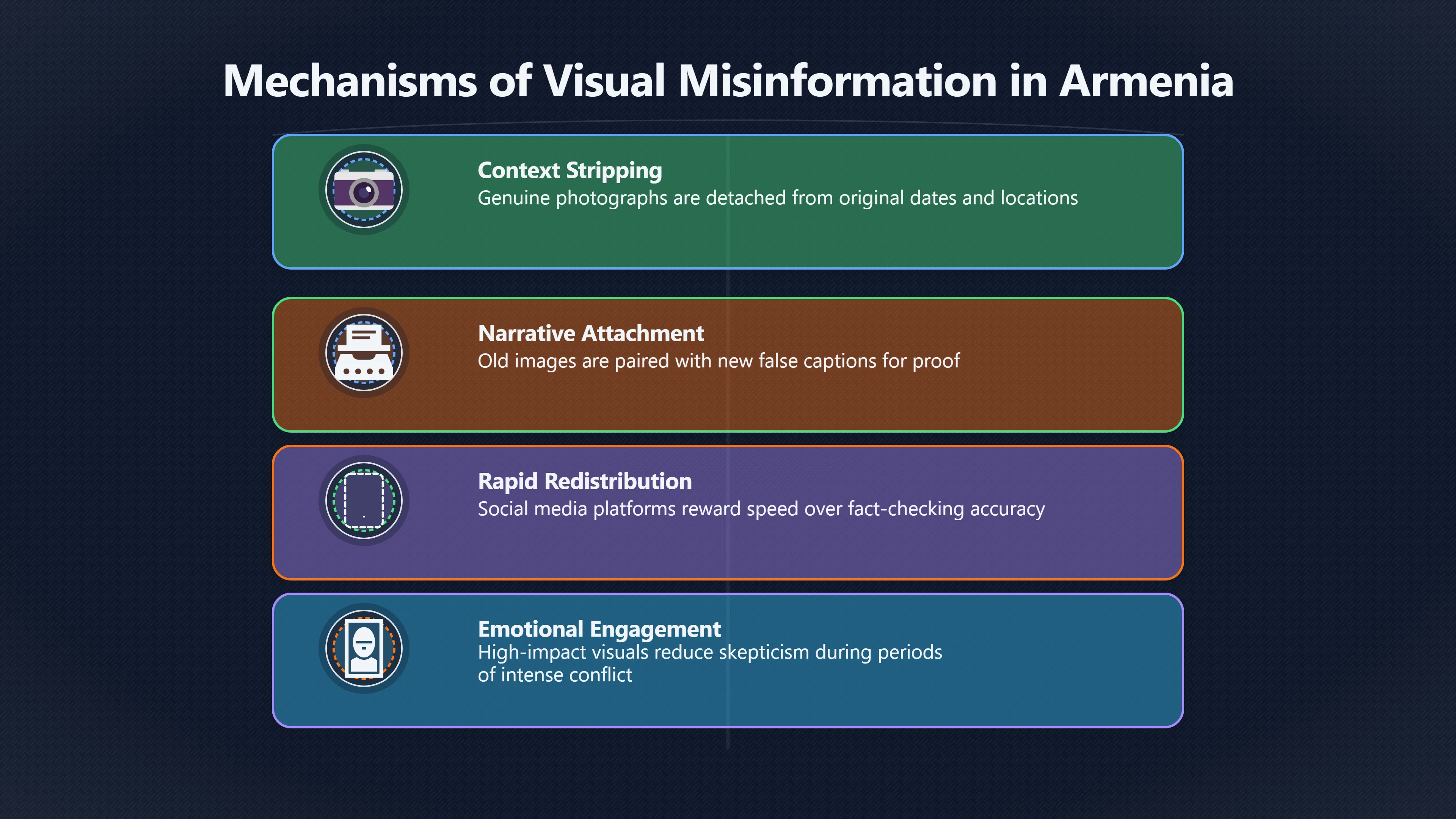
Few environments create a greater demand for instant visual evidence than armed conflict. During the Nagorno-Karabakh wars and related regional crises, photographs frequently circulated online with captions claiming to show recent attacks, military victories, atrocities or humanitarian emergencies. Many images were genuine photographs, but not necessarily from the place, date or event being claimed. Researchers studying information warfare around the conflict identified repeated examples of misleading visual material spreading through social media before verification could occur.[Jamnews in English]jam-news.netJamnews in English Misinformation in the Karabakh conflictArmenia: researchers in Yerevan and Baku used different fact-checking methods to uncover misinformation about the Karabakh conflict…
The mechanism is straightforward. A dramatic image already available online is rediscovered, stripped of its original context and attached to a new narrative. Because the photograph itself is authentic, viewers often assume the accompanying story must be authentic as well. Modern image-sharing platforms accelerate this process by rewarding speed and emotional impact rather than verification.
Several factors make recycled wartime imagery particularly persuasive:
- Photographs appear more trustworthy than anonymous text.
- Audiences often lack the time or expertise to conduct reverse-image searches.
- Emotional reactions to conflict reduce scepticism.
- Shared political or national loyalties can encourage rapid redistribution before verification.
Researchers examining misinformation connected with the Karabakh conflict noted that fact-checking increasingly depended on identifying the original source of photographs and videos, comparing publication dates, and locating earlier appearances of supposedly new material.[Jamnews in English]jam-news.netJamnews in English Misinformation in the Karabakh conflictArmenia: researchers in Yerevan and Baku used different fact-checking methods to uncover misinformation about the Karabakh conflict…
The problem is not unique to Armenia, but Armenia’s experience illustrates how quickly visual misinformation can become part of wider political narratives. Once a photograph has been shared thousands of times as proof of a particular claim, later corrections often reach a much smaller audience.
When a Photograph Creates a Person
Images can also create authority at the level of individual identity. In online environments, an unknown face can be transformed into a decorated soldier, a heroic witness, a victim of persecution or a historical figure simply by attaching a compelling biography.
This form of deception does not necessarily require photo manipulation. A real portrait may be taken from a news archive, a social-media profile or an unrelated publication and reassigned to an invented individual. The photograph functions as evidence that the person exists, even when the accompanying story is entirely fictional.
Armenia’s wartime information environment has repeatedly demonstrated the symbolic power of military imagery. Genuine photographs of soldiers, civilians and refugees can acquire lives of their own once detached from their original context. A striking image may circulate internationally while the accompanying explanation changes from account to account. The photograph becomes a visual shorthand for a broader narrative, whether or not that narrative matches the image’s actual origin.[Wikipedia]WikipediaAlbert HovhannisyanAlbert Hovhannisyan
The danger is not only the creation of false heroes or false victims. Misidentified photographs can distort public memory, attach real individuals to events they never experienced, and make later historical reconstruction more difficult. Because viewers tend to remember faces more readily than textual corrections, mistaken identifications can persist long after they have been disproved.
Forged Documents and the Appearance of Official Authority
If photographs borrow credibility from reality, forged documents borrow credibility from institutions. Seals, signatures, stamps, letterheads and bureaucratic formatting all signal authority. Even when readers do not understand a document’s technical details, they often recognise its visual cues.
Armenian authorities have periodically uncovered organised schemes involving counterfeit official documents. In one reported case, the National Security Service announced the exposure of a group involved in producing and selling forged documents that purportedly granted legal rights or exemptions from liability. The value of such documents depended not on their factual accuracy but on their ability to resemble authentic state paperwork.[Armenpress]armenpress.amArmenian national security uncovers counterfeitingArmenian national security uncovers counterfeiting…March 6, 2018 — 6 Mar 2018 — The national security service of Armenia has…
More recently, authorities investigated the sale of fraudulent vaccination certificates during the COVID-19 pandemic. Hundreds of people were reported to have obtained fake vaccination documents through healthcare workers. The certificates succeeded because they reproduced the appearance of legitimate records and could therefore pass casual inspection.[OC Media]oc-media.orgOC Media Fake vaccine passport scandal revealed in ArmeniaOC MediaFake vaccine passport scandal revealed in ArmeniaOctober 14, 2021 — 14 Oct 2021 — Over 700 people bought fake vaccine certificate…
These cases reveal an important distinction. A forged document rarely succeeds because people trust the forger. It succeeds because people trust the institution being imitated. The counterfeiter effectively rents the credibility of government agencies, medical systems, universities or courts.
Common features of forged-authority scams include:
- Official-looking logos and seals.
- Real names of institutions.
- Authentic document layouts copied from genuine examples.
- Partial use of real registration numbers or signatures.
- Claims that verification is difficult or unnecessary.
The visual language of bureaucracy can be powerful enough that many recipients focus on appearance rather than authenticity.
Why Fake Proof Travels So Easily
The effectiveness of recycled images and forged documents depends on several psychological shortcuts.
First, people often treat visual evidence as inherently more reliable than verbal testimony. A photograph appears to answer the question, “What really happened?” even when it merely illustrates a claim. Research into image-based misinformation has repeatedly shown that visual material increases perceived credibility and emotional engagement.[arXiv]arxiv.orgarXiv Fact-Checking Meets Fauxtography: Verifying Claims About ImagesarXiv Fact-Checking Meets Fauxtography: Verifying Claims About Images
Second, official formatting creates a sense of legitimacy. Most people cannot independently verify every document they encounter. Instead, they rely on visual indicators such as seals, signatures and institutional branding.
Third, conflict and crisis create strong demand for certainty. During wartime, elections, health emergencies or political disputes, audiences actively seek evidence that confirms rapidly changing events. This urgency can overwhelm normal scepticism. Studies of Armenia’s information environment have highlighted how disinformation campaigns exploit exactly these conditions.[freedomhouse.org]freedomhouse.orgDisinformation in Armenia En v3Freedom HouseDISINFORMATION AND MISINFORMATION IN ARMENIA3 Jun 2021 — Lastly, we hope to elevate the voices of Armenian analysts who are…
The result is a recurring cycle: an image or document appears, spreads rapidly, acquires endorsements from sympathetic networks, and only later faces detailed scrutiny.
How Investigators Expose False Authority
The exposure of fake proof usually relies on methods that are less dramatic than the original claim.
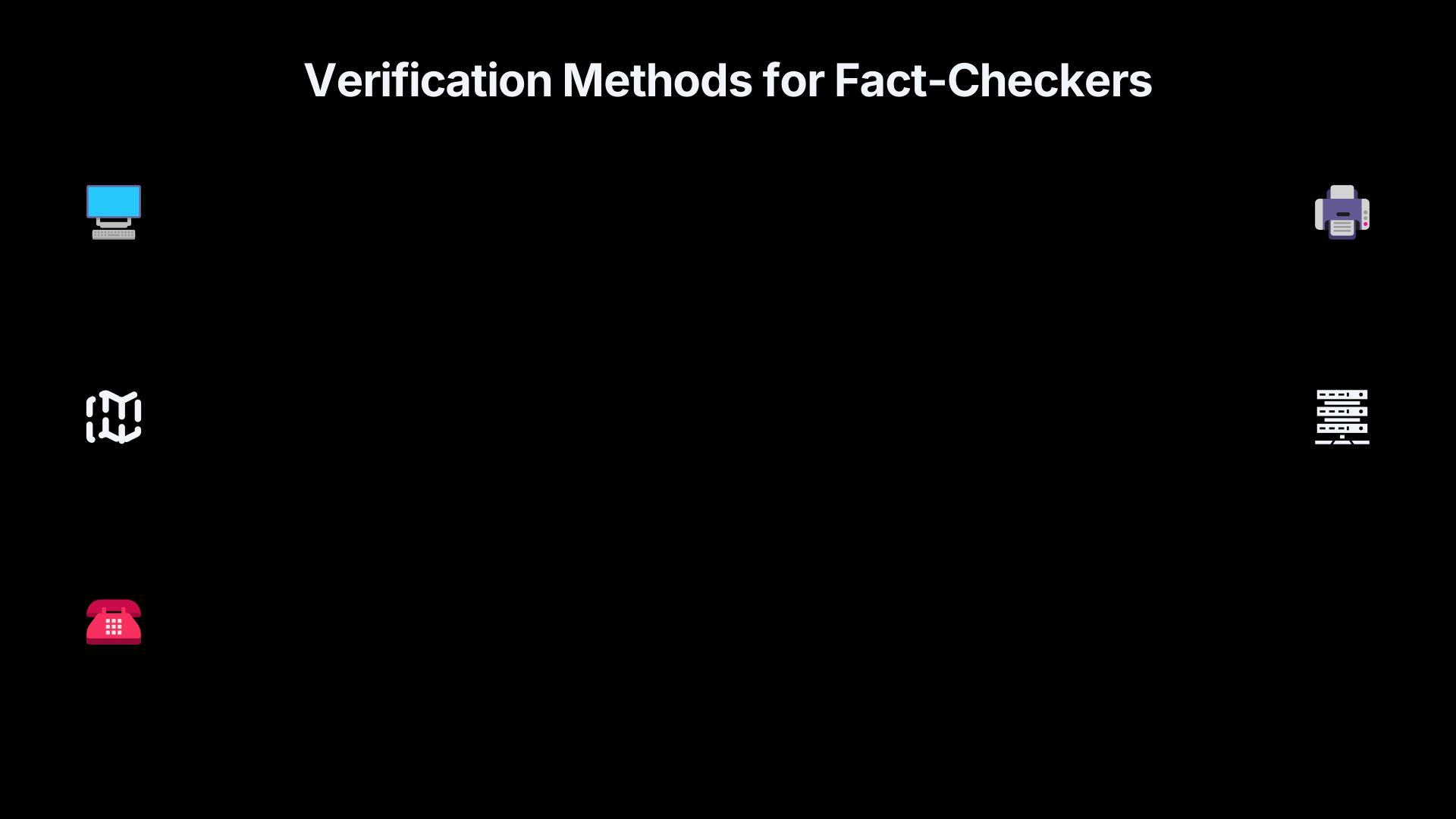
For misleading photographs, investigators often:
- Conduct reverse-image searches.
- Identify the earliest known publication.
- Compare weather, uniforms, landmarks or equipment.
- Check whether the image appeared years before the alleged event.
- Consult photographers or original publishers.
For suspicious documents, investigators examine:
- Registration numbers and databases.
- Signature authenticity.
- Metadata and printing characteristics.
- Institutional records.
- Inconsistencies in formatting or language.
These verification techniques have become increasingly important as digital editing tools improve and as forged materials circulate internationally within minutes. Armenia’s recent efforts to strengthen information integrity and expand fact-checking initiatives reflect recognition that visual misinformation and counterfeit authority are now enduring challenges rather than occasional anomalies.[Open Government Partnership]opengovpartnership.orgIn addressing this threat, Armenia pursued an “information integrity” approach…Read more…
What These Episodes Reveal
The most instructive Armenian cases are not necessarily the most elaborate forgeries. They show how little fabrication may be required when trust is already attached to a photograph or an official-looking document.
A recycled image gains influence because viewers trust cameras. A forged certificate gains influence because viewers trust institutions. In both cases, the deception works by borrowing credibility from something genuine. The photograph may be real. The document format may be authentic. The falsehood lies in the context, attribution or authority attached to it.
That makes these episodes particularly important within Armenia’s wider history of contested truth. They demonstrate that modern misinformation often succeeds not by inventing evidence from scratch, but by repurposing genuine evidence in misleading ways. The challenge for investigators is therefore not only detecting outright fabrications, but also recognising when authentic-looking proof has been detached from the reality it supposedly represents.
Amazon book picks
Further Reading
Books and field guides related to How Fake Proof Gains Authority in Armenia. Use these as the next step if you want deeper reading beyond the article.
The Demon-Haunted World
Rating: 4.5/5 from 43 Google Books ratings
Foundational guide to skepticism and evidence assessment.
Verification Handbook
Directly relevant to misleading images, documents and online claims.
eBay marketplace picks
Marketplace Samples
Live-tested eBay searches with available results related to this page.




Endnotes
1.
Source: arxiv.org
Title: arXiv Fact-Checking Meets Fauxtography: Verifying Claims About Images
Link:https://arxiv.org/abs/1908.11722
2.
Source: Wikipedia
Title: Albert Hovhannisyan
Link:https://en.wikipedia.org/wiki/Albert_Hovhannisyan
3.
Source: armenpress.am
Title: Armenian national security uncovers counterfeiting
Link:https://armenpress.am/en/article/925078
Source snippet
Armenian national security uncovers counterfeiting...March 6, 2018 — 6 Mar 2018 — The national security service of Armenia has...
Published: March 6, 2018
4.
Source: oc-media.org
Title: OC Media Fake vaccine passport scandal revealed in Armenia
Link:https://oc-media.org/fake-vaccine-passport-scandal-revealed-in-armenia/
Source snippet
OC MediaFake vaccine passport scandal revealed in ArmeniaOctober 14, 2021 — 14 Oct 2021 — Over 700 people bought fake vaccine certificate...
Published: October 14, 2021
5.
Source: time.com
Title: nagorno karabakh azerbaijan armenia
Link:https://time.com/5902290/nagorno-karabakh-azerbaijan-armenia/
6.
Source: jam-news.net
Title: Jamnews in English Misinformation in the Karabakh conflict
Link:https://jam-news.net/misinformation-in-the-karabakh-conflict-analysis-of-azerbaijani-media-from-armenia/
Source snippet
Armenia: researchers in Yerevan and Baku used different fact-checking methods to uncover misinformation about the Karabakh conflict...
7.
Source: freedomhouse.org
Title: Disinformation in Armenia En v3
Link:https://freedomhouse.org/sites/default/files/2021-06/Disinformation-in-Armenia_En-v3.pdf
Source snippet
Freedom HouseDISINFORMATION AND MISINFORMATION IN ARMENIA3 Jun 2021 — Lastly, we hope to elevate the voices of Armenian analysts who are...
8.
Source: opengovpartnership.org
Link:https://www.opengovpartnership.org/armenia-information-integrity-story/
Source snippet
In addressing this threat, Armenia pursued an “information integrity” approach...Read more...
Additional References
9.
Source: youtube.com
Link:https://www.youtube.com/watch?v=PS31_oAgxE0
Source snippet
Russian disinformation in Armenia 'neither a surprise nor effective', expert says...
10.
Source: youtube.com
Link:https://www.youtube.com/watch?v=YFGOcY9-CfI
Source snippet
Is Armenia gambling its future between Russia and the West? | Grigol Julukhidze...
11.
Source: youtube.com
Link:https://www.youtube.com/watch?v=8vGzy2fk_iQ
Source snippet
Europe, Russia, and Armenia's big choice in the elections | Anatomy of Disinformation...
12.
Source: youtube.com
Title: Turning the tables on Baku’s information warfare
Link:https://www.youtube.com/watch?v=zNDKnV4tDqs
Source snippet
Pro-Kremlin actors launch large scale disinformation campaign targeting Armenia's elections...
13.
Source: 1854.photography
Link:https://www.1854.photography/2024/05/rebecca-topakian-armenia-azerbaijan-conflict/
Source snippet
Picturing the swift and overlooked end to the Armenia-...21 May 2024 — In September 2020, an Azerbaijani offensive in the contested Nago...
Published: May 2024
14.
Source: avim.org.tr
Link:https://avim.org.tr/en/Kitaplar/FAKE-PHOTOS-AND-THE-ARMENIAN-PROPAGANDA
15.
Source: instagram.com
Link:https://www.instagram.com/reel/CGRdA9pBZIi/
16.
Source: instagram.com
Link:https://www.instagram.com/p/DZNWY14iTbR/
17.
Source: euneighbourseast.eu
Title: tackling disinformation iverify armenia platform launched in armenia
Link:https://euneighbourseast.eu/news/latest-news/tackling-disinformation-iverify-armenia-platform-launched-in-armenia/
18.
Source: youtube.com
Title: Is Armenia gambling its future between Russia and the West? | Grigol Julukhidze
Link:https://www.youtube.com/watch?v=iOhGawL5FOo
Topic Tree