How Ecuador's Strangest Hoaxes Won Belief
Ecuador’s best-known hoax stories range from a lethal radio drama to fabricated archaeological wonders, tourist science tricks and modern claims about giant humans. They did not succeed because Ecuadorians were unusually credulous.
Page outline Jump by section
Introduction
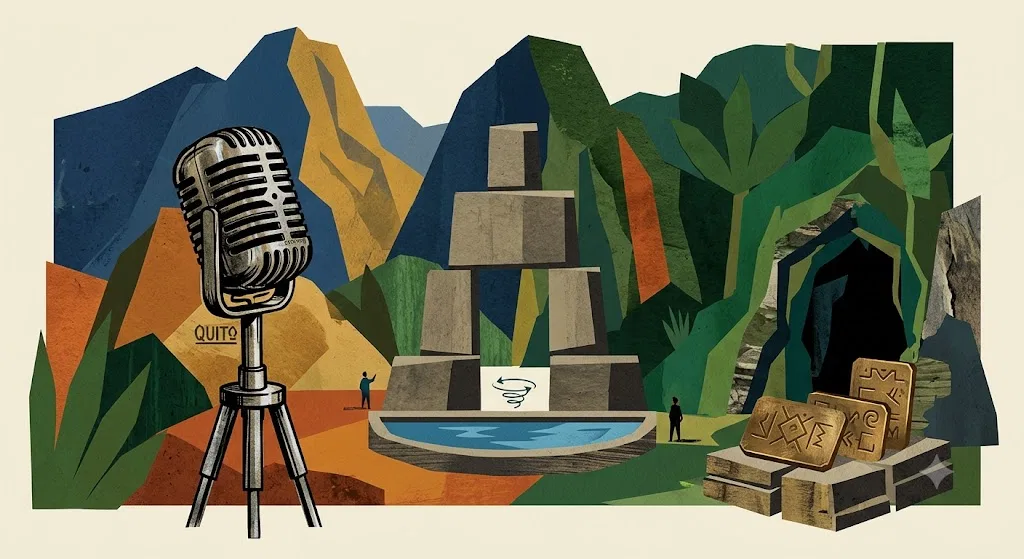
The clearest cases also differ sharply. Radio Quito’s 1949 Martian invasion was a deliberate media deception whose consequences escaped its creators’ control. The supposed metal library beneath the Amazon became a mixture of invention, dubious artefacts and profitable pseudoarchaeology. Equator demonstrations are usually theatrical tourist attractions rather than sinister frauds. Recent “giant” stories often begin with real bones or excavations before careless measurement, television spectacle and recycled images transform them into something extraordinary. Together, these episodes show that a successful hoax rarely needs to invent everything: it normally attaches one dramatic falsehood to facts that are already interesting.
The broadcast that ended in fire
On 12 February 1949, Radio Quito interrupted an evening entertainment programme with alarming reports that strange flying objects had appeared over Ecuador. Actors impersonated announcers, officials and witnesses as the supposed extraterrestrial threat moved towards Quito. The format imitated urgent news, while familiar places—including the Galápagos Islands and the district of Cotocollao—gave the fiction a local immediacy. Some reports indicate that the station’s associated newspaper, El Comercio, had helped prepare the audience by publishing earlier items about unusual objects in the sky.[Pure OAI]pure-oai.bham.ac.ukPure OAIThe war of the worlds may well start in Latin AmericaWorlds was indeed broadcast in Ecuador's capital. Radio Quito, the airing sta- tion, was destroyed in a fire…Read more…
The production was inspired by the famous 1938 American adaptation of H. G. Wells’s The War of the Worlds, but it was not simply a translated repeat. Its creators relocated the invasion to recognisable Ecuadorian settings and used the conventions of live broadcasting to make it sound current. Radio was then a particularly intimate source of information: listeners could not pause the programme, inspect its evidence or compare it instantly with competing accounts. The performance reportedly lasted only about twenty minutes before the station admitted that it was fiction.[brill.com]brill.comThe War of the Worlds May Well Start in Latin America inby LAM Cordova · 2021 · Cited by 1 — Radio Quito, the airing station, was de…
Relief quickly turned to fury. A crowd attacked the building shared by Radio Quito and El Comercio, throwing stones and then setting it alight. Paper and printing materials fed the blaze. Accounts differ over the precise death toll, generally placing it between five and eight, which is an important reminder that even this well-documented incident has acquired unstable details in retelling. Radio Quito remained off air for roughly two years.[bham.ac.uk]pure-oai.bham.ac.ukPure OAIThe war of the worlds may well start in Latin AmericaWorlds was indeed broadcast in Ecuador's capital. Radio Quito, the airing sta- tion, was destroyed in a fire…Read more…
The episode is sometimes described as proof that listeners will believe anything they hear. That interpretation is too simple. The hoax was engineered to exploit normal habits of trust: realistic interruptions, named locations, authoritative voices and the prestige of a recognised news organisation. It also removed the protective distance of ordinary drama. Listeners did not encounter Martians in a novel or theatre; they heard what sounded like an emergency developing around their own city.
The disaster further complicates the usual division between deceiver and victim. The broadcasters intended to frighten and entertain, not to cause deaths. The crowd, once informed of the trick, redirected its fear against the institution that had manipulated it. What began as a media stunt therefore became a violent crisis of trust. It remains Ecuador’s most consequential hoax because the exposure did not end the danger—it triggered its deadliest phase.
The golden library beneath the Amazon
Few Ecuadorian legends have travelled as widely as the claim that an immense artificial tunnel system beneath the Amazon contains statues, treasure and a library of metal tablets recording the knowledge of a lost civilisation. The story became attached to the Cave of the Oilbirds in Morona-Santiago Province, a real and impressive cave system long known to Indigenous communities. Its physical reality made the more extravagant additions feel possible.[Tayos]tayos.orgTayosSTAN HALL AND THE 1976 EXPEDITION. Cueva de los Tayos has been the subject of intense research, exploration, speculation and my…
The tale gained international momentum through explorer Juan Móricz and, above all, Swiss writer Erich von Däniken. In The Gold of the Gods, von Däniken presented an underground adventure involving engineered passages, extraordinary objects and metal records that he connected to ancient extraterrestrials. Yet Móricz denied having taken him on the journey described. When challenged in a 1974 interview, von Däniken conceded that the two men were each telling “half the truth”; later accounts record his admission that he had embellished or invented central elements of the cave visit.[jasoncolavito.com]jasoncolavito.complayboys 1974 von dniken interview part 5 admitting fraudJASON COLAVITOPlayboy's 1974 von Däniken Interview (Part 4)22 Feb 2012 — The conversation then turns to the cave in Ecuador where EVD cla…
The legend nevertheless acquired scientific-looking support in 1976, when a large British-Ecuadorian expedition entered the caves. More than one hundred participants were involved, including experienced cavers, military personnel and former astronaut Neil Armstrong. Their presence has repeatedly been presented online as proof that the metal library must have existed. In reality, the expedition mapped and studied a natural cave system and found material of geological, zoological and archaeological interest, but no golden library, alien archive or lost technological civilisation.[wikipedia.org]WikipediaCueva de los TayosCueva de los Tayos
Armstrong’s participation was especially valuable to later promoters. A famous astronaut supplied instant prestige even though fame is not evidence, and expertise in aviation or spaceflight does not authenticate archaeological claims. Photographs of expedition equipment, uniformed personnel and large caverns could be reused without showing the object at the heart of the story. The absence of the library was then converted into a new mystery: perhaps the explorers had searched the wrong chamber, perhaps the objects had been removed, or perhaps authorities were concealing them.
Father Crespi’s disputed objects
The cave story became entangled with the collection of Father Carlo Crespi, an Italian missionary in Cuenca who accumulated thousands of objects brought or sold to him by local people. The collection was not one uniform body of material. It reportedly included genuine archaeological and ethnographic pieces, ordinary craftwork, modern imitations and crude metal sheets engraved with motifs resembling those of distant civilisations. Crespi appears to have purchased at least some doubtful objects as a form of financial assistance to poor sellers rather than as a rigorous museum acquisition programme.[wordpress.com]fosvis.files.wordpress.comOpen source on wordpress.com.
That mixture was ideal for sensational interpretation. A photograph of one strange-looking plate could be detached from its uncertain provenance and presented as proof of contact between ancient Ecuador, Egypt, Mesopotamia or extraterrestrials. Modern tool marks, solder and cheap alloys mattered less in popular books than the visual resemblance of a symbol to something familiar from another culture. Once images were reproduced without excavation records, laboratory results or secure ownership histories, the objects became almost impossible for ordinary readers to evaluate.
It would be misleading to dismiss every item Crespi owned as fake. Some objects from his broader collection were regarded as culturally valuable, while others were plainly modern or remain poorly documented. The deception lies chiefly in treating this heterogeneous accumulation as a single authenticated archive from one secret cave. Archaeology depends heavily on context—where an object was found, in which layer, beside what other material and under whose observation. An artefact acquired from an anonymous seller without a documented excavation may be ancient, altered, recently manufactured or a combination of all three.
The metal-library legend still circulates because it offers several forms of wonder at once: hidden treasure, suppressed history, lost civilisation, Indigenous knowledge, celebrity exploration and alien visitation. Every failed search can be absorbed into the story rather than counted against it. The real cave’s unexplored passages and difficult access leave enough physical uncertainty for promoters to keep moving the alleged discovery beyond the area already examined.

Science tricks at the middle of the world
Around Quito’s equatorial attractions, visitors may be shown water draining in opposite directions a few steps north and south of a marked line. Directly on the line, it may appear to fall without forming a whirlpool. The demonstration is commonly attributed to the Coriolis effect—the deflection associated with Earth’s rotation—and therefore looks like an elegant, visible proof that the visitor is standing at latitude zero.
The underlying planetary effect is real, but the demonstration is misleading. Coriolis forces shape large, long-lasting systems such as weather patterns and ocean circulation. In a small portable basin emptied immediately after being placed on the ground, the direction of the vortex is overwhelmingly determined by the container, the motion used to fill or position it, tiny slopes and existing currents in the water. Moving the basin only a few metres across the equator does not reverse a powerful physical force. Near the equator, the relevant horizontal Coriolis effect is in fact weakest.[theguardian.com]theguardian.comThe Guardian The great plughole debate | ScienceThe Guardian The great plughole debate | Science
Carefully controlled laboratory experiments have detected Earth’s influence on draining water, but they require large symmetrical tanks, very long settling periods and exceptional protection from disturbances. Those conditions are the opposite of a rapid roadside or museum performance. A demonstrator can produce the desired spin by subtly changing how the basin is carried, set down, filled or unplugged.[The Guardian]theguardian.comThe Guardian The great plughole debate | ScienceThe Guardian The great plughole debate | Science
Other equator attractions include balancing an egg on a nail or claims that strength, balance or body weight changes dramatically on the line. Balancing an egg is possible elsewhere with patience and a suitable surface; it is not a special magnetic privilege of latitude zero. Such performances are best understood as participatory tourist theatre. Visitors receive a memorable story, a photograph and the feeling that an invisible planetary boundary has become tangible.[gadventures.com]gadventures.combusted top 3 equator line tricks debunkedbusted top 3 equator line tricks debunked
There is a further irony: the monumental line at Ciudad Mitad del Mundo does not precisely coincide with the modern satellite-defined equator. Measurements place latitude zero roughly 240 metres north of the principal monument. That discrepancy is not evidence of historical fraud. The eighteenth-century French geodesic mission worked before satellite navigation and was primarily concerned with measuring the shape of Earth, not placing a tourist line with modern precision. The later monument commemorates that scientific history rather than functioning as a perfect global-positioning marker.[Wikipedia]WikipediaCiudad Mitad del MundoCiudad Mitad del Mundo
The distinction matters because not every inaccurate attraction is a malicious hoax. The drainage show generally survives through repetition, audience expectation and commercial usefulness. Guides may themselves have learned the explanation as fact. It occupies the blurred boundary between demonstration, folklore, entertainment and pseudoscience—an error performed so convincingly that it becomes part of the destination.
How Ecuador acquired “giant” skeletons
Stories of giant prehistoric humans have long circulated across the Americas, often combining old folklore, misidentified animal fossils, exaggerated measurements and fabricated photographs. Ecuador supplies particularly persuasive scenery for such claims: it has rich palaeontological deposits, substantial pre-Columbian heritage and local traditions that can be selectively quoted as confirmation.
One widely shared set of images supposedly showed seven-metre human skeletons displayed in Ecuador. The bones were real, but they belonged to an extinct giant ground sloth, not a human being. The specimen’s large rib cage and limbs looked humanoid enough in poor photographs to encourage misidentification, especially once captions removed the museum label and supplied a sensational new description. The Associated Press traced the display and confirmed its zoological identity.[AP News]apnews.comAP News Giant humans? No, those bones belonged to giant slothsAP News Giant humans? No, those bones belonged to giant sloths
A different controversy concerned human remains recovered near Julcuy in Manabí Province in 2019 and presented in a television documentary as a possible giant. Anthropologist Nicholas Landol later reassessed the claim using established methods for estimating living stature from individual bones. Rather than supporting a height of about seven feet, his calculations placed the person at approximately 153 to 162 centimetres. The skeleton’s disarticulated condition—bones no longer joined as they were in life—had allowed an unreliable ground measurement to make the body appear much longer.[wiley.com]onlinelibrary.wiley.comOpen source on wiley.com.
This is not necessarily a straightforward case of somebody manufacturing a fake skeleton. It is better classified as sensational mismeasurement amplified by television. A real burial was found; the extraordinary conclusion came from arranging and measuring incomplete remains in a way that osteoarchaeologists do not use to estimate stature. The later loss of much of the material in flooding made independent re-examination more difficult, allowing the dramatic first impression to retain an advantage over the technical correction.[Wiley Online Library]onlinelibrary.wiley.comOpen source on wiley.com.
Online retellings often merge separate stories. A genuinely tall individual becomes a seven-foot skeleton; seven feet becomes seven metres; unrelated photographs of sculptures, animal fossils or digitally altered excavations are attached as visual proof. Similar giant-skeleton images have originated in art installations and image-manipulation contests, yet are repeatedly reassigned to Ecuador, India, Saudi Arabia or other locations.[Reuters]reuters.comGiant skeleton is not real, but part of an art exhibitionGiant skeleton is not real, but part of an art exhibition
The giant narratives also show why debunking a picture is not always enough. Believers may abandon one image while retaining the broader claim, arguing that another skeleton, cave or oral tradition remains unexplained. A stronger assessment separates the components:
- Was a physical specimen recovered?
- Is it human?
- Was it excavated and documented by qualified specialists?
- Are the bones complete and correctly articulated?
- Was height calculated from recognised anatomical methods?
- Can independent researchers inspect the material and records?
In the best-known Ecuadorian examples, the extraordinary conclusion fails one or more of these tests. Real bones and genuine cultural traditions should not be treated as fraudulent simply because promoters build unsupported claims around them.
Why these stories remain persuasive
Ecuador’s hoax history repeatedly turns on borrowed credibility. The 1949 broadcast sounded convincing because it copied news. The metal library gained authority from a real cave, a missionary’s collection and an astronaut’s expedition. Equator tricks use scientific vocabulary and a genuine geographic boundary. Giant stories begin with authentic fossils, burials or photographs before acquiring false labels and inflated measurements.
The country’s extraordinary real heritage can therefore become an asset for fakery. Ecuador does possess ancient metalworking, complex pre-Columbian societies, vast caves, unusual fossils and one of the world’s most symbolically important locations on the equator. Invented claims do not replace those facts; they parasitise them. A crude metal plate appears more plausible beside authentic antiquities, just as a misleading water demonstration feels credible beside a real latitude marker.
Commercial incentives also matter. Mystery sells books, television programmes, tours, souvenirs and online advertising. Yet financial gain is not the only motive. Crespi’s indiscriminate purchasing may partly have reflected charity. Tourist performers provide entertainment. Documentary makers face pressure to deliver a striking revelation. Social-media users receive attention for sharing material that appears to overturn accepted history. The result can be deception without a single mastermind directing it.
Finally, these cases endure because correction is usually less vivid than the original claim. “A metal library preserving alien knowledge” is easier to remember than a cave survey finding natural passages. A photograph of a towering skeleton travels faster than a paper explaining anatomical stature equations. The false story supplies a complete plot—discovery, danger, suppression and revelation—while the evidence often offers only uncertainty.
Ecuador’s famous hoaxes are therefore most revealing when examined not as tales of mass foolishness but as demonstrations of how credibility is constructed. Familiar voices, prestigious names, dramatic images and fragments of genuine history can make an unsupported claim feel established. The best defence is not automatic disbelief. It is careful attention to provenance, methods, contemporary records and the difference between what was actually found and what later storytellers said it meant.
Amazon book picks
Further Reading
Books and field guides related to How Ecuador's Strangest Hoaxes Won Belief. Use these as the next step if you want deeper reading beyond the article.
Frauds, Myths, and Mysteries: Science and Pseudoscience in Ar...
Relevant to pseudoarchaeology and fabricated discoveries.
The Demon-Haunted World
Rating: 4.5/5 from 43 Google Books ratings
Shows how extraordinary claims can mislead audiences.
The Geography of Bliss
Provides accessible regional context for readers interested in Ecuador.
eBay marketplace picks
Marketplace Samples
Live-tested eBay searches with available results related to this page.


Endnotes
1.
Source: pure-oai.bham.ac.uk
Title: Pure OAIThe war of the worlds may well start in Latin America
Link:https://pure-oai.bham.ac.uk/ws/files/148233125/_24056480_Journal_of_World_Literature_The_War_of_the_Worlds_May_Well_Start_in_Latin_America.pdf
Source snippet
Worlds was indeed broadcast in Ecuador's capital. Radio Quito, the airing sta- tion, was destroyed in a fire...Read more...
2.
Source: brill.com
Link:https://brill.com/view/journals/jwl/6/3/article-p414_9.xml?language=en&srsltid=AfmBOoqtHyaytT8ButrmQqJyX9Q16r5yjdHZKuE408q_KeTADtDEp5nb
Source snippet
The War of the Worlds May Well Start in Latin America inby LAM Cordova · 2021 · Cited by 1 — Radio Quito, the airing station, was de...
3.
Source: radiolab.org
Title: 91624 could it happen again and again
Link:https://radiolab.org/podcast/91624-could-it-happen-again-and-again
Source snippet
Could It Happen Again? (And Again?)In 1949, when Radio Quito decided to translate the Orson Welles stunt for an Ecuadorian audience, no o...
4.
Source: tayos.org
Link:https://www.tayos.org/
Source snippet
TayosSTAN HALL AND THE 1976 EXPEDITION. Cueva de los Tayos has been the subject of intense research, exploration, speculation and my...
5.
Source: Wikipedia
Title: Cueva de los Tayos
Link:https://en.wikipedia.org/wiki/Cueva_de_los_Tayos
6.
Source: jasoncolavito.com
Title: playboys 1974 von dniken interview part 5 admitting fraud
Link:https://www.jasoncolavito.com/blog/playboys-1974-von-dniken-interview-part-5-admitting-fraud
Source snippet
JASON COLAVITOPlayboy's 1974 von Däniken Interview (Part 4)22 Feb 2012 — The conversation then turns to the cave in Ecuador where EVD cla...
7.
Source: Wikipedia
Title: Erich von Däniken
Link:https://en.wikipedia.org/wiki/Erich_von_D%C3%A4niken
8.
Source: books.google.com
Title: Books Tayos Gold: The Archives of Atlantis
Link:https://books.google.com/books/about/Tayos_Gold.html?id=vIoVD1dVYK4C
9.
Source: fosvis.files.wordpress.com
Link:https://fosvis.files.wordpress.com/2015/04/the-crespi-ancient-artifact-collection-of-cuenca-ecuador-compiled-by-glen-w-chapman-nov-1998.pdf
10.
Source: ancient-origins.net
Title: truth about father crespi and his missing artifacts finally revealed 005498
Link:https://www.ancient-origins.net/news-general/truth-about-father-crespi-and-his-missing-artifacts-finally-revealed-005498
11.
Source: Wikipedia
Title: Coriolis force
Link:https://en.wikipedia.org/wiki/Coriolis_force
12.
Source: Wikipedia
Title: Ciudad Mitad del Mundo
Link:https://en.wikipedia.org/wiki/Ciudad_Mitad_del_Mundo
13.
Source: onlinelibrary.wiley.com
Link:https://onlinelibrary.wiley.com/doi/abs/10.1002/oa.3296
14.
Source: iflscience.com
Title: a giants skeleton unearthed in ecuador dont believe the hype 73509
Link:https://www.iflscience.com/a-giants-skeleton-unearthed-in-ecuador-dont-believe-the-hype-73509
15.
Source: onlinelibrary.wiley.com
Link:https://onlinelibrary.wiley.com/doi/10.1002/oa.3296
16.
Source: reuters.com
Title: Giant skeleton is not real, but part of an art exhibition
Link:https://www.reuters.com/article/fact-check/giant-skeleton-is-not-real-but-part-of-an-art-exhibition-idUSL2N2OD161/
17.
Source: archive.org
Title: Summer 1949 Radio Amateur Callbook Foreign djvu.txt
Link:https://archive.org/stream/Summer_1949_Radio_Amateur_Callbook/Summer_1949_Radio_Amateur_Callbook_Foreign_djvu.txt
18.
Source: archive.org
Title: Practical Antenna Handbook
Link:https://archive.org/download/fea_Practical_Antenna_Handbook/Practical_Antenna_Handbook.pdf
19.
Source: ia801504.us.archive.org
Link:https://ia801504.us.archive.org/29/items/lost-cities-of-the-ancients-ed-4f-647c-00fe-56254085b-971cff-4a-72e-annas-archive/lost%20cities%20of%20the%20ancients%20–%20ed4f647c00fe56254085b971cff4a72e%20–%20Anna%E2%80%99s%20Archive.pdf
20.
Source: archive.org
Link:https://archive.org/stream/B-001-014-153/B-001-014-153_djvu.txt
21.
Source: dn720002.ca.archive.org
Title: ABYA POST COLOMBIAN
Link:https://dn720002.ca.archive.org/0/items/abya-post-colombian/ABYA%20POST%20COLOMBIAN.pdf
22.
Source: dn790009.ca.archive.org
Title: In Search Of The Amazon
Link:https://dn790009.ca.archive.org/0/items/InSearchOfTheAmazon/InSearchOfTheAmazon.pdf
23.
Source: archive.org
Title: SAFO 157 djvu.txt
Link:https://archive.org/stream/alan_147/SAFO%20157_djvu.txt
24.
Source: dn720207.ca.archive.org
Link:https://dn720207.ca.archive.org/0/items/averybrundagecol00bric/averybrundagecol00bric.pdf
25.
Source: archive.org
Link:https://archive.org/download/AMIGOE-1987-03-28/AMIGOE-1987-03-28.pdf
26.
Source: archive.org
Link:https://archive.org/stream/bulletinofpaname7440pana/bulletinofpaname7440pana_djvu.txt
27.
Source: amazon.de
Link:https://www.amazon.de/Tayos-Gold-Archives-Stan-Hall/dp/1931882673?tag=searcht-20
28.
Source: Wikipedia
Title: Giant human skeletons
Link:https://en.wikipedia.org/wiki/Giant_human_skeletons
29.
Source: Wikipedia
Title: National Museum of Ecuador
Link:https://en.wikipedia.org/wiki/National_Museum_of_Ecuador
30.
Source: onlinelibrary.wiley.com
Link:https://onlinelibrary.wiley.com/toc/10991212/2024/34/2
31.
Source: skepticalinquirer.org
Link:https://skepticalinquirer.org/wp-content/uploads/sites/29/1977/10/p22.pdf
32.
Source: theguardian.com
Title: The Guardian The great plughole debate | Science
Link:https://www.theguardian.com/science/2003/nov/13/research.science
33.
Source: skepticalinquirer.org
Title: ecuadorian equatorial pseudoscience
Link:https://skepticalinquirer.org/exclusive/ecuadorian-equatorial-pseudoscience/
34.
Source: gadventures.com
Title: busted top 3 equator line tricks debunked
Link:https://www.gadventures.com/blog/busted-top-3-equator-line-tricks-debunked/
35.
Source: apnews.com
Title: AP News Giant humans? No, those bones belonged to giant sloths
Link:https://apnews.com/article/fact-check-image-skeleton-human-giant-sloth-200507510155
36.
Source: theguardian.com
Title: fake news stories clicks fact checking
Link:https://www.theguardian.com/media/2016/apr/17/fake-news-stories-clicks-fact-checking
Additional References
37.
Source: youtube.com
Title: Viral video sparks claims that water spins in reverse south of the equator
Link:https://www.youtube.com/watch?v=O3_v0Ujebd8
Source snippet
THE TAYOS MYSTERY: The Brutal Truth About the GOLD That Science Doesn't Want You to See...
38.
Source: radioambulante.org
Title: the extraterrestrials repeat translation
Link:https://radioambulante.org/en/translation/the-extraterrestrials-repeat-translation
Source snippet
The station Radio Quito was transmitting a recreation of “The War of the Worlds,” and people were...Read more...
39.
Source: youtube.com
Link:https://www.youtube.com/watch?v=gFPV0k4UZQs
Source snippet
Exploration of La Cueva de los Tayos in 1976...
40.
Source: youtube.com
Link:https://www.youtube.com/watch?v=kXmep2gp8w8
Source snippet
Archaeologists have found 5000 year old giants | 15 Shocking Discoveries of Giants in History...
41.
Source: youtube.com
Title: Real Archaeology vs Giant Conspiracy Theories
Link:https://www.youtube.com/watch?v=bU2NWOkGUBQ
Source snippet
Viral video sparks claims that water spins in reverse south of the equator...
42.
Source: researchgate.net
Link:https://www.researchgate.net/publication/373769263_Anthropology_of_forgery_A_multidisciplinary_approach_to_the_study_of_archaeological_fakes
43.
Source: researchgate.net
Link:https://www.researchgate.net/publication/389809547_Some_Highlights_From_2024_A_Year_in_Review_at_the_International_Journal_of_Osteoarchaeology
44.
Source: facebook.com
Link:https://www.facebook.com/groups/149844915349213/posts/2118759815124370/
45.
Source: scribd.com
Link:https://www.scribd.com/doc/132576784/Crespi-gold-tresure
46.
Source: facebook.com
Link:https://www.facebook.com/groups/648677616005071/posts/1599321910940632/
Topic Tree
Follow this branch
Related pages 192
- Albanian Hoaxes
- Algerian Hoaxes
- Antigua Deceptions
- Argentina Hoaxes
- Armenian Hoaxes
- +187 more in sidebar