Within Ecuador Hoaxes
Why Radio Quito's Martian Hoax Turned Deadly
A realistic alien-invasion broadcast exploited trusted news formats, then provoked a fatal attack when listeners discovered the deception.
On this page
- How the invasion broadcast imitated breaking news
- Why familiar places and trusted voices made it believable
- How exposure triggered fire, deaths and a crisis of trust
Page outline Jump by section
Introduction
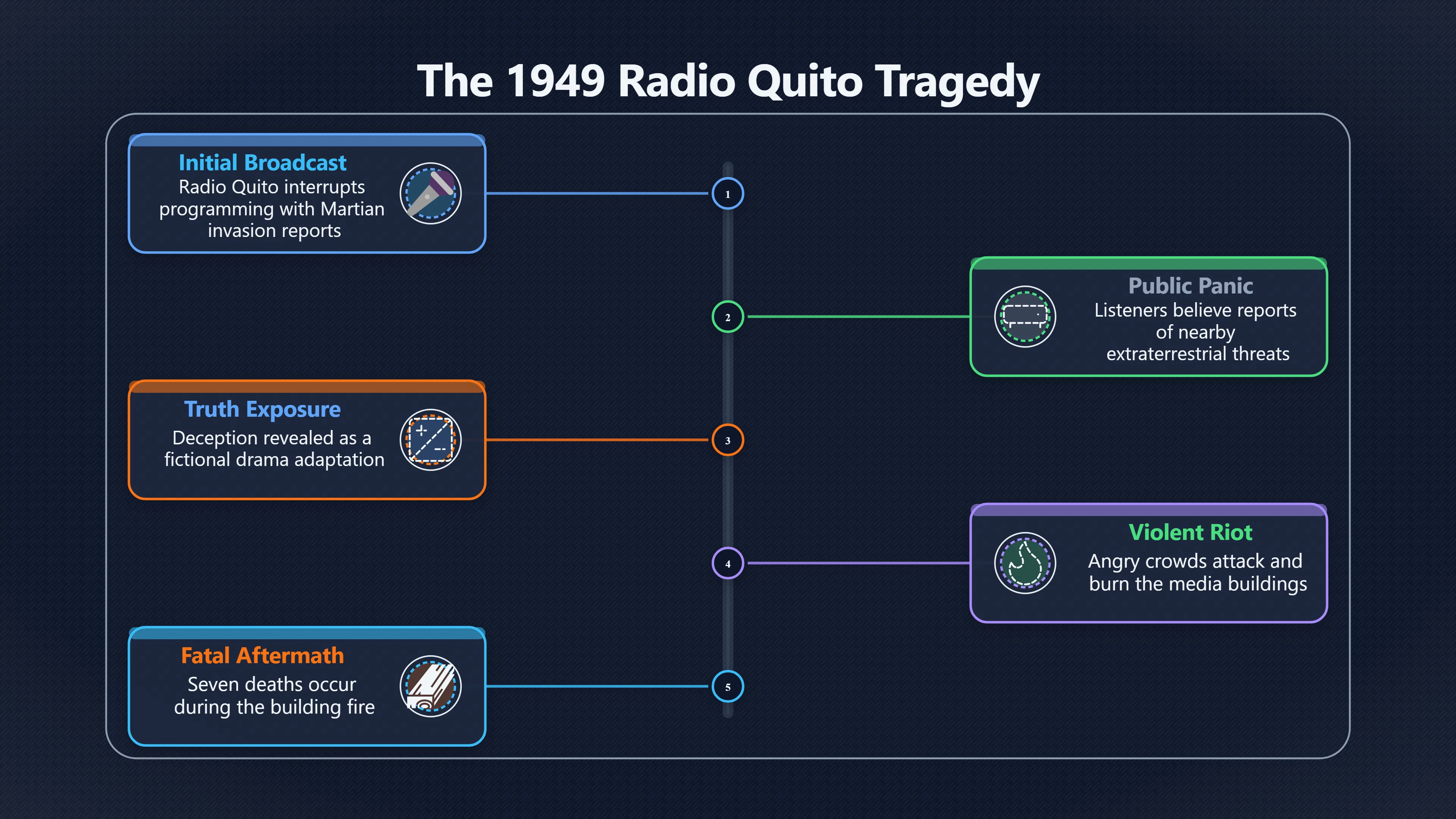
On the evening of 12 February 1949, listeners in Quito heard what sounded like an unfolding national emergency. Radio Quito interrupted its normal programming with urgent reports that strange craft had appeared over Ecuador and that hostile beings from Mars were advancing towards the capital. The broadcast was a local adaptation of H. G. Wells’s The War of the Worlds, presented in the style of live breaking news rather than obvious fiction. For a short time many listeners believed the reports were genuine. When the deception was revealed, fear rapidly turned into anger. A crowd attacked the building housing Radio Quito and the newspaper El Comercio, setting it on fire. Several people died, making the Ecuadorian incident one of the deadliest consequences of a media hoax anywhere in the world.[Radiolab]radiolab.org91624 could it happen again and againCould It Happen Again? (And Again?)In 1949, when Radio Quito decided to translate the Orson Welles stunt for an Ecuadorian audien…
The episode remains important not simply because people were frightened by a fictional invasion. Its lasting significance lies in what happened after the truth emerged. The disaster became a dramatic lesson in the power of trusted media, the dangers of realistic deception, and the consequences of breaking the audience’s trust.[Radiolab]radiolab.org91624 could it happen again and againCould It Happen Again? (And Again?)In 1949, when Radio Quito decided to translate the Orson Welles stunt for an Ecuadorian audien…
How the invasion broadcast imitated breaking news
The creators did not present the programme as a conventional drama. Inspired by the famous 1938 American radio adaptation associated with Orson Welles, Radio Quito’s production used the language and structure of emergency reporting. Regular programming was interrupted by urgent bulletins, eyewitness accounts and supposedly authoritative updates describing unidentified objects and an approaching extraterrestrial threat.[radiolab.org]radiolab.org91624 could it happen again and againCould It Happen Again? (And Again?)In 1949, when Radio Quito decided to translate the Orson Welles stunt for an Ecuadorian audien…
What made the deception effective was its localisation. Rather than describing events in distant places, the script placed the invasion inside recognisable Ecuadorian geography. Reports referred to familiar locations, including the Galápagos Islands and areas near Quito, making the crisis feel immediate rather than fantastical. Listeners were not hearing about aliens on another continent; they were hearing about a danger apparently moving through places they knew.[Time]time.comRadio: Martians & Wild AnimalsBased on H. G. Wells's fantasy, The War of the Worlds, the program whipped along from newsflash to fake…
Some accounts also note that El Comercio, which was linked to the radio station, had published stories about unusual objects in the sky before the broadcast. Whether these reports were intended as part of the promotion or simply contributed to the atmosphere, later retellings often cite them as helping to make the drama more convincing.[Wikipedia]WikipediaThe War of the Worlds (1938 radio dramaThe War of the Worlds (1938 radio drama
Why familiar places and trusted voices made it believable
The Quito broadcast succeeded because it exploited ordinary habits of trust rather than extraordinary gullibility. Radio occupied a unique position in the late 1940s. For many people it was the fastest and most authoritative source of news. Unlike modern audiences, listeners could not instantly check alternative sources online or compare reports across dozens of platforms.[Radiolab]radiolab.org91624 could it happen again and againCould It Happen Again? (And Again?)In 1949, when Radio Quito decided to translate the Orson Welles stunt for an Ecuadorian audien…
Several factors increased the programme’s credibility:
- Trusted broadcasters: The voices delivering the reports belonged to a respected station known for news and public information.
- Recognisable locations: Mentioning real Ecuadorian places gave the story a sense of authenticity.
- Emergency format: The interruption of entertainment programming mimicked genuine crisis coverage.
- Apparent official confirmation: The script included figures presented as authorities and witnesses, creating the impression of independent verification.[Time]time.comRadio: Martians & Wild AnimalsBased on H. G. Wells's fantasy, The War of the Worlds, the program whipped along from newsflash to fake…
The result was a powerful illusion. Listeners were not asked to imagine a Martian invasion as a piece of fiction. Instead, they were encouraged to experience it as a developing event. The broadcast borrowed the authority of journalism while temporarily concealing its identity as drama.[Radiolab]radiolab.org91624 could it happen again and againCould It Happen Again? (And Again?)In 1949, when Radio Quito decided to translate the Orson Welles stunt for an Ecuadorian audien…

How exposure triggered fire, deaths and a crisis of trust
The most remarkable feature of the incident is that the deadliest phase began after the hoax was exposed. Once listeners realised they had been deceived, panic gave way to outrage. Many felt that a trusted institution had deliberately manipulated them, causing fear for their families and communities.[Radiolab]radiolab.org91624 could it happen again and againCould It Happen Again? (And Again?)In 1949, when Radio Quito decided to translate the Orson Welles stunt for an Ecuadorian audien…
Crowds gathered outside the building shared by Radio Quito and El Comercio. Stones were thrown, and the confrontation escalated into arson. The building caught fire, fuelled by paper, printing materials and office contents. Contemporary and later accounts vary on the exact number of fatalities, but most estimates place the death toll between five and eight people. A commonly cited figure is seven deaths.[radiolab.org]radiolab.org91624 could it happen again and againCould It Happen Again? (And Again?)In 1949, when Radio Quito decided to translate the Orson Welles stunt for an Ecuadorian audien…
The violence affected people directly connected to the production as well as others inside the building. Later accounts report that individuals close to the programme’s creators were among those who died in the blaze. Radio Quito itself suffered severe damage and remained off the air for roughly two years.[Reddit]reddit.comThe radio dramatization of HG Well's "War of the Worlds…The riot resulted in at least seven deaths, including those of Paez's gi…
This sequence of events distinguishes the Quito case from many other famous media scares. In most hoaxes, exposure ends the danger. In Quito, exposure created a second and more destructive crisis. The audience’s anger at being misled became more consequential than the original fear of Martians.[Radiolab]radiolab.org91624 could it happen again and againCould It Happen Again? (And Again?)In 1949, when Radio Quito decided to translate the Orson Welles stunt for an Ecuadorian audien…
Was it really a hoax?
The event is often described as a hoax, but the label requires some nuance. The broadcast was certainly designed to deceive listeners temporarily by presenting fiction as news. However, there is little evidence that its creators intended to provoke violence or deaths. Their apparent goal was to recreate the dramatic realism that had made earlier War of the Worlds adaptations famous.[Radiolab]radiolab.org91624 could it happen again and againCould It Happen Again? (And Again?)In 1949, when Radio Quito decided to translate the Orson Welles stunt for an Ecuadorian audien…
This distinction matters because the Quito episode sits at the boundary between several categories:
- A radio drama, because it was based on a fictional story.
- A media stunt, because realism was central to its appeal.
- A deception, because listeners were initially encouraged to believe the reports were genuine.
- A public-trust failure, because the strongest reaction came when the audience realised it had been manipulated.[Radiolab]radiolab.org91624 could it happen again and againCould It Happen Again? (And Again?)In 1949, when Radio Quito decided to translate the Orson Welles stunt for an Ecuadorian audien…
For historians of hoaxes and misinformation, the case is less about belief in aliens than about belief in institutions. The Martians were fictional; the trust placed in the broadcaster was real.
Why claims about Radio Quito remained persuasive
The Radio Quito incident continues to appear in discussions of media ethics, misinformation and public panic because it offers an unusually stark example of the relationship between credibility and responsibility. Unlike many famous hoaxes, it did not depend on forged artefacts, fake photographs or pseudoscientific claims. Its power came from the format itself. The deception worked because it sounded exactly like the kind of information people relied upon during genuine emergencies.[Radiolab]radiolab.org91624 could it happen again and againCould It Happen Again? (And Again?)In 1949, when Radio Quito decided to translate the Orson Welles stunt for an Ecuadorian audien…
The story is also frequently compared with the 1938 American War of the Worlds broadcast. Yet the comparison highlights an important difference. Debate continues over how much panic the American programme actually caused, whereas the consequences in Quito were concrete and devastating: a riot, a fire, multiple deaths and the temporary destruction of a major broadcaster.[Wikipedia]WikipediaThe War of the Worlds (1938 radio dramaThe War of the Worlds (1938 radio drama
Within Ecuador’s history of hoaxes and contested truths, Radio Quito remains a defining case because it demonstrates how realism, authority and local detail can make fiction persuasive—and how the collapse of trust can prove more dangerous than the original deception.[Radio Ambulante]radioambulante.orgthe extraterrestrials repeatRadio AmbulanteThe Extraterrestrials [Repeat]31 Dec 2024 — On February 1949, Radio Quito broadcasted an adaptation of H.G. Wells' War of…
Amazon book picks
Further Reading
Books and field guides related to Why Radio Quito's Martian Hoax Turned Deadly. Use these as the next step if you want deeper reading beyond the article.
Amusing Ourselves to Death
Provides context on trust, broadcasting and public perception.
eBay marketplace picks
Marketplace Samples
Live-tested eBay searches with available results related to this page.
Endnotes
1.
Source: radiolab.org
Title: 91624 could it happen again and again
Link:https://radiolab.org/podcast/91624-could-it-happen-again-and-again
Source snippet
Could It Happen Again? (And Again?)In 1949, when Radio Quito decided to translate the Orson Welles stunt for an Ecuadorian audien...
2.
Source: time.com
Link:https://time.com/archive/6607399/radio-martians-wild-animals/
Source snippet
Radio: Martians & Wild AnimalsBased on H. G. Wells's fantasy, The War of the Worlds, the program whipped along from newsflash to fake...
3.
Source: Wikipedia
Title: The War of the Worlds (1938 radio drama)
Link:https://en.wikipedia.org/wiki/The_War_of_the_Worlds_%281938_radio_drama%29
4.
Source: reddit.com
Link:https://www.reddit.com/r/HistoryMemes/comments/17jy11k/the_radio_dramatization_of_hg_wells_war_of_the/
Source snippet
The radio dramatization of HG Well's "War of the Worlds...The riot resulted in at least seven deaths, including those of Paez's gi...
5.
Source: Wikipedia
Link:https://en.wikipedia.org/wiki/Radio
6.
Source: reddit.com
Title: til in 1949 a spanishlanguage version of orson
Link:https://www.reddit.com/r/todayilearned/comments/1ji8hr0/til_in_1949_a_spanishlanguage_version_of_orson/
7.
Source: radioambulante.org
Title: the extraterrestrials repeat
Link:https://radioambulante.org/en/audio-en/the-extraterrestrials-repeat
Source snippet
Radio AmbulanteThe Extraterrestrials [Repeat]31 Dec 2024 — On February 1949, Radio Quito broadcasted an adaptation of H.G. Wells' War of...
Published: February 1949
8.
Source: radioambulante.org
Title: the extraterrestrials repeat translation
Link:https://radioambulante.org/en/translation/the-extraterrestrials-repeat-translation
Source snippet
The station Radio Quito was transmitting a recreation of “The War of the Worlds,” and people were...Read more...
Additional References
9.
Source: radio-philippines.com
Link:https://www.radio-philippines.com/
Source snippet
Radio Philippines: Listen to Live FM & Online StationsListen to live FM radio in the Philippines. Discover top internet radio stations, A...
10.
Source: youtube.com
Link:https://www.youtube.com/watch?v=WP1RCBV7axk
Source snippet
Radio Quito 1949 War of the Worlds Tragedia en RADIO QUITO 1949 (La guerra de los mundos) | Caso Real #18 | TopsyKretts Topsy Kretts...
11.
Source: youtube.com
Title: The Broadcast That Terrified A Nation
Link:https://www.youtube.com/watch?v=VKralXDreqk
Source snippet
The War of the Worlds (1938) – Orson Welles' Legendary Radio Broadcast...
12.
Source: medium.com
Title: Aliens Are Here!
Link:https://medium.com/%40jfbermeo/aliens-are-here-the-war-of-the-worlds-happened-in-quito-10-years-later-601b04ca6f69
Source snippet
The War of the Worlds Happened in QuitoThen — not 9 years later, but about 11 — a similar broadcast in Quito, Ecuador (1949) triggered pa...
13.
Source: kensingtonbooks.com
Link:https://www.kensingtonbooks.com/5-things-i-didnt-know-about-the-1949-war-of-the-worlds-incident-in-ecuador-with-author-lorena-hughes/
14.
Source: aldianews.com
Link:https://aldianews.com/en/culture/heritage-and-history/other-war-worlds
15.
Source: newspapers.com
Link:https://www.newspapers.com/article/3096220/war_of_the_worlds_radio_broadcast/
16.
Source: youtube.com
Title: OLMEDO TORRES Y POLIBIO MAYORGA
Link:https://www.youtube.com/watch?v=BKrKcvvUEeo
Source snippet
The Broadcast That Terrified A Nation - Inside A Mind...
17.
Source: youtube.com
Link:https://www.youtube.com/watch?v=4Uv61eClS88
Source snippet
OLMEDO TORRES Y POLIBIO MAYORGA - Mi Paisa...
18.
Source: youtube.com
Title: “H.G. Wells in Ecuador”, by literary historian Michael Henrik Wynn
Link:https://www.youtube.com/watch?v=DqDfYMxUTD0
Source snippet
The 1949 Radio Panic That Shook Quito...
Topic Tree