How Nigeria's Most Famous Deceptions Worked
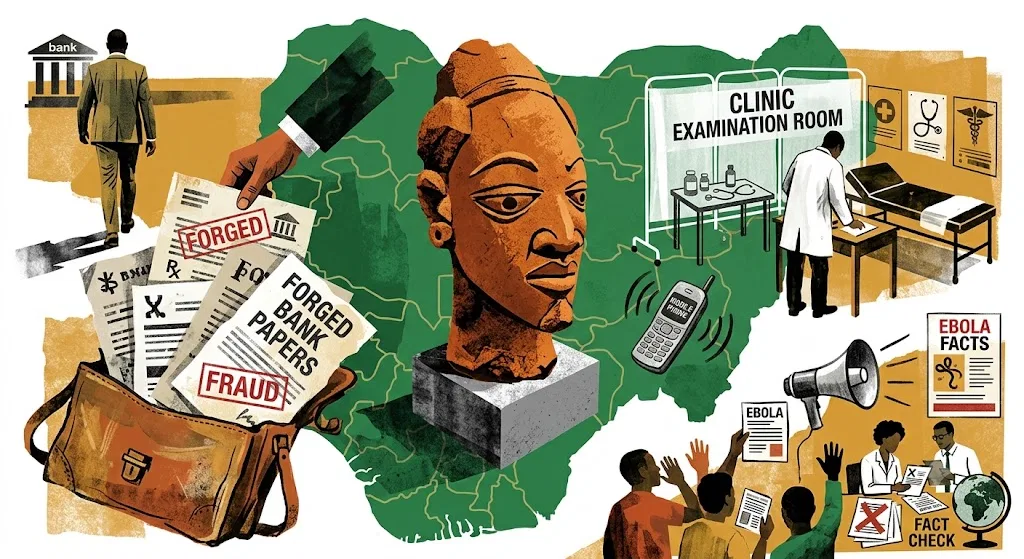
Nigeria’s best-known history of deception is not one story but a series of very different cases: forged Nok antiquities sold into the international art market, advance-fee fraud dressed up as secret government business, dangerous health rumours, fake pregnancies linked to baby trafficking, and political fabrications spread through radio, WhatsApp and...
Page outline Jump by section
Introduction
The most revealing cases share a common mechanism. They borrow credibility from institutions people already recognise — museums, banks, ministries, hospitals, churches or the presidency — and then place the victim under emotional pressure. Greed, desperation, illness, infertility and political distrust can all make weak evidence feel persuasive. Nigeria has also produced determined responses: archaeological testing, police investigations, public-health communication and collaborative fact-checking. These episodes therefore tell a larger story about how authority is imitated, how rumours become profitable and why exposure does not always make a false belief disappear.
When ancient Nigerian art became a forger’s market
Nok terracotta sculpture presents one of the clearest Nigerian examples of forgery becoming entangled with genuine cultural heritage. The Nok tradition, centred in what is now central Nigeria, produced large terracotta figures roughly 2,500 years ago. Their age, striking appearance and comparative rarity eventually made them highly desirable to museums and private collectors.[OUP Academic]oxfordre.comOUP AcademicThe Archaeology of Nok Culture in Nigeria (2nd/1st…30 Jan 2024 — With an age of around 2,500 years, the Nok terracotta fig…
That demand created two related problems. Genuine pieces were illegally excavated and removed without proper archaeological records, while workshops manufactured new objects intended to resemble ancient ones. According to research on the illicit antiquities trade, many supposedly complete Nok figures entering the market before the 1990s were fake; authentic discoveries were more often damaged fragments. Some forgers used clay from the Nok region and copied traditional production methods. Others assembled unrelated ancient fragments into apparently complete sculptures.[link.mellonfellows.high.org]link.mellonfellows.high.orgnok sculpturesby K Jones — Nok Artist, Nigeria, ca. 1000 BCE, terra-cotta, High Museum of Art, a new national museum had opened. Nok Terracottas, 11–18…
The deception worked because buyers wanted recognisable masterpieces rather than broken objects with uncertain histories. A complete, expressive head was easier to display and sell than a box of fragments, even though the fragments might have been archaeologically genuine. The international market therefore rewarded precisely the qualities that should have raised suspicion: completeness, dramatic form and lack of a documented excavation history.
Scientific testing helped, but it did not provide a perfect solution. Thermoluminescence testing can estimate when fired clay was last heated, making it useful for distinguishing an ancient terracotta from a recently made imitation. Forgers responded by incorporating genuinely old material or fragments into reconstructed objects, complicating the laboratory result. A test might establish that part of an object was ancient without proving that the sculpture, in its present form, was authentic.[Enact Africa]enact-africa.s3.amazonaws.comIn response, it became necessaryEnact AfricaC A SE STUD YNovember 12, 2020 — by J Stanyard · 2020 · Cited by 4 — The entry of looted Nok objects onto antiquities markets…
The Nok case is therefore more than an art-world curiosity. Looting destroys the archaeological setting that could establish where an object was found and what it was associated with. Once that context is gone, scholars face a mixed stream of genuine, restored, composite and wholly fabricated pieces. The result is both commercial fraud and damage to knowledge: even an authentic object becomes harder to interpret when its excavation history has been erased.[zammagazine.com]zammagazine.comInside the illicit trade in West Africa's oldest artworksNow they are at the centre of a multi-million dollar, globe-spanning…Read more…

How “419” turned bureaucracy into theatre
The fraud most closely associated with Nigeria internationally is advance-fee fraud, commonly called “419” after the section of Nigeria’s criminal law dealing with obtaining property by false pretences. Its familiar promise is simple: a stranger claims to control a fortune but needs the recipient’s help — and a comparatively small payment — to release or transfer it. Once the first fee is paid, new taxes, legal charges, certificates or emergencies appear. The promised fortune never arrives.[issafrica.s3.amazonaws.com]issafrica.s3.amazonaws.comDemystifying the advance‐fee fraud criminal networkDecember 2, 2009 — by OB Simon · Cited by 10 — The early letters, which were based on an inflated contract sum waiting to be claimed from…
The scheme was not invented from nothing in Nigeria. It belongs to a much older family of confidence tricks, including the “Spanish prisoner” story, in which a victim was promised a reward for helping to free a supposedly wealthy captive. Nigerian versions became especially visible during the late twentieth century, first through letters and faxes and then through email. Early scripts often referred to inflated government contracts, oil revenues, dormant bank accounts or money supposedly trapped by political upheaval.[amazonaws.com]issafrica.s3.amazonaws.comDemystifying the advance‐fee fraud criminal networkDecember 2, 2009 — by OB Simon · Cited by 10 — The early letters, which were based on an inflated contract sum waiting to be claimed from…
The famous “Nigerian prince” is only one variation, and often not the most convincing one. More elaborate operations have created fake officials, lawyers and bank employees, complete with forged documents, seals, websites and telephone numbers. Different members of a group may play separate roles, giving the impression that several independent institutions have verified the same transaction. The criminal performance resembles a small bureaucracy assembled around the victim.[Wikipedia]WikipediaAdvance-fee scamAdvance-fee scam
A crucial part of the trap is moral compromise. Many scripts invite the recipient to assist with hiding money, impersonating an heir or evading official controls. The victim’s expectation of an illicit windfall can discourage them from seeking advice or reporting the crime. Each additional payment is then framed as the final obstacle between the victim and a life-changing reward.
Email transformed the economics of the fraud. A postal operation had printing and delivery costs; an email campaign could reach enormous numbers of people cheaply. The response rate did not need to be high. A tiny proportion of recipients willing to continue could sustain the scheme, particularly when fraudsters concentrated their attention on those who had already paid once.[University of Warwick]warwick.ac.ukOpen source on warwick.ac.uk.
The international label has also distorted perceptions of Nigeria. Advance-fee fraud operates across borders, and Nigerian authorities have investigated and prosecuted it. Yet the phrase “Nigerian scam” became so familiar that it encouraged a caricature of an entire country rather than an understanding of a particular criminal method. The more useful lesson is not that Nigerians are uniquely deceptive, but that fraud travels easily when it can imitate distant institutions and exploit the difficulty of checking them.
The “miracle pregnancy” scam and the trafficking behind it
One of the most disturbing Nigerian frauds exploits the social and emotional pressure surrounding infertility. Undercover reporting in Anambra State documented clinics promoting supposed treatments for “cryptic pregnancy”. Women were told that ordinary pregnancy tests and scans could not detect their condition and that unusual medicines or injections would eventually produce a baby. Some were persuaded that pregnancies could continue far beyond the normal term.[The Guardian Nigeria]guardian.ngThe Guardian Nigeria Anambra clinics accused of fake pregnancies, babyThe Guardian Nigeria Anambra clinics accused of fake pregnancies, baby
The claim borrowed language from medicine while insulating itself from medical disproof. A negative test was not treated as evidence that the woman was not pregnant; it was reinterpreted as proof that the pregnancy was exceptionally hidden. This is a classic closed belief system: every contradiction becomes part of the explanation.
According to the investigation, drugs could produce bodily changes that women interpreted as signs of pregnancy. At the supposed delivery, a patient might be sedated and later presented with a baby. The fear is not merely that women were deceived about conception, but that some babies supplied through these operations may have come from trafficking networks. DNA testing can expose the deception by showing that the child is not biologically related to the supposed mother.[Nigerian Voice]thenigerianvoice.combbc africa eye investigates the cryptic pregnancy scam explobbc africa eye investigates the cryptic pregnancy scam explo
The scam’s power comes from more than medical ignorance. Women experiencing infertility may face stigma, family conflict, social exclusion or abuse. A clinic promising certainty can therefore offer emotional relief that conventional fertility medicine, with its tests, probabilities and possible failure, cannot provide. Fraudsters benefit financially from consultations, drugs and repeated payments, while any trafficking network behind the final “delivery” profits from the demand for newborn children.
This case must be distinguished from sincere religious belief and from the medical use of the term “cryptic pregnancy” for a real pregnancy that remains unrecognised for a time. The deception lies in telling women that repeated negative medical evidence proves an extraordinary hidden gestation, then apparently substituting another person’s child. It is a commercial and potentially criminal operation, not simply a disputed miracle story.
The salt-water Ebola rumour that caused real harm
When Ebola reached Lagos in July 2014, uncertainty created ideal conditions for a false cure. Messages circulated claiming that drinking salt water or bathing in it could prevent the disease. The advice moved quickly through text messages, telephone calls, social media and personal networks, often arriving from friends, relatives or even health workers who believed they were helping.[The New Humanitarian]thenewhumanitarian.orgThe New Humanitarian Ebola and the media – Nigeria's good news storyThe New Humanitarian Ebola and the media – Nigeria's good news story
The remedy sounded plausible to some recipients because salt is associated with cleaning, preservation and home treatment. It was also immediate and accessible at a moment when people feared a deadly infection and had little control over the threat. Unlike official guidance about monitoring symptoms, avoiding bodily fluids and tracing contacts, the rumour offered a simple action that could be performed at home.
Reports stated that excessive salt consumption sent about twenty people to hospital and was associated with at least two deaths. Health authorities publicly rejected the claim, while international health bodies warned that untested Ebola remedies could themselves be dangerous.[thenewhumanitarian.org]thenewhumanitarian.orgThe New Humanitarian Ebola and the media – Nigeria's good news storyThe New Humanitarian Ebola and the media – Nigeria's good news story
The contrast with Nigeria’s actual Ebola response is striking. The outbreak was contained through rapid diagnosis, isolation, contact tracing and coordinated public-health work — not through a household cure. Nigeria recorded twenty cases in the outbreak, linked to the arrival of an infected traveller, and health teams followed numerous possible contacts to stop wider transmission.[PMC]pmc.ncbi.nlm.nih.govPMCEbola epidemicPMCEbola epidemic
This was not necessarily a centrally planned hoax. Much of its spread appears to have been sincere person-to-person warning. That makes it a useful example of the boundary between deception and error: a harmful falsehood can grow without every participant intending to mislead. Trust between relatives accelerated the message, while official correction had to overcome the emotional force of advice delivered as an urgent act of care.
Why the “Buhari double” story survived disproof
During Muhammadu Buhari’s presidency, a claim spread that he had died during a lengthy period of medical treatment abroad and had been replaced by a Sudanese lookalike or clone usually called “Jubril”. The story was promoted through separatist media and political networks, then repeated by public figures and social-media users. Buhari eventually addressed it publicly in December 2018, stating that he was the real person rather than a double.[legit.ng]legit.ngOpen source on legit.ng.
No credible evidence established the existence of the supposed replacement. Images offered as proof generally depended on ordinary changes in weight, age, health, lighting or camera angle. Yet the claim had a built-in defence: any appearance by Buhari could be dismissed as another performance by the impostor. Direct denial was likewise interpreted by committed believers as evidence that the conspiracy was being protected.
The rumour drew strength from a real information gap. Buhari had spent extended periods receiving medical care in London, while official statements disclosed limited detail about his condition. In a polarised political environment, secrecy encouraged speculation. The story also attached itself to existing distrust of the federal government and to the separatist politics surrounding the Indigenous People of Biafra.[African Arguments]africanarguments.orgAfrican Arguments Insiders Insight: The serious side of the Buhari clone storyAfrican Arguments Insiders Insight: The serious side of the Buhari clone story
Calling the episode merely silly misses its political function. A body-double story questions whether the state’s visible leader is legitimate at all. It converts criticism of secrecy or competence into a total claim that the presidency has become an impersonation. Because such a belief expresses alienation as much as it describes an alleged event, factual correction alone may not remove its appeal.
The theory later demonstrated the endurance of conspiratorial folklore by resurfacing after Buhari’s actual death was announced in July 2025. Rather than ending the story, the real death became new material for people already committed to the belief that he had died years earlier.[New Lines Magazine]newlinesmag.comNew Lines Magazine Buhari Is Dead, but the 'Body Double' Conspiracy TheoryNew Lines Magazine Buhari Is Dead, but the 'Body Double' Conspiracy Theory
From doctored pictures to paid political narratives
Nigeria’s election misinformation shows how older hoax techniques have adapted to digital media. During recent campaigns, fact-checkers encountered altered photographs, fabricated quotations, false endorsements, forged statements and videos taken from unrelated events. WhatsApp was particularly important because messages could move rapidly through family, religious, professional and neighbourhood groups while appearing to come from a trusted acquaintance.[reutersinstitute.politics.ox.ac.uk]reutersinstitute.politics.ox.ac.ukOpen source on ox.ac.uk.
Some fabrications were crude. Ahead of the 2023 presidential election, a manipulated video appeared to show actors Idris Elba and Matthew McConaughey endorsing a Nigerian candidate. Other falsehoods were harder to identify and occasionally crossed from social media into conventional news reporting, giving them an additional layer of credibility.[Reuters]reuters.comNigeria's social media fact-checkers fight fake news as vote nears As Nigeria'sDigital misinformation tactics have become more sophisticated, with content rapidly disseminated across platforms. While companies like M…
Investigations also described political actors recruiting or paying online influencers to attack opponents or push favourable narratives. The motives were not mysterious: suppress support for rivals, damage reputations, provoke anger or make an election result appear untrustworthy in advance.[Al Jazeera]aljazeera.comAl Jazeera Nigeria election triggers deluge of 'fake news' on socialAl Jazeera Nigeria election triggers deluge of 'fake news' on social
The response has involved cooperation rather than a single official debunker. Nigerian fact-checking organisations and newsrooms formed partnerships to divide claims, compare findings and circulate corrections more widely. Their work highlights a persistent disadvantage: creating an emotional falsehood takes seconds, while verifying a video, locating its original source and explaining the manipulation requires time.[reutersinstitute.politics.ox.ac.uk]reutersinstitute.politics.ox.ac.ukOpen source on ox.ac.uk.
Political disinformation also blurs the categories of hoax, propaganda and partisan interpretation. A fabricated government statement is a clear fake. A genuine photograph presented with a false date is a deceptive miscaption. A selective account of a real event may be propaganda without being wholly invented. Distinguishing these forms matters because the evidence needed to challenge each one is different.
What Nigeria’s hoaxes have in common
These cases range from museum forgery to public-health rumour, yet several recurring features explain why they worked.
Borrowed authority. Forged antiquities came with scientific-looking certificates or impressive provenance stories. Advance-fee fraudsters posed as officials and bankers. Miracle-pregnancy clinics adopted medical language. Political fabrications copied the visual form of news reports and government announcements.
An emotionally charged promise or threat. The target might be offered wealth, motherhood or protection from disease. Political rumours offered certainty about a distrusted leader. Strong emotion shortened the time people gave themselves to verify the claim.
Distance from the evidence. A sculpture had been removed from its excavation site. A fortune was supposedly held in a foreign bank. A hidden pregnancy was said to defeat ordinary scans. A political video had been copied repeatedly until its original context disappeared. The harder the underlying evidence was to inspect, the easier it became to substitute a story.
Escalating commitment. Fraud victims who had already paid a fee were asked for another. A woman who had invested months in a false pregnancy had powerful reasons to trust the clinic. A partisan who had publicly shared a conspiracy faced a social cost in admitting error.
Adaptation after exposure. Nok forgers adjusted their methods to scientific testing. Advance-fee schemes moved from post to fax, email, romance fraud and cryptocurrency stories. Political misinformation shifted from text and still images towards manipulated audio and video. Exposure changes the deception, but rarely ends the incentive behind it.[amazonaws.com]enact-africa.s3.amazonaws.comIn response, it became necessaryEnact AfricaC A SE STUD YNovember 12, 2020 — by J Stanyard · 2020 · Cited by 4 — The entry of looted Nok objects onto antiquities markets…
Why the stories continue to circulate
A famous falsehood often survives because it becomes useful after its factual claim has collapsed. The “Nigerian prince” email became an international joke and stereotype. The Buhari-double theory became a political identity marker. Nok forgeries remain visually attractive even when their history is doubtful. The Ebola salt story is retold as a warning about panic, while miracle-pregnancy cases persist because the underlying desperation and demand have not disappeared.
The strongest debunking therefore does more than announce that something is false. It reconstructs the chain of evidence: where an artefact was excavated, who first published an image, whether a child is genetically related to the supposed parents, or how an epidemic was actually contained. It also explains why the false account seemed believable at the time.
Nigeria’s record is not a catalogue of national gullibility. It is a study of how deception enters ordinary life through familiar institutions and urgent human needs. The country’s hoaxes and frauds reveal the same vulnerability found elsewhere: people are most easily misled when a story offers certainty, hope or moral vindication before reliable evidence can catch up.
eBay marketplace picks
Marketplace Samples
Live-tested eBay searches with available results related to this page.

Endnotes
1.
Source: link.mellonfellows.high.org
Title: nok sculptures
Link:https://link.mellonfellows.high.org/essay/nok-sculptures/
Source snippet
by K Jones — Nok Artist, Nigeria, ca. 1000 BCE, terra-cotta, High Museum of Art, a new national museum had opened. Nok Terracottas, 11–18...
2.
Source: enact-africa.s3.amazonaws.com
Title: In response, it became necessary
Link:https://enact-africa.s3.amazonaws.com/site/uploads/2020-11-12-calture-in-ruins-nigeria-case-study.pdf
Source snippet
Enact AfricaC A SE STUD YNovember 12, 2020 — by J Stanyard · 2020 · Cited by 4 — The entry of looted Nok objects onto antiquities markets...
Published: November 12, 2020
3.
Source: zammagazine.com
Title: Inside the illicit trade in West Africa’s oldest artworks
Link:https://www.zammagazine.com/arts/1324-inside-the-illicit-trade-in-west-africa-s-oldest-artworks
Source snippet
Now they are at the centre of a multi-million dollar, globe-spanning...Read more...
4.
Source: issafrica.s3.amazonaws.com
Title: Demystifying the advance‐fee fraud criminal network
Link:https://issafrica.s3.amazonaws.com/site/uploads/18N4SIMON.PDF
Source snippet
December 2, 2009 — by OB Simon · Cited by 10 — The early letters, which were based on an inflated contract sum waiting to be claimed from...
Published: December 2, 2009
5.
Source: Wikipedia
Title: Advance-fee scam
Link:https://en.wikipedia.org/wiki/Advance-fee_scam
6.
Source: arxiv.org
Link:https://arxiv.org/abs/1001.1993
7.
Source: guardian.ng
Title: The Guardian Nigeria Anambra clinics accused of fake pregnancies, baby
Link:https://guardian.ng/news/miracle-babies-anambra-clinics-accused-of-fake-pregnancies-baby-trafficking-in-shocking-investigation/
8.
Source: time.com
Link:https://time.com/3117313/fake-cures-and-ebola-drug-sensationalism-need-to-stop-who-says/
9.
Source: pmc.ncbi.nlm.nih.gov
Title: PMCEbola epidemic
Link:https://pmc.ncbi.nlm.nih.gov/articles/PMC4695530/
10.
Source: legit.ng
Link:https://www.legit.ng/1206933-fact-check-how-true-claim-buhari-dead-replaced-a-lookalike.html
11.
Source: guardian.ng
Title: fact checking is there a buhari double or clone
Link:https://guardian.ng/news/fact-checking-is-there-a-buhari-double-or-clone/
12.
Source: reutersinstitute.politics.ox.ac.uk
Link:https://reutersinstitute.politics.ox.ac.uk/news/we-cant-do-alone-nigerian-fact-checkers-teamed-debunk-politicians-false-claims-years-election
13.
Source: reuters.com
Title: Nigeria’s social media fact-checkers fight fake news as vote nears As Nigeria’s
Link:https://www.reuters.com/world/nigerias-social-media-fact-checkers-fight-fake-news-vote-nears–trfn-2023-01-18/
Source snippet
Digital misinformation tactics have become more sophisticated, with content rapidly disseminated across platforms. While companies like M...
14.
Source: arxiv.org
Title: arXiv Trend and Emerging Types of 419 Scams
Link:https://arxiv.org/abs/2308.12448
15.
Source: oxfordre.com
Link:https://oxfordre.com/africanhistory/display/10.1093/acrefore/9780190277734.001.0001/acrefore-9780190277734-e-1380?d=%2F10.1093%2Facrefore%2F9780190277734.001.0001%2Facrefore-9780190277734-e-1380&p=emailA6jIrdTsG91XY
Source snippet
OUP AcademicThe Archaeology of Nok Culture in Nigeria (2nd/1st...30 Jan 2024 — With an age of around 2,500 years, the Nok terracotta fig...
16.
Source: aic.gov.au
Link:https://www.aic.gov.au/sites/default/files/2020-05/tandi121.pdf
Source snippet
Australian Institute of CriminologyNigerian advance fee fraudby RG Smith · 1999 · Cited by 116 — The gist of so-called “advance fee fraud...
17.
Source: warwick.ac.uk
Link:https://warwick.ac.uk/fac/soc/law/elj/jilt/2009_1/chawki/chawki.pdf
18.
Source: thenigerianvoice.com
Title: bbc africa eye investigates the cryptic pregnancy scam explo
Link:https://www.thenigerianvoice.com/news/343437/bbc-africa-eye-investigates-the-cryptic-pregnancy-scam-explo.html
19.
Source: thenewhumanitarian.org
Title: The New Humanitarian Ebola and the media – Nigeria’s good news story
Link:https://www.thenewhumanitarian.org/news/2014/09/30/ebola-and-media-nigeria-s-good-news-story
20.
Source: abcnews.com
Link:https://abcnews.com/Health/nigerian-ebola-hoax-results-deaths/story?id=25842191
21.
Source: statehouse.gov.ng
Title: its real me president buhari responds to cloning allegation
Link:https://statehouse.gov.ng/its-real-me-president-buhari-responds-to-cloning-allegation/
22.
Source: africanarguments.org
Title: African Arguments Insiders Insight: The serious side of the Buhari clone story
Link:https://africanarguments.org/2018/12/serious-side-buhari-clone-story/
23.
Source: newlinesmag.com
Title: New Lines Magazine Buhari Is Dead, but the ‘Body Double’ Conspiracy Theory
Link:https://newlinesmag.com/spotlight/buhari-is-dead-but-the-body-double-conspiracy-theory-lives-on/
24.
Source: aljazeera.com
Title: Al Jazeera Nigeria election triggers deluge of ‘fake news’ on social
Link:https://www.aljazeera.com/features/2023/2/15/nigeria-election-triggers-deluge-of-fake-news-on-social-media
25.
Source: theguardian.com
Link:https://www.theguardian.com/artanddesign/2025/sep/01/beware-of-419-how-a-playwright-delved-into-nigerian-scams-and-what-it-taught-him-about-money
26.
Source: mha.gov.in
Title: Annual Report 15 16
Link:https://www.mha.gov.in/sites/default/files/AnnualReport_15_16.pdf
27.
Source: pubmed.ncbi.nlm.nih.gov
Link:https://pubmed.ncbi.nlm.nih.gov/37147913/
Additional References
28.
Source: youtube.com
Title: Russia is trying to undermine democracy in African countries | DW News
Link:https://www.youtube.com/watch?v=SrQSmet3xPU
Source snippet
"Niger" "uranium" forgery war disinformation The Forgery That Shaped a War: The Niger Uranium Deception Jeriel Harris...
29.
Source: cdc.gov
Link:https://www.cdc.gov/mmwr/preview/mmwrhtml/mm6339a5.htm
30.
Source: traffickingculture.org
Title: nok terracottas
Link:https://traffickingculture.org/encyclopedia/case-studies/nok-terracottas/
Source snippet
by N Brodie — before 1993, most Nok terracottas appearing on the market were fakes, and that genuine objects were usually poorly-preserve...
31.
Source: youtube.com
Title: Ex-envoy who questioned Iraq War intelligence dies
Link:https://www.youtube.com/watch?v=E4TNaEkKpMY
Source snippet
Russia is trying to undermine democracy in African countries | DW News...
32.
Source: youtube.com
Title: The Forgery That Shaped a War: The Niger Uranium Deception
Link:https://www.youtube.com/watch?v=kQhUO1_ld08
Source snippet
What Did the CIA REALLY Find in Iraq? (Ep5/6)...
33.
Source: facebook.com
Link:https://www.facebook.com/BBCnewsafrica/posts/nigerias-miracle-baby-scammerscoming-monday-25th-november-from-bbcafricaeye%EF%B8%8F-sub/1121891689295233/
34.
Source: researchgate.net
Link:https://www.researchgate.net/publication/356835670_Social_Media_Fake_News_Myths_and_Conspiracies_on_COVID-19_Threat_to_Public_Health_in_Nigeria
35.
Source: researchgate.net
Link:https://www.researchgate.net/publication/332774607_Misinformation_on_salt_water_use_among_Nigerians_during_2014_Ebola_outbreak_and_the_role_of_social_media
36.
Source: theabi.org.uk
Link:https://www.theabi.org.uk/news/advance-fee-fraud-case-studies
37.
Source: facebook.com
Link:https://www.facebook.com/PoliceServiceTT/posts/how-the-419-or-nigerian-scam-worksyou-receive-a-message-often-claiming-to-be-fro/1315387693960594/
Topic Tree
Follow this branch
Related pages 192
- Albanian Hoaxes
- Algerian Hoaxes
- Antigua Deceptions
- Argentina Hoaxes
- Armenian Hoaxes
- +187 more in sidebar