Within Grenada
How the Information Vacuum Shaped the War
Restricted reporting allowed mass-grave rumours, shifting casualty figures and official slogans to harden before independent checks were possible.
On this page
- Why reporters were kept away
- The unsubstantiated mass grave story
- How early claims became lasting memory
Page outline Jump by section
Introduction
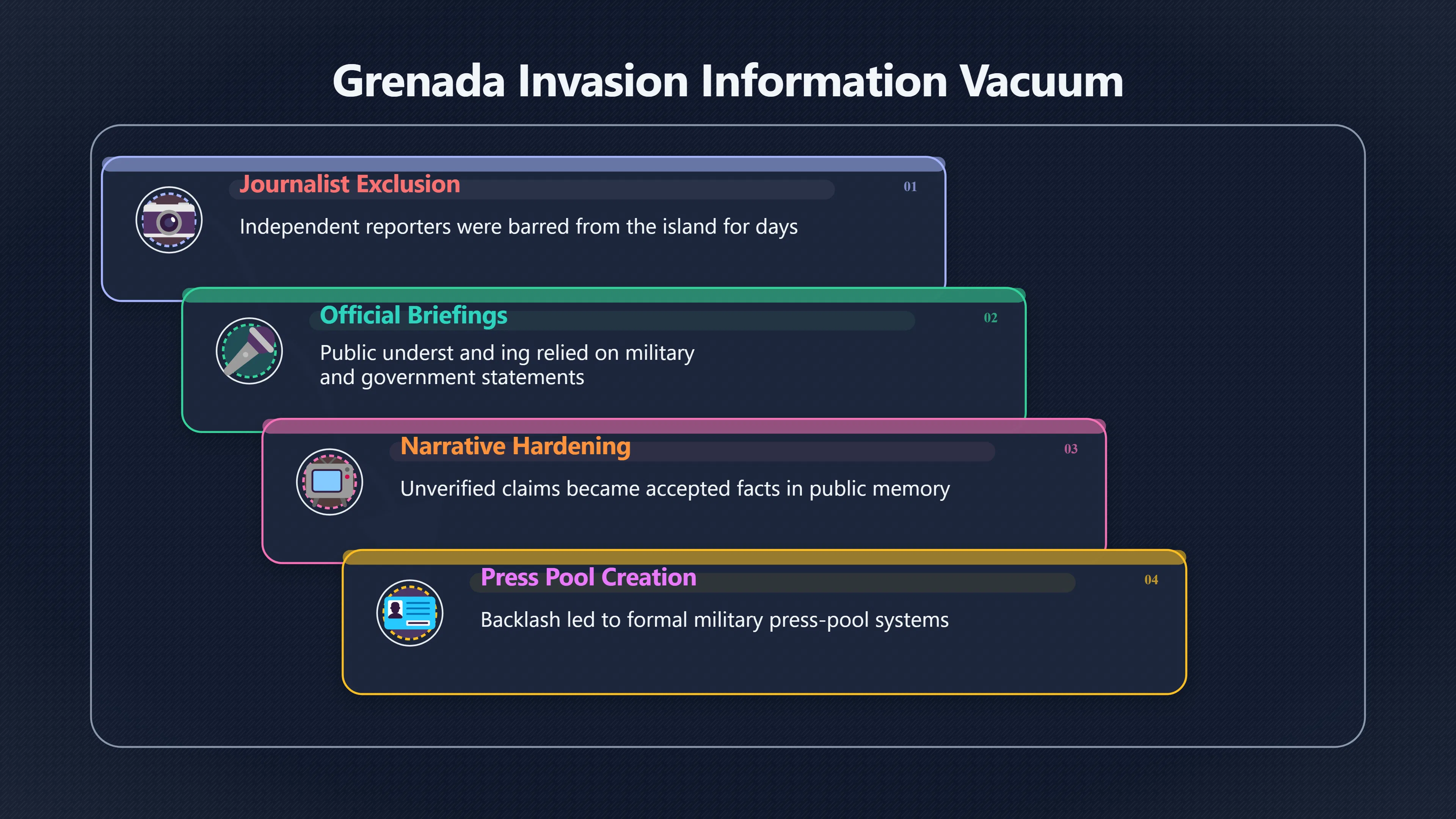
One of the most enduring controversies surrounding the 1983 invasion of Grenada was not a battlefield event but an information vacuum. For the crucial first days of Operation Urgent Fury, independent journalists were largely excluded from the island, leaving international audiences dependent on military briefings, official statements and partisan broadcasts. In that environment, dramatic claims spread quickly, casualty figures shifted repeatedly, and stories that had not yet been independently verified acquired the appearance of established fact. Some later proved exaggerated or unsupported, yet they continued to influence public memory long after reporters finally gained access. The episode has become a classic case study in how restricted reporting can shape wartime narratives and allow uncertain stories to harden into accepted history.[ebsco.com]ebsco.comCensorship during the Grenada Occupation | Historyindependent journalists from the island during the initial stages of the invasion…. War, where the press had at least some access, alb…
Why Reporters Were Kept Away
When United States and Caribbean forces landed in Grenada on 25 October 1983, journalists were prevented from accompanying the invasion force. Reporters who had travelled to the region found themselves stranded in Barbados while military operations were already under way. For roughly the first forty-eight hours, the world’s understanding of events depended overwhelmingly on official military and government sources.[ebsco.com]ebsco.comCensorship during the Grenada Occupation | Historyindependent journalists from the island during the initial stages of the invasion…. War, where the press had at least some access, alb…
The exclusion was controversial even at the time. Military officials argued that operational security and the safety of reporters required strict controls. Critics in the press countered that war correspondents had long accepted such risks and that the absence of independent witnesses created ideal conditions for misinformation. Later studies of the invasion described Grenada as a turning point in modern military information management, with the Pentagon experimenting with tighter control over battlefield reporting than had existed during the Vietnam War.[upi.com]upi.comReporters would have risked lives to cover Grenada UPI executive saysReporters would have risked lives to cover Grenada, UPI…13 Dec 1983 — Journalists for decades have risked their lives reporting wars a…
The backlash proved significant. Complaints from news organisations eventually contributed to the creation of a formal military press-pool system intended to provide at least limited media access during future operations. Grenada therefore became remembered not only as a military campaign but also as a landmark dispute over who gets to witness war in real time.[Reporters Committee]rcfp.orgReporters CommitteeBlame Grenada!… opening stages of a war, an invasion or other military maneuver. Chuck… Veteran war journalist Pe…
The Unsubstantiated Mass-Grave Story
The most famous example of an unverified wartime claim concerned reports of a mass grave supposedly containing victims of the revolutionary government that had ruled Grenada before the invasion.
In the chaotic days after the landing, official statements suggested that investigators had discovered evidence of large-scale killings by the island’s previous leadership. Numbers circulated rapidly. Some reports spoke of around one hundred bodies. The story fit neatly into a broader Cold War narrative portraying the overthrown regime as exceptionally brutal and helped reinforce public support for the intervention.[Wikipedia]WikipediaUnited States invasion of GrenadaUnited States invasion of Grenada
The problem was that independent confirmation was unavailable when the claim first spread. Journalists were not yet free to investigate the site themselves, and outside observers had little ability to verify what officials were reporting. As access gradually improved, the dramatic early accounts failed to receive equivalent evidential support. Histories of the invasion and later assessments of media coverage frequently cite the mass-grave allegation as an example of how an unverified claim gained traction during the reporting blackout.[wikipedia.org]WikipediaUnited States invasion of GrenadaUnited States invasion of Grenada
The episode does not mean every allegation made during the invasion was false. Grenada had genuinely experienced political violence, including the execution of Prime Minister Maurice Bishop and several supporters only days before the intervention. Yet the existence of real violence made additional claims easier to believe. In an atmosphere of uncertainty, the boundary between documented facts and unproven reports became blurred.[Wikipedia]WikipediaMaurice BishopMaurice Bishop
How Casualty Claims Shifted
The same information problems affected casualty reporting. Early death tolls issued during and immediately after the invasion varied considerably between official sources. Different military briefings produced different estimates of Grenadian and Cuban losses, while civilian casualties were often unclear or revised later.[Wikipedia]WikipediaUnited States invasion of GrenadaUnited States invasion of Grenada
Such discrepancies are not unusual in wartime, particularly during fast-moving operations. What made Grenada distinctive was the lack of independent observers capable of challenging or confirming figures as they emerged. Because reporters were absent from the battlefield, official numbers often circulated globally before meaningful scrutiny was possible. By the time revised figures appeared, the original claims had frequently received wider attention.[EBSCO]ebsco.comCensorship during the Grenada Occupation | Historyindependent journalists from the island during the initial stages of the invasion…. War, where the press had at least some access, alb…
For historians of propaganda and misinformation, this illustrates an important point: inaccurate wartime stories do not always require deliberate fabrication. Confusion, limited access and the pressure to produce immediate explanations can generate misleading narratives even when participants believe they are reporting honestly.[City Research Online]openaccess.city.ac.ukWar had recently taken place and the Pentagon looked at British information management as an example…Read more…
How Early Claims Became Lasting Memory
The press blackout mattered because first impressions often survive later corrections. Once dramatic stories entered newspapers, television broadcasts and political speeches, they helped define how the invasion was understood abroad. Later qualifications rarely travelled as far as the original headlines.[City Research Online]openaccess.city.ac.ukWar had recently taken place and the Pentagon looked at British information management as an example…Read more…
Several factors made the early narratives especially persuasive:
- The Cold War setting encouraged audiences to interpret events through a familiar struggle between East and West.
- Recent memories of the Iranian hostage crisis made stories of endangered Americans particularly compelling.
- The absence of independent reporting meant official briefings faced little immediate challenge.
- Real political violence in Grenada lent credibility to broader allegations that were still being investigated.[City Research Online]openaccess.city.ac.ukWar had recently taken place and the Pentagon looked at British information management as an example…Read more…
The result was a lasting public memory shaped as much by information control as by combat itself. For scholars of media history, Grenada remains a cautionary example of how restricted access can influence what the public believes happened during a conflict. The debate is therefore not simply about whether particular stories were true or false. It is about how audiences judge truth when the normal mechanisms of verification are temporarily absent.[city.ac.uk]openaccess.city.ac.ukCity Research OnlineJournalism and the Invasion of Grenada 30 Years Onby H Tumber · 2014 · Cited by 10 — The 1983 United States-led invas…
Grenada’s Place in the History of Wartime Narratives
Within Grenada’s broader history of contested claims and political storytelling, the press blackout occupies a distinctive place. It was not a conventional hoax with a single inventor, nor a forged document or fabricated photograph. Instead, it was a situation in which limited access allowed rumours, assumptions and official assertions to circulate before they could be independently tested.
That makes the episode especially revealing. It shows how an information vacuum can function almost like a deception mechanism even when no single false story is deliberately manufactured. The unverified mass-grave reports, shifting casualty figures and competing accounts of events became part of a larger lesson about wartime information: when independent scrutiny is delayed, the earliest version of the story often becomes the one people remember.[city.ac.uk]openaccess.city.ac.ukWar had recently taken place and the Pentagon looked at British information management as an example…Read more…
eBay marketplace picks
Marketplace Samples
Live-tested eBay searches with available results related to this page.
Endnotes
1.
Source: ebsco.com
Title: Censorship during the Grenada Occupation | History
Link:https://www.ebsco.com/research-starters/history/censorship-during-grenada-occupation
Source snippet
independent journalists from the island during the initial stages of the invasion.... War, where the press had at least some access, alb...
2.
Source: annenbergclassroom.org
Link:https://www.annenbergclassroom.org/timeline_event/media-access-limited-grenada-panama-invasions/
Source snippet
Media Access Limited In Grenada, Panama InvasionsMedia access is banned for the first two days when the United States invades Grenada, it...
3.
Source: upi.com
Title: Reporters would have risked lives to cover Grenada UPI executive says
Link:https://www.upi.com/Archives/1983/12/13/Reporters-would-have-risked-lives-to-cover-Grenada-UPI-executive-says/5902440139600/
Source snippet
Reporters would have risked lives to cover Grenada, UPI...13 Dec 1983 — Journalists for decades have risked their lives reporting wars a...
4.
Source: Wikipedia
Title: United States invasion of Grenada
Link:https://en.wikipedia.org/wiki/United_States_invasion_of_Grenada
5.
Source: Wikipedia
Title: Maurice Bishop
Link:https://en.wikipedia.org/wiki/Maurice_Bishop
6.
Source: content.time.com
Title: 0,33009,949860 1,00
Link:https://content.time.com/time/subscriber/article/0%2C33009%2C949860-1%2C00.html
7.
Source: openaccess.city.ac.uk
Link:https://openaccess.city.ac.uk/id/eprint/14418/3/Journalism%20and%20the%20Invasion%20of%20Grenada%2030%20years%20on.pdf
Source snippet
War had recently taken place and the Pentagon looked at British information management as an example...Read more...
8.
Source: rcfp.org
Link:https://www.rcfp.org/journals/the-news-media-and-the-law-fall-2001/blame-grenada/
Source snippet
Reporters CommitteeBlame Grenada!... opening stages of a war, an invasion or other military maneuver. Chuck... Veteran war journalist Pe...
9.
Source: openaccess.city.ac.uk
Link:https://openaccess.city.ac.uk/id/eprint/14418/
Source snippet
City Research OnlineJournalism and the Invasion of Grenada 30 Years Onby H Tumber · 2014 · Cited by 10 — The 1983 United States-led invas...
10.
Source: armyupress.army.mil
Title: Operation Urgent Fury
Link:https://www.armyupress.army.mil/Journals/Military-Review/Directors-Select-Articles/Operation-Urgent-Fury/
Additional References
11.
Source: youtube.com
Title: US Invasion of Grenada
Link:https://www.youtube.com/watch?v=G73NBQgwNf8
Source snippet
10/27/1983 CNN Newscast Grenada Operation Urgent Fury Update...
12.
Source: arxiv.org
Link:https://arxiv.org/abs/1804.03461
13.
Source: youtube.com
Link:https://www.youtube.com/watch?v=-LMKyx67nQc
Source snippet
Grenada 1983: Reagan's Cold War Gamble | Operation Urgent Fury...
14.
Source: youtube.com
Title: NBC News Special Reports
Link:https://www.youtube.com/watch?v=Jl9nTxdJUY0
Source snippet
US Invasion of Grenada - Operation Urgent Fury | Rare Cold War News Footage (1983)...
Published: October 25, 1983
15.
Source: youtube.com
Link:https://www.youtube.com/watch?v=4-qXk-N6k_g
Source snippet
NBC News Special Reports: October 25, 1983...
Published: October 25, 1983
16.
Source: academia.edu
Link:https://www.academia.edu/44832278/American_War_Cinema_and_Media_since_Vietnam
17.
Source: dokumen.pub
Link:https://dokumen.pub/grenada.html
18.
Source: costsofwar.watson.brown.edu
Title: Turse Costs of War The Reporting Graveyard 4 2 25
Link:https://costsofwar.watson.brown.edu/sites/default/files/papers/Turse_Costs-of-War_The-Reporting-Graveyard-4-2-25.pdf
19.
Source: youtube.com
Link:https://www.youtube.com/watch?v=jZD1KRTCmEs
20.
Source: washingtonpost.com
Link:https://www.washingtonpost.com/archive/politics/1983/12/16/hints-at-future-news-blackouts/b7bb04bc-1121-4333-9058-1727fd5af5ea/
Topic Tree