Within Azerbaijan
Who Owns the History of Karabakh's Churches?
Competing histories of medieval churches show how monuments can be reclassified to support modern territorial narratives.
On this page
- What Caucasian Albania Was
- How Armenian Monuments Were Reclassified
- Why Inscriptions and Restoration Matter
Page outline Jump by section
Introduction
The dispute over Karabakh’s medieval churches is not a conventional hoax story involving forged artefacts or fabricated photographs. Instead, it centres on competing historical narratives about who built, used and inherited some of the South Caucasus’s most important Christian monuments. In Azerbaijan, a long-running theory argues that many churches traditionally identified as Armenian are actually monuments of ancient Caucasian Albania, a Christian kingdom that existed in parts of the eastern Caucasus before being absorbed into larger political and religious structures. Critics, including many international historians, archaeologists and heritage specialists, argue that the theory has often been expanded beyond the available evidence and used to reclassify clearly Armenian monuments in support of modern territorial claims.[ecoi.net]ecoi.netAzerbaijan announces plans to erase Armenian traces…4 Feb 2022 — The Albanian theory was first developed in the 1950s by prominent Aze…
The controversy matters because monuments are not merely old buildings. Their inscriptions, architecture and restoration histories are frequently treated as evidence of who belonged to a region in the past. In the Armenian-Azerbaijani conflict, arguments about medieval churches have therefore become arguments about identity, legitimacy and historical ownership.[Eurasianet]eurasianet.orgperspectives now comes a karabakh war over cultural heritagePerspectives | Now comes a Karabakh war over cultural…16 Nov 2020 — Attention has now turned to the rich cultural heritage…
Who Owns the History of Karabakh’s Churches?
The modern dispute revolves around a simple question: when a medieval church stands in Karabakh, should it be understood primarily as Armenian heritage, Caucasian Albanian heritage, or some combination of overlapping traditions?
For most of the twentieth century, many churches and monasteries in Nagorno-Karabakh were widely described in academic literature as Armenian monuments because they contain Armenian inscriptions, follow recognised Armenian architectural forms and were historically associated with the Armenian Apostolic Church. Monasteries such as Dadivank and Gandzasar became especially important examples because of their size, preservation and documentary record.[Wikipedia]WikipediaChurch of Caucasian AlbaniaChurch of Caucasian Albania
Azerbaijani nationalist scholarship from the Soviet period onward increasingly challenged this interpretation. Some historians argued that these sites originated within the tradition of Caucasian Albania and were only later “Armenianised”. According to this view, Armenian inscriptions were added after the original construction or reflected later ecclesiastical influence rather than the monuments’ original identity.[ecoi.net]ecoi.netAzerbaijan announces plans to erase Armenian traces…4 Feb 2022 — The Albanian theory was first developed in the 1950s by prominent Aze…
The disagreement is therefore not about whether Caucasian Albania existed. It unquestionably did. The dispute concerns how far its legacy extends and whether medieval monuments traditionally identified as Armenian should be reassigned to that earlier heritage.[Wikipedia]WikipediaChurch of Caucasian AlbaniaChurch of Caucasian Albania
What Caucasian Albania Was
Caucasian Albania was an ancient kingdom occupying parts of what is now Azerbaijan and neighbouring regions. It adopted Christianity in late antiquity and developed its own ecclesiastical institutions. Historical sources indicate that its church eventually came under the authority of the Armenian Church, creating centuries of religious and cultural interaction between Albanian and Armenian communities.[Wikipedia]WikipediaChurch of Caucasian AlbaniaChurch of Caucasian Albania
This genuine historical complexity helps explain why the reclassification theory gained traction. The region’s past was never neatly divided into modern national categories. Political boundaries shifted, populations mixed and churches often served communities with changing identities over many centuries.
However, many specialists argue that acknowledging Albanian history does not automatically transform every medieval Christian monument in Karabakh into an Albanian monument. Linguistic evidence, inscriptions and documented church administration frequently point toward strong Armenian involvement by the medieval period.[Titus]titus.uni-frankfurt.deCaucasian Albaniaby J Gippert · 2023 · Cited by 18 — classify medieval Armenian sites in Karabakh as Albanian, even demonstrably rem…
The existence of Caucasian Albania is therefore not the controversial part. The controversy arises when that history is used to reinterpret monuments whose surviving evidence appears overwhelmingly Armenian to many scholars.[Titus]titus.uni-frankfurt.deCaucasian Albaniaby J Gippert · 2023 · Cited by 18 — classify medieval Armenian sites in Karabakh as Albanian, even demonstrably rem…
How Armenian Monuments Were Reclassified
The modern reclassification campaign is often traced to Soviet-era Azerbaijani historians, particularly Ziya Bunyadov, who argued that many Armenian inscriptions on churches in Azerbaijan were later additions rather than original features. His work helped establish what became known as the “Albanian theory” in Azerbaijani historical writing.[ecoi.net]ecoi.netAzerbaijan announces plans to erase Armenian traces…4 Feb 2022 — The Albanian theory was first developed in the 1950s by prominent Aze…
Under this interpretation:
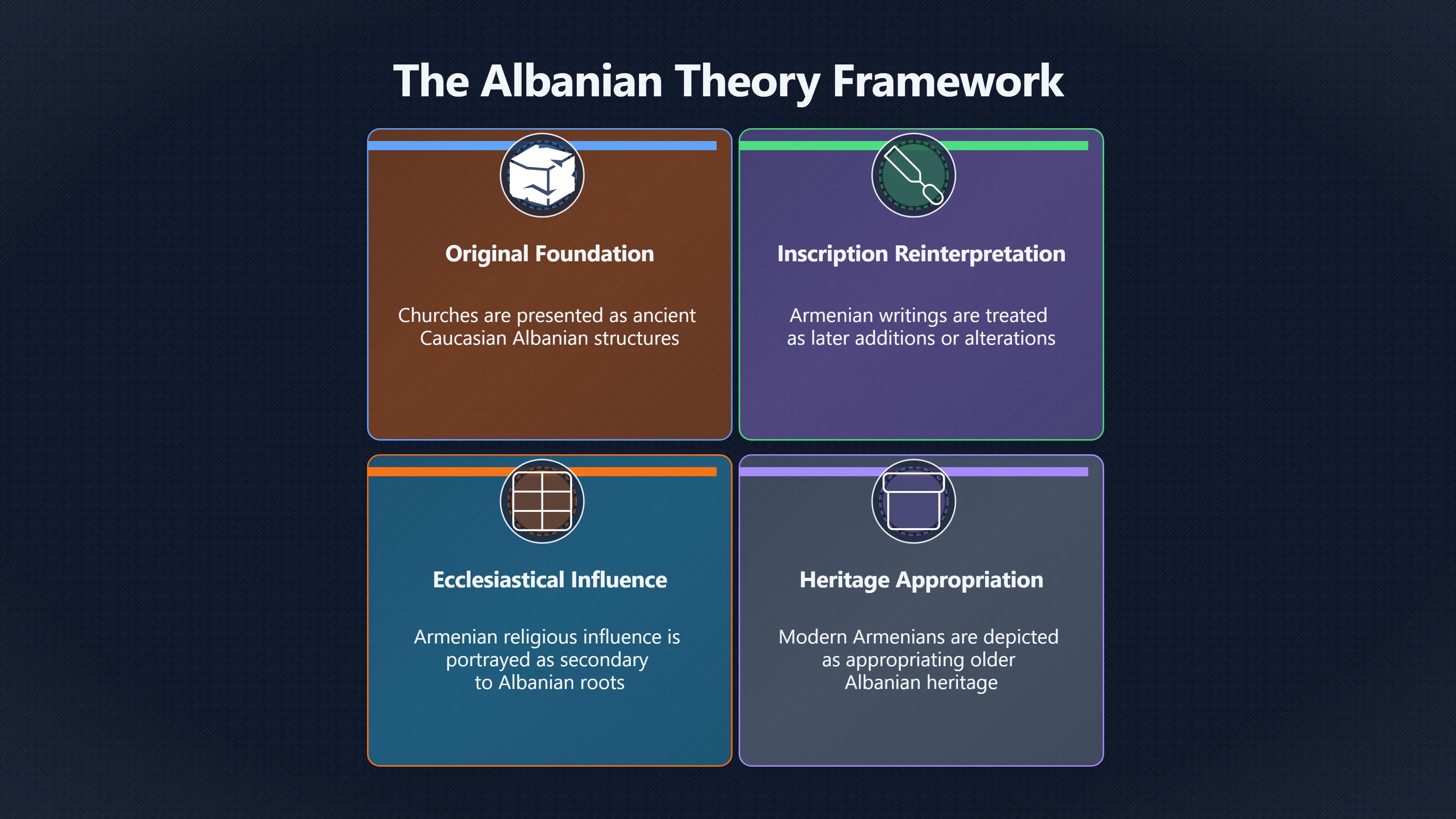
- Medieval churches were presented as Albanian foundations.
- Armenian inscriptions were treated as later alterations.
- Armenian ecclesiastical influence was acknowledged but portrayed as secondary.
- Modern Armenians were depicted as having appropriated an older Albanian heritage.[ecoi.net]ecoi.netAzerbaijan announces plans to erase Armenian traces…4 Feb 2022 — The Albanian theory was first developed in the 1950s by prominent Aze…
Supporters argue that Soviet and Armenian scholarship previously underestimated the role of Caucasian Albania. Critics argue that the theory moved beyond legitimate revision and became a politically useful historical narrative tied to territorial disputes. They note that the theory expanded over time from a limited discussion of specific sites into broader claims affecting large portions of the region’s Christian heritage.[Wikipedia]WikipediaCaucasian AlbaniaCaucasian Albania
What makes the case relevant in a study of contested truth is not merely the existence of disagreement. Historians routinely debate interpretations. The controversy stems from accusations that historical evidence has sometimes been selectively used, ignored or altered in order to support present-day political goals.[OC Media]oc-media.orgthe battle over christian monuments in nagorno karabakhOC MediaThe battle over Christian monuments in Nagorno-Karabakh10 Feb 2022 — Azerbaijan's Minister of Culture, citing a fringe historical…
Why Inscriptions and Restoration Matter
The most important evidence in these disputes is often surprisingly simple: the writing carved into the stone.
Many churches in Karabakh contain Armenian inscriptions recording patrons, dates of construction, donations and religious dedications. For historians, these inscriptions are among the strongest pieces of evidence available because they are contemporary records physically attached to the buildings themselves.[Eurasianet]eurasianet.orgperspectives now comes a karabakh war over cultural heritagePerspectives | Now comes a Karabakh war over cultural…16 Nov 2020 — Attention has now turned to the rich cultural heritage…
This is why restoration projects attract intense scrutiny. If inscriptions are removed, damaged, covered or reinterpreted, future researchers may lose direct evidence about a monument’s history.
International concern increased after Azerbaijani officials announced plans to establish a working group to examine what they described as Armenian inscriptions added to Albanian churches. Critics feared that such efforts could lead to the removal of inscriptions regarded by most scholars as authentic medieval Armenian material.[OC Media]oc-media.orgthe battle over christian monuments in nagorno karabakhOC MediaThe battle over Christian monuments in Nagorno-Karabakh10 Feb 2022 — Azerbaijan's Minister of Culture, citing a fringe historical…
Earlier controversies reinforced these fears. One frequently cited example is the restoration of the Church of Saint Elisæus at Nij, where Armenian inscriptions were reportedly removed during renovation work, prompting criticism from observers including Norwegian representatives involved with the project.[Wikipedia]WikipediaChurch of Saint Elisæus (NijChurch of Saint Elisæus (Nij
Because inscriptions function as historical documents, arguments about cleaning, repairing or restoring a church can quickly become arguments about rewriting its history.
Why the Narrative Persists
The Caucasian Albanian interpretation remains influential because it serves several purposes simultaneously.
For Azerbaijan, it offers a way to emphasise an ancient Christian heritage within the territory of the modern state while reducing the perceived historical centrality of Armenians in contested regions. It also provides a framework for presenting Christian monuments as part of Azerbaijan’s own national story rather than as evidence of Armenian historical claims.[Albanian Daily News]albaniandailynews.comOpen source on albaniandailynews.com.
For Armenians, the theory is often viewed as an attempt to erase or minimise centuries of Armenian presence. Heritage organisations, Armenian scholars and many international observers therefore treat reclassification efforts with deep suspicion.[evnreport.com]evnreport.comEVN Report Appropriation of Armenian Cultural Heritage of ArtsakhEVN Report Appropriation of Armenian Cultural Heritage of Artsakh
The dispute survives because it sits at the intersection of archaeology, religion, nationalism and war. Each side can point to elements of the historical record that support parts of its story, while the broader political conflict encourages maximal interpretations.
What the Monument Dispute Reveals
The controversy over Karabakh’s churches demonstrates how historical monuments can become battlegrounds long after armies stop fighting. Unlike a forged relic or fabricated document, the churches themselves are real. The dispute concerns how those real objects are interpreted.
That makes this case an important example of contested historical narrative rather than a straightforward hoax. The central question is not whether the monuments exist, but whether modern political actors can successfully redefine what those monuments mean. As a result, inscriptions, restoration decisions and scholarly classifications acquire significance far beyond architecture. They become evidence in a struggle over memory, identity and the ownership of the past.[uni-frankfurt.de]titus.uni-frankfurt.deCaucasian Albaniaby J Gippert · 2023 · Cited by 18 — classify medieval Armenian sites in Karabakh as Albanian, even demonstrably rem…
Amazon book picks
Further Reading
Books and field guides related to Who Owns the History of Karabakh's Churches?. Use these as the next step if you want deeper reading beyond the article.
Black Garden
Explains the historical and political context behind heritage disputes in Karabakh.
The Silk Roads
Places Caucasian religious and cultural heritage in wider Eurasian history.
Armenia
Offers historical material relevant to debates over monuments and inscriptions.
eBay marketplace picks
Marketplace Samples
Live-tested eBay searches with available results related to this page.




Endnotes
1.
Source: ecoi.net
Link:https://www.ecoi.net/en/document/2067823.html
Source snippet
Azerbaijan announces plans to erase Armenian traces...4 Feb 2022 — The Albanian theory was first developed in the 1950s by prominent Aze...
2.
Source: eurasianet.org
Title: perspectives now comes a karabakh war over cultural heritage
Link:https://eurasianet.org/perspectives-now-comes-a-karabakh-war-over-cultural-heritage
Source snippet
Perspectives | Now comes a Karabakh war over cultural...16 Nov 2020 — Attention has now turned to the rich cultural heritage...
3.
Source: oc-media.org
Title: the battle over christian monuments in nagorno karabakh
Link:https://oc-media.org/the-battle-over-christian-monuments-in-nagorno-karabakh/
Source snippet
OC MediaThe battle over Christian monuments in Nagorno-Karabakh10 Feb 2022 — Azerbaijan's Minister of Culture, citing a fringe historical...
4.
Source: Wikipedia
Title: Church of Caucasian Albania
Link:https://en.wikipedia.org/wiki/Church_of_Caucasian_Albania
5.
Source: Wikipedia
Title: Azerbaijan in the Early Middle Ages
Link:https://en.wikipedia.org/wiki/Azerbaijan_in_the_Early_Middle_Ages
6.
Source: Wikipedia
Title: Caucasian Albania
Link:https://en.wikipedia.org/wiki/Caucasian_Albania
7.
Source: Wikipedia
Title: Church of Saint Elisæus (Nij)
Link:https://en.wikipedia.org/wiki/Church_of_Saint_Elis%C3%A6us_%28Nij%29
8.
Source: titus.uni-frankfurt.de
Link:https://titus.uni-frankfurt.de/personal/jg/pdf/jg2022j.pdf
Source snippet
Caucasian Albaniaby J Gippert · 2023 · Cited by 18 — classify medieval Armenian sites in Karabakh as Albanian, even demonstrably rem...
9.
Source: albaniandailynews.com
Link:https://albaniandailynews.com/news/revival-of-christian-heritage-in-karabakh-by-azerbaijan-exemplary-respect-and-tolerance-1?fbclid=IwAR1KqMTsPda8WvExGtRhxmm2fmGGtdFxSL0–W8g7ZgZ6FPR-DASLkSxNCg
10.
Source: evnreport.com
Title: EVN Report Appropriation of Armenian Cultural Heritage of Artsakh
Link:https://evnreport.com/spotlight-karabakh/appropriation-of-armenian-cultural-heritage-of-artsakh/
11.
Source: pace.coe.int
Link:https://pace.coe.int/files/9533/html
Additional References
12.
Source: researchgate.net
Link:https://www.researchgate.net/publication/377472872_Shrines_of_Caucasian_Albania_in_Karabakh
Source snippet
Armenian scholars have been seeking throughout. decades to prove the unscienti c theory suggesting. that the unique...Read more...
13.
Source: youtube.com
Title: The Churches of Caucasian Albania: The Heritage of Ancient Azerbaijan
Link:https://www.youtube.com/watch?v=WH2hQBBu94E
Source snippet
Dadivank must be protected: where were the Azerbaijanis when the Armenians adopted Christianity?...
14.
Source: youtube.com
Link:https://www.youtube.com/watch?v=IoVD2x-nykg
Source snippet
Crimes Against Armenian Cultural Heritage in Nagorno-Karabakh...
15.
Source: youtube.com
Title: History of Caucasian Albania & History of the House of the Artsrunik
Link:https://www.youtube.com/watch?v=fJZV0VvI80c
Source snippet
The Churches of Caucasian Albania: The Heritage of Ancient Azerbaijan...
16.
Source: academia.edu
Link:https://www.academia.edu/105380912/Azerbaijan_s_Policy_of_Forced_Cultural_Appropriation_after_the_Second_Artsakh_War_Case_of_Dadivank
17.
Source: facebook.com
Link:https://www.facebook.com/groups/155837376254411/posts/735133884991421/
18.
Source: mfa.am
Link:https://www.mfa.am/filemanager/nkr/monuments.pdf
19.
Source: youtube.com
Title: How Azerbaijan Weaponizes History
Link:https://www.youtube.com/watch?v=l9wNZSnoWgE
Source snippet
History of Caucasian Albania & History of the House of the Artsrunik...
20.
Source: facebook.com
Title: my colleaguestell me that as soon as the armenian identity of a writing on a chu
Link:https://www.facebook.com/ArtofArmenia/posts/my-colleaguestell-me-that-as-soon-as-the-armenian-identity-of-a-writing-on-a-chu/3539275326166034/
21.
Source: dakd.de
Title: Why Armenian Cultural Heritage Threatens Azerbaijans Claims to Nagorno Karabakh
Link:https://dakd.de/wp-content/uploads/2021/06/Why-Armenian-Cultural-Heritage-Threatens-Azerbaijans-Claims-to-Nagorno-Karabakh.pdf
Topic Tree