Within Italian Hoaxes
How Fake Etruscan Warriors Fooled a Great Museum
The Metropolitan Museum's fake Etruscan warriors show how provenance, prestige and dramatic presentation can make modern objects appear ancient.
On this page
- How the fragmented warriors entered the art market
- Why museum display strengthened belief
- The tests, confession and missing thumb that exposed them
Page outline Jump by section
Introduction
The fake Etruscan warriors acquired by New York’s Metropolitan Museum of Art are one of the most revealing forgery stories connected with Italy. Between 1915 and 1921, the museum bought three monumental terracotta sculptures that were presented as rare survivals from the ancient Etruscan world. For decades they were treated as important archaeological discoveries and displayed as evidence of a largely lost sculptural tradition. Only in 1961 did the museum publicly acknowledge that all three were modern creations made in Italy by skilled forgers.[archaeology.org]archive.archaeology.orgMagazine Tracking the Etruscan WarriorsMet had to announce that it was housing a fake." Put on display in 1933, the… warrior's hands, from which the thumb was missing. Fiora…
What makes the case especially important is not simply that experts were deceived. The warriors demonstrate how provenance, institutional prestige and dramatic presentation can make doubtful objects appear convincing. Once the sculptures entered a major museum collection, their credibility increased enormously. Visitors saw them not as claims awaiting verification but as authenticated pieces of antiquity. The story remains a classic warning about the power of museum authority in the history of forged antiquities.[archaeology.org]archive.archaeology.orgMagazine Tracking the Etruscan WarriorsMet had to announce that it was housing a fake." Put on display in 1933, the… warrior's hands, from which the thumb was missing. Fiora…
How the fragmented warriors entered the art market
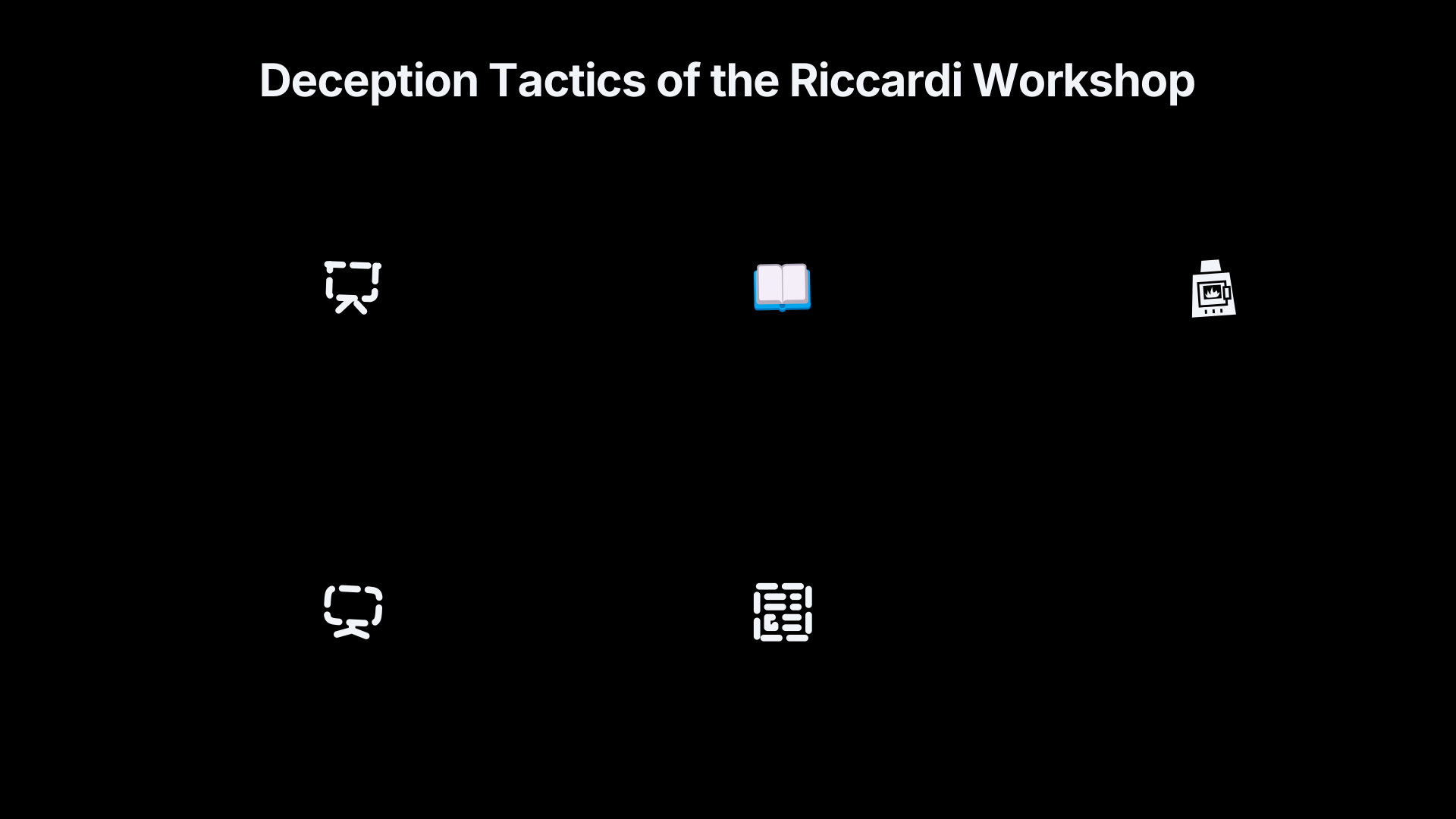
The three sculptures were created by members of the Riccardi family, experienced restorers and forgers, working with the sculptor Alfredo Fioravanti. Their workshop had already gained experience producing imitation antiquities and objects that could be passed off as archaeological finds.[Wikipedia]WikipediaEtruscan terracotta warriorsEtruscan terracotta warriors
The first figure, later known as the Old Warrior, reached the Metropolitan Museum in 1915. A colossal warrior head followed in 1916, and a larger standing warrior was acquired shortly afterwards. Rather than appearing as complete sculptures fresh from a studio, the works entered the market in fragments and reconstructed sections, resembling genuine archaeological discoveries. This was partly a practical necessity: the makers lacked a kiln large enough to fire monumental statues in one piece. By producing sections separately and presenting them as excavated fragments, they turned a manufacturing limitation into evidence of authenticity.[Wikipedia]WikipediaEtruscan terracotta warriorsEtruscan terracotta warriors
The sculptures also benefited from a gap in knowledge. Large Etruscan terracotta statuary was comparatively rare, and scholars were eager to understand what such monuments might have looked like. The warriors seemed to provide precisely the missing evidence researchers hoped to find. Instead of contradicting expectations, they appeared to confirm an attractive historical possibility.[Metropolitan Museum Resources]resources.metmuseum.orgEtruscan Art in The Metropolitan MuseumMetropolitan Museum ResourcesEtr uscan a r t24 Mar 2023 — View of the Striding Warrior (later determined a forgery; see 8.5) looking sout…
This is a recurring pattern in antiquities fraud. The most successful forgeries often do not invent an entirely new past. They supply a missing piece of a story that experts already want to believe.
Why museum display strengthened belief
The Metropolitan Museum did more than purchase the sculptures. It helped transform them into accepted facts.
Museum publications analysed the figures, scholars discussed their style, and the objects became part of wider conversations about Etruscan art. When all three were displayed together in 1933, visitors encountered them not as controversial acquisitions but as celebrated archaeological treasures. Their size and dramatic appearance made them particularly persuasive. Monumental objects naturally command attention, and the museum setting implied that extensive scrutiny had already occurred.[Archaeology Magazine]archive.archaeology.orgMagazine Tracking the Etruscan WarriorsMet had to announce that it was housing a fake." Put on display in 1933, the… warrior's hands, from which the thumb was missing. Fiora…
The authority of the institution also changed how doubts were interpreted. Some specialists, particularly in Italy, questioned the warriors on stylistic grounds. Certain details looked unusual or inconsistent with known Etruscan works. Yet stylistic criticism remained subjective. Against the prestige of a major museum and decades of scholarly acceptance, suspicion alone carried limited weight.[Wikipedia]WikipediaEtruscan terracotta warriorsEtruscan terracotta warriors
Ironically, features later recognised as warning signs were initially treated as virtues. The sculptures displayed remarkably consistent firing characteristics across very large ceramic sections. Rather than provoking concern, this technical achievement was admired as evidence of ancient craftsmanship. The same observations would later contribute to the case against authenticity.[Wikipedia]WikipediaEtruscan terracotta warriorsEtruscan terracotta warriors
The episode illustrates a broader lesson in the history of deception. Authority does not merely persuade the public; it can influence experts by framing what counts as a reasonable interpretation of the evidence.
The tests, confession and missing thumb that exposed them
The collapse of the warriors’ reputation came through a combination of scientific analysis and old-fashioned detective work.
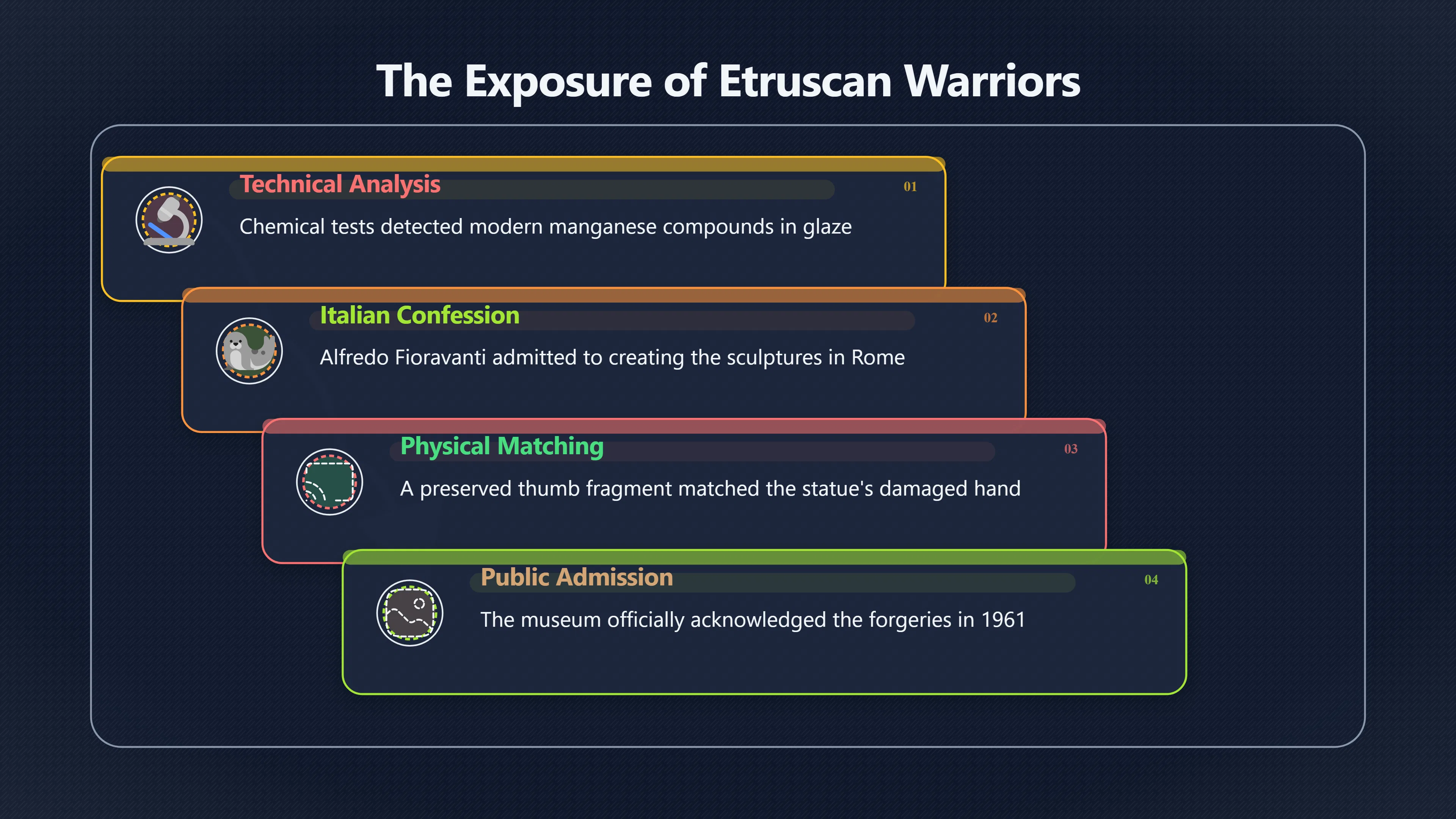
In the late 1950s and early 1960s, Metropolitan Museum administrator Joseph V. Noble began a detailed investigation of the sculptures’ manufacture. Technical studies revealed features inconsistent with ancient Etruscan production. Chemical analysis detected materials in the glaze that should not have appeared on genuine Etruscan objects, including manganese compounds associated with more modern practices. Researchers also reconstructed how the statues could have been fabricated in sections, broken while still unfired, and then assembled to resemble excavated fragments.[Wikipedia]WikipediaEtruscan terracotta warriorsEtruscan terracotta warriors
The decisive breakthrough arrived from Italy. On 5 January 1961, Alfredo Fioravanti reportedly entered the American consulate in Rome and confessed to helping create the sculptures decades earlier. His testimony described how the figures had been made and marketed as antiquities.[Wikipedia]WikipediaEtruscan terracotta warriorsEtruscan terracotta warriors
The most memorable piece of evidence was startlingly simple. Fioravanti produced a thumb that had supposedly broken from the Old Warrior during manufacture. Investigators compared it with a cast taken from the statue’s damaged hand. The pieces matched. According to accounts of the meeting, the fit was exact. A missing fragment preserved by the maker for years became the physical link connecting the museum masterpiece to the forger’s workshop.[Archaeology Magazine]archive.archaeology.orgMagazine Tracking the Etruscan WarriorsMet had to announce that it was housing a fake." Put on display in 1933, the… warrior's hands, from which the thumb was missing. Fiora…
In February 1961 the Metropolitan Museum publicly acknowledged that the sculptures were modern forgeries. Contemporary accounts described the admission as unprecedented for the institution.[Archaeology Magazine]archive.archaeology.orgMagazine Tracking the Etruscan WarriorsMet had to announce that it was housing a fake." Put on display in 1933, the… warrior's hands, from which the thumb was missing. Fiora…
What the warriors reveal about credibility
The Etruscan warrior affair remains influential because it exposed weaknesses in the way authenticity was often established during the early twentieth century.
Several factors combined to make the deception successful:
- A convincing narrative: the sculptures appeared to fill a genuine historical gap.
- Fragmentary condition: damage and reconstruction looked archaeological rather than suspicious.
- Expert endorsement: respected scholars discussed the pieces as authentic.
- Institutional authority: museum acquisition became evidence in itself.
- Limited scientific testing: technical authentication methods were less developed than they are today.[archaeology.org]archive.archaeology.orgMagazine Tracking the Etruscan WarriorsMet had to announce that it was housing a fake." Put on display in 1933, the… warrior's hands, from which the thumb was missing. Fiora…
The case also helped encourage a more scientific approach to antiquities. Questions about manufacturing techniques, materials, firing methods and provenance gained greater importance. Rather than relying mainly on connoisseurship and stylistic judgement, museums increasingly turned to laboratory analysis and interdisciplinary investigation.[oclc.org]libmma.contentdm.oclc.orgThomas JWatson LibraryAn inquiry into the forgery of the Etruscan… - OCLCAn inquiry into the forgery of the Etruscan terracotta warriors in th…

How The Fake Etruscan Warriors Acquired By New York’s entered public memory
Many forgery scandals focus on the brilliance of the forger. The Etruscan warriors are more interesting because they expose the social machinery of belief.
The sculptures were not accepted simply because they looked ancient. They became credible because dealers, scholars, publications and one of the world’s most prestigious museums collectively reinforced their authenticity. Once displayed behind the authority of a museum label, uncertainty largely disappeared from public view.[Art Newspaper]theartnewspaper.comthe met s antiquated views of antiquities need updatingmuseum to be a forgery. The museum's labels make no mention…Read more…
For that reason, the fake warriors remain a landmark episode in Italy’s history of forged antiquities. They demonstrate that authenticity is never guaranteed by prestige alone. Even respected institutions can mistake confidence for proof, and a convincing object can acquire a powerful aura of truth long before its claims have been properly tested.[archaeology.org]archive.archaeology.orgMagazine Tracking the Etruscan WarriorsMet had to announce that it was housing a fake." Put on display in 1933, the… warrior's hands, from which the thumb was missing. Fiora…
Amazon book picks
Further Reading
Books and field guides related to How Fake Etruscan Warriors Fooled a Great Museum. Use these as the next step if you want deeper reading beyond the article.
Frauds, Myths, and Mysteries: Science and Pseudoscience in Ar...
Explains methods used to expose forged artifacts.
eBay marketplace picks
Marketplace Samples
Live-tested eBay searches with available results related to this page.


Endnotes
1.
Source: archive.archaeology.org
Title: Magazine Tracking the Etruscan Warriors
Link:https://archive.archaeology.org/online/features/hoaxes/warriors.html
Source snippet
Met had to announce that it was housing a fake." Put on display in 1933, the... warrior's hands, from which the thumb was missing. Fiora...
2.
Source: Wikipedia
Title: Etruscan terracotta warriors
Link:https://en.wikipedia.org/wiki/Etruscan_terracotta_warriors
3.
Source: libmma.contentdm.oclc.org
Title: Thomas J
Link:https://libmma.contentdm.oclc.org/digital/collection/p15324coll10/id/195973/
Source snippet
Watson LibraryAn inquiry into the forgery of the Etruscan... - OCLCAn inquiry into the forgery of the Etruscan terracotta warriors in th...
4.
Source: Wikipedia
Title: Alfredo Fioravanti
Link:https://en.wikipedia.org/wiki/Alfredo_Fioravanti
5.
Source: Wikipedia
Title: Faux guerriers étrusques
Link:https://fr.wikipedia.org/wiki/Faux_guerriers_%C3%A9trusques
6.
Source: Wikipedia
Title: Joseph V. Noble
Link:https://en.wikipedia.org/wiki/Joseph_V._Noble
7.
Source: Wikipedia
Title: Alfredo Fioravanti
Link:https://fr.wikipedia.org/wiki/Alfredo_Fioravanti
8.
Source: theartnewspaper.com
Title: the met s antiquated views of antiquities need updating
Link:https://www.theartnewspaper.com/comment/the-met-s-antiquated-views-of-antiquities-need-updating
Source snippet
museum to be a forgery. The museum's labels make no mention...Read more...
9.
Source: resources.metmuseum.org
Title: Etruscan Art in The Metropolitan Museum
Link:https://resources.metmuseum.org/resources/metpublications/pdf/Etruscan_Art_in_The_Metropolitan_Museum.pdf
Source snippet
Metropolitan Museum ResourcesEtr uscan a r t24 Mar 2023 — View of the Striding Warrior (later determined a forgery; see 8.5) looking sout...
Additional References
10.
Source: iheart.com
Link:https://www.iheart.com/podcast/1119-criminalia-69919305/episode/the-fake-etruscan-terracotta-warriors-in-121545395/
Source snippet
The Fake Etruscan Terracotta Warriors in... - iHeart22 Aug 2023 — On Valentine's Day of 1961, the Metropolitan Museum of Art in Ne...
11.
Source: youtube.com
Title: 10 Bizarre Archaeological Hoaxes That Fooled Everyone
Link:http://www.youtube.com/watch?v=pFuGcUsawV8
Source snippet
Etruscan terracotta warriors forgery Met The Forged Warriors—The Etruscan Terracotta Hoax AML & Fraud History Channel...
12.
Source: youtube.com
Title: The Forged Warriors—The Etruscan Terracotta Hoax
Link:http://www.youtube.com/watch?v=XEEbykGl1yQ
Source snippet
Museum Files: Etruscan Warrior - Decades of Deception Unveiled...
13.
Source: youtube.com
Title: How Fake Artifacts Fooled the World’s Best Museums
Link:http://www.youtube.com/watch?v=wGE713pywk4
Source snippet
10 Bizarre Archaeological Hoaxes That Fooled Everyone...
14.
Source: bcin.info
Link:https://bcin.info/vufind/Record/ICCROM.ICCROM22240?lng=da
15.
Source: gbd.digital
Link:https://www.gbd.digital/gbd/Record/BV007145002?lng=en&sid=638838
16.
Source: facebook.com
Link:https://www.facebook.com/groups/1519103878311682/posts/3544443479111035/
17.
Source: joslinhall.com
Link:https://www.joslinhall.com/etruscan_terracotta.htm
18.
Source: youtube.com
Title: The museum that bought a lie
Link:http://www.youtube.com/watch?v=kxFIHEITxCY
Source snippet
How Fake Artifacts Fooled the World’s Best Museums...
19.
Source: youtube.com
Title: Museum Files: Etruscan Warrior
Link:http://www.youtube.com/watch?v=sNpRZCHlRcU
Source snippet
The museum that bought a lie...
Topic Tree