Within Hungarian Hoaxes
How Did a Rumour Become a Murder Trial?
A girl's disappearance became an antisemitic murder case through coercion, political agitation and sensational reporting.
On this page
- The disappearance of Eszter Solymosi
- Móric Scharf's testimony and the collapsing prosecution
- Acquittal, propaganda and later political retellings
Page outline Jump by section
Introduction
The Tiszaeszlár affair was not a hoax in the usual sense of a forged object or fabricated photograph. It was something more dangerous: an unresolved disappearance transformed into a false murder narrative through rumour, coercive investigation, political agitation and sensational publicity. In 1882, the disappearance of a fourteen-year-old servant girl, Eszter Solymosi, in the Hungarian village of Tiszaeszlár became the basis for one of Europe’s most notorious modern blood libel cases—the ancient accusation that Jews murdered Christians for ritual purposes. Thirteen Jewish villagers were eventually put on trial, yet the prosecution’s case collapsed under scrutiny and all defendants were acquitted. The affair nevertheless became a powerful piece of antisemitic propaganda whose influence outlasted the trial itself.[YIVO Encyclopedia]encyclopedia.yivo.orgEncyclopedia Tiszaeszlár Blood LibelYIVO EncyclopediaTiszaeszlár Blood Libel - YIVO EncyclopediaThe Tiszaeszlár blood libel played a conspicuous role in the proceedings of t…
For the history of deception in Hungary, Tiszaeszlár is significant because it shows how an unsupported claim can gain credibility when fear, prejudice and political interests reinforce one another. The false accusation was defeated in court, but the story continued to circulate long after the evidence failed.
How Did a Missing Girl Become a Ritual Murder Victim?
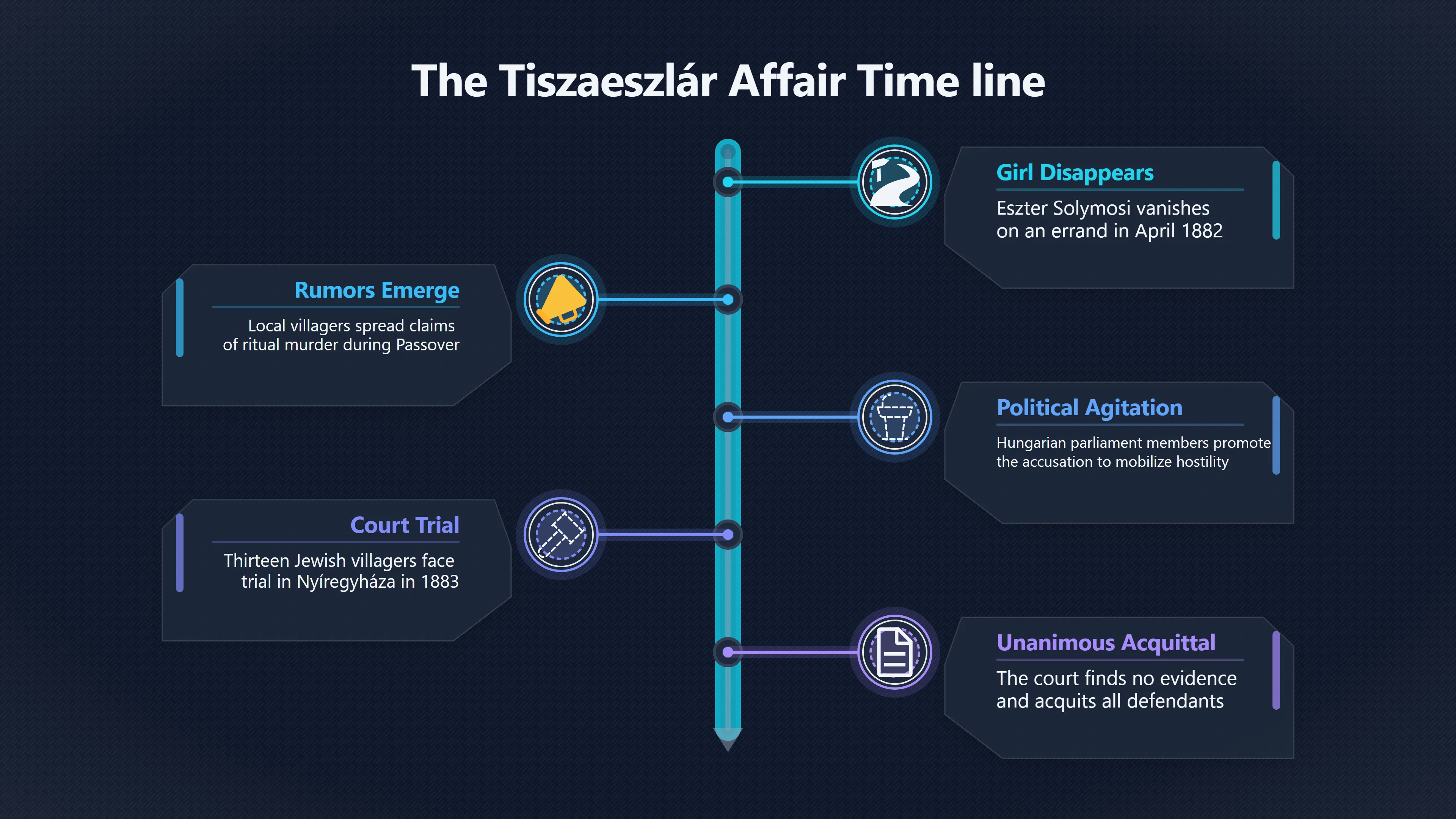
On 1 April 1882, Eszter Solymosi disappeared after being sent on an errand. Searches produced no immediate explanation. In many communities, an unexplained disappearance might have remained a tragic mystery. In Tiszaeszlár, however, the timing proved explosive. Passover was approaching, and longstanding antisemitic myths about Jewish ritual murder were already circulating in parts of Central and Eastern Europe.[yivo.org]encyclopedia.yivo.orgEncyclopedia Tiszaeszlár Blood LibelYIVO EncyclopediaTiszaeszlár Blood Libel - YIVO EncyclopediaThe Tiszaeszlár blood libel played a conspicuous role in the proceedings of t…
Within days, rumours emerged that local Jews had abducted and killed the girl to obtain her blood for religious purposes. The accusation had no basis in Jewish practice, theology or evidence, but blood libel stories had persisted in European culture for centuries. What made Tiszaeszlár distinctive was that the allegation entered a modern legal system and became the centre of a major criminal prosecution.[YIVO Encyclopedia]encyclopedia.yivo.orgEncyclopedia Tiszaeszlár Blood LibelYIVO EncyclopediaTiszaeszlár Blood Libel - YIVO EncyclopediaThe Tiszaeszlár blood libel played a conspicuous role in the proceedings of t…
The case quickly expanded beyond a village dispute. Antisemitic politicians, including members of the Hungarian parliament, promoted the accusation and used it to mobilise public hostility toward Jewish communities. Newspapers amplified the story, helping transform a local disappearance into a national controversy.[Wikipedia]WikipediaTiszaeszlár affairTiszaeszlár affair
Móric Scharf’s Testimony and the Collapsing Prosecution
The prosecution’s case depended heavily on one witness: Móric Scharf, the teenage son of a synagogue caretaker. Investigators claimed that the boy had seen the alleged murder and could identify those responsible. His testimony became the centrepiece of the accusation.[Wikipedia]WikipediaTiszaeszlár affairTiszaeszlár affair
Yet the circumstances surrounding his evidence raised serious doubts. Contemporary accounts and later scholarship describe intense pressure on the boy during the investigation. Isolated from his family and questioned repeatedly, he produced statements that investigators treated as confirmation of the ritual-murder theory. Critics argued that his evidence had been shaped by coercion rather than observation.[Wikipedia]WikipediaTiszaeszlár affairTiszaeszlár affair
As the trial proceeded in Nyíregyháza in 1883, the prosecution’s narrative began to unravel.
Several developments proved damaging:
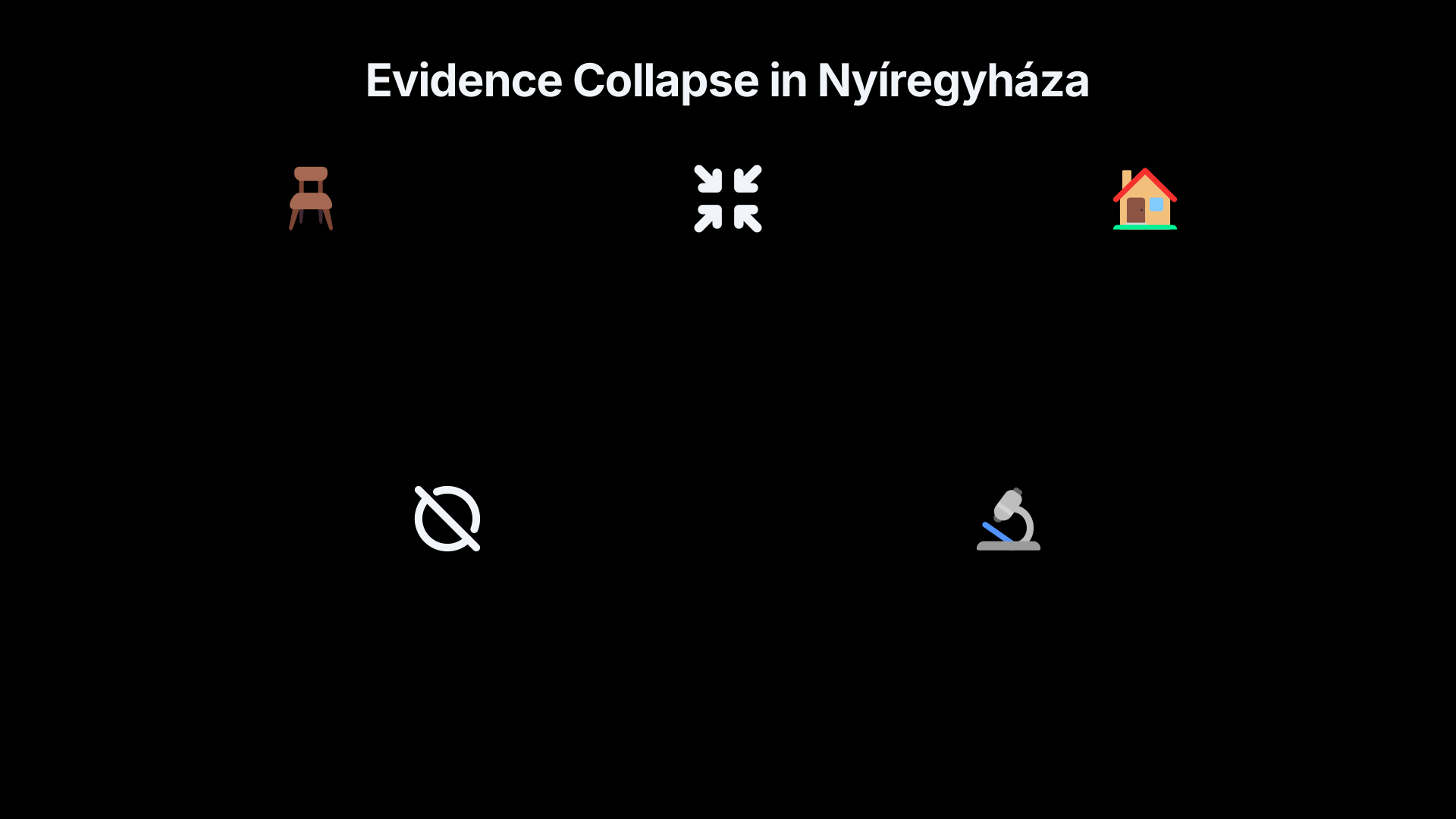
- Scharf’s statements contained contradictions and inconsistencies.
- Court inspections of the alleged crime scene failed to support his account.
- Investigators could not produce physical evidence linking the defendants to a murder.
- Medical examinations cast doubt on claims that a ritual killing had occurred.[Wikipedia]WikipediaTiszaeszlár affairTiszaeszlár affair
A body recovered from the River Tisza complicated matters further. Debate emerged over whether it was Eszter Solymosi. Some early examiners argued it was not, while later medical reviews challenged those conclusions. The condition of the remains made certainty difficult, but experts found no reliable evidence supporting ritual murder claims. The actual cause of Eszter’s disappearance and death was never conclusively established.[Wikipedia]WikipediaTiszaeszlár affairTiszaeszlár affair
By the end of the proceedings, the prosecution’s theory depended largely on testimony that had become increasingly difficult to believe. In August 1883 the court unanimously acquitted the accused. Appeals failed, and the verdict stood.[Wikipedia]WikipediaTiszaeszlár affairTiszaeszlár affair
Why So Many People Believed It
One of the most revealing aspects of the affair is that belief in the accusation often survived the collapse of the evidence.
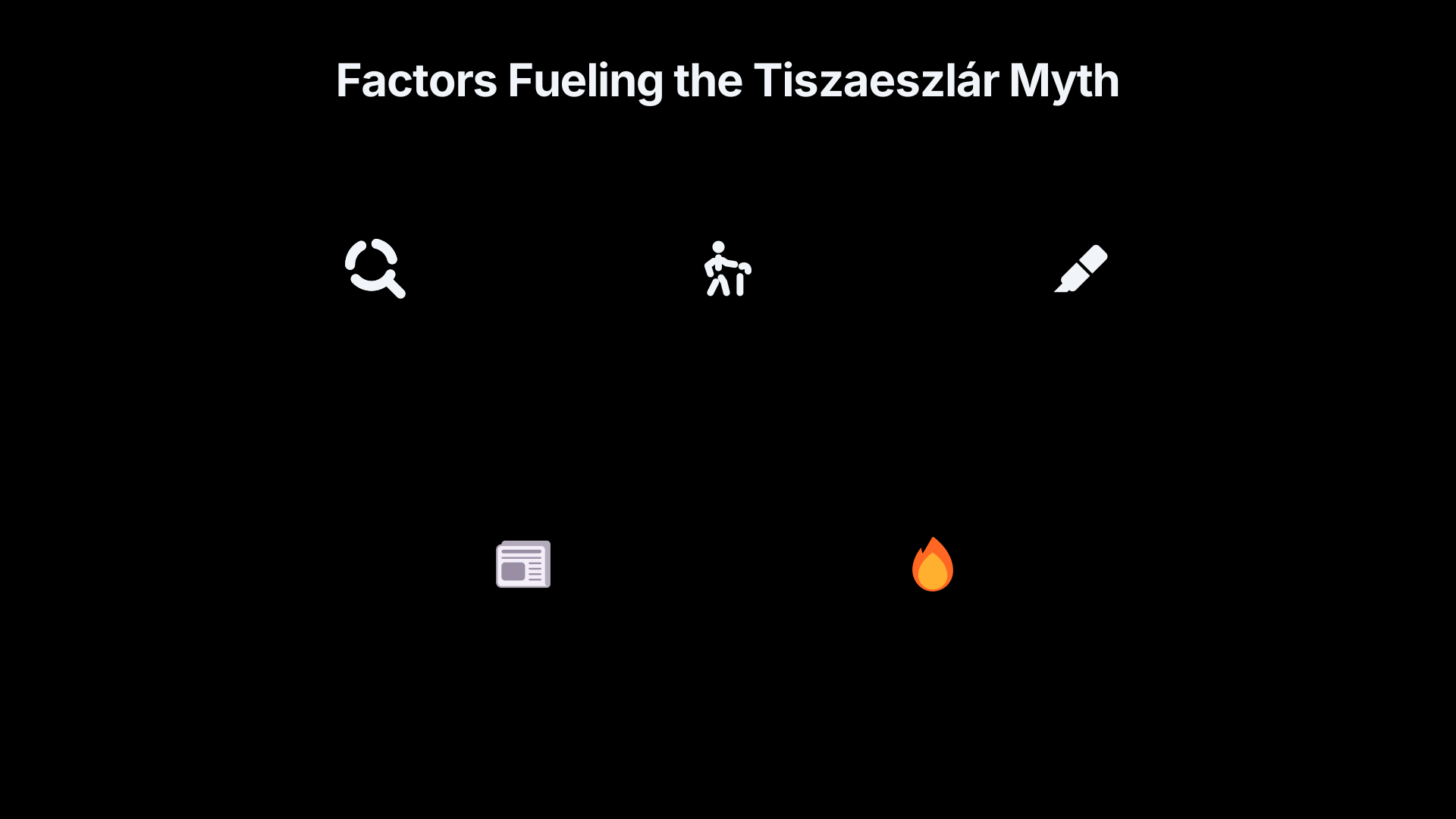
Several factors made the story persuasive to many contemporaries:
An unresolved mystery. People naturally seek explanations for disappearances. The absence of a clear answer created space for speculation.
Existing prejudice. Blood libel myths were already familiar to some audiences. The accusation did not need to be invented from scratch; it relied on a pre-existing cultural script.[YIVO Encyclopedia]encyclopedia.yivo.orgEncyclopedia Tiszaeszlár Blood LibelYIVO EncyclopediaTiszaeszlár Blood Libel - YIVO EncyclopediaThe Tiszaeszlár blood libel played a conspicuous role in the proceedings of t…
Political incentives. Antisemitic activists used the case to argue that Jews were incompatible with Hungarian society. The affair became a political weapon rather than a simple criminal investigation.[Wikipedia]WikipediaTiszaeszlár affairTiszaeszlár affair
Media amplification. Newspapers spread allegations much faster than earlier blood libel episodes. Historians have sometimes described Tiszaészlár as a distinctly modern case because traditional superstition was combined with mass politics and modern publicity.[Taylor & Francis Online]tandfonline.comEszter Solymosi, a fourteen-year-old Christian maidservant who went missing on 1 April 1882, just three days before Passover. Krúdy was o…
The result was a moral panic in which evidence often mattered less than the emotional power of the accusation.
Acquittal Did Not End the Story
The court’s verdict did not eliminate the myth. In fact, the acquittal triggered further unrest and antisemitic agitation in parts of Hungary. For campaigners who had invested political capital in the accusation, the verdict was interpreted not as proof of innocence but as proof that justice had supposedly failed.[Wikipedia]WikipediaTiszaeszlár affairTiszaeszlár affair
This pattern is common in conspiracy thinking and moral panics. Once a dramatic accusation becomes part of a political identity, contradictory evidence can be reinterpreted as evidence of a cover-up. Tiszaészlár became an early example of this phenomenon.
The affair also entered literature, journalism and political memory. Writers revisited the case, sometimes as a warning about prejudice and sometimes as material for nationalist or antisemitic narratives. The disappearance of Eszter Solymosi remained unresolved, which allowed later generations to project their own interpretations onto the event.[Taylor & Francis Online]tandfonline.comEszter Solymosi, a fourteen-year-old Christian maidservant who went missing on 1 April 1882, just three days before Passover. Krúdy was o…
The Long Afterlife of Tiszaeszlár
The most important legacy of the affair is not the trial itself but the way it continued to be reused.
The case became a reference point for organised antisemitic movements beyond Hungary. Contemporary observers noted that it played a visible role in international antisemitic discussions during the late nineteenth century, helping spread and modernise blood libel narratives.[YIVO Encyclopedia]yivo.orgOpen source on yivo.org.
Visual propaganda proved especially influential. Posters, illustrations and later publications repeatedly recycled imagery associated with the alleged crime. Researchers studying the affair’s visual history have shown how images from the case continued to function as antisemitic propaganda long after the legal proceedings ended.[hypotheses.org]mws.hypotheses.orgOpen source on hypotheses.org.
The story has also resurfaced periodically in modern politics. More than a century after the acquittals, references to Tiszaészlár still appeared in Hungarian public debate, with some far-right figures questioning the verdict or reviving suspicions that historians regard as unsupported. These episodes demonstrate how durable false narratives can be when they become symbols rather than evidence-based claims.[Jewish Telegraphic Agency]jta.orghungarian lawmaker claims jews implicated in blood libelhungarian lawmaker claims jews implicated in blood libel
What Tiszaeszlár Reveals About False Accusations
Tiszaészlár occupies a distinctive place in Hungary’s history of deception and contested truth. The affair was not exposed through a dramatic confession or a newly discovered document. Instead, the accusation failed because its evidence could not withstand sustained examination.
The case illustrates several recurring features of destructive false narratives:
- A genuine mystery created demand for an explanation.
- Existing prejudices supplied a ready-made culprit.
- Political activists benefited from promoting the accusation.
- Questionable testimony was treated as certainty.
- Public belief survived even after legal scrutiny dismantled the case.[YIVO Encyclopedia]encyclopedia.yivo.orgEncyclopedia Tiszaeszlár Blood LibelYIVO EncyclopediaTiszaeszlár Blood Libel - YIVO EncyclopediaThe Tiszaeszlár blood libel played a conspicuous role in the proceedings of t…
For that reason, the Tiszaészlár blood libel remains more than a historical curiosity. It is a reminder that rumours can acquire the authority of fact when they align with fear, identity and political advantage—and that disproving a false story is often easier than preventing it from becoming a lasting myth.
Amazon book picks
Further Reading
Books and field guides related to How Did a Rumour Become a Murder Trial?. Use these as the next step if you want deeper reading beyond the article.
Anti-Judaism: The Western Tradition
Explains the historical roots of accusations like blood libel.
eBay marketplace picks
Marketplace Samples
Live-tested eBay searches with available results related to this page.
Endnotes
1.
Source: encyclopedia.yivo.org
Title: Encyclopedia Tiszaeszlár Blood Libel
Link:https://encyclopedia.yivo.org/article.aspx/Tiszaeszlar_Blood_Libel
Source snippet
YIVO EncyclopediaTiszaeszlár Blood Libel - YIVO EncyclopediaThe Tiszaeszlár blood libel played a conspicuous role in the proceedings of t...
2.
Source: Wikipedia
Title: Tiszaeszlár affair
Link:https://en.wikipedia.org/wiki/Tiszaeszl%C3%A1r_affair
3.
Source: Wikipedia
Title: Blood libel
Link:https://en.wikipedia.org/wiki/Blood_libel
4.
Source: mws.hypotheses.org
Link:https://mws.hypotheses.org/37349
5.
Source: perspectivia.net
Link:https://www.perspectivia.net/servlets/MCRFileNodeServlet/pnet_derivate_00000841/9783737009775.263.pdf
6.
Source: youtube.com
Title: The Velizh Affair: Ritual Murder in a Russian Border Town
Link:https://www.youtube.com/watch?v=SI0A4gU5KaA
Source snippet
Blood Libel - The Murder Accusation against the Jews of Norwich (1144): Meaning, Memory & Legacy...
7.
Source: youtube.com
Title: Blood Libel
Link:https://www.youtube.com/watch?v=HSwwSZLWO3o
Source snippet
Tiszaeszlar blood libel The Tiszaeszlár Affair — How Forensic Science Exposed a 19th-Century Lie Secrets of Criminalistics...
8.
Source: tandfonline.com
Link:https://www.tandfonline.com/doi/full/10.1080/13501674.2025.2479253
Source snippet
Eszter Solymosi, a fourteen-year-old Christian maidservant who went missing on 1 April 1882, just three days before Passover. Krúdy was o...
Published: April 1882
9.
Source: jta.org
Title: hungarian lawmaker claims jews implicated in blood libel
Link:https://www.jta.org/2012/04/05/global/hungarian-lawmaker-claims-jews-implicated-in-blood-libel
Additional References
10.
Source: danwymanbooks.com
Link:https://www.danwymanbooks.com/archive/32.htm
Source snippet
Dan Wyman BooksDan Wyman Books, LLC.Holubek's acquittal was a victory for the growing political antisemitism. Rohling and his works acqui...
11.
Source: associationforjewishstudies.org
Link:https://www.associationforjewishstudies.org/docs/default-source/conference-files/other-conference-materials/2006-ajs-conference-abstracts.pdf?sfvrsn=1bcedb06_4
Source snippet
Abstracts for Session 1 Sunday, December, 17, 2006 09:30...19 Dec 2006 — Jews to the Tiszaeszlár blood libel affair (1882-1883), which t...
12.
Source: iffr.com
Title: Memories of a River
Link:https://iffr.com/en/iffr/2023/films/memories-of-a-river
Source snippet
Memories of a River - IFFR ENAged just 14, Solymosi Eszter vanished without a trace after having been sent on an errand on April 1, 1...
13.
Source: youtube.com
Title: The Tiszaeszlár Affair — How Forensic Science Exposed a 19th-Century Lie
Link:https://www.youtube.com/watch?v=l_kYILRfVZo
Source snippet
What Is Blood Libel? The Antisemitic Myth Still Spreading Today...
14.
Source: hunghist.org
Link:https://hunghist.org/83-articles/279-2014-4-kover
Source snippet
2014_4_KövérAt around noon on Saturday, April 1, 1882, Eszter Solymosi, a 14-year-old girl disappeared without a trace from Tiszaeszlár...
Published: April 1, 1882
15.
Source: youtube.com
Title: What Is Blood Libel? The Antisemitic Myth Still Spreading Today
Link:https://www.youtube.com/watch?v=fb5VTfwHE9I
Source snippet
The History of Antisemitism: Blood Libel...
16.
Source: jaceklewinson.com
Link:https://www.jaceklewinson.com/files/local_interest/2Q2021/2021Q2_Hungary.xlsx
17.
Source: azahari.blog
Link:https://azahari.blog/wp-content/uploads/2025/02/the-cambridge-dictionary-of-judaism-and-jewish-culture.pdf
18.
Source: scribd.com
Link:https://www.scribd.com/document/615643232/The-Rise-and-Fall-of-Judapest
19.
Source: jewishvirtuallibrary.org
Link:https://www.jewishvirtuallibrary.org/tiszaeszlar
Topic Tree