Within Sierra Leone Hoaxes
How Ebola Rumours Turned Hospitals Into Suspects
Claims that Ebola was invented for blood or organ harvesting turned necessary medical controls into supposed proof of wrongdoing.
On this page
- The blood and organ harvesting allegation
- Why isolation and protective clothing fuelled suspicion
- How trust, survivors and local communication changed beliefs
Page outline Jump by section
Introduction
During Sierra Leone’s 2014–15 Ebola crisis, some of the most damaging false stories were not about the disease itself but about the people trying to treat it. Rumours spread that Ebola was an invention, that treatment centres were harvesting blood or organs, and that patients taken into isolation would never return. These claims were not harmless misunderstandings. They helped turn hospitals, ambulances and treatment units into objects of fear and, in some cases, targets of violence.[The Guardian]theguardian.comThe Guardian Ebola in Sierra Leone: myths and misconceptionsEbola was not real and that health workers were using it as a way to harvest organs and steal blood. The streets were closed off that…

This episode is an important example of how misinformation can become a real-world danger. The rumours drew strength from genuine anxieties: families were separated from sick relatives, bodies disappeared into unfamiliar burial systems, and health workers appeared in full protective suits that concealed their identities. In a country emerging from civil war and facing deep mistrust of institutions, those extraordinary measures could be interpreted as evidence of wrongdoing rather than evidence of disease control.[nih.gov]pmc.ncbi.nlm.nih.govTrust, and distrust, of Ebola Treatment Centers: A case-study…by P Richards · 2019 · Cited by 69 — This paper presents results of a…
The Blood and Organ-Harvesting Allegation
Among the most persistent Ebola rumours was the claim that health workers were stealing blood or harvesting organs from patients. In some versions, Ebola itself was said not to exist. Instead, treatment centres were portrayed as places where foreign organisations, government officials or medical staff secretly profited from patients’ suffering.[The Guardian]theguardian.comThe Guardian Ebola in Sierra Leone: myths and misconceptionsEbola was not real and that health workers were using it as a way to harvest organs and steal blood. The streets were closed off that…
One widely reported incident occurred in Kenema, one of the areas hardest hit by the outbreak. According to contemporary reporting, unrest followed radio claims that Ebola was a fabrication and that health workers were using the crisis to take blood and organs from local people. A crowd gathered outside the hospital, stones were thrown, and authorities imposed emergency restrictions to restore order.[The Guardian]theguardian.comThe Guardian Ebola in Sierra Leone: myths and misconceptionsEbola was not real and that health workers were using it as a way to harvest organs and steal blood. The streets were closed off that…
The rumour was powerful because it attached itself to visible but poorly understood medical procedures. Blood samples were routinely collected to confirm infection. Patients were transported away from their communities. Families often received little direct contact with isolated relatives. For people already frightened by a deadly disease, these practices could be reinterpreted as evidence that something sinister was happening behind hospital walls.[PMC]pmc.ncbi.nlm.nih.govTrust, and distrust, of Ebola Treatment Centers: A case-study…by P Richards · 2019 · Cited by 69 — This paper presents results of a…
Researchers studying community perceptions later found that suspicion of Ebola treatment centres was widespread in some areas. Stories circulated that patients entered treatment units alive and never emerged, reinforcing the idea that hospitals were concealing the truth. In reality, mortality rates were high during the worst stages of the epidemic, but survivors did leave treatment centres and many later became important public witnesses against the rumours.[PMC]pmc.ncbi.nlm.nih.govTrust, and distrust, of Ebola Treatment Centers: A case-study…by P Richards · 2019 · Cited by 69 — This paper presents results of a…
Why Isolation and Protective Clothing Fuelled Suspicion
The measures needed to stop Ebola transmission often looked alarming to people encountering them for the first time.
Health workers wore full-body protective equipment, including masks, goggles and gloves. Ambulances arrived unexpectedly. Patients were removed from their homes and placed in restricted facilities. Traditional funeral practices were curtailed because bodies remained highly infectious after death. Each of these measures had a clear medical purpose, but together they created an atmosphere that could seem frightening and secretive.[PMC]pmc.ncbi.nlm.nih.govEbola: Ten years later—Lessons learned and future pandemic…by K Kuppalli · 2024 · Cited by 11 — Traditional cultural beliefs and pr…
Several factors made rumours especially persuasive:
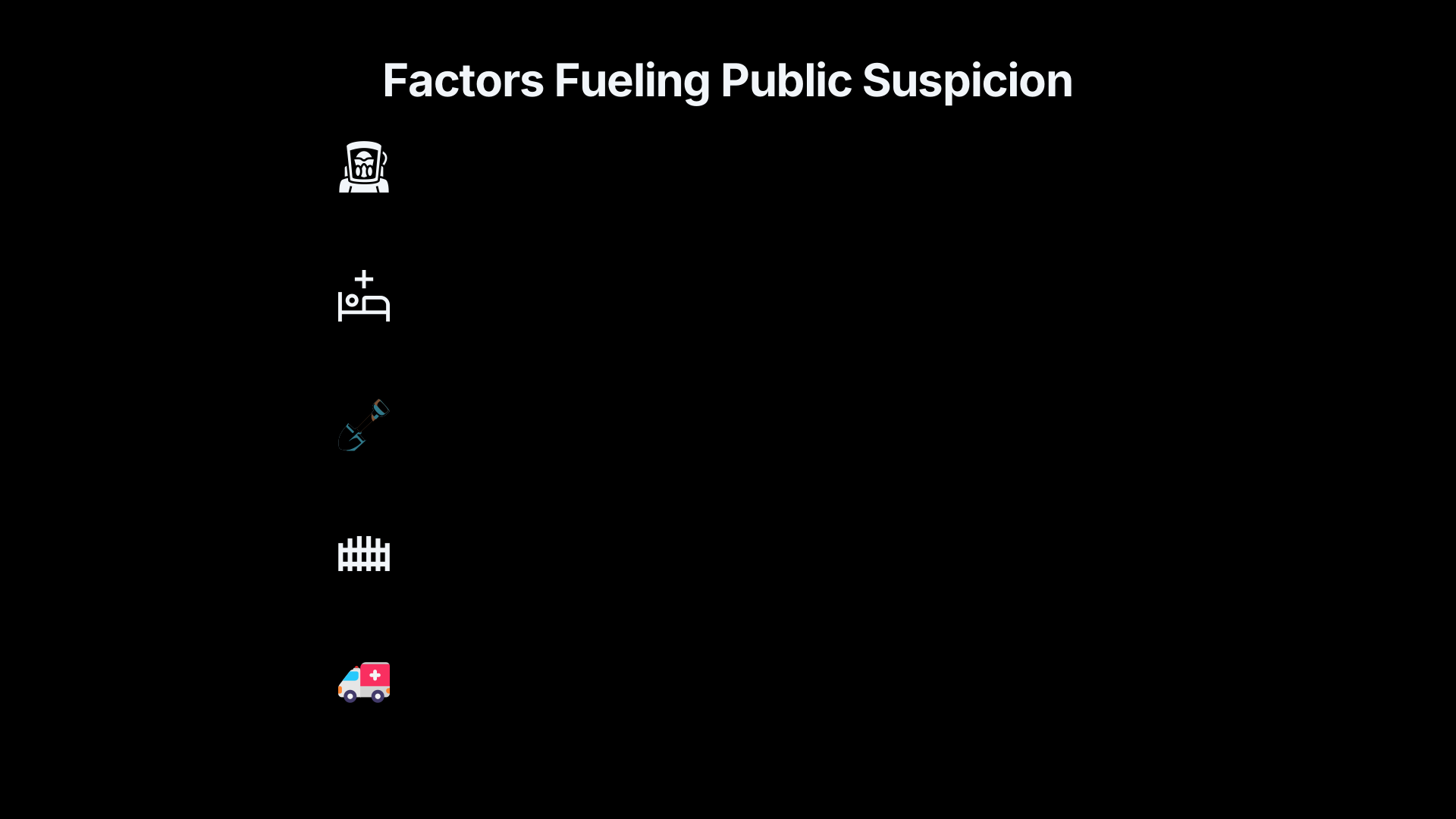
- Protective suits hid identities. Villagers often saw strangers in white protective gear rather than familiar local nurses or doctors.
- Isolation separated families. Relatives could not provide normal care or maintain regular contact with patients.
- Safe burials replaced traditional rituals. Families were prevented from washing, touching or preparing bodies in customary ways.
- Treatment centres were physically closed environments. People outside could not easily observe what happened inside.[nih.gov]pmc.ncbi.nlm.nih.govTrust, and distrust, of Ebola Treatment Centers: A case-study…by P Richards · 2019 · Cited by 69 — This paper presents results of a…
Researchers examining public attitudes during the epidemic found that many people accepted control measures only after they saw evidence with their own eyes. Before that point, the combination of secrecy, fear and rapid social change left space for alternative explanations, including rumours about blood theft and organ harvesting.[ResearchGate]researchgate.netResearchGate(PDF) 'When Ebola enters a home, a family, a community''When Ebola enters a home, a family, a community': A qualitative study…
When Rumours Led to Confrontation
The consequences were not limited to gossip. False claims contributed to resistance against health interventions and occasionally erupted into violence.
Medical teams attempting to investigate suspected Ebola deaths sometimes encountered angry crowds who believed authorities were misrepresenting the cause of death. In one Sierra Leone incident, officials trying to collect samples from a corpse were confronted by residents who rejected the Ebola diagnosis. The dispute escalated into serious disorder and attacks on buildings.[Wikipedia]WikipediaEbola virus epidemic in Sierra LeoneEbola virus epidemic in Sierra Leone
The broader pattern was visible across the Ebola-affected region. Studies of the epidemic found that distrust of treatment centres, fears about hidden motives and rumours of organ harvesting undermined contact tracing, delayed reporting of cases and encouraged families to hide sick relatives. These actions increased transmission risks and complicated efforts to control the outbreak.[nih.gov]pmc.ncbi.nlm.nih.govTrust, and distrust, of Ebola Treatment Centers: A case-study…by P Richards · 2019 · Cited by 69 — This paper presents results of a…
Importantly, most people spreading such stories were not professional hoaxers seeking profit. Many genuinely believed the claims. This places the episode in a grey area between deliberate deception, rumour and collective misunderstanding. The falsehoods nevertheless had effects similar to those of a classic hoax: they persuaded people to act on information that was untrue and dangerous.[PMC]pmc.ncbi.nlm.nih.govTrust, and distrust, of Ebola Treatment Centers: A case-study…by P Richards · 2019 · Cited by 69 — This paper presents results of a…
How Trust, Survivors and Local Communication Changed Beliefs
The eventual decline of these rumours did not come primarily through official denials. It came through trusted local voices and visible evidence.
One of the most effective responses was the appearance of Ebola survivors. People who had entered treatment centres and returned alive contradicted the claim that hospitals existed to harm patients. Their testimony provided something government announcements often could not: proof from neighbours, relatives and community members.[PMC]pmc.ncbi.nlm.nih.govTrust, and distrust, of Ebola Treatment Centers: A case-study…by P Richards · 2019 · Cited by 69 — This paper presents results of a…
Community engagement also changed. Health agencies increasingly worked with local leaders, religious figures and community volunteers rather than relying solely on top-down messaging. Lessons identified after the outbreak stressed the importance of consultation, dialogue and locally trusted communicators rather than simply broadcasting instructions.[ACAPS]acaps.orgEbola Outbreak, Sierra LeoneEbola Outbreak, Sierra Leone
Surveys conducted after the epidemic showed significant improvements in public understanding of Ebola transmission and growing acceptance of measures such as safe burials and survivor reintegration. These shifts suggest that direct engagement and lived experience gradually displaced many of the most damaging rumours.[PMC]pmc.ncbi.nlm.nih.govOpen source on nih.gov.
What the Episode Reveals About Rumours and Public Health
The blood- and organ-harvesting stories became influential because they offered an explanation for events that seemed shocking and unfamiliar. Families watched relatives disappear into isolation wards, saw health workers hidden behind protective equipment and lost access to traditional ways of caring for the sick and burying the dead. In that environment, rumours filled gaps in understanding.[PMC]pmc.ncbi.nlm.nih.govTrust, and distrust, of Ebola Treatment Centers: A case-study…by P Richards · 2019 · Cited by 69 — This paper presents results of a…
For the history of misinformation in Sierra Leone, this episode stands out because the false claims transformed institutions designed to save lives into suspected enemies. The rumours were eventually undermined by evidence, survivors and stronger community communication, but not before they had fuelled unrest, delayed treatment and deepened public fear. The story remains a reminder that trust can be as important as medicine during a public-health emergency.[theguardian.com]theguardian.comThe Guardian Ebola in Sierra Leone: myths and misconceptionsEbola was not real and that health workers were using it as a way to harvest organs and steal blood. The streets were closed off that…
Amazon book picks
Further Reading
Books and field guides related to How Ebola Rumours Turned Hospitals Into Suspects. Use these as the next step if you want deeper reading beyond the article.
The Hot Zone
Provides accessible background on deadly viral outbreaks and public fear.
The Psychology of Conspiracy Theories
Helps explain rumours about hospitals, authorities and hidden motives.
eBay marketplace picks
Marketplace Samples
Live-tested eBay searches with available results related to this page.


Endnotes
1.
Source: pmc.ncbi.nlm.nih.gov
Link:https://pmc.ncbi.nlm.nih.gov/articles/PMC6886773/
Source snippet
Trust, and distrust, of Ebola Treatment Centers: A case-study...by P Richards · 2019 · Cited by 69 — This paper presents results of a...
2.
Source: researchgate.net
Link:https://www.researchgate.net/publication/325666546_%27When_Ebola_enters_a_home_a_family_a_community%27_A_qualitative_study_of_population_perspectives_on_Ebola_control_measures_in_rural_and_urban_areas_of_Sierra_Leone
Source snippet
ResearchGate(PDF) 'When Ebola enters a home, a family, a community''When Ebola enters a home, a family, a community': A qualitative study...
3.
Source: afro.who.int
Title: more patients discharged ebola treatment centres sierra leone
Link:https://www.afro.who.int/news/more-patients-discharged-ebola-treatment-centres-sierra-leone
Source snippet
Regional Office for AfricaMore patients discharged from the Ebola treatment centres...On 30 June 2014 four patients were discharge...
Published: June 2014
4.
Source: pmc.ncbi.nlm.nih.gov
Link:https://pmc.ncbi.nlm.nih.gov/articles/PMC11426465/
Source snippet
Ebola: Ten years later—Lessons learned and future pandemic...by K Kuppalli · 2024 · Cited by 11 — Traditional cultural beliefs and pr...
5.
Source: Wikipedia
Title: Ebola virus epidemic in Sierra Leone
Link:https://en.wikipedia.org/wiki/Ebola_virus_epidemic_in_Sierra_Leone
6.
Source: acaps.org
Title: Ebola Outbreak, Sierra Leone
Link:https://www.acaps.org/fileadmin/Data_Product/Main_media/v_sierra_leone_communication_challenges_and_good_practice_dec_2015_2-ilovepdf-compressed_ul.pdf
7.
Source: pmc.ncbi.nlm.nih.gov
Link:https://pmc.ncbi.nlm.nih.gov/articles/PMC7265950/
8.
Source: Wikipedia
Title: Western African Ebola epidemic
Link:https://en.wikipedia.org/wiki/Western_African_Ebola_epidemic
9.
Source: theguardian.com
Title: The Guardian Ebola in Sierra Leone: myths and misconceptions
Link:https://www.theguardian.com/global-development/2014/aug/09/ebola-sierra-leone-myths-misconceptions
Source snippet
Ebola was not real and that health workers were using it as a way to harvest organs and steal blood. The streets were closed off that...
10.
Source: tandfonline.com
Link:https://www.tandfonline.com/doi/full/10.1080/01459740.2019.1609472
Source snippet
Taylor & Francis OnlineEbola and Public Authority: Saving Loved Ones in Sierra...by M Parker · 2019 · Cited by 85 — Mutuality between ne...
11.
Source: iwm.org.uk
Title: sierra leone
Link:https://www.iwm.org.uk/history/contemporary-conflict/sierra-leone
Additional References
12.
Source: youtube.com
Title: Surviving Ebola: Manjo’s Story | Unreported World Shorts | Channel 4
Link:https://www.youtube.com/watch?v=a7u7oUFQBYM
Source snippet
Ebola crisis worsens as health officials fight misinformation...
13.
Source: youtube.com
Title: Looking back at the Ebola crisis in Sierra Leone | Unreported World
Link:https://www.youtube.com/watch?v=X29qQRDdyAk
Source snippet
The Fight Against Ebola: Sierra Leone's Story...
14.
Source: youtube.com
Title: The Fight Against Ebola: Sierra Leone’s Story
Link:https://www.youtube.com/watch?v=VqyTcYWSTFA
Source snippet
Surviving Ebola: Manjo's Story | Unreported World Shorts | Channel 4...
15.
Source: gh.bmj.com
Link:https://gh.bmj.com/content/10/3/e017285
Source snippet
BMJ Global HealthBarriers to community engagement during the response to...by D Musoke · 2025 · Cited by 10 — Our findings indicate that...
16.
Source: aol.com
Link:https://www.aol.com/news/ebola-misinformation-fuelling-violent-attacks-050215728.html
17.
Source: facebook.com
Link:https://www.facebook.com/bbcnews/posts/an-attack-on-four-red-cross-volunteers-last-month-in-the-democratic-republic-of-/1527359189428068/
18.
Source: facebook.com
Link:https://www.facebook.com/TheStarKenya/posts/false-claims-about-ebola-are-linked-to-attacks-on-treatment-facilities-assaults-/1499527368883134/
19.
Source: facebook.com
Link:https://www.facebook.com/concernworldwide/posts/in-late-2014-west-africa-was-in-chaos-as-ebola-spread-through-the-population-the/953769410131247/
20.
Source: youtube.com
Link:https://www.youtube.com/shorts/ArHpLRYsivs
21.
Source: youtube.com
Title: Ebola crisis worsens as health officials fight misinformation
Link:https://www.youtube.com/watch?v=a-oGga9_lUk
Source snippet
Sierra Leone: Ebola survivors in Limbo...
Topic Tree