When Denmark's Best Stories Outran the Evidence
Denmark’s best-known stories of deception are not a simple catalogue of swindlers fooling a credulous public. They range from staged séances and artificial music streams to mistaken archaeological identifications and patriotic legends that became more famous than the events they supposedly described. Some were deliberate frauds.
Page outline Jump by section
Introduction
Several patterns recur. A claim becomes persuasive when it arrives with the backing of science, royalty, journalism or national memory. Exposure usually follows when investigators replace atmosphere and authority with controlled tests, physical examination, documentary records or new technology. Yet correction does not always kill the story. Denmark’s imaginary Viking helmets and the legend of King Christian X wearing a yellow star remain powerful precisely because they express ideas people find emotionally satisfying, even though the historical evidence says otherwise.
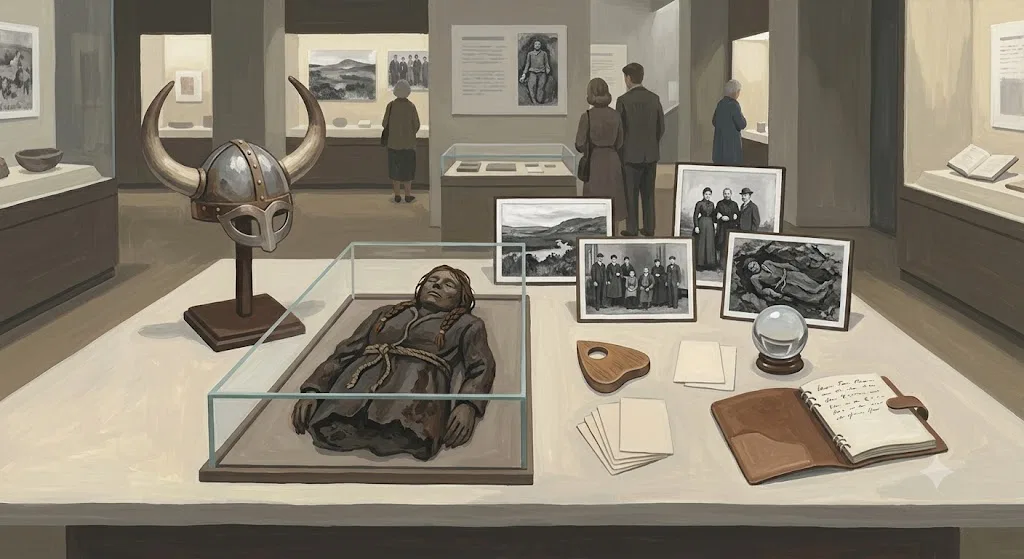
When a bog body became a Viking queen
In 1835, peat workers at Haraldskær in Jutland uncovered the remarkably preserved body of a woman. The discovery quickly attracted an identity: she was said to be Queen Gunhild, a medieval royal figure whom a saga described as having been drowned in a bog on the orders of the Danish king Harald Bluetooth.
The identification offered everything a compelling historical story needed. There was an ancient-looking body, a named queen, a violent death and a literary source that seemed to connect them. The supposed royal remains were treated accordingly. King Frederick VI ordered an elaborate sarcophagus, helping to give an uncertain interpretation the appearance of official recognition.
This was not an archaeological forgery. Nobody had manufactured the corpse or necessarily set out to deceive the public. It was a case of evidence being forced into an attractive pre-existing narrative. The body’s survival was extraordinary, but its identity depended largely on resemblance between the discovery and a saga episode.
The young archaeologist Jens Jacob Asmussen Worsaae challenged the claim in the 1840s. He argued from the archaeological setting and the developing chronological system of European prehistory that the woman belonged to the Iron Age rather than the Viking or medieval period. Later scientific dating vindicated that objection. Radiocarbon work placed her around the fifth century BC, roughly 1,500 years before the queen with whom she had been identified.[ScienceDirect]sciencedirect.comDating bog bodies by means of 14 C-AMSby J van der Plicht · 2004 · Cited by 80 — In the past, this led to interesting specul…
The Haraldskær Woman is important because it shows how easily an interpretation can acquire institutional weight before the evidence is secure. A royal coffin did not make her royal; it made the theory more memorable. Modern isotope and forensic research now asks narrower, answerable questions about her movements, diet and death rather than attempting to match her to a famous name.[OpenEdition Journals]journals.openedition.orgOpenEdition JournalsStrontium isotope investigations of the Haraldskær Woman2Here we focus on investigating the human and textile remains…
The mistaken identity still circulates because “the unknown Iron Age woman” is less narratively complete than “the murdered Viking queen”. The case is therefore better understood as a debunked national legend than as a calculated hoax.
How horned helmets conquered the Vikings
Few false historical images are as durable as the horned Viking helmet. It appears on souvenirs, cartoons, sports branding and fancy dress, despite the absence of archaeological evidence that Viking warriors routinely wore horns on their helmets.
Denmark’s archaeological record helps explain both the error and its correction. Genuine horned helmets have been found at Viksø on Zealand, but they date from the Bronze Age, many centuries before the Viking Age. The National Museum of Denmark describes them as ceremonial objects from the early first millennium BC, probably deposited in a bog as offerings.[National Museum of Denmark]en.natmus.dkNational Museum of Denmark The Viksø helmetsThey were probably used at religious ceremonies.Read more…
There are also prehistoric Scandinavian images of horned headgear. Such objects and pictures make the popular image feel vaguely authentic, but they belong to different periods and probably different ritual settings. The National Museum notes that no horned helmet of Viking Age date has been found. Actual Viking helmet evidence is scarce and fragmentary, but what survives points towards practical protective equipment rather than theatrical horns.[National Museum of Denmark]en.natmus.dkNational Museum of Denmark Viking helmetsNational Museum of DenmarkViking helmets - Museums and palacesParts of helmets have been found in Denmark, including “brow ridges” to pro…
The stereotype was not created by a single fraudulent object. It emerged from nineteenth-century art, theatre and romantic nationalism, when designers gave the ancient North a distinctive visual language. Horns made warriors instantly recognisable on stage and in illustration. Repetition then detached the image from its artistic origin and turned costume design into supposed history.
This is an invented tradition rather than a hoax in the strict sense. Its spread demonstrates how visual shorthand can overpower archaeological detail. A complicated truth — that ceremonial horned headgear existed in prehistoric Scandinavia but is not known as standard Viking battle equipment — loses easily to a simple silhouette.
The myth also shows why exposing false history sometimes has little effect. Archaeology can establish what has and has not been found, but popular culture rewards recognisability. The horned Viking remains useful to advertisers and entertainers even after it has ceased to be credible as reconstruction.
The mediums who made spirits materialise
Spiritualism gained followers across Europe in the late nineteenth and early twentieth centuries by presenting communication with the dead as an observable phenomenon. Denmark developed societies and investigators who hoped that séances might bring spiritual claims within the reach of experimental science. That mixture of grief, curiosity and scientific ambition also created opportunities for performers skilled in concealment and misdirection.
Einer Nielsen and artificial “spirit matter”
The Copenhagen medium Einer Nielsen claimed that spirits could materialise through him. His speciality was a pale substance generally called ectoplasm or teleplasm, supposedly emitted by the medium and shaped by supernatural forces into faces, hands or bodies.
Darkness was central to such performances. Sitters were asked to accept that bright light could harm the medium or disrupt the manifestation. That restriction also made ordinary stage methods difficult to observe. Cloth, paper, masks and other materials could appear uncanny when glimpsed briefly in low light by an audience expecting contact with the dead.
Nielsen initially received favourable attention from Danish psychical researchers. The authority of an investigative society mattered: it suggested that the séance had survived controls rather than merely impressed believers. His reputation suffered badly, however, when a Norwegian committee investigated him in Kristiania, now Oslo, in 1922.
The Norwegian Museum of Science and Technology records that Nielsen was put into restrictive clothing intended to prevent concealment, yet investigators found that the supposed supernatural substance was tulle fabric. The exposure received substantial press attention and embarrassed Danish researchers who had previously endorsed him.[Teknisk museum]tekniskmuseum.noTeknisk museum Spirit photography and spiritualismTeleplasma was the Danish medium Einer Nielsen's specialty. He visited Norway in 1922 and while he was here, he was exposed as a fraud.Re…
Nielsen’s career did not end immediately. Like many exposed mediums, he retained committed supporters and disputed hostile investigations. In 1932, Johs Carstensen, previously the leader of Nielsen’s own circle, published a further denunciation of his methods. Nielsen sued but lost the case, weakening his standing outside his remaining spiritualist following.[Encyclopedia.com]encyclopedia.comnielsen einer d 1965nielsen einer d 1965
The episode illustrates a recurring weakness in paranormal investigation. Elaborate-looking precautions are not useful unless investigators understand every possible route of concealment and maintain control throughout the performance. A tight garment sounded conclusive; a concealed piece of fabric showed that it was not.
Anna Rasmussen and the secret camera
Another Danish medium, Anna Rasmussen, claimed psychokinetic powers, including the ability to move pendulums enclosed in glass cases. She too attracted favourable reports, including an investigation published by Christian Winther of the Danish Society for Psychical Research.
Later experiments at the University of Copenhagen indicated that the effects could be produced through physical means. In 1950, a concealed camera reportedly recorded Rasmussen using fraudulent methods. The resulting newspaper coverage harmed both her reputation and the wider Danish spiritualist movement.[Wikipedia]WikipediaAnna RasmussenAnna Rasmussen
Secret photography changed the balance of evidence. Séance testimony depended heavily on what observers thought they had seen in difficult conditions. A camera could preserve movements that passed too quickly, subtly or unexpectedly for sitters to interpret at the time.
These cases should not be reduced to stories about foolish audiences. Spiritualist meetings offered comfort to bereaved people and presented themselves as serious inquiries into survival after death. Investigators were sometimes caught between two roles: protecting participants from deception and hoping to witness a genuine breakthrough. That hope could make weak controls appear stronger than they were.

The yellow star the Danish king never wore
One of the most persistent stories about occupied Denmark says that King Christian X wore a yellow Star of David in solidarity with Danish Jews. Some versions add that ordinary Danes followed his example, frustrating German attempts to isolate the Jewish population.
The story is false. Danish Jews were not ordered to wear the yellow badge, and neither the king nor the wider Danish population staged the mass star-wearing protest described in the legend. The United States Holocaust Memorial Museum explicitly identifies both versions as fictional.[Holocaust Encyclopedia]encyclopedia.ushmm.orgOpen source on ushmm.org.
The myth nevertheless attaches itself to a real and remarkable history. In October 1943, after information about an impending German roundup became known, Danish citizens, resistance members and others helped most of the country’s Jewish population escape by sea to neutral Sweden. The invented star story therefore did not arise in a vacuum. It compressed a complicated rescue involving warnings, hiding places, money, fishing boats, risk and collective action into one immediately understandable royal gesture.
There were also genuine signs of Christian X’s opposition to German measures and his insistence that Danish Jews were citizens of Denmark. Such attitudes may have helped create fertile ground for the later legend. Wartime reports, retellings and post-war fiction then gave the image international reach. The story became especially attractive because it resembled a perfect moral parable: when a persecuting power marks a minority, everyone adopts the mark.
Correcting it does not diminish the actual rescue. On the contrary, the legend can conceal the harder and more significant truth. Danish Jews were saved not by a symbolic accessory worn by one famous man, but by thousands of decisions made under occupation. Removing the fictional star restores attention to the people who warned families, offered shelter, arranged transport and navigated the waters to Sweden.
The case also raises a distinction important throughout hoax history. A story can be historically false without having one identifiable hoaxer. Legends often grow by repetition, simplification and embellishment. Each retelling may be sincere, yet the cumulative result is misinformation.
Patriotic animals and stories too neat to verify
The so-called Danish Protest Pig is said to have been bred by Danish-speaking farmers in Schleswig after Prussian authorities restricted displays of the Danish flag. According to the familiar account, breeders produced a red pig with a broad white band, allowing livestock to serve as a living substitute for the prohibited red-and-white banner.
Pigs with the relevant colouring certainly exist, commonly identified as the Husum Red Pied. The difficulty lies in proving the heroic origin story. Popular accounts often repeat the breeding-as-resistance explanation without presenting contemporary documents showing that farmers actually planned the breed as a political symbol. Even basic descriptions vary over whether it should be regarded as Danish, German or a regional variety associated with the contested borderlands of Schleswig.[Wikipedia]WikipediaHusum Red PiedHusum Red Pied
The safest conclusion is that the animal is real while the precise protest narrative is uncertain. It may preserve an authentic regional memory, a later patriotic interpretation or a mixture of both.
This kind of tourist legend survives because it turns a complicated border history into an irresistible image. A pig resembling a national flag is memorable; livestock breeding records and shifting territorial identities are not. Reputable retellings should therefore describe the political origin as a tradition or legend unless stronger contemporary evidence is produced.
When fake listeners became real income
Denmark also produced an unusually clear internet-era fraud: a scheme that converted artificial music streams into royalty payments.
A Danish man registered hundreds of tracks and used automated listening to create plays that did not represent genuine audiences. According to evidence presented in court, small numbers of accounts generated implausibly large listening totals. In one reported week, 20 accounts were responsible for most of 5.5 million plays across 244 tracks.[WIRED]wired.comOne Man's Army of Streaming Bots Reveals a Whole Industry's ProblemOne Man's Army of Streaming Bots Reveals a Whole Industry's Problem
The mechanism exploited the way streaming royalties are distributed. A play appears tiny in isolation, but millions of fabricated plays can redirect substantial sums from the shared royalty pool. The deception was not aimed primarily at listeners. It targeted an automated commercial measurement system that treated a recorded stream as evidence of human demand.
In March 2024, a court in Aarhus convicted the defendant of data fraud and copyright infringement. He received an 18-month sentence, with part to be served in prison, while two million Danish kroner was confiscated from him and his company. The case also involved tracks derived from other musicians’ work through alterations such as changes of length or tempo.[The Guardian]theguardian.comOpen source on theguardian.com.
The prosecution could not prove every element of the original allegation. The defendant had initially been accused of earning more than four million kroner from streams of 689 works, but the court concluded that the available data did not establish the full number of artificial plays and resulting royalties. That limitation matters: even a successful fraud case may expose how difficult it is to reconstruct activity inside commercial platforms years later.[The Guardian]theguardian.comOpen source on theguardian.com.
The scheme resembles an old confidence trick performed for machines. Instead of forging a painting’s provenance or staging a ghost, it forged popularity. Fake accounts supplied the appearance of an audience, algorithms translated that appearance into statistics, and statistics triggered payment.
It also reveals why modern exposure increasingly depends on patterns rather than eyewitnesses. Investigators look for impossible listening rates, tightly clustered accounts, repeated behaviour and a mismatch between apparent popularity and organic public engagement. The “tell” is mathematical.
Art stunt, broken contract or deception?
In 2021, the Kunsten Museum of Modern Art in Aalborg gave artist Jens Haaning more than half a million kroner in banknotes to recreate two works representing average incomes. When the delivery arrived, the expected money-filled pieces had been replaced by empty framed canvases entitled Take the Money and Run.
The museum exhibited the result, giving the gesture the status of a conceptual artwork. The dispute began when Haaning declined to return the borrowed cash. In 2023, a Copenhagen court ordered him to repay most of it while allowing him to retain his agreed artist’s fee.[The Guardian]theguardian.comThe Guardian Danish artist who submitted empty frames as artwork toldThe Guardian Danish artist who submitted empty frames as artwork told
Calling the episode a hoax is tempting but incomplete. Haaning did not secretly pass off the empty frames as the commissioned recreations once they had been unpacked. He openly reframed his failure to follow the commission as a new artwork and criticism of working conditions. The museum, despite objecting to the missing money, chose to show it.
The deception therefore lay less in what visitors saw than in the transaction between artist and institution. The museum expected its banknotes to become part of specified works and later be returned. Haaning treated keeping them as part of his artistic act. The court distinguished provocative art from the obligation to repay property supplied under a contract.
The case belongs in Denmark’s history of contested fakery because it exposes the unstable boundary between stunt, appropriation and fraud. An object can be accepted as art while the conduct that produced it remains legally actionable.
Why the false versions survive
Denmark’s hoaxes and debunked legends endured for different reasons, but the most durable ones share a useful structure.
They provide a satisfying identity. Queen Gunhild transformed an anonymous ancient body into a royal tragedy. The yellow-star story turned resistance into a perfectly unified moral gesture. The protest pig made regional nationalism visible in an animal’s coat.
They borrow authority. A royal sarcophagus, a psychical research society, a dramatic photograph or a streaming counter appears to confirm the claim. In each case, the authority is indirect. It validates presentation rather than truth.
They work with the limits of observation. Séance darkness concealed fabric and movement. Archaeologists in 1835 lacked radiocarbon dating. Streaming platforms could count plays more easily than they could establish whether a person was listening.
They are easier to repeat than to correct. “The king wore the star” fits in one sentence. The real history requires an explanation of occupation policy, Danish institutions, warnings, resistance networks and the escape to Sweden. The compact version has an advantage even when it is wrong.
Exposure rarely settles every social question. A fraudulent medium can retain followers. A courtroom can establish repayment obligations without deciding whether empty frames are meaningful art. Archaeology can disprove Viking horns without removing them from popular culture.
The central lesson is not that Denmark has been unusually vulnerable to deception. It is that false stories flourish where evidence meets strong human needs: grief, patriotism, profit, wonder, humour and the desire for an uncomplicated past. The best debunking does more than announce that a claim is false. It explains what made it convincing, identifies the test that changed the verdict and replaces the memorable fiction with a truer story worth remembering.
Amazon book picks
Further Reading
Books and field guides related to When Denmark's Best Stories Outran the Evidence. Use these as the next step if you want deeper reading beyond the article.
Frauds, Myths, and Mysteries: Science and Pseudoscience in Ar...
Examines famous historical misconceptions and archaeological myths.
The Skeptics' Guide to the Universe
Explains how myths, errors and unsupported claims become accepted as facts.
eBay marketplace picks
Marketplace Samples
Live-tested eBay searches with available results related to this page.
Endnotes
1.
Source: sciencedirect.com
Link:https://www.sciencedirect.com/science/article/abs/pii/S0305440303001444
Source snippet
Dating bog bodies by means of 14 C-AMSby J van der Plicht · 2004 · Cited by 80 — In the past, this led to interesting specul...
2.
Source: journals.openedition.org
Link:https://journals.openedition.org/archeosciences/4407?lang=en
Source snippet
OpenEdition JournalsStrontium isotope investigations of the Haraldskær Woman2Here we focus on investigating the human and textile remains...
3.
Source: Wikipedia
Title: Einer Nielsen
Link:https://en.wikipedia.org/wiki/Einer_Nielsen
4.
Source: encyclopedia.com
Title: nielsen einer d 1965
Link:https://www.encyclopedia.com/science/encyclopedias-almanacs-transcripts-and-maps/nielsen-einer-d-1965
5.
Source: Wikipedia
Title: Anna Rasmussen
Link:https://en.wikipedia.org/wiki/Anna_Rasmussen
6.
Source: Wikipedia
Title: Husum Red Pied
Link:https://en.wikipedia.org/wiki/Husum_Red_Pied
7.
Source: wired.com
Title: One Man’s Army of Streaming Bots Reveals a Whole Industry’s Problem
Link:https://www.wired.com/story/streaming-bots-spotify
8.
Source: Wikipedia
Link:https://en.wikipedia.org/wiki/Mediumship
9.
Source: Wikipedia
Title: Ectoplasm (paranormal)
Link:https://en.wikipedia.org/wiki/Ectoplasm_%28paranormal%29
10.
Source: Wikipedia
Title: Haraldskær Woman
Link:https://en.wikipedia.org/wiki/Haraldsk%C3%A6r_Woman
12.
Source: archive.archaeology.org
Link:https://archive.archaeology.org/online/features/bog/gunhild.html
13.
Source: historianandrew.medium.com
Link:https://historianandrew.medium.com/the-breed-of-pig-that-was-created-to-be-a-living-flag-after-a-country-had-theirs-banned-715e4be7b813
14.
Source: en.natmus.dk
Title: National Museum of Denmark The Viksø helmets
Link:https://en.natmus.dk/historical-knowledge/denmark/prehistoric-period-until-1050-ad/the-bronze-age/the-viksoe-helmets/
Source snippet
They were probably used at religious ceremonies.Read more...
15.
Source: en.natmus.dk
Title: National Museum of Denmark Viking helmets
Link:https://en.natmus.dk/historical-knowledge/denmark/prehistoric-period-until-1050-ad/the-viking-age/weapons/helmets/
Source snippet
National Museum of DenmarkViking helmets - Museums and palacesParts of helmets have been found in Denmark, including “brow ridges” to pro...
16.
Source: en.natmus.dk
Title: National Museum of Denmark Berserkers
Link:https://en.natmus.dk/historical-knowledge/denmark/prehistoric-period-until-1050-ad/the-viking-age/weapons/berserkers/
Source snippet
This is partly due to the fact that no such headgear of...Read more...
17.
Source: tekniskmuseum.no
Title: Teknisk museum Spirit photography and spiritualism
Link:https://www.tekniskmuseum.no/en/stories/spirit-photography-and-spiritualism
Source snippet
Teleplasma was the Danish medium Einer Nielsen's specialty. He visited Norway in 1922 and while he was here, he was exposed as a fraud.Re...
18.
Source: encyclopedia.ushmm.org
Link:https://encyclopedia.ushmm.org/content/en/article/king-christian-x-of-denmark
19.
Source: theguardian.com
Link:https://www.theguardian.com/world/2024/mar/21/danish-man-found-guilty-of-fraudulently-profiting-from-music-streaming-royalties
20.
Source: theguardian.com
Title: The Guardian Danish artist who submitted empty frames as artwork told
Link:https://www.theguardian.com/world/2023/sep/18/danish-artist-jens-haaning-empty-frames-ordered-repay
21.
Source: encyclopedia.ushmm.org
Link:https://encyclopedia.ushmm.org/en/a-z/article?page=21&perPage=25&query=%2A%3A%2A
22.
Source: collections.ushmm.org
Link:https://collections.ushmm.org/search/catalog/irn1004793
23.
Source: collections.ushmm.org
Link:https://collections.ushmm.org/search/catalog/irn512442
24.
Source: collections.ushmm.org
Link:https://collections.ushmm.org/search/catalog/irn550878
25.
Source: collections.ushmm.org
Link:https://collections.ushmm.org/search/catalog/irn507666
26.
Source: collections.ushmm.org
Link:https://collections.ushmm.org/search/catalog/irn1004643
27.
Source: collections.ushmm.org
Link:https://collections.ushmm.org/search/catalog/irn508223
28.
Source: collections.ushmm.org
Link:https://collections.ushmm.org/search/catalog/irn709458
29.
Source: collections.ushmm.org
Link:https://collections.ushmm.org/search/catalog/irn506672
30.
Source: collections.ushmm.org
Link:https://collections.ushmm.org/search/catalog/irn639593
31.
Source: en.natmus.dk
Title: prehistoric period until 1050 ad
Link:https://en.natmus.dk/historical-knowledge/denmark/prehistoric-period-until-1050-ad/
32.
Source: amusingplanet.com
Title: danish protest pig
Link:https://www.amusingplanet.com/2025/03/danish-protest-pig.html
Additional References
33.
Source: youtube.com
Title: A Danish Bog Hid His Body for 5,000 Years. DNA Said He Wasn’t From There
Link:https://www.youtube.com/watch?v=ZmZH_pDRgns
Source snippet
8th May 1950: The Tollund Man, who lived in the 5th century BC, discovered in a Danish peat bog...
Published: May 1950
34.
Source: youtube.com
Link:https://www.youtube.com/watch?v=QVEENWaD5Lw
Source snippet
Every Body Found in the Bog Was Murdered. No One Knows Why...
35.
Source: youtube.com
Title: The Yellow Star: The Legend of King Christian X of Denmark
Link:https://www.youtube.com/watch?v=jxRMi9p-BVs
Source snippet
The Bog Mummies Found In Denmark Had DNA That Rewrote Everything We Knew About Iron Age Europe...
36.
Source: youtube.com
Title: Every Body Found in the Bog Was Murdered. No One Knows Why
Link:https://www.youtube.com/watch?v=3lI9Y2opKtY
Source snippet
A Danish Bog Hid His Body for 5,000 Years. DNA Said He Wasn't From There...
37.
Source: academia.edu
Link:https://www.academia.edu/100788502/Fake_for_Real_The_Exhibition_Narrative
38.
Source: facebook.com
Link:https://www.facebook.com/brieflyza/posts/a-danish-artist-named-jens-haaning-is-at-the-centre-of-controversy-after-he-was-/2205072972983261/
39.
Source: facebook.com
Link:https://www.facebook.com/groups/onhmfd/posts/1292720768726763/
40.
Source: spr.ac.uk
Link:https://www.spr.ac.uk/book-reviews-physical-mediums
41.
Source: reddit.com
Link:https://www.reddit.com/r/news/comments/16m2va9/danish_artist_who_submitted_empty_frames_as/
42.
Source: instagram.com
Link:https://www.instagram.com/p/C3DzH0SNIlw/
Topic Tree
Follow this branch
Related pages 192
- Albanian Hoaxes
- Algerian Hoaxes
- Antigua Deceptions
- Argentina Hoaxes
- Armenian Hoaxes
- +187 more in sidebar