Within British Hoaxes
How Doctors Came to Believe the Rabbit Births
Mary Toft's rabbit births spread because painful spectacle, medical theory and social inequality made an impossible claim appear credible.
On this page
- What Mary Toft was said to have delivered
- Why respected doctors treated the claim seriously
- How surveillance, physical clues and confession ended the case
Page outline Jump by section
Introduction
The Mary Toft affair of 1726 remains one of the most striking examples in British history of respected medical authorities accepting an impossible claim because it appeared to fit contemporary ideas about the human body. Toft, a poor woman from Godalming in Surrey, was said to be giving birth to rabbits and rabbit parts. The story attracted surgeons, royal physicians, newspaper coverage and even the attention of the court. For weeks, prominent medical men treated the phenomenon as potentially genuine rather than obvious fraud.[PMC]pmc.ncbi.nlm.nih.govThe case became a sensation and was reported widely in newspapers,What Mary Toft Felt: Women's Voices, Pain, Power and the Bodyby K Harvey · 2015 · Cited by 26 — In autumn 1726, Mary Toft began to del…
What makes the episode important is not simply that a hoax succeeded. It is that trained experts examined the supposed evidence, witnessed apparent “deliveries”, published defences of the case and publicly attached their reputations to it. The scandal exposed weaknesses in early eighteenth-century medicine, demonstrated the power of spectacle over scepticism and became a lasting warning about the dangers of authority lending credibility to manufactured evidence.[PMC]pmc.ncbi.nlm.nih.govThe case became a sensation and was reported widely in newspapers,What Mary Toft Felt: Women's Voices, Pain, Power and the Bodyby K Harvey · 2015 · Cited by 26 — In autumn 1726, Mary Toft began to del…
What Mary Toft Was Said to Have Delivered
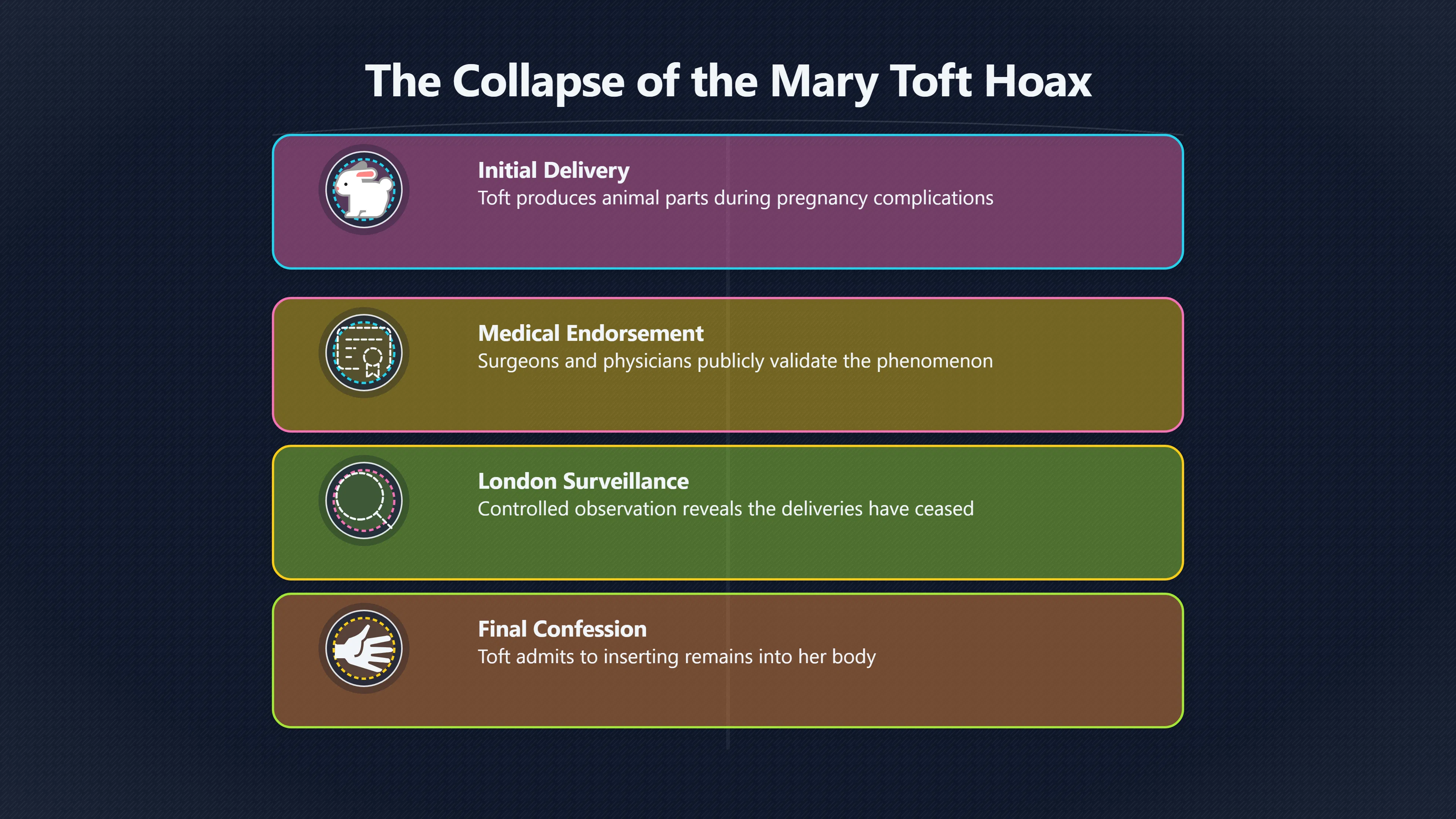
The affair began after Toft suffered complications during a pregnancy in 1726. According to reports circulated at the time, she started producing animal parts, including pieces of rabbits. Local surgeon John Howard became involved and claimed to have observed and recovered multiple rabbit remains from her body. As the reports multiplied, the alleged births became increasingly extraordinary.[The Paris Review]theparisreview.organ extraordinary delivery of rabbitsThe Paris ReviewHow Mary Toft Convinced the World She'd Birthed Rabbits5 Jul 2016 — But her midwife, John Howard, observed that Mary gave…
News spread rapidly through newspapers, pamphlets and word of mouth. To many readers, the claim sounded absurd. Yet it arrived accompanied by witness testimony from medical practitioners who insisted they had personally observed the events. That endorsement transformed what might have remained a local curiosity into a national sensation.[PMC]pmc.ncbi.nlm.nih.govThe case became a sensation and was reported widely in newspapers,What Mary Toft Felt: Women's Voices, Pain, Power and the Bodyby K Harvey · 2015 · Cited by 26 — In autumn 1726, Mary Toft began to del…
The physical evidence appeared persuasive because actual rabbit remains were produced. Observers were not being asked to believe in an invisible phenomenon. They could inspect bodies, organs and animal parts that seemed to emerge from a living patient. The apparent material reality of the evidence gave the story a credibility that rumours alone could never have achieved.[The Public Domain Review]publicdomainreview.orgmary toft and her extraordinary delivery of rabbitsThe Public Domain ReviewMary Toft and Her Extraordinary Delivery of Rabbits20 Mar 2013 — Toft was forced to admit on 7th December 1726 th…
Why Respected Doctors Treated the Claim Seriously
From a modern perspective, the most surprising aspect of the story is not Toft’s deception but the willingness of educated physicians to consider it plausible.
Part of the explanation lies in contemporary medical theory. Many doctors accepted some version of “maternal impression”, the belief that a pregnant woman’s experiences, fears, desires or imagination could physically affect the developing foetus. Stories circulated of children supposedly marked by frightening sights or powerful emotions experienced by their mothers. Within that intellectual framework, the idea that an intense encounter with a rabbit might somehow influence a pregnancy did not immediately appear impossible.[nih.gov]pmc.ncbi.nlm.nih.govThe case became a sensation and was reported widely in newspapers,What Mary Toft Felt: Women's Voices, Pain, Power and the Bodyby K Harvey · 2015 · Cited by 26 — In autumn 1726, Mary Toft began to del…
Another factor was the state of reproductive medicine itself. Pregnancy and childbirth remained poorly understood. Physicians had limited diagnostic tools and often relied on observation, testimony and bodily signs rather than laboratory evidence. The boundaries between established knowledge, speculation and folklore were far less rigid than they would become in later centuries.[PMC]pmc.ncbi.nlm.nih.govThe case became a sensation and was reported widely in newspapers,What Mary Toft Felt: Women's Voices, Pain, Power and the Bodyby K Harvey · 2015 · Cited by 26 — In autumn 1726, Mary Toft began to del…
The case also appealed to professional ambition. Nathaniel St André, a surgeon associated with the royal household, became convinced that the phenomenon was genuine and publicly defended it. By validating a remarkable medical rarity, he could position himself at the centre of a major scientific discovery. Once prominent figures committed themselves to the claim, retreat became increasingly difficult.[Wikipedia]WikipediaNathaniel St AndréNathaniel St André
Social hierarchy played a role as well. Toft was a poor, largely powerless woman surrounded by educated male investigators. Ironically, that imbalance sometimes strengthened belief in the story. Some doctors assumed that a woman of her background would be incapable of orchestrating such a complex fraud, while others focused more on proving theories than on questioning the source of the evidence.[PMC]pmc.ncbi.nlm.nih.govThe case became a sensation and was reported widely in newspapers,What Mary Toft Felt: Women's Voices, Pain, Power and the Bodyby K Harvey · 2015 · Cited by 26 — In autumn 1726, Mary Toft began to del…
The Sceptics Who Looked More Closely
Not every physician accepted the rabbit births.
Cyriacus Ahlers, a surgeon sent to investigate on behalf of the royal court, became suspicious. He noticed behaviour that seemed inconsistent with genuine labour and found aspects of the examinations troubling. Most importantly, he studied rabbit specimens associated with the case and concluded that some showed signs of having been cut by instruments rather than naturally produced through childbirth. He also reported finding evidence that suggested the animals had lived normal lives before death.[Wikipedia]WikipediaMary ToftMary Toft
Ahlers’ doubts challenged the growing consensus. Yet scepticism initially struggled to compete with dramatic eyewitness accounts and the prestige of doctors already committed to the phenomenon. The affair demonstrates a recurring feature of famous hoaxes: contradictory evidence often receives less attention than spectacular claims during the height of public excitement.[Wikipedia]WikipediaMary ToftMary Toft
Other investigators, including the physician James Douglas and the obstetrician Richard Manningham, gradually became more doubtful. Their concerns centred not only on the biological impossibility of the claim but also on inconsistencies in what they observed during close examinations.[Wikipedia]WikipediaRichard ManninghamRichard Manningham
How Surveillance, Physical Clues and Confession Ended the Case
The turning point came when Toft was brought to London for closer observation. Under more controlled conditions, the rabbit deliveries largely ceased. Investigators gained greater ability to monitor who entered her room and what objects were brought to her.[Wikipedia]WikipediaMary ToftMary Toft
At the same time, evidence emerged that rabbits were being obtained and transported in suspicious circumstances. Reports suggested that people connected to Toft had acquired rabbits while the supposed miracle was ongoing. The chain of evidence increasingly pointed toward deliberate insertion of animal parts rather than any natural reproductive process.[Wikipedia]WikipediaMary ToftMary Toft
The hoax finally collapsed after intensive questioning. Facing growing scrutiny and threats of further invasive examinations, Toft confessed in December 1726. In various statements she described how rabbit remains and other animal parts had been inserted into her body and later presented as products of childbirth. Her accounts differed in some details, but the central claim of miraculous rabbit births was abandoned.[gla.ac.uk]gla.ac.ukOpen source on gla.ac.uk.
The exposure was not the result of a single brilliant discovery. Rather, it emerged through a combination of careful surveillance, attention to physical evidence, sceptical re-examination and the simple observation that the phenomenon stopped when conditions for deception became more difficult.[Wikipedia]WikipediaMary ToftMary Toft
Why the Scandal Damaged Medical Authority
The rabbit-birth affair became a public embarrassment for the medical profession. Satirists seized on the spectacle of learned men debating and defending an impossibility. William Hogarth’s famous print Cunicularii, or The Wise Men of Godliman in Consultation mocked the physicians who had treated the affair seriously and turned them into objects of ridicule.[British Museum]britishmuseum.orgOpen source on britishmuseum.org.
The reputations of several participants suffered badly, especially those who had published arguments supporting the authenticity of the births. Nathaniel St André’s standing was particularly damaged because he had become one of the claim’s most visible defenders. Meanwhile, sceptics such as Ahlers and Douglas emerged with enhanced credibility.[Wikipedia]WikipediaNathaniel St AndréNathaniel St André
More broadly, the scandal exposed tensions within eighteenth-century medicine. Physicians increasingly wanted to present themselves as empirical investigators guided by observation and reason. Yet the Toft case revealed how easily observation could be distorted when investigators approached evidence with strong expectations and professional incentives.[Wikipedia]WikipediaRichard ManninghamRichard Manningham
What the Rabbit Births Reveal About Belief and Expertise
Mary Toft’s story survives because it was more than a bizarre fraud. It showed how authority can amplify doubtful claims when evidence appears to support existing theories. The doctors involved were not simply irrational or foolish. Many were working within accepted medical assumptions, relying on methods that seemed reasonable at the time.[PMC]pmc.ncbi.nlm.nih.govThe case became a sensation and was reported widely in newspapers,What Mary Toft Felt: Women's Voices, Pain, Power and the Bodyby K Harvey · 2015 · Cited by 26 — In autumn 1726, Mary Toft began to del…
The episode also highlights the relationship between social status and credibility. A poor rural woman became the centre of a national controversy because influential experts transformed her case into a scientific question. Once medical authority endorsed the story, newspapers, politicians and the public paid attention.[PMC]pmc.ncbi.nlm.nih.govThe case became a sensation and was reported widely in newspapers,What Mary Toft Felt: Women's Voices, Pain, Power and the Bodyby K Harvey · 2015 · Cited by 26 — In autumn 1726, Mary Toft began to del…
Within the history of British hoaxes, Mary Toft occupies a special place because the deception was never sustained by forged documents or hidden machinery. Instead, it depended on something often more powerful: respected experts publicly convincing themselves that the impossible deserved belief.[nih.gov]pmc.ncbi.nlm.nih.govThe case became a sensation and was reported widely in newspapers,What Mary Toft Felt: Women's Voices, Pain, Power and the Bodyby K Harvey · 2015 · Cited by 26 — In autumn 1726, Mary Toft began to del…
Amazon book picks
Further Reading
Books and field guides related to How Doctors Came to Believe the Rabbit Births. Use these as the next step if you want deeper reading beyond the article.
Mistakes Were Made (but Not by Me)
Illuminates why authorities defended a failing claim.
The Demon-Haunted World
Rating: 4.5/5 from 43 Google Books ratings
Promotes evidence-based evaluation of extraordinary assertions.
eBay marketplace picks
Marketplace Samples
Live-tested eBay searches with available results related to this page.
Endnotes
1.
Source: pmc.ncbi.nlm.nih.gov
Title: The case became a sensation and was reported widely in newspapers,
Link:https://pmc.ncbi.nlm.nih.gov/articles/PMC4804233/
Source snippet
What Mary Toft Felt: Women's Voices, Pain, Power and the Bodyby K Harvey · 2015 · Cited by 26 — In autumn 1726, Mary Toft began to del...
2.
Source: Wikipedia
Title: Nathaniel St André
Link:https://en.wikipedia.org/wiki/Nathaniel_St_Andr%C3%A9
3.
Source: Wikipedia
Title: Mary Toft
Link:https://en.wikipedia.org/wiki/Mary_Toft
4.
Source: Wikipedia
Title: Richard Manningham
Link:https://en.wikipedia.org/wiki/Richard_Manningham
5.
Source: rcseng.ac.uk
Title: a hare raising tale
Link:https://www.rcseng.ac.uk/library-and-publications/library/blog/a-hare-raising-tale/
Source snippet
Royal College of SurgeonsA hare-raising tale29 Mar 2018 — Mary Tofts duping several distinguished surgeons, physicians and male-midwives...
6.
Source: theparisreview.org
Title: an extraordinary delivery of rabbits
Link:https://www.theparisreview.org/blog/2016/07/05/an-extraordinary-delivery-of-rabbits/
Source snippet
The Paris ReviewHow Mary Toft Convinced the World She'd Birthed Rabbits5 Jul 2016 — But her midwife, John Howard, observed that Mary gave...
7.
Source: publicdomainreview.org
Title: mary toft and her extraordinary delivery of rabbits
Link:https://publicdomainreview.org/essay/mary-toft-and-her-extraordinary-delivery-of-rabbits
Source snippet
The Public Domain ReviewMary Toft and Her Extraordinary Delivery of Rabbits20 Mar 2013 — Toft was forced to admit on 7th December 1726 th...
Published: December 1726
8.
Source: theguardian.com
Title: The Guardian Mary and the Rabbit Dream by Noémi Kiss-Deáki review
Link:https://www.theguardian.com/books/article/2024/jul/11/mary-and-the-rabbit-dream-by-noemi-kiss-deaki-review-an-18th-century-hoax
Source snippet
In 1726, Toft's fake rabbit births captured public imagination and led to extensive examinations by the medical establishment, driven by...
9.
Source: gla.ac.uk
Link:https://www.gla.ac.uk/myglasgow/library/files/special/exhibns/month/aug2009.html
10.
Source: britishmuseum.org
Link:https://www.britishmuseum.org/collection/object/P
Additional References
11.
Source: blogs.library.duke.edu
Title: mary toft and an extraordinary delivery of rabbits
Link:https://blogs.library.duke.edu/rubenstein/2025/03/19/mary-toft-and-an-extraordinary-delivery-of-rabbits/
Source snippet
Duke University Libraries BlogsMary Toft and An Extraordinary Delivery of Rabbits19 Mar 2025 — Mary Toft was a 25-year-old poor, illitera...
12.
Source: youtube.com
Title: The Woman Who Gave Birth to Rabbits and Fooled England
Link:https://www.youtube.com/watch?v=g7DF7fTJXqc
Source snippet
The woman who GAVE BIRTH TO RABBITS | Mary Toft | famous medical hoax | strange tales from history...
13.
Source: youtube.com
Title: Fake News in the 18th Century | Collection in Focus | British Library
Link:https://www.youtube.com/watch?v=9dbV2YuAMpQ
Source snippet
Mary Toft and the Great Rabbit Hoax of 1726...
14.
Source: youtube.com
Link:https://www.youtube.com/watch?v=cNmjEpsFx88
Source snippet
The Woman Who Gave Birth To Rabbits...
15.
Source: youtube.com
Title: The Woman Who Gave Birth To Rabbits
Link:https://www.youtube.com/watch?v=m4yzFFao-Ng
Source snippet
Fake News in the 18th Century | Collection in Focus | British Library...
16.
Source: facebook.com
Title: in 1726 a young woman from surrey called mary toft becomes an overnight celebrit
Link:https://www.facebook.com/TrinityCollegeCambridge/posts/in-1726-a-young-woman-from-surrey-called-mary-toft-becomes-an-overnight-celebrit/1395370969292492/
17.
Source: facebook.com
Title: mary toft apparently gave birth to multiple rabbits in 1726marytoft history 18th
Link:https://www.facebook.com/61554921195366/posts/mary-toft-apparently-gave-birth-to-multiple-rabbits-in-1726marytoft-history-18th/122264827892164039/
18.
Source: researchgate.net
Title: 282268730 What Mary Toft Felt Women’s Voices Pain Power and the Body
Link:https://www.researchgate.net/publication/282268730_What_Mary_Toft_Felt_Women%27s_Voices_Pain_Power_and_the_Body
19.
Source: medicalhealthhumanities.com
Title: Reimagining Mary Toft’s Rabbit Births
Link:https://medicalhealthhumanities.com/2018/10/18/reimagining-mary-tofts-rabbit-births/
20.
Source: youtube.com
Link:https://www.youtube.com/watch?v=w98FRD62XC4
Topic Tree