Within Iran Hoaxes
How Fake Persian Treasures Entered Museums
Dealers, weak provenance and institutional prestige helped modern objects acquire convincing identities as treasures of ancient Persia.
On this page
- Why missing provenance made forgery easier
- The Ziwiye hoard and invented archaeological histories
- Reliefs, griffins and the limits of laboratory testing
Page outline Jump by section
Introduction
Some of the most influential stories about ancient Persia were built not on excavated discoveries but on objects that emerged through dealers, collectors and museums with little or no reliable record of where they had been found. In the twentieth century, demand for spectacular Persian antiquities was so strong that an object did not always need a documented archaeological history to acquire prestige. A convincing style, an attractive story and endorsement from respected institutions could be enough.
This does not mean that every disputed object was fake. The more important lesson is that forged artefacts, altered objects and invented provenances often travelled together. A genuine ancient object might receive a false origin story. A modern forgery might be mixed into a group of authentic finds. Once museums, scholars or collectors accepted the narrative, the object gained authority that was difficult to challenge. The history of forged Persian antiquities is therefore less about a single master fraud and more about the mechanisms that allowed uncertain objects to become accepted evidence of Iran’s ancient past.[Iranica Online]iranicaonline.orgforgeries iiIranica OnlineFORGERIES ii. OF PRE-ISLAMIC ART OBJECTS15 Dec 1999 — Forgery is a lucrative trade. Iranian forgeries fetch very high price…
Why Missing Provenance Made Forgery Easier
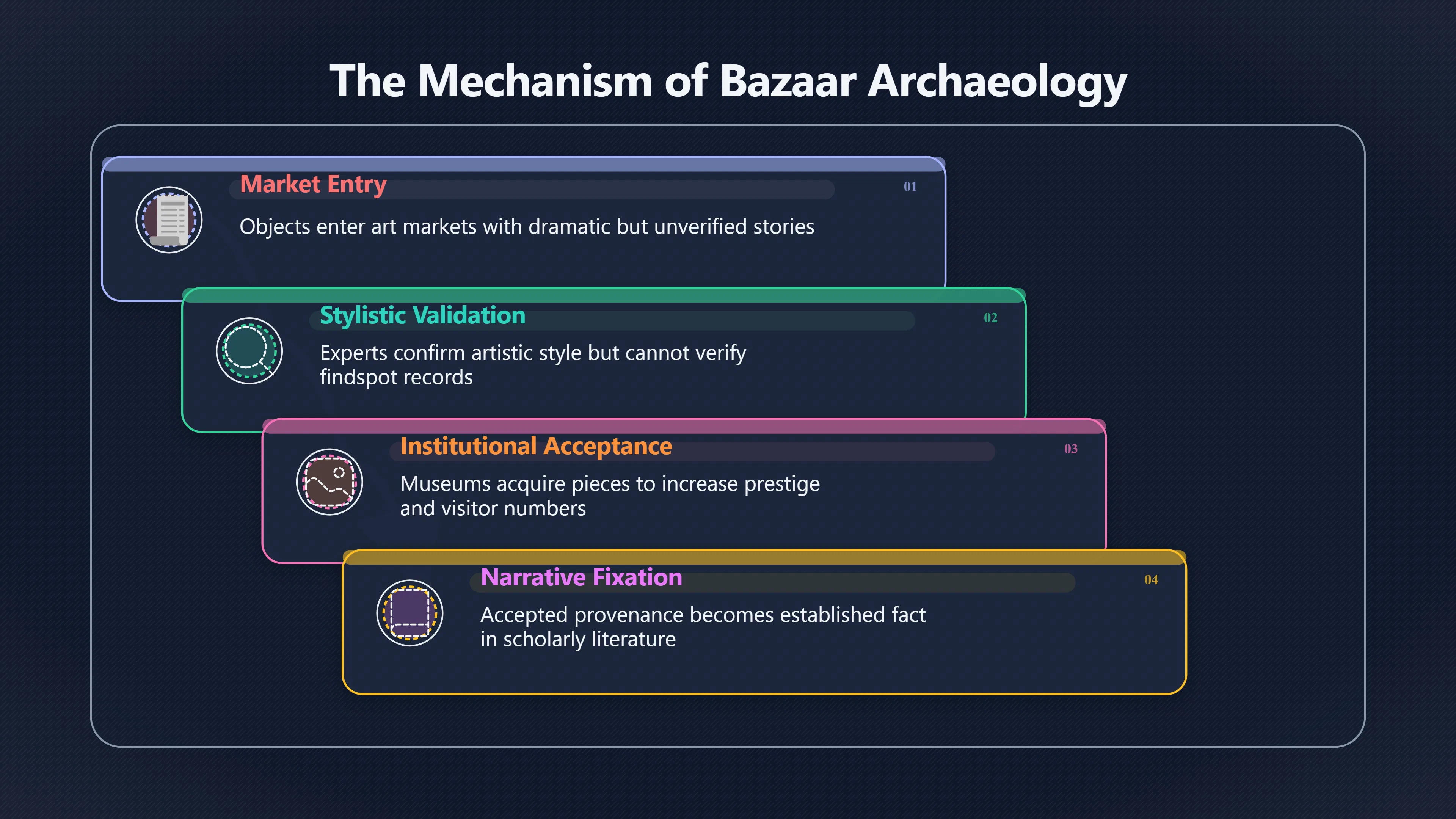
Archaeologists use the word provenance to describe the documented history of an object: where it was found, who excavated it and how it moved from discovery to collection. For many celebrated Persian antiquities entering the market during the twentieth century, that chain was incomplete or entirely absent.
The problem was particularly acute because Iran contained rich archaeological regions that attracted international collectors. Objects could appear in art markets accompanied by dramatic stories of accidental discoveries, looting or forgotten tombs. Buyers often valued the artefact itself more than the evidence proving where it came from. As a result, dealers could attach archaeological identities to pieces that lacked secure documentation.[iranicaonline.org]iranicaonline.orgforgeries iiIranica OnlineFORGERIES ii. OF PRE-ISLAMIC ART OBJECTS15 Dec 1999 — Forgery is a lucrative trade. Iranian forgeries fetch very high price…
Several factors made this persuasive:
- Ancient Persian art was highly desirable and commanded high prices.
- Museums wanted important acquisitions that would attract visitors and scholarly attention.
- Scientific testing was often unable to prove a claimed findspot.
- Stylistic expertise could identify broad periods or regions but not necessarily expose a fabricated discovery story.
- Once an object entered a respected collection, later researchers frequently treated its provenance as established fact.[iranicaonline.org]iranicaonline.orgforgeries iiIranica OnlineFORGERIES ii. OF PRE-ISLAMIC ART OBJECTS15 Dec 1999 — Forgery is a lucrative trade. Iranian forgeries fetch very high price…
The result was a feedback loop. The museum’s reputation increased confidence in the object, while the object increased the museum’s prestige.
The Ziwiye Hoard and Invented Archaeological Histories
No case illustrates this process more clearly than the so-called Ziwiye hoard from north-western Iran.
According to the traditional account, villagers discovered a treasure near Ziwiye in the late 1940s. Gold, silver, ivory and other objects soon appeared on the antiquities market. The collection became famous because it seemed to reveal a remarkable meeting point of Assyrian, Scythian, Median and early Iranian artistic traditions. Objects attributed to the hoard eventually entered major collections and became widely discussed in scholarship.[Wikipedia]WikipediaZiwiye hoardZiwiye hoard
The difficulty is that the story was never securely documented. Many of the objects were not excavated under controlled archaeological conditions. Instead, they emerged through dealers and collectors. Over time, more and more artefacts were labelled “Ziwiye”, even when their connection to the original discovery was uncertain. Some scholars came to suspect that the famous hoard was not a coherent archaeological find at all but a mixture assembled through the art market.[wikipedia.org]WikipediaOscar White MuscarellaOscar White Muscarella
Archaeologist Oscar White Muscarella became the most prominent critic of the accepted narrative. He argued that scholars had effectively accepted a forged provenance: an archaeological history created after the fact and attached to objects lacking secure excavation records. In his view, many pieces attributed to Ziwiye could not be treated as evidence from a single historical context because there was no reliable proof that they had ever belonged together.[wikipedia.org]WikipediaOscar White MuscarellaOscar White Muscarella
The controversy deepened because some artefacts associated with the Ziwiye tradition have been identified as modern forgeries. Encyclopaedia Iranica notes that a number of objects labelled “Ziwiye” were modern creations that nevertheless acquired archaeological significance through repeated scholarly acceptance.[Iranica Online]iranicaonline.orgIranica Online ZIWIYEIranica OnlineZIWIYE - Encyclopaedia Iranica26 Jun 2017 — Also, a number of the artifacts baptized “Ziwiye” are modern forgeries, albeit…
The case demonstrates how a powerful archaeological narrative can become self-sustaining. Once museums, books and exhibitions repeat a provenance, the story itself begins to function as evidence.
Reliefs, Griffins and the Limits of Laboratory Testing
Many forged Persian antiquities were not crude copies. They were sophisticated objects designed to resemble authentic works from ancient Iran.
Forgers often focused on visually striking categories that appealed to collectors: relief carvings, ceremonial vessels, animal-style ornaments and mythical creatures such as griffins. These pieces were attractive because they looked important even to non-specialists. Their artistic quality encouraged buyers to focus on appearance rather than documentation.[Iranica Online]iranicaonline.orgforgeries iiIranica OnlineFORGERIES ii. OF PRE-ISLAMIC ART OBJECTS15 Dec 1999 — Forgery is a lucrative trade. Iranian forgeries fetch very high price…
Laboratory testing could help, but it was not a complete solution. Scientific methods can identify modern pigments, recent tool marks or artificial ageing. However, they often struggle when a forgery incorporates genuinely ancient material. A forger might carve an ancient fragment into a new shape, assemble old pieces into a new object or reuse authentic metal. In such cases the materials may be ancient even though the artefact itself is not.[Iranica Online]iranicaonline.orgforgeries iiIranica OnlineFORGERIES ii. OF PRE-ISLAMIC ART OBJECTS15 Dec 1999 — Forgery is a lucrative trade. Iranian forgeries fetch very high price…
This is one reason provenance became increasingly important. Archaeologists realised that chemistry and dating tests could not always answer the crucial question: where did the object come from, and what happened to it before it appeared on the market?
The lesson was especially significant for Persian material because many disputed objects circulated internationally before modern documentation standards became common. An artefact could pass through several hands, acquire a persuasive history and enter a museum long before doubts emerged.[Wikipedia]WikipediaOscar White MuscarellaOscar White Muscarella
Why Museums Were Vulnerable
Museum involvement in these controversies does not usually reflect deliberate deception by museum staff. The problem arose from institutional incentives that rewarded acquisition and interpretation.
Curators were often asked to judge objects that lacked excavation records. If a piece appeared stylistically convincing and comparable examples were already accepted, there was pressure to treat it as authentic. In some cases, scholars built historical arguments around such objects, making later criticism professionally uncomfortable. Muscarella argued that museums and collectors sometimes became participants in what he called “bazaar archaeology”, where market objects were transformed into archaeological evidence without adequate proof.[Wikipedia]WikipediaOscar White MuscarellaOscar White Muscarella
The issue was not confined to Iran, but Persian antiquities provided especially fertile ground because of their prestige, rarity and high market value. A dramatic object attributed to an ancient Persian kingdom could reshape ideas about art, trade or political history, giving institutions strong reasons to believe the attribution.[Iranica Online]iranicaonline.orgforgeries iiIranica OnlineFORGERIES ii. OF PRE-ISLAMIC ART OBJECTS15 Dec 1999 — Forgery is a lucrative trade. Iranian forgeries fetch very high price…
What Changed After the Controversies
The debates surrounding Ziwiye and similar cases helped transform museum practice.
Modern museums are far more likely to demand detailed ownership histories, export documentation and evidence of legal excavation. Researchers increasingly distinguish between an object’s artistic value and its archaeological value. An artefact may still be ancient and beautiful while remaining unreliable evidence for reconstructing history if its provenance cannot be verified.[De Gruyter Brill]degruyterbrill.comDe Gruyter Brill Forgeries of Ancient Near Eastern Artifacts and Culturesforgery of provenance grafted onto a genuineor a forged antiquity.Some… forgeries (the Museum admits many of the coinsare counterfeit)…
The controversy also changed how scholars read museum collections. Instead of asking only whether an object looks authentic, researchers ask how it entered the collection, who handled it, what documentation exists and whether the provenance story appeared before or after the object reached the market. This shift reflects one of the most important lessons from the history of forged Persian antiquities: the deception often lies not in the artefact itself, but in the story attached to it.[semanticscholar.org]semanticscholar.org“Ziwiye” and Ziwiye: The Forgery of a Provenience… 2018. For most of its history, archaeology has taken an indulgent attitude toward…
Amazon book picks
Further Reading
Books and field guides related to How Fake Persian Treasures Entered Museums. Use these as the next step if you want deeper reading beyond the article.
Frauds, Myths, and Mysteries: Science and Pseudoscience in Ar...
Directly relevant to forged antiquities and false provenance.
The Persian Empire
Helps readers understand the cultural background exploited by forgers.
The Archaeology of Knowledge
Encourages critical examination of how historical knowledge is constructed.
The Oxford Handbook of the Archaeology of the Levant
Provides regional archaeological context relevant to Persian artifacts.
eBay marketplace picks
Marketplace Samples
Live-tested eBay searches with available results related to this page.

Endnotes
1.
Source: Wikipedia
Title: Oscar White Muscarella
Link:https://en.wikipedia.org/wiki/Oscar_White_Muscarella
2.
Source: scribd.com
Link:https://www.scribd.com/document/558855494/529647
Source snippet
Ziwiye Treasure: Provenience Issues | PDF | ArchaeologyThis article analyzes the scholarly treatment of artifacts claimed to come f...
3.
Source: Wikipedia
Title: Ziwiye hoard
Link:https://en.wikipedia.org/wiki/Ziwiye_hoard
4.
Source: brill.com
Link:https://brill.com/display/book/9789004502147/B9789004502147_s008.pdf?srsltid=AfmBOor8wY7taiZqEoIgbelM1qJkBXYSzfGNTBGQbWjfZbp39_s73mqx
5.
Source: iranicaonline.org
Title: forgeries ii
Link:https://www.iranicaonline.org/articles/forgeries-ii/?generate_pdf=1
Source snippet
Iranica OnlineFORGERIES ii. OF PRE-ISLAMIC ART OBJECTS15 Dec 1999 — Forgery is a lucrative trade. Iranian forgeries fetch very high price...
6.
Source: degruyterbrill.com
Title: De Gruyter Brill Forgeries of Ancient Near Eastern Artifacts and Cultures
Link:https://www.degruyterbrill.com/document/doi/10.1515/9781614510352.31/html?srsltid=AfmBOorErZjOlWDph17sNyUl0l7OIdC3K6nm87R1qQhA4DBymElC1OMm
Source snippet
forgery of provenance grafted onto a genuineor a forged antiquity.Some... forgeries (the Museum admits many of the coinsare counterfeit)...
7.
Source: iranicaonline.org
Title: Iranica Online ZIWIYE
Link:https://www.iranicaonline.org/articles/ziwiye/
Source snippet
Iranica OnlineZIWIYE - Encyclopaedia Iranica26 Jun 2017 — Also, a number of the artifacts baptized “Ziwiye” are modern forgeries, albeit...
8.
Source: semanticscholar.org
Link:https://www.semanticscholar.org/paper/e138a126a9be6e352135dce26d74a40f78dd7b9a
Source snippet
“Ziwiye” and Ziwiye: The Forgery of a Provenience... 2018. For most of its history, archaeology has taken an indulgent attitude toward...
Additional References
9.
Source: ahnp.ub.uni-heidelberg.de
Title: Heidelberg University Library The Art Dealership of Saeed Motamed
Link:https://ahnp.ub.uni-heidelberg.de/journals/transfer/article/view/113826/110204
Source snippet
A Case Study on...by LD Ersoy · 2025 — Some objects with similar dimensions, depictions and supposed date of origin seem to appear in ma...
10.
Source: penn.museum
Link:https://www.penn.museum/sites/expedition/archaeological-scrap/
Source snippet
Expedition Magazine | Archaeological ScrapThe local village of Ziwiye, not far from the town of Saqqiz, gave its name to this hoard which...
11.
Source: youtube.com
Title: The Kingdom of Mannea: Between Assyria and Urartu
Link:https://www.youtube.com/watch?v=Yqo0jXfBGNk
Source snippet
British Museum: Forgotten Empire the world of Ancient Persia...
12.
Source: facebook.com
Link:https://www.facebook.com/groups/2671851939515450/posts/24175659518708048/
13.
Source: illicitculturalproperty.com
Link:https://illicitculturalproperty.com/tag/provenance/
14.
Source: youtube.com
Title: Ancient Iranian and Achaemenid Artifacts
Link:https://www.youtube.com/watch?v=ZfsrFu9g1gE
Source snippet
The Kingdom of Mannea: Between Assyria and Urartu...
15.
Source: academia.edu
Link:https://www.academia.edu/62303976/A_Chronological_Overview_of_Some_Ziwiye_Belts
16.
Source: youtube.com
Title: Provenance and The Art Thief
Link:https://www.youtube.com/watch?v=RBeIgXOxVvE
Source snippet
Ancient Iranian and Achaemenid Artifacts...
17.
Source: youtube.com
Title: Fakes in the art world
Link:https://www.youtube.com/watch?v=1lNSXB4i4fE
Source snippet
Provenance and The Art Thief...
18.
Source: youtube.com
Title: British Museum: Forgotten Empire the world of Ancient Persia
Link:https://www.youtube.com/watch?v=n8VgFugJnh8
Topic Tree