Which Liechtenstein Stories Were Really True?
Liechtenstein has no famous home-grown monster hoax or world-renowned archaeological forgery.
Page outline Jump by section
Introduction
The clearest cases fall into different categories. The stamp affair of 1919–22 involved contractual abuse rather than counterfeit stamps in the ordinary sense. The 1928 savings-bank scandal was deliberate fraud and embezzlement. Nazi-era claims against two Jewish theatre entrepreneurs were inflammatory propaganda with fatal consequences. By contrast, the tale of Liechtenstein’s army returning from war with an extra man is better treated as an embellished national legend, while the offer to “rent an entire country” was an openly theatrical tourism promotion. More recently, an artificial-intelligence image falsely linking a Liechtenstein prince to Belgium’s future queen showed how easily the principality’s royal mystique can be exploited online.
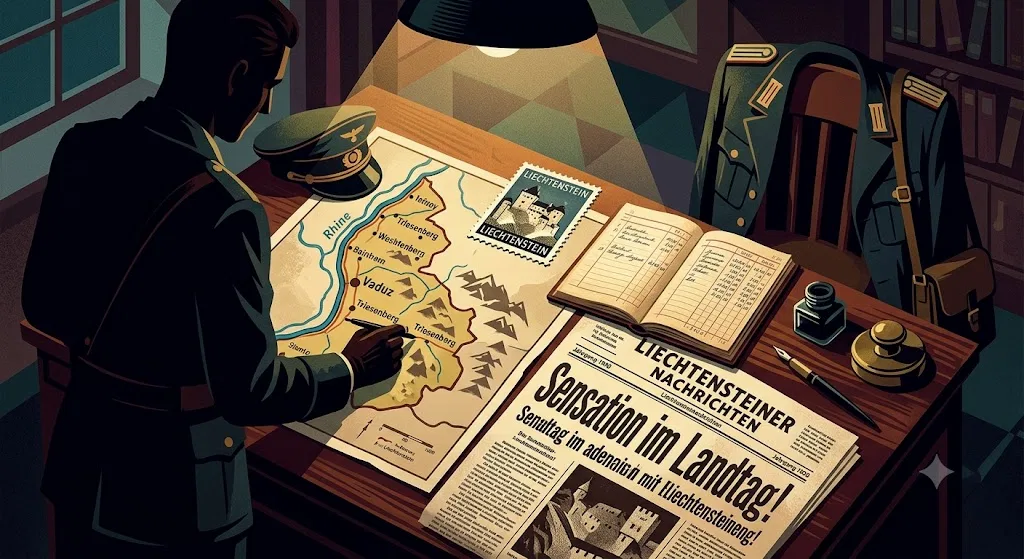
When stamps became a manufactured rarity
In the years after the First World War, postage stamps looked like an attractive source of revenue for a small state facing economic uncertainty. Liechtenstein had begun issuing its own stamps, and collectors abroad were potentially willing to pay far more than the face value for unusual designs, printing errors and scarce varieties.
In October 1919, a Liechtenstein-Austrian consortium promised the government substantial profits in return for control of stamp production and distribution. A contract followed on 27 November. The problem was not that every stamp it produced was counterfeit. The deception lay in manipulating the market for supposedly exceptional official material. According to Liechtenstein’s Historical Lexicon, the consortium produced large quantities of printing errors and unusual variants in breach of its contract. These manufactured “rarities” damaged confidence in Liechtenstein stamps and triggered a domestic political dispute.[historisches-lexikon.li]historisches-lexikon.liIm Oktober 1919 versprach ein liechtensteinisch-österreichisches Konsortium, bestehend aus Eugen Nipp, Ferdinand Nigg, Luigi Kasimir und…
The episode exploited a weakness built into collecting markets. A misprint can be worth more than a perfect copy because collectors believe it is accidental and scarce. Once a producer deliberately creates errors in volume, the appearance of rarity becomes a commercial fiction. The object may be genuinely issued, yet the story that gives it value is false.
The affair also shows why the boundary between forgery and official misconduct can be misleading. No backstreet counterfeiter needed to imitate the state’s stamps: the authorised distributor had access to the genuine production system. That made the resulting material look more convincing, while the government’s association with it lent apparent legitimacy.
An investigation exposed deficiencies in the operation, and the arrangement ended in 1922. The reputational damage mattered because philately was not merely a hobby at the edge of Liechtenstein’s economy. Stamp sales became an important way for the country to present itself internationally, so confidence in the integrity and scarcity of its issues had real commercial value.[historisches-lexikon.li]historisches-lexikon.liPhilatelieDas. Ansehen der liechtensteinischen Briefmarken erlitt Schaden und in Liechtenstein kam es zu politischen. Spannungen zwischen…
The bank fraud sold as national progress
Liechtenstein’s most consequential documented fraud was the savings-bank scandal uncovered in 1928. It began not with an implausible confidence trick but with an appealing promise: speculative ventures, including an international class lottery, would generate employment and revenue for the country.
From 1926 to 1928, the manager of the state savings bank, Franz Thöny, and associates Anton Walser, Niko Beck and Rudolf Carbone diverted bank funds into unsuccessful speculative transactions. One major venture involved expanding a lottery business into Romania. The Historical Lexicon describes the affair plainly as embezzlement and records that the men were later convicted, with Walser receiving four years’ imprisonment and the others three.[historisches-lexikon.li]historisches-lexikon.liIm Juni 1928 wurden Walser, Thöny und Beck verhaftet, ein gutes Jahr später auch Carbone. Im November 1929 wurden der Hauptverantwortlich…
The scheme was persuasive because it mixed genuine policy concerns with private opportunity. Liechtenstein was seeking new sources of income during a difficult economic period. Lotteries and other concessions were presented as ways to attract money from abroad and relieve unemployment. The class-lottery project therefore did not initially resemble a crude theft from a bank vault; it resembled an ambitious development plan with official connections. The same venture also attracted people who hoped to become rich quickly, creating overlapping political, institutional and personal incentives to overlook warning signs.[historisches-lexikon.li]historisches-lexikon.liSparkassaskandal). Im Vorfeld der Landtagswahlen von 1926 gab es wegen… Liechtenstein in den Dreissigerjahren 1928–1939, Bd. 1, Vaduz/…
Oversight failed at several levels. Several people involved had political connections, while Wilhelm Beck, a leading politician, chaired the bank’s governing board. The scandal was consequently not confined to the criminal acts themselves. It became a crisis of institutional credibility: who had authorised the risks, who should have noticed the missing money, and whether political loyalty had weakened supervision.
Once the losses emerged, arrests followed in June 1928, with Carbone arrested the next year. The scandal brought down Gustav Schädler’s government. Prince Johann II forced the ministry to resign and dissolved parliament; the subsequent election produced a decisive victory for the opposition Progressive Citizens’ Party.[historisches-lexikon.li]historisches-lexikon.liChristlich soziale Volkspartei (VPChristlich soziale Volkspartei (VP
This was fraud rather than mere overconfidence because money was deliberately diverted without lawful authority. Yet its success depended on something more subtle than secrecy. The promise of national modernisation gave speculative dealings a respectable public face. The episode remains a useful warning that schemes framed as patriotic economic rescue can suppress ordinary questions about conflicts of interest, auditing and control.
Propaganda that helped turn accusation into violence
The darkest Liechtenstein case concerns Alfred and Fritz Rotter, Jewish theatre entrepreneurs who fled Germany after their business empire collapsed. Their bankruptcy became the subject of an antisemitic press campaign in 1933. Newspapers portrayed it as fraudulent, circulated invented sums allegedly transferred abroad and demanded that the brothers be handed to Germany, even though German legal authorities reportedly regarded extradition as unlikely.[historisches-lexikon.li]historisches-lexikon.liOpen source on historisches-lexikon.li.
This was not a playful newspaper hoax. It was propaganda: selective facts, unsupported financial claims and antisemitic insinuation were combined to create the image of criminal fugitives protected by Liechtenstein. The charge was powerful because it attached an established prejudice to a real event. The Rotters’ companies had failed, so readers did not have to accept a wholly fictional starting point. They only had to accept an increasingly distorted explanation of why the failure occurred and where the money had gone.
Four Liechtenstein Nazis, encouraged by the campaign, decided to abduct the brothers and deliver them to Germany. In April 1933 they lured Alfred Rotter, his wife Gertrud and Fritz Rotter to an isolated location. During the attempted kidnapping, Alfred and Gertrud fell to their deaths while trying to escape. Fritz survived. The conspirators also intended the action to help launch an organised Nazi movement inside Liechtenstein.[historisches-lexikon.li]historisches-lexikon.liRotter EntführungRotter Entführung
The case illustrates how propaganda differs from an ordinary false rumour. Its purpose was not simply to make people believe an incorrect financial claim. It sought to redefine its targets as enemies whose legal rights no longer deserved respect. The invented or inflated details gave would-be kidnappers a story in which violence could be presented as the correction of official weakness.
The episode also complicates the comforting idea that a falsehood is exposed when the facts are checked. The German press claims did not need to survive a rigorous investigation to do harm. They needed only to circulate long enough, and within a receptive ideological climate, to legitimise action.
The soldier who may have been added to the story
One of the internet’s favourite Liechtenstein anecdotes says that the country sent 80 soldiers to war in 1866 and returned with 81 because the men had made a friend. The basic military setting is real. Liechtenstein’s contingent served on Austria’s side during the Austro-Prussian War, guarding the Tyrolean frontier against possible Italian attack. It did not fight a battle, and the country abolished its standing army in 1868.[historisches-lexikon.li]historisches-lexikon.liOpen source on historisches-lexikon.li.
What is less secure is the polished ending. Later accounts agree that an additional person may have accompanied the contingent home, but they disagree about who he was. One version identifies an Austrian liaison officer; another turns him into an Italian farmer or friend. Liechtenstein-based commentary has presented the Austrian-officer version as true, while historical summaries more cautiously describe the extra man’s identity as disputed.[LGT Wealth Management]lgtwm.comliechtenstein myths uncovered 123848liechtenstein myths uncovered 123848
This is best classified as folklore built around a historical core, not a proven deliberate hoax. The comic arithmetic — 80 departed, 81 returned — is memorable, easy to repeat and perfectly suited to modern “strange but true” lists. Each retelling tends to remove qualifications. “An additional Austrian officer apparently marched with them” becomes “they made an Italian friend”, because the second version has a warmer punchline.
The story persists because it expresses an attractive national image: Liechtenstein as so peaceful that it comes home from war with more companions than casualties. That symbolic neatness is precisely why scepticism is useful. A story can be broadly rooted in fact while its most famous detail remains uncertain.
The same caution applies to reports that Switzerland “invaded” Liechtenstein in 2007. About 170 Swiss soldiers did accidentally cross the unmarked border during a training exercise, and the Swiss army confirmed and apologised for the mistake. Calling it an invasion is humorous exaggeration, but the border incident itself was not invented.[The Guardian]theguardian.comThe Guardian Liechtenstein: no retaliation for Swiss 'invasion' | World newsThe Guardian Liechtenstein: no retaliation for Swiss 'invasion' | World news
Could anyone really rent the whole country?
In 2011, Airbnb and the Liechtenstein-based marketing company Rent a Village promoted an offer to hire Liechtenstein for roughly US$70,000 per night, with a two-night minimum. Reports promised accommodation for large groups and customisable features such as symbolic keys, signs and staged events.[The Guardian]theguardian.comliechtenstein hire rental schemeliechtenstein hire rental scheme
The offer was real as an event package, but the phrase “rent an entire country” was advertising theatre. Customers were not acquiring sovereign authority, excluding residents or taking temporary possession of every building, road and field. What they could purchase was a coordinated hospitality and branding experience spread across participating venues.
That distinction matters because later retellings often convert promotional language into a literal claim. Social-media posts have suggested that a guest could rename streets, issue a personal currency or spend time with the monarch as though these were enforceable powers. In practice, such elements were ceremonial props or optional event arrangements, not transfers of governmental control.
The campaign worked because Liechtenstein’s size made the exaggeration feel just plausible enough. Hiring “a country” sounds impossible, but hiring enough hotels, halls, signs and activities to make a corporate group feel as though it has taken over a microstate is commercially feasible. The deception, such as it was, lay not in a hidden scam but in the playful gap between the headline and the product.
It is therefore better described as a publicity stunt than a hoax. The organisers wanted journalists to repeat the extraordinary formulation, and journalists did. The story still circulates because “Liechtenstein offered large-scale event packages” is accurate but forgettable, whereas “you could rent an entire nation on Airbnb” demands to be shared.
A royal romance manufactured by artificial intelligence
In September 2025, a photograph circulated online that appeared to show Princess Elisabeth of Belgium with Prince Georg of Liechtenstein. It prompted speculation that the future Belgian queen was romantically involved with a member of another reigning European family.
The image gained traction because it supplied apparent visual proof of a story with familiar ingredients: private royals, dynastic romance and a supposedly leaked personal photograph. Initial uncertainty from the Belgian side added room for speculation, as the palace said it had seen the image but would not comment on private matters or confirm whether it was authentic.[Marie Claire]marieclaire.comPrincess Elisabeth, currently 23 and studying at Harvard, and Prince Georg, 26, who works in business development and is third in line to…
The Liechtenstein side then provided a direct rebuttal. The private secretary of Hereditary Prince Alois stated that the picture did not depict Prince Georg and had been created with artificial intelligence.[Nine]nine.com.auOpen source on com.au.
The episode demonstrates a modern reversal in the mechanics of fake photography. Older manipulated images often required darkroom skills, physical collage or careful staging. A synthetic picture can now be generated quickly, placed into an existing network of royal gossip and allowed to acquire credibility through repetition. The creator need not forge documents or construct an elaborate backstory; the audience supplies one.
Liechtenstein’s monarchy is especially usable in this kind of fabrication because it is simultaneously genuine, wealthy and relatively unfamiliar to international audiences. Most readers cannot readily recognise every member of the princely family, compare the supposed face with verified photographs or judge whether the social situation is plausible. The principality’s reputation for royal privacy also helps the fake: a lack of public images can be interpreted as evidence of secrecy rather than a reason for caution.
Why Liechtenstein’s false stories travel so well
The country’s small size is not evidence that its people are unusually susceptible to deception. It does, however, shape the stories outsiders tell about it. A microstate can be presented as a novelty: a place with an army small enough to count in a joke, a border easy to cross by accident, a territory that can supposedly be rented and a royal family famous enough to attract gossip but private enough to remain mysterious.
Across the strongest cases, the persuasive mechanisms differ:
- Official access created credibility. The stamp consortium could manufacture questionable rarities because it controlled genuine production.
- Promises of growth softened scrutiny. The savings-bank fraud was concealed within ventures advertised as sources of national income and employment.
- Prejudice converted allegation into certainty. The campaign against the Rotter brothers used antisemitic assumptions to make unsupported financial claims feel believable.
- A satisfying punchline replaced uncertainty. The returning army’s unidentified companion became a friendly Italian in popular retellings.
- Advertising was repeated literally. An event package became the claim that an entire sovereign country was available to rent.
- A convincing image outran verification. The fake royal photograph encouraged a romance narrative before an authoritative denial caught up.
Liechtenstein’s most useful contribution to the history of hoaxes is therefore not one spectacular fraud. It is a compact collection of examples showing that false stories thrive when they borrow legitimacy from something real: an official stamp, a public bank, an actual bankruptcy, a genuine military deployment, a purchasable tourism package or recognisable royal faces. The invented part rarely has to carry the whole story. It only has to complete it in the form people most want to believe.
Amazon book picks
Further Reading
Books and field guides related to Which Liechtenstein Stories Were Really True?. Use these as the next step if you want deeper reading beyond the article.
Extraordinary Popular Delusions and the Madness of Crowds
Rating: 4.0/5 from 5 Google Books ratings
Explores how misleading stories gain credibility and spread.
The Demon-Haunted World
Rating: 4.5/5 from 43 Google Books ratings
Addresses the broader problem of separating fact from attractive myths.
The Confidence Game
Provides a framework for understanding frauds, myths and manipulated narratives.
eBay marketplace picks
Marketplace Samples
Live-tested eBay searches with available results related to this page.
Endnotes
1.
Source: historisches-lexikon.li
Link:https://historisches-lexikon.li/Briefmarkenaff%C3%A4re
Source snippet
Im Oktober 1919 versprach ein liechtensteinisch-österreichisches Konsortium, bestehend aus Eugen Nipp, Ferdinand Nigg, Luigi Kasimir und...
2.
Source: historisches-lexikon.li
Link:https://historisches-lexikon.li/Philatelie
Source snippet
1919 übertrug die Regierung die Herstellung, die Herausgabe und den Vertrieb der Marken einem liechtensteinisch-österreichischen Konsorti...
3.
Source: historisches-lexikon.li
Link:https://historisches-lexikon.li/index.php?action=mpdf&title=Philatelie
Source snippet
PhilatelieDas. Ansehen der liechtensteinischen Briefmarken erlitt Schaden und in Liechtenstein kam es zu politischen. Spannungen zwischen...
4.
Source: historisches-lexikon.li
Link:https://historisches-lexikon.li/Sparkassaskandal
Source snippet
Im Juni 1928 wurden Walser, Thöny und Beck verhaftet, ein gutes Jahr später auch Carbone. Im November 1929 wurden der Hauptverantwortlich...
Published: November 1929
5.
Source: historisches-lexikon.li
Link:https://historisches-lexikon.li/Klassenlotterie
Source snippet
Sparkassaskandal). Im Vorfeld der Landtagswahlen von 1926 gab es wegen... Liechtenstein in den Dreissigerjahren 1928–1939, Bd. 1, Vaduz/...
6.
Source: historisches-lexikon.li
Link:https://historisches-lexikon.li/Liechtenstein_%28Land%29
Source snippet
des Briefmarkenvertriebs an ein Konsortium...Read more...
7.
Source: historisches-lexikon.li
Title: Christlich soziale Volkspartei (VP)
Link:https://historisches-lexikon.li/Christlich-soziale_Volkspartei_%28VP%29
8.
Source: historisches-lexikon.li
Link:https://historisches-lexikon.li/index.php?action=mpdf&title=Rotter-Entf%C3%BChrung
9.
Source: historisches-lexikon.li
Title: Rotter Entführung
Link:https://historisches-lexikon.li/Rotter-Entf%C3%BChrung
10.
Source: historisches-lexikon.li
Link:https://historisches-lexikon.li/Deutschland
11.
Source: historisches-lexikon.li
Link:https://historisches-lexikon.li/Triesen
12.
Source: historisches-lexikon.li
Title: Walser (Kirchthaler), Anton
Link:https://historisches-lexikon.li/Walser_%28-Kirchthaler%29%2C_Anton?marker=Anton+Walser
13.
Source: historisches-lexikon.li
Link:https://historisches-lexikon.li/Flugbl%C3%A4tter
14.
Source: historisches-lexikon.li
Title: Beck, Wilhelm
Link:https://historisches-lexikon.li/Beck%2C_Wilhelm
15.
Source: historisches-lexikon.li
Title: Wachter, Stephan
Link:https://historisches-lexikon.li/Wachter%2C_Stephan
16.
Source: historisches-lexikon.li
Title: Gassner, Josef (1873–1943)
Link:https://historisches-lexikon.li/Gassner%2C_Josef_%281873%E2%80%931943%29
17.
Source: historisches-lexikon.li
Link:https://historisches-lexikon.li/index.php?action=mpdf&title=Briefmarkenaff%C3%A4re
18.
Source: historisches-lexikon.li
Title: Kasimir, Luigi
Link:https://historisches-lexikon.li/Kasimir%2C_Luigi
19.
Source: historisches-lexikon.li
Title: Risch, Emil
Link:https://historisches-lexikon.li/Risch%2C_Emil
20.
Source: historisches-lexikon.li
Title: Nipp, Eugen
Link:https://historisches-lexikon.li/Nipp%2C_Eugen
21.
Source: historisches-lexikon.li
Title: Artikel A Z
Link:https://historisches-lexikon.li/Artikel_A-Z
22.
Source: people.com
Title: princess elisabeth belgium prince georg liechtenstein photo fake ai 11821487
Link:https://people.com/princess-elisabeth-belgium-prince-georg-liechtenstein-photo-fake-ai-11821487
23.
Source: hoaxes.org
Link:https://hoaxes.org/
24.
Source: hoaxes.org
Link:https://hoaxes.org/aprilfool/P40
25.
Source: lgtwm.com
Title: liechtenstein myths uncovered 123848
Link:https://www.lgtwm.com/uk-en/insights/lifestyle/liechtenstein-myths-uncovered-123848
26.
Source: theguardian.com
Title: The Guardian Liechtenstein: no retaliation for Swiss ‘invasion’ | World news
Link:https://www.theguardian.com/world/2007/mar/02/markoliver
27.
Source: abcnews.com
Link:https://abcnews.com/International/story?id=2921407&page=1
28.
Source: theguardian.com
Title: liechtenstein hire rental scheme
Link:https://www.theguardian.com/world/2011/apr/15/liechtenstein-hire-rental-scheme
29.
Source: marieclaire.com
Link:https://www.marieclaire.com/celebrity/royals/princess-elisabeth-prince-georg-dating-rumors-palace-response/
Source snippet
Princess Elisabeth, currently 23 and studying at Harvard, and Prince Georg, 26, who works in business development and is third in line to...
30.
Source: nine.com.au
Link:https://www.nine.com.au/lifestyle/royals/princess-elisabeth-belgium-photo-prince-georg-liechtenstein-is-fake-artificial-intelligence-palace-says-20251001-p5qrbs.html
31.
Source: philatelie.li
Link:https://www.philatelie.li/
32.
Source: briefmarkenmesse-essen.de
Link:https://www.briefmarkenmesse-essen.de/sammeln/liechtenstein/
33.
Source: stampworld.com
Link:https://www.stampworld.com/de/stamps/Liechtenstein/
34.
Source: theguardian.com
Title: 28 fake images that fooled the world
Link:https://www.theguardian.com/artanddesign/2025/apr/12/28-fake-images-that-fooled-the-world
Additional References
35.
Source: stamps.postmuseum.li
Link:https://stamps.postmuseum.li/history
Source snippet
Public charges such as taxes, fees, fines, etc. had to be paid in Swiss francs from 1920...
36.
Source: science.org
Link:https://www.science.org/content/article/hoax-detecting-software-spots-fake-papers
37.
Source: youtube.com
Title: THE ARMY THAT WENT TO WAR WITH 80 PEOPLE AND RETURNED WITH 81
Link:https://www.youtube.com/watch?v=GqatJIXG9aE
Source snippet
Who Actually Banks in Liechtenstein? (The Royal Secret)...
38.
Source: youtube.com
Title: Who Actually Banks in Liechtenstein? (The Royal Secret)
Link:https://www.youtube.com/watch?v=3i_3dfuRKfA
Source snippet
How an Isolated Valley Became the World's Richest Country...
39.
Source: youtube.com
Title: How an Isolated Valley Became the World’s Richest Country
Link:https://www.youtube.com/watch?v=jQQrkOF63kE
Source snippet
Liechtenstein: Europe's Last Absolute Monarchy...
40.
Source: facebook.com
Link:https://www.facebook.com/wesh2news/posts/a-father-daughter-duo-fooled-major-auction-houses-with-fake-paintings-click-the-/1005215345353717/
41.
Source: romania-insider.com
Link:https://www.romania-insider.com/big-prizes-romanias-fraud-investigated-national-lottery
42.
Source: facebook.com
Link:https://www.facebook.com/groups/ClevelandStreets/posts/1859739371288163/
43.
Source: t1p.de
Link:https://t1p.de/yn6u
44.
Source: facebook.com
Link:https://www.facebook.com/NYDailyNews/posts/dad-and-daughter-admit-to-forgery-in-2-million-counterfeit-art-scam/1402378261917922/
Topic Tree
Follow this branch
Related pages 192
- Albanian Hoaxes
- Algerian Hoaxes
- Antigua Deceptions
- Argentina Hoaxes
- Armenian Hoaxes
- +187 more in sidebar