Within Norwegian Hoaxes
How Fake Antiquities Borrowed Norway's Past
The Ringasen stone and Sauherad demon wall show how authentic settings and ancient-looking details can make modern creations seem historic.
On this page
- Why the Ringasen runestone looked convincing
- How the Sauherad demon wall gained authority
- The linguistic and technical clues that exposed them
Page outline Jump by section
Introduction
Norway’s most revealing false antiquities were not discovered in remote wildernesses or hidden collections. They appeared in places that already carried immense cultural authority: a runestone that seemed to speak from the Viking past and a mural apparently uncovered inside a genuine medieval church. Both cases show how convincing a forgery can become when it borrows the setting, symbols and prestige of authentic history.

The Ringåsen runestone and the Sauherad “demon wall” were persuasive for similar reasons. They looked ancient, appeared in historically significant locations and seemed to offer exciting new evidence about Norway’s past. Yet closer investigation exposed technical and linguistic problems that genuine medieval artefacts should not have contained. Together, these episodes illustrate a recurring lesson in the history of hoaxes: authenticity is not created by appearance alone. It must survive detailed scrutiny of language, materials, style and provenance.[historiskmuseum.no]historiskmuseum.noA fake runestoneThe inscription is written in older runes and the front side reads: hringur…Read more…
Why the Ringåsen runestone looked convincing
When a rune-inscribed stone was found at Ringåsen in Ringerike in 1990, it immediately possessed several features that encouraged belief. The inscription used characters associated with the older runic alphabet, and the object appeared to belong to Norway’s early runic tradition. To non-specialists, the stone looked exactly like the sort of discovery that might reshape understanding of the country’s ancient past.[historiskmuseum.no]historiskmuseum.noA fake runestoneThe inscription is written in older runes and the front side reads: hringur…Read more…
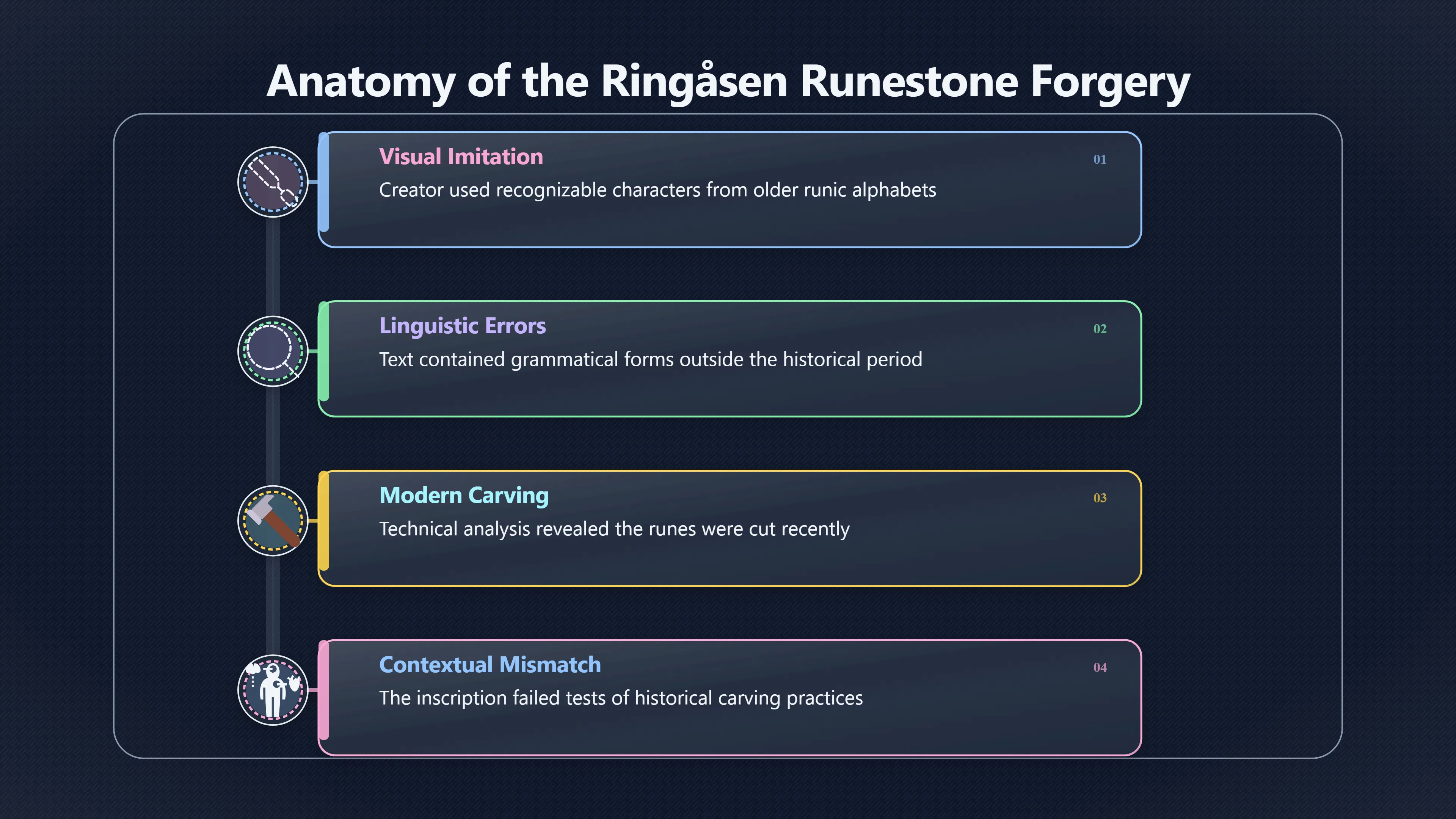
The power of the forgery lay in its selective accuracy. Whoever created it understood the visual language of antiquity. The stone contained recognisable runes and imitated the appearance of an archaeological find. For many observers, that was enough to create an impression of authenticity.
Runologists, however, examine far more than letter shapes. Specialists compare inscriptions with known historical grammar, vocabulary, spelling conventions and carving practices. According to the University of Oslo’s Historical Museum, the Ringåsen inscription failed these tests. The runes had been cut recently, and the text contained linguistic forms that did not belong to the period it supposedly represented. The forger had copied the outward appearance of ancient writing without fully understanding the language behind it.[historiskmuseum.no]historiskmuseum.noA fake runestoneThe inscription is written in older runes and the front side reads: hringur…Read more…
This pattern is common in forged inscriptions worldwide. A creator may successfully imitate visual details while introducing mistakes that a genuine medieval writer would never have made. The Ringåsen stone therefore became a useful teaching example: convincing archaeology requires consistency between appearance, language and historical context, not merely an ancient-looking surface.[historiskmuseum.no]historiskmuseum.noA fake runestoneThe inscription is written in older runes and the front side reads: hringur…Read more…
How the Sauherad demon wall gained authority
The Sauherad case was even more striking because the setting itself encouraged trust.
During restoration work in Sauherad Church in Telemark in 1940–41, conservator Gerhard Gotaas announced the discovery of an extraordinary wall decoration. The mural appeared to contain thousands of tiny demonic and human figures clustered around the church’s chancel arch. Visitors and researchers were fascinated because nothing quite like it was known from Norwegian medieval church art. Its apparent uniqueness became part of its appeal.[ScienceNorway]sciencenorway.noBut it's only 80 years old — and a fake. Gerhard Gotaas had begun work uncovering it…
Unlike a suspicious object appearing on the art market, the mural seemed to possess impeccable provenance. It was located inside a genuine medieval church and was presented as a rediscovered historical painting uncovered beneath later layers. The authority of both the building and the restoration process encouraged acceptance. Few people expected that the conservator responsible for revealing the artwork might also be responsible for creating much of it.[ScienceNorway]sciencenorway.noBut it's only 80 years old — and a fake. Gerhard Gotaas had begun work uncovering it…
For decades the mural remained a puzzle. Researchers struggled to find convincing parallels in medieval Scandinavian church decoration. The imagery appeared disconnected from established artistic traditions. Rather than immediately generating suspicion, this unusual character often increased the wall’s mystique. Observers wondered whether Sauherad preserved a rare local tradition that had survived nowhere else.[ScienceNorway]sciencenorway.noBut it's only 80 years old — and a fake. Gerhard Gotaas had begun work uncovering it…
Only much later did detailed investigation by researchers from the Norwegian Institute for Cultural Heritage Research (NIKU) overturn the accepted story. Their analysis concluded that Gotaas had painted the demon decoration himself, incorporating and building around fragments of an older wall scheme. What had long been treated as a medieval survival was largely a twentieth-century creation.[niku.no]niku.noKonservatoren og demoneneet veggmaleri i Sauherad…Mural og mosaikk Sauherad kirke i Telemark har en spektakulær veggdekor som kalles demonveggen. Gerhard Gotaa…
The linguistic and technical clues that exposed them
Although one case involved carved runes and the other painted church art, both were ultimately exposed through the same basic principle: experts looked beyond surface appearance.
In the Ringåsen case, linguistic analysis proved decisive. The inscription contained forms inconsistent with the historical period it claimed to represent. The stone’s visual resemblance to genuine runic monuments could not compensate for grammatical and linguistic errors. The forgery failed because authentic runestones are not merely collections of old-looking symbols; they are products of specific languages and historical conventions.[historiskmuseum.no]historiskmuseum.noA fake runestoneThe inscription is written in older runes and the front side reads: hringur…Read more…
The Sauherad mural was challenged through a combination of stylistic, archival and technical investigation. Researchers examined the wall itself, compared the imagery with known medieval art and studied restoration records. Their work showed that the decoration lacked credible historical parallels and that Gotaas had painted the figures during the restoration campaign rather than simply uncovering them. NIKU’s findings indicated that remnants of an older decorative programme existed beneath or around the work, but the spectacular demon imagery that attracted attention was modern.[niku.no]niku.noKonservatoren og demoneneet veggmaleri i Sauherad…Mural og mosaikk Sauherad kirke i Telemark har en spektakulær veggdekor som kalles demonveggen. Gerhard Gotaa…
The two cases highlight different methods of authentication:
- Runic specialists test language, grammar, carving technique and archaeological context.
- Art historians and conservators compare style, materials, documentation and physical layers of paint.
- Provenance researchers examine whether an object’s documented history matches the claims made for it.
In both stories, the decisive evidence came not from dramatic revelations but from careful technical analysis.[historiskmuseum.no]historiskmuseum.noA fake runestoneThe inscription is written in older runes and the front side reads: hringur…Read more…
Why people believed the claims
Neither episode succeeded simply because observers were careless. Each exploited assumptions that normally help people identify genuine history.
Runestones are associated with Viking-age Norway and possess strong symbolic value. A newly discovered inscription promises a direct connection to the past, making it easy to focus on the excitement of the find before testing every detail.[historiskmuseum.no]historiskmuseum.noA fake runestoneThe inscription is written in older runes and the front side reads: hringur…Read more…
The Sauherad mural benefited from an even stronger advantage: institutional authority. Visitors were not evaluating a loose painting of uncertain origin. They were looking at imagery inside a medieval church that had apparently been revealed by a respected conservator. The setting supplied credibility before any scholarly debate began.[ScienceNorway]sciencenorway.noBut it's only 80 years old — and a fake. Gerhard Gotaas had begun work uncovering it…
These cases demonstrate that false antiquities rarely succeed by inventing history from nothing. They succeed by attaching themselves to real history. Genuine churches, authentic archaeological traditions and respected experts can all provide a framework that makes doubtful claims appear trustworthy.
What these cases reveal about false antiquities in Norway
The Ringåsen runestone and the Sauherad demon wall occupy different corners of Norway’s history of deception, yet they illustrate the same broader pattern. The most convincing forgeries often borrow authority rather than manufacture it.
The runestone borrowed the prestige of Viking-age literacy. The demon wall borrowed the prestige of a medieval church and the restoration profession. Both appeared plausible because they were anchored to real places, real traditions and genuine cultural heritage.[historiskmuseum.no]historiskmuseum.noA fake runestoneThe inscription is written in older runes and the front side reads: hringur…Read more…
Their eventual exposure also demonstrates why historical investigation depends on specialised knowledge. Ancient-looking objects can be carved in modern times. Mysterious church art can be painted during restoration. What separates authentic discoveries from persuasive inventions is the ability to test claims against language, technique, documentation and historical context.
For Norway’s history of hoaxes and contested artefacts, these episodes remain valuable reminders that the strongest evidence is often found not in what an object appears to be, but in what close examination reveals it cannot be.[historiskmuseum.no]historiskmuseum.noA fake runestoneThe inscription is written in older runes and the front side reads: hringur…Read more…
Amazon book picks
Further Reading
Books and field guides related to How Fake Antiquities Borrowed Norway's Past. Use these as the next step if you want deeper reading beyond the article.
Frauds, Myths, and Mysteries: Science and Pseudoscience in Ar...
Directly addresses fake antiquities and questionable discoveries.
A History of the Vikings
Provides historical background for runic and medieval claims.
The Invention of Tradition
Relevant to manufactured historical narratives and heritage claims.
eBay marketplace picks
Marketplace Samples
Live-tested eBay searches with available results related to this page.

Endnotes
1.
Source: historiskmuseum.no
Title: A fake runestone
Link:https://www.historiskmuseum.no/english/exhibitions/exhibitions-archive/kiss-me-the-world-of-runes/a-fake-runestone/
Source snippet
The inscription is written in older runes and the front side reads: hringur...Read more...
2.
Source: sciencenorway.no
Link:https://www.sciencenorway.no/art-historie-humanities/this-demon-wall-was-supposed-to-be-from-the-middle-ages-but-its-only-80-years-old-and-a-fake/1942260
Source snippet
But it's only 80 years old — and a fake. Gerhard Gotaas had begun work uncovering it...
3.
Source: niku.no
Title: Konservatoren og demonene
Link:https://www.niku.no/prosjekter/konservatoren-og-demonene-et-veggmaleri-i-sauherad-kirke/
Source snippet
et veggmaleri i Sauherad...Mural og mosaikk Sauherad kirke i Telemark har en spektakulær veggdekor som kalles demonveggen. Gerhard Gotaa...
Additional References
4.
Source: commonreader.wustl.edu
Title: Common Reader The Demon Wall
Link:https://commonreader.wustl.edu/the-demon-wall/
Source snippet
Common ReaderThe Demon Wall - Common Reader - WashU25 Oct 2021 — The demonveggen, or Demon Wall, covers a limestone archway in a small ch...
5.
Source: mnhs.org
Title: kensington runestone
Link:https://www.mnhs.org/mnopedia/search/index/thing/kensington-runestone
Source snippet
MNopedia15 May 2020 — The Kensington Runestone is a gravestone-sized slab of hard, gray sandstone called graywacke into which Scandinavia...
Published: May 2020
6.
Source: atlasobscura.com
Title: demon wall norway
Link:https://www.atlasobscura.com/articles/demon-wall-norway
Source snippet
Atlas ObscuraThe Curious Case of Norway's Disturbing Demon Wall13 Oct 2021 — It's a tale of scandal, fraud, and possible madness that beg...
7.
Source: youtube.com
Link:https://www.youtube.com/watch?v=mLu0ze5L-6E
Source snippet
Election info changes quickly. Verify responses with official sources...
8.
Source: youtube.com
Title: Heather Hughes: the Fake News industry in North Macedonia
Link:https://www.youtube.com/watch?v=wDM2RFtGQyw
Source snippet
65 - Jonas Bendiksen - THE BOOK OF VELES...
9.
Source: instagram.com
Link:https://www.instagram.com/p/DU5uJ2jjFRW/
10.
Source: history.co.uk
Link:https://www.history.co.uk/shows/secrets-of-the-viking-stone/the-kensington-runestone-fascinating-find-or-fake-news-
11.
Source: forskning.no
Link:https://www.forskning.no/historie-humaniora-kunst/demonveggen-skulle-vaere-fra-middelalderen-men-veggen-er-bare-80-ar-gammel-og-et-stort-bedrag/1935754
12.
Source: youtube.com
Title: Macedonia’s Fake News Factories | AJ+
Link:https://www.youtube.com/watch?v=qjnsV8MhVK8
Source snippet
Heather Hughes: the Fake News industry in North Macedonia...
13.
Source: youtube.com
Link:https://www.youtube.com/watch?v=EcPLwMai5_E
Source snippet
The Rock that Makes People Argue A Lot | Kensington...Allegedly unearthed in 1898 by Olof Öhman, Despite scientific and scholarly resear...
Topic Tree