Chile's Most Famous Hoaxes and Debunked Mysteries
Chile’s best-known stories of deception range from colonial-era giants and blood-sucking monsters to an “alien” skeleton, a hidden island of miracle healers and state-sponsored propaganda. They did not all begin as deliberate hoaxes.
Page outline Jump by section
Introduction
What links them is not national gullibility, but a recurring set of conditions: remote landscapes that are difficult to check, newspapers and broadcasters hungry for extraordinary stories, scientific authority applied without enough care, and political institutions able to repeat claims faster than critics could investigate them. Chile’s hoax history is therefore also a history of changing evidence. Maps, expeditions, forensic examination, genetics, court records and declassified documents gradually replaced dramatic testimony with more testable accounts.
The giants Europeans expected to find
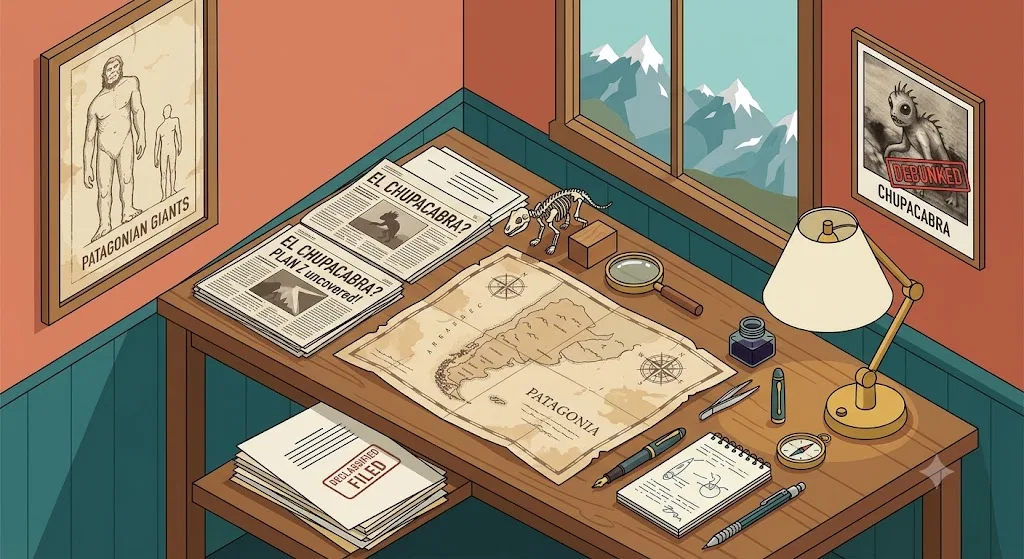
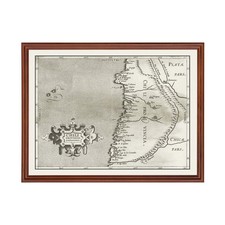
One of the oldest deceptions associated with southern Chile is the legend of the Patagonian giants. In the 1520s, Antonio Pigafetta’s account of Ferdinand Magellan’s expedition described an Indigenous man so tall that Europeans supposedly reached only to his waist. Later travellers repeated and enlarged the story, turning the inhabitants of Patagonia and the Strait of Magellan into a race of beings sometimes said to stand three or four metres high. The idea survived in European travel writing and maps for centuries.[static-prod.lib.princeton.edu]static-prod.lib.princeton.eduPatagonian GiantsThe myth of the Patagonian Giants, like other stories about remote, exotic places, captured the European imagination for…
This was not necessarily a planned fraud by a single inventor. It was more likely a mixture of genuine first impressions, literary embellishment and competitive storytelling. The Tehuelche people encountered in Patagonia were often tall by contemporary European standards, while bulky clothing and large footwear could make unfamiliar bodies appear still larger. Each retelling then rewarded the most striking version rather than the most cautious one.
The myth was persuasive because Patagonia lay at the edge of European geographical knowledge. Few readers could verify what sailors reported, and publishers had strong reasons to present distant voyages as encounters with marvels. Reports of giant bones, enormous footprints and exceptionally tall captives supplied apparent confirmation, even though the evidence was inconsistent.
Later visitors increasingly contradicted the most spectacular claims. Accounts linked to Francis Drake’s expedition accepted that Patagonians could be unusually tall but rejected the monstrous proportions described by earlier writers. Nineteenth-century measurements placed average heights within the human range, although some individuals remained notably tall. The “giants” were therefore reduced from a supposed biological mystery to a case of observation magnified by expectation and print culture.[WIRED]wired.comfantastically wrong giants of patagoniaThe Portuguese explorer's chronicler, Antonio Pigafetta, documented the event, describing how the natives, likely the Tehuelche tribe, se…
The legend still circulates because it suits the landscape. Patagonia’s scale, isolation and harsh weather make stories of lost races feel intuitively at home there. Yet the tale also carries a colonial distortion: real Indigenous people were converted into fabulous specimens, while European amazement became more memorable than their societies and histories.
When fabrication became an instrument of power
Chile’s most consequential falsehoods were not supernatural curiosities. After the military coup of 11 September 1973, fabricated plots and coordinated media stories helped legitimise the new regime and disguise what its security services were doing.

Plan Z and the invented massacre
Soon after the coup, military authorities promoted the existence of “Plan Z”, an alleged scheme by supporters of Salvador Allende to carry out a self-coup and murder senior officers, politicians and other opponents. Newspapers publicised claims that documents had exposed an imminent Marxist bloodbath. The story appeared in the military government’s White Book on the Change of Government in Chile, giving the allegation an official form and allowing it to be cited as evidence rather than merely repeated as rumour.[Memoria Chilena]memoriachilena.gob.clMemoria Chilena Plan ZetaUn supuesto plan del gobierno de Salvador Allende para terminar con la oposición a su gobierno. Si bien, en la actualidad no…
No credible proof established that such an operational plan existed. Subsequent historical scrutiny treated Plan Z as a fabrication or propaganda construction assembled from unverified material and presented after the coup as retrospective justification. Its practical function was clear: violence by the new authorities could be portrayed as prevention, while detainees and political opponents could be cast as participants in a conspiracy rather than victims of repression.[Memoria Chilena]memoriachilena.gob.clMemoria Chilena Plan ZetaUn supuesto plan del gobierno de Salvador Allende para terminar con la oposición a su gobierno. Si bien, en la actualidad no…
The claim worked because it entered an atmosphere already charged by polarisation, economic disruption, armed rhetoric and genuine fear of political violence. It did not need every detail to be believable. It needed to confirm what supporters of the coup already suspected and to create enough uncertainty for repression to seem defensible.
Plan Z remains an important warning about official documents. A claim does not become reliable simply because it appears in a government publication, carries military terminology or contains lists, diagrams and operational language. Those features can manufacture an appearance of precision without providing independently verifiable evidence.
Operation Colombo and the case of the 119
Operation Colombo was more elaborate and more directly tied to concealing state crimes. In 1975, reports appeared outside Chile claiming that 119 Chilean left-wing activists had died abroad in clashes, internal purges or disputes among opposition groups. Chilean newspapers then reproduced these stories, sometimes under headlines implying that the missing people had killed one another.[National Security Archive]nsarchive.gwu.eduNational Security Archive U.SEmbassy, Santiago, Cable, “Analysis of Deaths and…18 Jun 2024 — The case of the 119 was later revealed to be a secret disinformation s…
The reports had been constructed to answer a growing problem for the dictatorship. Families, lawyers, churches and human-rights organisations were demanding information about people arrested by Chilean security forces. By placing the alleged deaths outside the country, the disinformation campaign denied that those people had remained in state custody.
The foreign publications used to launch the story were themselves highly suspect. One appeared only once in Argentina, while another Brazilian outlet supplied a matching list. The duplication gave the appearance of independent confirmation: a claim printed abroad could be cited by Chilean media as external news, even when it formed part of the same coordinated operation.
Investigations, survivor testimony, judicial proceedings and later documentary evidence showed that many of the 119 had been detained and disappeared by Chile’s National Intelligence Directorate, known as DINA. A declassified United States diplomatic assessment described the episode as a disinformation scheme run by DINA’s external branch with allies in Argentina and Brazil.[National Security Archive]nsarchive.gwu.eduNational Security Archive U.SEmbassy, Santiago, Cable, “Analysis of Deaths and…18 Jun 2024 — The case of the 119 was later revealed to be a secret disinformation s…
Operation Colombo illustrates a particularly powerful hoax mechanism: information laundering. The original source is hidden or disguised; a friendly outlet publishes the claim; domestic media then report that “foreign newspapers say” it is true. Repetition across borders makes one operation look like several independent confirmations.
Unlike a harmless newspaper prank, this deception deepened the suffering of families. It denied the victims’ detention, smeared them after death and obstructed accountability. The case is now remembered not only as propaganda but as part of the machinery of forced disappearance.
The six-inch “alien” from the Atacama Desert
In the early 2000s, a tiny mummified body found near an abandoned settlement in the Atacama Desert began circulating through private collections and UFO media. The remains, nicknamed Ata, measured about 15 centimetres and had an elongated skull, an unusual-looking rib cage and features that appeared startling in photographs. Promoters suggested that the body might belong to an extraterrestrial or an unknown form of human. The specimen later appeared in a documentary supporting claims of alien visitation.[Time]time.comGenetic Tests Reveal Six-Inch "Alien" Skeleton Is Actually a HumanGenetic Tests Reveal Six-Inch "Alien" Skeleton Is Actually a Human
The extraordinary interpretation depended heavily on presentation. A small body photographed without proper forensic context can look far stranger than it is. Claims about its anatomy were repeated before specialists had established its developmental age, medical history, burial circumstances or even a secure chain of custody.
Genetic testing settled the central question: the remains were human and female, with ancestry consistent with populations from the region as well as European ancestry. A 2018 study proposed that several genetic variants might explain skeletal abnormalities and suggested that the individual had survived beyond the earliest stages of pregnancy.[Genome Research]genome.cshlp.orgOpen source on cshlp.org.
That paper did not end the controversy. Bioarchaeologists argued that the skeleton showed features compatible with an ordinary human foetus and that some supposed abnormalities had been misread because the researchers had not adequately consulted specialists in infant skeletal development. They also criticised attempts to infer a collection of rare disorders from genetic variants without strong clinical or anatomical support.[PubMed]pubmed.ncbi.nlm.nih.govOpen source on nih.gov.
The ethical questions were equally serious. Chilean authorities and researchers raised concerns about how human remains of uncertain legal origin had left the country and been sampled. The spectacle of an “alien mummy” risked obscuring the simplest and most humane description: these were the remains of a human child, not a prop whose unusual appearance removed the need for consent, provenance or respectful treatment.[The Scientist]the-scientist.comOpen source on the-scientist.com.
Ata is therefore not best understood as a single cleanly exposed hoax. The alien claim was unsupported, but genuine scientific work was conducted on the specimen, and specialists subsequently disputed parts of that work. The case sits at the boundary between commercial sensationalism, premature diagnosis and scientific correction. Its lasting lesson is that advanced technology cannot compensate for weak archaeological context or missing expertise.
Friendship Island and the mystery carried by radio
During the 1980s, Chilean radio enthusiasts began reporting conversations with people who claimed to inhabit a secret island in the far south. The alleged community was isolated, technologically advanced and variously described as religious, foreign or connected to non-human beings. In later versions, its inhabitants could cure otherwise fatal illnesses.
The story became known as Friendship Island. It drew strength from the geography of southern Chile, where scattered islands, difficult seas and sparse settlement make absence hard to prove. A voice on a radio could sound intimate and authentic while remaining physically unreachable. The mystery therefore offered both apparent evidence and a ready explanation for why stronger evidence never appeared.[La Tercera]latercera.comLa Tercera Isla Friendship: nuevas miradas en torno a una obsesiónLa Tercera Isla Friendship: nuevas miradas en torno a una obsesión
The legend changed as it spread. What began as contact with an unusual community acquired increasingly explicit UFO themes. Ernesto de la Fuente became a central figure after claiming that he had visited the island and been cured of cancer. Television programmes, investigators and enthusiasts repeated the story, while expeditions failed to locate a community matching the descriptions.
Later investigation focused less on proving where the island was and more on whether the witnesses’ accounts held together. The documentary Isla Alien revisited recordings and interviewed radio operators, believers and sceptics, presenting the affair as a story about obsession, performance and the creation of a modern myth rather than confirmation of an extraterrestrial settlement. Chilean coverage of the film described the case as a four-decade legend built around radio communications and claims that grew more fantastic over time.[La Tercera]latercera.comLa Tercera Isla Friendship: nuevas miradas en torno a una obsesiónLa Tercera Isla Friendship: nuevas miradas en torno a una obsesión
No verified island community, advanced medical centre or alien presence has been found. That does not prove that every participant deliberately lied. Some may have been playing roles, some may have sincerely believed the voices, and later retellings may have combined separate stories. Friendship Island is better classified as an evolving urban legend with likely elements of performance and deception than as a single, fully documented conspiracy.
Its survival owes much to its design. The island is always remote, its residents avoid ordinary contact, and its technology supposedly exceeds what outsiders can understand. Every failed search can therefore be absorbed into the story: perhaps the island is hidden, perhaps it appears under another name, or perhaps its inhabitants choose who may find it.
The Chilean chupacabra panic
In 2000, reports from around Calama in northern Chile claimed that livestock had been found mutilated or mysteriously drained of blood. The attacks were soon attributed to the chupacabra, a creature whose legend had begun in Puerto Rico in the mid-1990s and spread rapidly through Latin American television, radio and newspapers. Chilean versions added rumours of secret government activity and even a supposed foreign space-agency operation.[Wikipedia]WikipediaOpen source on wikipedia.org.
The animal deaths were real; the blood-sucking monster was not established. Sensational coverage grouped different carcasses and injuries under one dramatic label before investigators had shown that they shared a cause. Ordinary predation, scavenging and post-mortem damage could then be interpreted through the monster story already circulating in the media.
Investigations of the Chilean incidents found evidence pointing to dogs, including tracks and hair. Claims that carcasses had been completely drained of blood were not supported by the kind of controlled veterinary examinations needed to demonstrate such a process. Similar chupacabra episodes elsewhere have repeatedly involved dogs, coyotes, scavengers or animals affected by mange.[Wikipedia]WikipediaOpen source on wikipedia.org.
The Calama panic is best treated as a moral and media panic rather than a carefully organised hoax. Farmers faced unexplained losses, journalists had a vivid international monster ready to name, and each new report made the next one easier to interpret in the same way. The mystery travelled faster than veterinary findings because it supplied a single memorable cause for varied and disturbing events.
The chupacabra still returns whenever a hairless animal is photographed or livestock die in unusual circumstances. Its image has changed so often—from a spined, upright creature to a sickly canine—that it is difficult to describe what evidence would disprove it. That flexibility is one reason the legend endures.
Why these stories keep returning
Chile’s famous hoaxes and debunked claims succeed through different mechanisms, but several patterns recur.
Distance protects the claim. Patagonia, the Atacama Desert and the southern archipelagos are physically real landscapes whose remoteness can shelter imaginary populations, monsters or secret installations from easy verification.
Authority can manufacture credibility. A military publication, foreign newspaper, television documentary or genetics laboratory may appear to settle a question. Yet authority is reliable only when evidence, methods and provenance can be checked independently.
Repetition can imitate confirmation. Operation Colombo deliberately exploited this principle, but folklore does it too. Several outlets repeating the same weak account do not create several sources.
A vivid image outruns a careful explanation. A tiny skeleton, mutilated animal or antique drawing of a giant communicates instantly. Explanations involving foetal anatomy, scavenging or the history of travel writing require more patience.
Corrections rarely erase the original story. Debunking changes what responsible investigators can say, but the dramatic claim remains available in archives, documentaries and social media. A mystery can therefore survive long after its evidential foundation has collapsed.
The most useful distinction is not simply between “true” and “hoax”. Chile’s cases include deliberate state disinformation, embellished travellers’ tales, unsupported paranormal claims, sincere misidentification and research conducted without sufficient context. Treating them all as identical would conceal who held power, who profited and who was harmed. The better question is how each claim was produced, what evidence it relied upon, and whether its promoters allowed that evidence to be tested.
Amazon book picks
Further Reading
Books and field guides related to Chile's Most Famous Hoaxes and Debunked Mysteries. Use these as the next step if you want deeper reading beyond the article.
Extraordinary Popular Delusions and the Madness of Crowds
Rating: 4.0/5 from 5 Google Books ratings
Explores famous episodes of collective belief and misinformation.
The Demon-Haunted World
Rating: 4.5/5 from 43 Google Books ratings
Explains how myths, hoaxes and dubious evidence gain acceptance.
Why People Believe Weird Things
Examines belief formation behind hoaxes and fringe claims.
eBay marketplace picks
Marketplace Samples
Live-tested eBay searches with available results related to this page.
Endnotes
1.
Source: static-prod.lib.princeton.edu
Link:https://static-prod.lib.princeton.edu/visual_materials/maps/websites/pacific/magellan-strait/patgonian-giants.html
Source snippet
Patagonian GiantsThe myth of the Patagonian Giants, like other stories about remote, exotic places, captured the European imagination for...
2.
Source: wired.com
Title: fantastically wrong giants of patagonia
Link:https://www.wired.com/2014/09/fantastically-wrong-giants-of-patagonia
Source snippet
The Portuguese explorer's chronicler, Antonio Pigafetta, documented the event, describing how the natives, likely the Tehuelche tribe, se...
3.
Source: time.com
Title: Genetic Tests Reveal Six-Inch “Alien” Skeleton Is Actually a Human
Link:https://time.com/5210714/ata-six-inch-skeleton-human/
4.
Source: the-scientist.com
Link:https://www.the-scientist.com/scientists-in-chile-protest-mummy-study-29885
5.
Source: Wikipedia
Link:https://en.wikipedia.org/wiki/Chupacabra
6.
Source: hoaxes.org
Link:https://hoaxes.org/photo_database
7.
Source: hoaxes.org
Title: the patagonian giants
Link:https://hoaxes.org/archive/permalink/the_patagonian_giants
8.
Source: Wikipedia
Link:https://en.wikipedia.org/wiki/Patagons
9.
Source: Wikipedia
Title: Operation Colombo
Link:https://en.wikipedia.org/wiki/Operation_Colombo
10.
Source: Wikipedia
Title: Isla Friendship
Link:https://es.wikipedia.org/wiki/Isla_Friendship
11.
Source: memoriachilena.gob.cl
Title: Memoria Chilena Plan Zeta
Link:https://www.memoriachilena.gob.cl/602/w3-article-96802.html
Source snippet
Un supuesto plan del gobierno de Salvador Allende para terminar con la oposición a su gobierno. Si bien, en la actualidad no...
12.
Source: memoriachilena.gob.cl
Link:https://www.memoriachilena.gob.cl/archivos2/pdfs/MC0054551.pdf
Source snippet
Memoria ChilenaRESPONDE A GONZALO VIALel Plan Z... hasta donde se sabe, no diciendo que, pese a saber muy poco o era socialista"). No asi...
13.
Source: nsarchive.gwu.edu
Title: National Security Archive U.S
Link:https://nsarchive.gwu.edu/document/32165-document-8-us-embassy-santiago-cable-analysis-deaths-and-disappearances-chilean
Source snippet
Embassy, Santiago, Cable, “Analysis of Deaths and...18 Jun 2024 — The case of the 119 was later revealed to be a secret disinformation s...
14.
Source: genome.cshlp.org
Link:https://genome.cshlp.org/content/28/5/607
15.
Source: pubmed.ncbi.nlm.nih.gov
Link:https://pubmed.ncbi.nlm.nih.gov/30025270/
16.
Source: latercera.com
Title: La Tercera Isla Friendship: nuevas miradas en torno a una obsesión
Link:https://www.latercera.com/culto/2023/10/20/isla-friendship-nuevas-miradas-en-torno-a-una-obsesion/
17.
Source: memoriachilena.gob.cl
Link:https://www.memoriachilena.gob.cl/archivos2/pdfs/MC0062897.pdf
18.
Source: memoriachilena.gob.cl
Link:https://www.memoriachilena.gob.cl/archivos2/pdfs/MC0037313.pdf
19.
Source: memoriachilena.gob.cl
Link:https://www.memoriachilena.gob.cl/archivos2/pdfs/MC0018166.pdf
20.
Source: memoriachilena.gob.cl
Link:https://www.memoriachilena.gob.cl/archivos2/pdfs/MC0053554.pdf
21.
Source: memoriachilena.gob.cl
Link:https://www.memoriachilena.gob.cl/archivos2/pdfs/MC0062820.pdf
22.
Source: memoriachilena.gob.cl
Link:https://www.memoriachilena.gob.cl/archivos2/pdfs/MC0039026.pdf
23.
Source: memoriachilena.gob.cl
Link:https://www.memoriachilena.gob.cl/archivos2/pdfs/MC0003647.pdf
24.
Source: memoriachilena.gob.cl
Link:https://www.memoriachilena.gob.cl/archivos2/pdfs/MC0066269.pdf
25.
Source: memoriachilena.gob.cl
Link:https://www.memoriachilena.gob.cl/archivos2/pdfs/MC0062898.pdf
26.
Source: memoriachilena.gob.cl
Link:https://www.memoriachilena.gob.cl/archivos2/pdfs/MC0005041.pdf
27.
Source: memoriachilena.gob.cl
Link:https://www.memoriachilena.gob.cl/archivos2/pdfs/MC0042472.pdf
28.
Source: memoriachilena.gob.cl
Link:https://www.memoriachilena.gob.cl/archivos2/pdfs/MC0005463.pdf
29.
Source: memoriachilena.gob.cl
Link:https://www.memoriachilena.gob.cl/archivos2/pdfs/MC0016916.pdf
30.
Source: memoriachilena.gob.cl
Link:https://www.memoriachilena.gob.cl/archivos2/pdfs/mc0007683.pdf
31.
Source: memoriachilena.gob.cl
Link:https://www.memoriachilena.gob.cl/archivos2/pdfs/MC0005284.pdf
32.
Source: memoriachilena.gob.cl
Link:https://www.memoriachilena.gob.cl/archivos2/pdfs/MC0053682.pdf
33.
Source: memoriachilena.gob.cl
Link:https://www.memoriachilena.gob.cl/archivos2/pdfs/MC0005285.pdf
34.
Source: latercera.com
Title: pablo diaz
Link:https://www.latercera.com/etiqueta/pablo-diaz
35.
Source: latercera.com
Title: a 20 anos del mayor fraude en la historia de la ufologia
Link:https://www.latercera.com/noticia/a-20-anos-del-mayor-fraude-en-la-historia-de-la-ufologia/
36.
Source: latercera.com
Link:https://www.latercera.com/etiqueta/sanfic/
37.
Source: latercera.com
Title: el asesinato de tupac shakur como el primer acusado planeo la muerte del rapero
Link:https://www.latercera.com/culto/2023/10/03/el-asesinato-de-tupac-shakur-como-el-primer-acusado-planeo-la-muerte-del-rapero/
38.
Source: youtube.com
Title: Isla Alien
Link:https://www.youtube.com/watch?v=zB9rRZGc05w
Additional References
39.
Source: educamemoria.museodelamemoria.cl
Title: Educa Memoria Guía de bolsillo para la visita
Link:https://educamemoria.museodelamemoria.cl/wp-content/uploads/2023/11/Guia-de-bolsillo-para-la-visita.pdf
Source snippet
Educa MemoriaGuía de bolsillo para la visita - EDUCA MEMORIAUn resultado de esta coordinación entre los organismos represores fue la “Ope...
40.
Source: youtube.com
Link:https://www.youtube.com/watch?v=EEMJoZvN-dQ
Source snippet
Archeological Discoveries Blown Way Out of Proportion...
41.
Source: jstor.org
Link:https://www.jstor.org/stable/j.ctt7ztms2
Source snippet
Patagonia: Natural History, Prehistory, and Ethnography at...The first contacts led to tales of a race of giants and, ever since, P...
42.
Source: youtube.com
Title: The FORGOTTEN Race of GIANTS in Human History
Link:https://www.youtube.com/watch?v=w8K3u0vO0h0
Source snippet
The CIA's UAP & Alien Research! 'Their Brains Looked Fried' | Stanford's Garry Nolan...
43.
Source: facebook.com
Link:https://www.facebook.com/CBSBaltimore/posts/a-plot-spanning-three-countries-to-sell-suspected-forgeries-of-paintings-by-arti/1227620156066343/
44.
Source: instagram.com
Link:https://www.instagram.com/p/DadS5islVG1/
45.
Source: rockartblog.blogspot.com
Link:https://rockartblog.blogspot.com/p/dubitative_9063.html
46.
Source: instagram.com
Link:https://www.instagram.com/reel/DWNA3GMDpMd/?hl=en
47.
Source: freemanart.ca
Link:https://www.freemanart.ca/greatest_art_forgers_fakers.htm
48.
Source: reddit.com
Link:https://www.reddit.com/r/Cryptozoology/comments/1gx78io/it_is_curious_that_in_many_cultures_there_are/
Topic Tree
Follow this branch
Related pages 192
- Albanian Hoaxes
- Algerian Hoaxes
- Antigua Deceptions
- Argentina Hoaxes
- Armenian Hoaxes
- +187 more in sidebar