How Syria's Most Famous Fakes Fooled the World
Syria’s best-documented history of hoaxes is not a neat collection of old newspaper pranks or legendary monsters.
Page outline Jump by section
Introduction
The most important distinction is between a deliberate fake and a real object or image given a false story. Some Syrian “hoaxes” were commercial frauds produced for collectors. Others were artworks or dramatic reconstructions stripped of their original labels. Still others began as errors, impostures or ill-judged publicity stunts and became politically useful only after they circulated. The recurring lesson is that deception succeeds not because audiences are uniquely gullible, but because war creates urgency, weakens normal verification and supplies stories that people already expect to be true.
How war created a market for fake antiquities
The civil war that began in 2011 devastated archaeological sites, museums and historic districts while also generating international demand for supposedly looted Syrian treasures. That demand created an unusually persuasive cover story for forgery. A sculpture, tablet or coin no longer needed a detailed ownership history if a seller could imply that it had recently emerged from the chaos around Palmyra, Aleppo or another damaged site.
By 2016, Syria’s antiquities authorities were reporting that nearly 70 per cent of objects seized in anti-smuggling operations in Syria and neighbouring Lebanon during that year were modern fakes. Contemporary investigations described workshops in Damascus, Aleppo and elsewhere manufacturing objects for a market eager to believe that masterpieces were pouring out of the country. The resulting trade mixed genuine loot, modern copies, badly restored fragments and objects whose origins could not be established.[independent.co.uk]independent.co.ukThe Independent Fake antiquities flood out of Syria as smugglers fail to stealThe IndependentFake antiquities flood out of Syria as smugglers fail to steal…September 7, 2016 — 7 Sept 2016 — These look like impres…
The deception worked because fake and genuine antiquities travelled through the same shadowy channels. Photographs passed between middlemen, dealers and prospective buyers, often without reliable excavation records or export documents. Under those conditions, even an expert might be asked to judge an object from a few low-resolution images. Researchers studying online antiquities markets have found that obviously false pieces appear beside objects that may be genuine, making the marketplace itself a device for laundering uncertainty.[cbsnews.com]cbsnews.comCBS NewsFollowing the trail of Syria's looted historySeptember 9, 2015 — 9 Sept 2015 — He sent us images of coins and statuettes, jewelry…
The buyer was purchasing a story
A fake Syrian antiquity was often more than a copy of an old object. It was packaged with an emotionally and politically powerful narrative:
- it had supposedly been rescued from a threatened site;
- it had allegedly been hidden by a family during fighting;
- it was said to have passed through smugglers fleeing an armed group;
- or it was offered as a rare chance to “save” an artefact before its destruction.
These stories converted a missing provenance—the documented history of an object’s ownership—into a selling point. The absence of paperwork appeared understandable because Syria was at war. Buyers could even imagine themselves preserving heritage, although purchasing undocumented material increased the commercial incentive for both looting and counterfeiting.
International organisations consequently stress that forged papers are part of the problem, not merely forged objects. Fake invoices, invented collection histories and misleading export declarations can make newly excavated or newly manufactured pieces appear respectable. UNESCO guidance treats provenance research, regulation of online sales and cooperation between museums, customs officers and law-enforcement agencies as central protections against both trafficking and forgery.[unesco.org]unesdoc.unesco.orgUNESCO Digital LibraryFighting the illicit trafficking of cultural property: a toolkit for…Antiquities taken out of Syria are thus sto…
The scale of the counterfeit trade also complicates claims about armed groups financing themselves through antiquities. Genuine looting unquestionably occurred, and international measures were introduced to restrict trade in unlawfully removed Syrian cultural property. Yet dramatic objects displayed by smugglers or militants were not automatically authentic. In 2015, observers even questioned whether statues shown being destroyed by Islamic State were real antiquities or disposable copies, possibly used to conceal the sale of genuine pieces. That particular suspicion was not conclusively proved, but it illustrates the difficulty of interpreting propaganda produced by an organisation that combined destruction, publicity and illicit commerce.[voanews.com]voanews.comVoice of America Monitors: Palmyra Statues Ruined by IS May Have BeenVoice of America Monitors: Palmyra Statues Ruined by IS May Have Been

The orphan photograph that was not taken in Syria
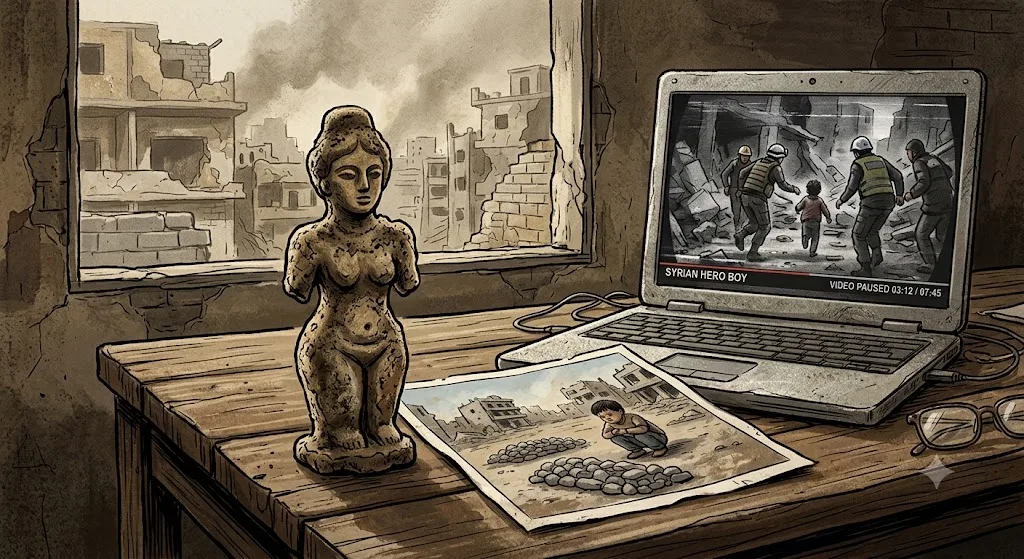
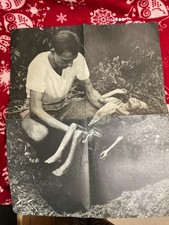
One of the most durable images associated with Syria showed a small boy asleep between two long mounds of stones, supposedly the graves of his parents. The caption transformed the scene into an almost perfect symbol of the civil war: a bereaved child, anonymous victims and a barren landscape that seemed to require no further explanation.
The photograph was not taken in Syria. It was made near Yanbu in Saudi Arabia by photographer Aziz Alotaibi as a conceptual project about an orphan’s continuing love for dead parents. The child was his nephew, and the photographer constructed the grave-like mounds for the picture. Once separated from that explanation, the image circulated as documentary evidence of Syrian suffering and was shared by political figures and media outlets.[afp.com]factcheck.afp.comimage was staged photography student saudi arabiaimage was staged photography student saudi arabia
This was not a conventional hoax organised by the photographer. The original work was staged but presented as symbolic art; the falsehood arose when other people attached a factual Syrian caption to it. Alotaibi publicly objected to the appropriation of his picture for propaganda, while at least one newspaper later apologised for publishing it without proper verification.[iMediaEthics]imediaethics.orgOpen source on imediaethics.org.
The image survived repeated exposure because it was emotionally self-contained. Viewers did not need to know a name, town or date to understand its alleged meaning. Those missing details, which should have prompted caution, instead helped the photograph travel between conflicts. Years after being debunked as a Syrian scene, it was relabelled as an image from Gaza.[CEDMO]cedmohub.euCEDMOWar of narratives: Syrian imagery falsely illustrates GazaCEDMOWar of narratives: Syrian imagery falsely illustrates Gaza
The episode demonstrates a common feature of wartime misinformation: the picture itself need not be digitally altered. A new caption can do nearly all the deceptive work.
The “Syrian Hero Boy” film
In November 2014, a short video appeared to show a young Syrian boy running through gunfire to rescue a girl. He seemed to be struck, collapsed, then rose and led her to safety as bullets hit a nearby wall. Its shaky camera, dusty setting and abrupt action gave it the appearance of footage recorded inside a war zone.
The scene was fictional. Norwegian director Lars Klevberg and his crew had filmed it in Malta with professional actors. They used cinematic effects to simulate bullets and presented the finished piece in a way that allowed viewers to interpret it as genuine Syrian footage. Millions watched it before the filmmakers publicly disclosed how it had been made.[arabnews.com]arabnews.comOpen source on arabnews.com.
Klevberg said that he wanted to encourage discussion about children in war. That intention did not settle the ethical problem. The film did not merely dramatise an acknowledged possibility; it borrowed the authority of eyewitness evidence. Human-rights advocates warned that such fakery made it easier for governments and armed groups to dismiss real documentation of attacks as staged.[The Times of Israel]timesofisrael.comThe Times of Israel Producer of fake 'Syrian hero boy' video apologizesThe Times of Israel Producer of fake 'Syrian hero boy' video apologizes
The video was persuasive because its technical imperfections looked authentic. The camera did not behave like a polished feature film, while the landscape matched international audiences’ broad visual expectations of Syria. It also supplied a satisfying miniature story—danger, courage and rescue—that real conflict footage rarely provides so neatly.
Unlike the orphan photograph, whose creator had not claimed it documented Syria, the “Hero Boy” film was designed to exploit uncertainty about whether viewers were seeing fact or fiction. It therefore stands as one of the clearest deliberate media hoaxes attached to the Syrian war.
When one staged rescue fed a much larger falsehood
In 2016, members of the Syrian Civil Defence, widely known at the time as the White Helmets, took part in a “Mannequin Challenge” video. The internet craze involved people freezing in place while a camera moved around them. In the Syrian version, volunteers posed as though they were conducting a rescue before suddenly beginning to move.
The stunt was real, staged and badly judged. The organisation distanced itself from the recording and apologised. In isolation, it was an ill-conceived imitation of a social-media trend. In the wider information war, however, the footage became supposed proof that the White Helmets routinely fabricated rescues and even chemical attacks. It continued to be reposted long after its original context had been established.[Global News]globalnews.caOpen source on globalnews.ca.
That conclusion did not follow from the evidence. A single acknowledged performance could establish that one performance occurred; it could not demonstrate that unrelated footage from bombings was fictional. Nevertheless, the clip was ideal propaganda material because it offered a genuine example of staging that could be extended into a far broader accusation.
Researchers examining online discussion of the White Helmets have identified coordinated amplification, repeated text and networks of sites and accounts promoting mutually reinforcing claims. A Harvard Kennedy School study described the campaign as cross-platform rather than confined to isolated social-media posts, while another computational study found organised groups using duplicated material and automated retweeting to promote hostile narratives about the rescue organisation.[Misinformation Review]misinforeview.hks.harvard.eduMisinformation Review Cross-platform disinformation campaigns: Lessons learnedMisinformation Review Cross-platform disinformation campaigns: Lessons learned
False “proof” was also manufactured from unrelated visual material. Images circulated as evidence that the White Helmets had staged a chemical attack were traced to a film set, while photographs of one injured Syrian girl being carried by different rescuers were falsely described as either repeated performances or separate miraculous survivals. AFP established that the photographs showed the same child after one attack in Aleppo, carried by several people during the rescue.[snopes.com]snopes.comis this proof white helmets staged chemical attackis this proof white helmets staged chemical attack
This case matters because it shows how effective disinformation often incorporates a fragment of truth. The mannequin video existed. Volunteers really had staged it. The deceptive step was to treat that admitted stunt as a master key capable of invalidating a large body of unrelated evidence.
The prisoner who gave CNN a false identity
A more recent Syrian imposture unfolded after the fall of Bashar al-Assad’s government in December 2024. A CNN team entering a former Air Force Intelligence facility in Damascus found a man alone in a locked cell. He identified himself as Adel Ghurbal, claimed to be an ordinary civilian from Homs and said that he had been imprisoned for months.
The report showed his apparent release and attracted international attention. Syrian fact-checkers at Verify-Sy subsequently identified him as Salama Mohammad Salama, an officer associated with the former government’s Air Force Intelligence service. Residents accused him of extortion and other abuses. CNN conducted its own investigation, used facial-recognition analysis and acknowledged that the man had supplied a false identity.[apnews.com]apnews.comOpen source on apnews.com.
There is an important limit to the debunking. The discovery of the man in the cell was not necessarily staged by CNN, and the network maintained that its team had encountered him during a genuine search. What failed was the identification and the resulting interpretation: an intelligence officer was initially presented as an innocent victim because reporters were working in a chaotic location without access to normal records or dependable official contacts.[AP News]apnews.comOpen source on apnews.com.
Salama’s motives remain less certain than his false identity. Presenting himself as a civilian prisoner may have offered immediate protection at a moment when former regime personnel faced detention or retaliation. His story also fitted what journalists reasonably expected to find in an intelligence prison, where genuine victims had been held and abused. The plausibility of the setting helped the imposture succeed.
The correction is a useful example of local verification reversing a powerful international narrative. Syrian researchers gathered testimony and identification evidence that an outside news crew could not obtain during the initial encounter. The case was embarrassing for CNN, but its later acknowledgement also showed the difference between an exposed error and a continuing organised hoax.
Why fake Syrian images keep returning
Syria has become what might be called a visual archive for later conflicts. Photographs and videos from Aleppo, Damascus and other locations are repeatedly reposted as scenes from Gaza, Ukraine or fresh fighting elsewhere. The reverse also occurs: material from films, other wars, accidents and art projects is relabelled as Syrian.
AFP documented numerous Syrian photographs reused to illustrate the Israel–Gaza war, including images dating back to the height of Syria’s civil conflict. Other fact-checks have traced supposedly current Syrian attacks to old footage from Iraq or unrelated events.[Fact Check AFP]factcheck.afp.comOpen source on afp.com.
Several features make this recycling effective:
- Ruined urban landscapes are difficult to place. A damaged concrete building may resemble locations across several modern conflicts.
- Children and rescue scenes require little translation. Their emotional force travels more easily than dates, street names or military details.
- Platform sharing removes provenance. Each repost can strip away the photographer’s name, original caption and publication date.
- The picture often confirms an existing belief. Supporters of opposing sides may share the same image under contradictory descriptions.
- Corrections spread more slowly than the first claim. By the time a source photograph is found, copies may already exist across many platforms.
Research on out-of-context imagery treats the mismatch between a real photograph and a false caption as a distinct misinformation problem. Verifying it often requires comparing both visual details and documentary evidence rather than simply checking for signs of digital manipulation.[arXiv]arxiv.orgOpen source on arxiv.org.
What the Syrian cases reveal
Syria’s famous fakes do not form a single tradition, and responsibility is widely dispersed. Some objects were forged inside Syria for profit. Some media stunts were produced abroad. Some false captions were circulated by activists, political supporters or ordinary users. Some narratives were amplified systematically by states and coordinated networks. Others arose because journalists and audiences made mistakes under pressure.
What joins the cases is the value of an apparently authentic fragment. A limestone face resembles a Palmyrene sculpture. A staged photograph resembles documentary tragedy. A Maltese film set resembles a Syrian street. A real social-media stunt resembles evidence for a larger conspiracy. A real prisoner presents a false biography. The successful deception rarely invents every detail; it attaches a misleading explanation to something the audience can see.
The most reliable questions are therefore practical ones. Who first published the material? Was it labelled as art, fiction or reconstruction? Is there a precise date and place? Does an antiquity have a documented ownership history? Are claims based on the object itself or on a seller’s dramatic account? Does one admitted fake genuinely establish anything about separate evidence?
Syria’s experience also warns against allowing exposed hoaxes to erase real events. The existence of counterfeit antiquities does not mean that Syrian sites were not looted. A staged rescue film does not make authentic footage fictional. An impostor in a prison does not disprove the imprisonment and torture of civilians. Hoaxes matter partly because they provide convenient excuses for dismissing truths that are harder, messier and better supported.
Amazon book picks
Further Reading
Books and field guides related to How Syria's Most Famous Fakes Fooled the World. Use these as the next step if you want deeper reading beyond the article.
The Misinformation Age
Explains why hoaxes, misleading images and fabricated stories gain traction.
Black Wave
Provides regional context for conflicts and information battles affecting Syria.
The Destruction of Memory
Connects conflict, cultural heritage and contested narratives.
The Debunking Handbook 2020
Covers methods for identifying and correcting false claims.
eBay marketplace picks
Marketplace Samples
Live-tested eBay searches with available results related to this page.
Endnotes
1.
Source: unesdoc.unesco.org
Link:https://unesdoc.unesco.org/ark%3A/48223/pf0000266098
Source snippet
UNESCO Digital LibraryFighting the illicit trafficking of cultural property: a toolkit for...Antiquities taken out of Syria are thus sto...
2.
Source: unesco.org
Title: G20 Priority 1 India CWG Background Paper
Link:https://www.unesco.org/sites/default/files/medias/fichiers/2023/03/G20_Priority%201%20India%20CWG%20Background%20Paper.pdf
3.
Source: unesdoc.unesco.org
Link:https://unesdoc.unesco.org/ark%3A/48223/pf0000371110
4.
Source: unesdoc.unesco.org
Link:https://unesdoc.unesco.org/ark%3A/48223/pf0000368450
5.
Source: factcheck.afp.com
Title: image was staged photography student saudi arabia
Link:https://factcheck.afp.com/image-was-staged-photography-student-saudi-arabia
6.
Source: reuters.com
Link:https://www.reuters.com/article/fact-check/photo-of-child-laying-between-graves-was-staged-and-originates-from-2014-idUSL2N2X11T9/
7.
Source: reuters.com
Link:https://www.reuters.com/fact-check/image-child-sleeping-between-graves-is-an-old-art-project-not-gaza-2024-06-11/
8.
Source: imediaethics.org
Link:https://www.imediaethics.org/muslim-observer-newspaper-apologizes-after-fake-photo-of-syrian-boy/
9.
Source: cedmohub.eu
Title: CEDMOWar of narratives: Syrian imagery falsely illustrates Gaza
Link:https://cedmohub.eu/war-of-narratives-syrian-imagery-falsely-illustrates-gaza/
10.
Source: misinforeview.hks.harvard.edu
Title: Misinformation Review Cross-platform disinformation campaigns: Lessons learned
Link:https://misinforeview.hks.harvard.edu/article/cross-platform-disinformation-campaigns/
11.
Source: arxiv.org
Title: arXiv Unveiling Coordinated Groups Behind White Helmets Disinformation
Link:https://arxiv.org/abs/2003.01313
12.
Source: snopes.com
Title: is this proof white helmets staged chemical attack
Link:https://www.snopes.com/fact-check/is-this-proof-white-helmets-staged-chemical-attack/
13.
Source: factcheck.afp.com
Title: no syrian girl isnt part staged scene or survivor several attacks
Link:https://factcheck.afp.com/no-syrian-girl-isnt-part-staged-scene-or-survivor-several-attacks
14.
Source: factcheck.afp.com
Link:https://factcheck.afp.com/doc.afp.com.33ZG84E
15.
Source: factcheck.afp.com
Link:https://factcheck.afp.com/doc.afp.com.33YZ9KA
16.
Source: factcheck.afp.com
Link:https://factcheck.afp.com/doc.afp.com.349A4RK
17.
Source: reuters.com
Title: old photo missiles falsely linked april 21 iraqi rocket attack 2024 04 22
Link:https://www.reuters.com/fact-check/old-photo-missiles-falsely-linked-april-21-iraqi-rocket-attack-2024-04-22/
18.
Source: arxiv.org
Link:https://arxiv.org/abs/2112.00061
19.
Source: arxiv.org
Title: arXiv Fact-Checking Meets Fauxtography: Verifying Claims About Images
Link:https://arxiv.org/abs/1908.11722
20.
Source: reuters.com
Link:https://www.reuters.com/technology/how-meta-fumbled-propaganda-moderation-during-russias-invasion-ukraine-2022-04-11/
21.
Source: unesdoc.unesco.org
Link:https://unesdoc.unesco.org/ark%3A/48223/pf0000259900
22.
Source: unesdoc.unesco.org
Link:https://unesdoc.unesco.org/ark%3A/48223/pf0000374570_eng
23.
Source: unesdoc.unesco.org
Link:https://unesdoc.unesco.org/ark%3A/48223/pf0000263350
24.
Source: unesco.org
Title: samuel andrew hardy archaeomafias traffic antiquities well drugs
Link:https://www.unesco.org/en/articles/samuel-andrew-hardy-archaeomafias-traffic-antiquities-well-drugs
25.
Source: unesdoc.unesco.org
Link:https://unesdoc.unesco.org/ark%3A/48223/pf0000393485
26.
Source: unesdoc.unesco.org
Link:https://unesdoc.unesco.org/ark%3A/48223/pf0000372955
27.
Source: factcheck.afp.com
Title: computer generated image statue liberty not real one made rubble syria
Link:https://factcheck.afp.com/computer-generated-image-statue-liberty-not-real-one-made-rubble-syria
28.
Source: factcheck.afp.com
Link:https://factcheck.afp.com/doc.afp.com.36T44J4
29.
Source: factcheck.afp.com
Title: no these photos actually show scene syrian television drama series
Link:https://factcheck.afp.com/no-these-photos-actually-show-scene-syrian-television-drama-series
30.
Source: factcheck.afp.com
Link:https://factcheck.afp.com/doc.afp.com.36KL3ZA
31.
Source: factcheck.afp.com
Link:https://factcheck.afp.com/doc.afp.com.32KL6M7
32.
Source: snopes.com
Title: hero ploy
Link:https://www.snopes.com/fact-check/hero-ploy/
33.
Source: independent.co.uk
Title: The Independent [Fake antiquities]({{ ‘fake-antiquities-d5b7ef/’ | relative_url }}) flood out of Syria as smugglers fail to steal
Link:https://www.independent.co.uk/news/world/middle-east/syria-isis-civil-war-antiquities-fakes-palmyra-a7228336.html
Source snippet
The IndependentFake antiquities flood out of Syria as smugglers fail to steal...September 7, 2016 — 7 Sept 2016 — These look like impres...
Published: September 7, 2016
34.
Source: latimes.com
Title: counterfeit antiquities.Read more
Link:https://www.latimes.com/world/middleeast/la-fg-syria-fake-antiquities-2016-story.html
Source snippet
Los Angeles TimesAfter Islamic State institutionalized looting in Syria, the...31 Dec 2016 — After Islamic State institutionalized looti...
35.
Source: cbsnews.com
Link:https://www.cbsnews.com/news/isis-looted-syrian-ancient-artifacts-black-market-us-and-europe/
Source snippet
CBS NewsFollowing the trail of Syria's looted historySeptember 9, 2015 — 9 Sept 2015 — He sent us images of coins and statuettes, jewelry...
Published: September 9, 2015
36.
Source: ethz.ch
Title: 01 Hardy 2017 fake conflict antiquities market
Link:https://ethz.ch/content/dam/ethz/special-interest/phys/particle-physics/ion-beam-physics-dam/documents/01%20Hardy%202017%20fake%20conflict%20antiquities%20market.pdf
Source snippet
ETH Zürichthe market for conflict antiquities and fake...17 Nov 2017 — the market for conflict antiquities and fake conflict antiquities...
37.
Source: voanews.com
Title: Voice of America Monitors: Palmyra Statues Ruined by IS May Have Been
Link:https://www.voanews.com/a/palmyra-statues-ruined-may-have-been-fakes/2848649.html
38.
Source: conflictantiquities.wordpress.com
Link:https://conflictantiquities.wordpress.com/2015/11/30/pretty-crude-fakes-that-were-advertised-as-conflict-antiquities-from-palmyra-museum/
39.
Source: arabnews.com
Link:https://www.arabnews.com/node/660556/amp
40.
Source: timesofmalta.com
Title: viral syrian hero boy video was a fake filmed in malta.544030
Link:https://timesofmalta.com/article/viral-syrian-hero-boy-video-was-a-fake-filmed-in-malta.544030
41.
Source: timesofisrael.com
Title: The Times of Israel Producer of fake ‘Syrian hero boy’ video apologizes
Link:https://www.timesofisrael.com/producer-of-fake-syrian-hero-boy-video-apologizes/
42.
Source: globalnews.ca
Link:https://globalnews.ca/video/3088699/syrias-white-helmets-draw-anger-with-their-own-version-of-the-mannequin-challenge
43.
Source: apnews.com
Link:https://apnews.com/article/98ee34d4e125d45bd18b57f55526c709
44.
Source: aljazeera.com
Title: cnn faces backlash over staged syrian prisoner rescue report
Link:https://www.aljazeera.com/news/2024/12/17/cnn-faces-backlash-over-staged-syrian-prisoner-rescue-report
45.
Source: mei.nus.edu.sg
Title: humanitarian crisis in syria truth disinformation
Link:https://mei.nus.edu.sg/event/humanitarian-crisis-in-syria-truth-disinformation/
Additional References
46.
Source: theartnewspaper.com
Link:https://www.theartnewspaper.com/2016/08/24/almost-70percent-of-smuggled-objects-seized-in-syria-and-lebanon-are-fakes-antiquities-chief-says
Source snippet
Syria and neighbouring Lebanon this year have proved to be fakes, Syria's antiquities chief Maamoun Abdulkarim tells The Art Newspaper.Re...
47.
Source: youtube.com
Link:https://www.youtube.com/watch?v=CT_CYWzH_UI
Source snippet
ABC News Airs "Syria" Footage From A Kentucky Gun Range...
48.
Source: youtube.com
Title: ABC News Airs “Syria” Footage From A Kentucky Gun Range
Link:https://www.youtube.com/watch?v=Pf8PvDMPgI8
Source snippet
The Point: The truth behind BBC's broadcast of the Syrian hospital footage...
49.
Source: youtube.com
Title: Fake Antiquities: Core Formed and “Roman” Glass
Link:https://www.youtube.com/watch?v=cHzWt4qL0hI
Source snippet
The Dark Trade of Ancient History | Nefertiti: The Lonely Queen | Full Documentary...
50.
Source: traffickingculture.org
Title: Virtually Gone!
Link:https://traffickingculture.org/uploads/2019/02/Brodie-2017-Virtually-Gone.pdf
Source snippet
The Internet Market in Antiquitiesby N BRODIE · Cited by 25 — Some of the antiquities looked obviously fake, and more besides were probab...
51.
Source: youtube.com
Title: The fake war photographer
Link:https://www.youtube.com/watch?v=fzw6Sukae5I
Source snippet
Syria chemical attacks: Smoke and mirrors, truth and lies - The Listening Post...
52.
Source: trtworld.com
Link:https://www.trtworld.com/article/18244470
53.
Source: reddit.com
Link:https://www.reddit.com/r/interestingasfuck/comments/1hht5h4/a_prisoner_was_freed_by_cnn_but_in_reality_he_was/
54.
Source: instagram.com
Link:https://www.instagram.com/p/C2P1l-cMoD0/
55.
Source: instagram.com
Link:https://www.instagram.com/p/DDrgpDUoMbL/?hl=en
Topic Tree
Follow this branch
Related pages 192
- Albanian Hoaxes
- Algerian Hoaxes
- Antigua Deceptions
- Argentina Hoaxes
- Armenian Hoaxes
- +187 more in sidebar