When Uncertainty Became Useful in Hungary
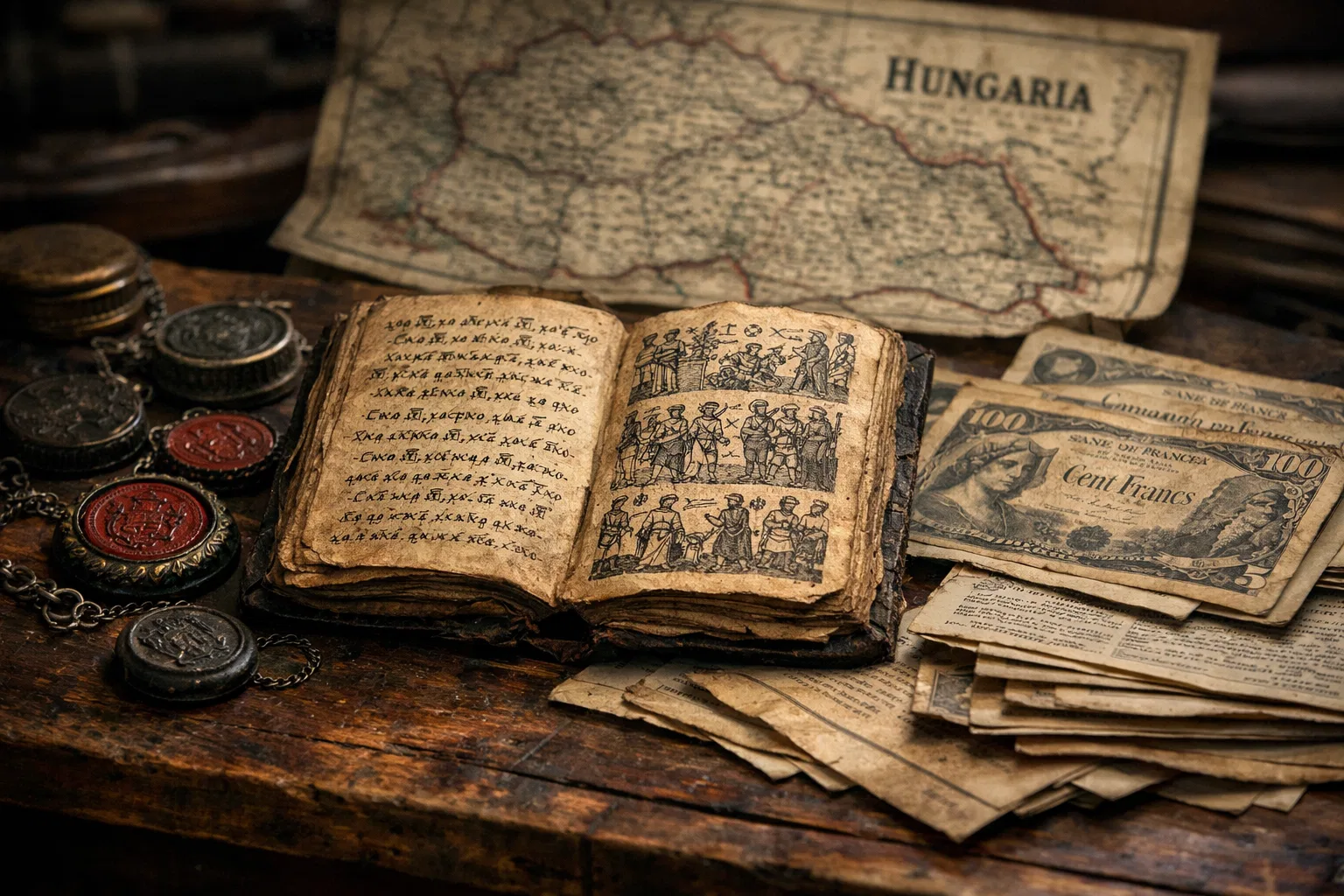
Hungary’s most revealing hoax stories are not a parade of amusing tricks. They range from forged medieval relics and counterfeit banknotes to a murderous antisemitic accusation, an allegedly lethal song and disputed bones said to belong to a national poet. What links them is the way uncertainty becomes useful.
Page outline Jump by section
Introduction
Some of these episodes were deliberate frauds. Others were rumours, sincere errors or contested claims enlarged by newspapers and campaigners. That distinction matters. The history of deception in Hungary is less about collective gullibility than about powerful incentives: profit, national prestige, political revenge, fear and the desire to solve emotionally unfinished stories.
Forging the national past
Nineteenth-century Hungary offered unusually favourable conditions for historical forgery. Scholars and collectors were searching for manuscripts, inscriptions and artefacts that could illuminate the country’s medieval history and distinctive cultural origins. Genuine material was scarce, while aristocratic collectors were willing to pay for dramatic discoveries. A convincing relic could therefore deliver money, status and patriotic satisfaction at the same time.
The antiquarian Sámuel Literáti Nemes became the central figure in this market. He travelled widely, bought and sold genuine books and objects, and helped preserve material that might otherwise have disappeared. Yet research into his career also identifies him as the creator or vendor of fabricated documents, inscriptions and supposed medieval antiquities. His success depended partly on mixing false objects with authentic ones and partly on understanding what contemporary scholars hoped to find. The frauds were persuasive because they supplied a missing Hungarian Middle Ages in forms that collectors already expected to see.[Academia]academia.eduAcademia(PDF) "Invented Middle Ages in 19th century Hungary…This article explores the dual role of Sámuel Literáti as both an antiquar…
This was not simply a matter of crude fakery defeating careless buyers. Historical authentication was still developing as a discipline. Specialists had fewer comparative collections, scientific dating methods were unavailable, and provenance — the documented history of an object’s ownership — was often weak. Literáti Nemes operated in the gap between enthusiastic antiquarian collecting and modern professional archaeology. His work illustrates a recurring rule of successful forgery: the fake must satisfy the intellectual desires of its audience, not merely resemble something old.
The unresolved Rohonc Codex
The Rohonc Codex is often drawn into Literáti Nemes’s story, although the connection has never been proved. The small illustrated manuscript entered the Hungarian Academy of Sciences with Count Gusztáv Batthyány’s library in 1838. Its hundreds of pages contain an unknown writing system and religious or military-looking scenes. No proposed translation has won general acceptance, and the Academy has made a digital copy available for continued study.[Wikipedia]WikipediaRohonc CodexRohonc Codex
Historian Károly Szabó suggested in 1866 that Literáti Nemes might have forged the codex. The suspicion was understandable: Nemes was active at the right time and had already produced deceptive antiquities. It nevertheless remains circumstantial. Modern analysis has found recurring patterns and structural regularities in the text, making simple random scribbling less likely. Benedek Láng has argued that it may be a genuine cipher, shorthand system or constructed script rather than meaningless nonsense. Older paper does not settle the question, because a later writer could have used unused historical sheets.[Wikipedia]WikipediaRohonc CodexRohonc Codex
The responsible verdict is therefore not “exposed hoax” but “unresolved artefact with a long history of doubtful decipherments”. Its later life is almost as instructive as its origin. Proposed readers have claimed to find early Hungarian, Romanian, religious, Indian or ancient Near Eastern texts in it, often by changing symbol values or rearranging signs until meaningful phrases appear. The codex shows how an authentic mystery can generate unreliable solutions even when the object itself has not been proved fraudulent.
When rumour became a criminal case
The Tiszaeszlár affair of 1882–83 was far more consequential than an antiquarian deception. After fourteen-year-old Eszter Solymosi disappeared from the village of Tiszaeszlár, local Jews were accused of killing her to obtain Christian blood for a religious ritual. This was a version of the medieval “blood libel”, an antisemitic fabrication repeatedly used in Europe despite Jewish religious law forbidding the consumption of blood. The allegation moved from village rumour into newspapers, parliamentary agitation and a formal murder prosecution.[Wikipedia]WikipediaTiszaeszlár affairTiszaeszlár affair
The accusation gained force from several sources. Eszter’s disappearance was real and emotionally disturbing. The cause of her death was uncertain. Political agitators were already promoting organised antisemitism, while a sensational case offered publicity and a supposed example around which supporters could rally. Most importantly, a Jewish boy, Móric Scharf, was induced to give an elaborate account implicating his father and other members of the community. His story supplied the theatrical detail that rumour required: a hidden killing, ritual specialists and an alleged view through a keyhole.
The prosecution’s case weakened under examination. Scharf’s evidence contained serious contradictions, and an inspection of the supposed crime scene challenged his account of what he could have witnessed. Medical experts also rejected confident claims that a recovered body showed ritual throat-cutting. After a lengthy trial, the defendants were unanimously acquitted on 3 August 1883; the higher court upheld the result. Eszter’s exact fate remained unresolved, but the evidence did not support the ritual-murder story.[Wikipedia]WikipediaTiszaeszlár affairTiszaeszlár affair
Calling the affair simply a “hoax” risks understating its nature. It was a false accusation assembled from prejudice, coercive investigation, political opportunism and sensational publicity. Whether every promoter privately believed it is less important than the fact that people benefited from circulating it. Antisemitic politicians gained attention and organisation; newspapers gained a gripping narrative; investigators transformed uncertainty into apparent certainty.
Acquittal did not erase the allegation. The trial itself gave the fantasy a vast public platform, while later retellings could portray the legal defeat as evidence of suppression rather than innocence. The case has continued to appear in Hungarian political and cultural disputes. Composer Iván Fischer’s opera The Red Heifer, for example, revisited the affair partly in response to modern attempts by extremists to rehabilitate the accusation.[The New Yorker]newyorker.comThe New Yorker Notes of DissentThe New Yorker Notes of Dissent
The counterfeit-franc conspiracy
In the mid-1920s, Hungarian conspirators attempted a fraud on an international scale: the mass production of counterfeit French 1,000-franc notes. Unlike many stories in which patriotic motives were invented after an ordinary crime, this operation appears to have been closely connected to post-war nationalist politics.
Hungary had lost large territories under the 1920 Treaty of Trianon, and France was widely regarded by Hungarian revisionists as a principal architect of the settlement. Prince Lajos Windischgrätz and associates planned to circulate false currency abroad, with proposed aims that included damaging France and raising money for nationalist organisations. The operation drew in military men, officials and figures with access to state facilities. Academic accounts describe roughly 30,000 high-denomination notes being prepared by September 1925.[JSTOR]jstor.orgHungarian Counterfeit Francs: A Case of Post-World War IHungarian Counterfeit Francs: A Case of Post-World War I
The scheme had impressive connections but poor execution. The notes were produced with specialised equipment, reportedly including machinery concealed at the State Cartographic Institute, yet they were not convincing enough to survive ordinary banking scrutiny. Distribution began in the Netherlands in December 1925. Arrests followed almost immediately when counterfeit notes were detected, leading investigators back towards Budapest. Contemporary reporting described printing machines, thousands of forged notes and the involvement or prior knowledge of prominent nationalist and clerical figures.[Time]time.comOpen source on time.com.
The resulting scandal embarrassed Prime Minister István Bethlen’s government. Twenty-four defendants went on trial in Budapest in 1926, but the sentences were widely regarded as lenient, encouraging suspicions that the proceedings had been managed to limit political damage. The available evidence supports the existence of a large nationalist conspiracy, although the precise knowledge and responsibility of senior government figures remain debated.[Wikipedia]WikipediaFranc affairFranc affair
The franc affair reveals how fraud can be rebranded as patriotism. Counterfeiting enriched or empowered its organisers while being presented as revenge against a foreign state. Yet the scheme’s nationalist justification did not make the banknotes any less fraudulent, and its practical effect was to damage Hungary’s international standing rather than France’s currency. The affair also contributed to international efforts to coordinate the suppression of currency counterfeiting, eventually reflected in the 1929 international convention on the subject.[Wikipedia]WikipediaFranc affairFranc affair

Legends enlarged by the media
Not every famous Hungarian falsehood began with a person deliberately fabricating evidence. Some grew through repetition, selective reporting and the appeal of a memorable label.
The “Hungarian suicide song”
Rezső Seress’s melancholy composition Gloomy Sunday, published in the 1930s, became internationally notorious as the “Hungarian suicide song”. Newspapers associated it with a series of deaths, while later accounts claimed that listeners killed themselves after hearing it or that broadcasters around the world prohibited it because of its deadly influence. The label was irresistible: it turned a sad popular song into a supposedly dangerous object.
Contemporary reporting helped establish the legend. A 1936 New Yorker item repeated claims that the song had caused eighteen suicides in Budapest, while also noting Hungary’s already high suicide rate. The BBC did restrict Billie Holiday’s version during the Second World War, but the reason was its effect on wartime morale, not proven evidence that the music compelled listeners to die.[The New Yorker]newyorker.comThe New Yorker Szomoru Vasarnap A short article in The New Yorker fromThe New Yorker Szomoru Vasarnap A short article in The New Yorker from
A later study by sociologist Steven Stack examined the historical claims and found no persuasive basis for treating the song as a direct cause of a suicide epidemic. Individual deaths may have been associated with the song in notes or press reports, but association does not establish that the music caused them. The legend grew by combining genuine tragedy, Hungary’s elevated suicide rate, dramatic lyrics, scattered anecdotes and the publicity value of calling a record lethal.[PubMed]pubmed.ncbi.nlm.nih.govOpen source on nih.gov.
This is best understood as a media legend rather than a planned hoax by Seress. The composer created a sombre song; journalists, promoters and later storytellers created the supernatural reputation. Each repetition made earlier reports look like independent confirmation, even when later articles were merely recycling the same poorly documented cases.
Petőfi’s supposed Siberian remains
The disappearance of poet and revolutionary Sándor Petőfi during the 1849 Battle of Segesvár left Hungary without a securely identified body for one of its greatest national figures. The absence created a lasting opening for stories that he had survived, been captured by Russian troops and transported to Siberia.
In 1989 an expedition financed by businessman Ferenc Morvai excavated a skeleton at Barguzin, in what is now Buryatia, and supporters argued that the remains were Petőfi’s. The claim promised an extraordinary reversal of national history: the revolutionary poet had not fallen on the battlefield but had lived and died in Russian exile.
The identification was not accepted by Hungary’s principal scientific authorities. Conventional anthropological examinations concluded that the skeleton was female, directly undermining the proposed match. Later advocates disputed those findings and promoted further genetic tests, but arguments over samples, methods, access to remains and the interpretation of results prevented the claimed identification from gaining broad scientific acceptance.[real-j.mtak.hu]real-j.mtak.huOpen source on mtak.hu.
The Barguzin controversy is not a straightforward case of proven fraud. Some participants may have sincerely believed that they had found Petőfi. It is instead an example of claim-driven investigation: a desired identity was announced before a stable chain of mutually accepted evidence had been established. The case survives because the poet’s historical ending remains emotionally incomplete. A missing body permits hope, suspicion and patriotic imagination to outlast an adverse scientific assessment.

Why these stories endure
Hungary’s best-known episodes of deception and disputed truth differ greatly, but they share several mechanisms.
They fill gaps. Forged manuscripts supplied a missing medieval past. The Tiszaeszlár accusation supplied an explanation for an unexplained disappearance. The Barguzin skeleton supplied a body for a vanished poet.
They flatter or mobilise an audience. Antiquarian forgeries promised ancient national distinction. Counterfeit francs were framed as revenge for the post-war settlement. Blood libel converted existing prejudice into political action.
They borrow authority. A fake object gains weight when it enters a noble collection or learned institution. A rumour appears factual when repeated in court or in newspapers. An uncertain identification sounds settled when presented through the language of archaeology or DNA.
Exposure rarely ends the story. Acquittals can be recast as cover-ups; failed decipherments inspire new decipherers; weakly supported anecdotes become “cases” through repetition. Once a claim is attached to national memory, merely disproving one piece of evidence may not remove the emotional reason people want the story to be true.
The most useful lesson is therefore not that old audiences were easily fooled. Successful hoaxes and legends attach themselves to real needs: the wish for historical continuity, justice, revenge, certainty or wonder. Hungary’s cases show that sceptical investigation must examine not only whether a document, banknote, accusation or skeleton is genuine, but also why that particular story found people ready to preserve it.
Amazon book picks
Further Reading
No matched book cards were available for When Uncertainty Became Useful in Hungary, so this fallback keeps a direct Amazon reading path visible.
Topical books
Sámuel Literáti Nemes guide
Browse books, explainers and reference titles related to this topic.
Search AmazonRelated search
Sándor Petőfi guide
Browse books, explainers and reference titles related to this topic.
Search AmazonRelated search
Historical Forgery guide
Browse books, explainers and reference titles related to this topic.
Search AmazonAmazon book picks
Further Reading
Books and field guides related to When Uncertainty Became Useful in Hungary. Use these as the next step if you want deeper reading beyond the article.
The Proud Tower
Provides Central European context for political myths, scandals and nationalism.
The Holocaust
Relevant to understanding the consequences of antisemitic myths and propaganda.
The Invention of Tradition
Explores how historical narratives and traditions are constructed.
eBay marketplace picks
Marketplace Samples
Live-tested eBay searches with available results related to this page.
Endnotes
1.
Source: academia.edu
Link:https://www.academia.edu/33548200/_Invented_Middle_Ages_in_19th_century_Hungary_The_forgeries_of_Samuel_Literati_Nemes_in_Patrick_Geary_and_Klaniczay_G%C3%A1bor_eds_Manufacturing_a_Past_for_the_Present_Forgery_and_Authenticity_in_Medievalist_Texts_and_Objects_in_Nineteenth_Century_Europe_Leiden_Brill
Source snippet
Academia(PDF) "Invented Middle Ages in 19th century Hungary...This article explores the dual role of Sámuel Literáti as both an antiquar...
2.
Source: Wikipedia
Title: Rohonc Codex
Link:https://en.wikipedia.org/wiki/Rohonc_Codex
3.
Source: real-ms.mtak.hu
Link:https://real-ms.mtak.hu/80/
Source snippet
Rohonc Codex24 Jan 2017 — REAL-MS, az alkalamzott szoftver: EPrints 3 amit a School of Electronics and Computer Science, University of So...
4.
Source: Wikipedia
Title: Tiszaeszlár affair
Link:https://en.wikipedia.org/wiki/Tiszaeszl%C3%A1r_affair
5.
Source: jstor.org
Title: Hungarian Counterfeit Francs: A Case of Post-World War I
Link:https://www.jstor.org/stable/2495329
6.
Source: time.com
Link:https://time.com/archive/6659127/hungary-counterfeiters/
7.
Source: Wikipedia
Title: Franc affair
Link:https://en.wikipedia.org/wiki/Franc_affair
8.
Source: real-j.mtak.hu
Title: hungarian studies 2021 1
Link:https://real-j.mtak.hu/22633/1/hungarian_studies_2021_1.pdf
9.
Source: Wikipedia
Title: Gloomy Sunday
Link:https://en.wikipedia.org/wiki/Gloomy_Sunday
10.
Source: real-j.mtak.hu
Link:https://real-j.mtak.hu/19854/1/folia_anthropologica_2012_11.pdf
11.
Source: real.mtak.hu
Title: Németh Varga E21TA
Link:https://real.mtak.hu/124495/1/Ne%CC%81meth-Varga_E21TA.pdf
12.
Source: real.mtak.hu
Link:https://real.mtak.hu/view/year/2010.default.html
13.
Source: real.mtak.hu
Title: Zwischen Ostsee und Adria ebook
Link:https://real.mtak.hu/186034/1/Zwischen%20Ostsee%20und%20Adria_ebook.pdf
14.
Source: real-j.mtak.hu
Title: Anthropologiai Kozlemenyek 34
Link:https://real-j.mtak.hu/6543/1/AnthropologiaiKozlemenyek_34.pdf
15.
Source: real.mtak.hu
Link:https://real.mtak.hu/view/year/2010.html
16.
Source: Wikipedia
Title: Sándor Petőfi
Link:https://en.wikipedia.org/wiki/S%C3%A1ndor_Pet%C5%91fi
17.
Source: Wikipedia
Title: Victor Lustig
Link:https://en.wikipedia.org/wiki/Victor_Lustig
18.
Source: Wikipedia
Title: Literáti Nemes Sámuel
Link:https://hu.wikipedia.org/wiki/Liter%C3%A1ti_Nemes_S%C3%A1muel
19.
Source: Wikipedia
Title: Sámuel Literáti Nemes
Link:https://en.wikipedia.org/wiki/S%C3%A1muel_Liter%C3%A1ti_Nemes
20.
Source: academia.edu
Link:https://www.academia.edu/22150595/Ih%C3%A1sz_D%C3%A1niel_%C3%ADr%C3%A1sai_v%C3%B6r%C3%B6storonyi_tev%C3%A9kenys%C3%A9g%C3%A9r%C5%91l_%C3%A9s_emigr%C3%A1ci%C3%B3j%C3%A1nak_korai_%C3%A9veib%C5%91l
21.
Source: academia.edu
Title: [Tiszaeszlar Blood]({{ ‘tiszaeszlar/’ | relative_url }}) Libel
Link:https://www.academia.edu/Documents/in/Tiszaeszlar_Blood_Libel
22.
Source: academia.edu
Link:https://www.academia.edu/10485137/Manufacturing_a_Past_for_the_Present_Forgery_and_Authenticity_in_Medievalist_Texts_and_Objects_in_Nineteenth_Century_Europe
23.
Source: academia.edu
Link:https://www.academia.edu/122233377/Of_Women_Their_Lives_and_Ways_of_Being_Depicted_in_the_Late_Neolithic_of_Hungary
24.
Source: academia.edu
Link:https://www.academia.edu/114787616/National_Poets_Cultural_Saints_Canonization_and_Commemorative_Cults_of_Writers_in_Europe
25.
Source: jstor.org
Link:https://www.jstor.org/stable/45332099
26.
Source: content.time.com
Title: 0,33009,728879 2,00
Link:https://content.time.com/time/subscriber/article/0%2C33009%2C728879-2%2C00.html
27.
Source: time.com
Link:https://time.com/archive/6766777/hungary-madcap-trial/
28.
Source: newyorker.com
Title: The New Yorker Notes of Dissent
Link:https://www.newyorker.com/magazine/2014/06/02/notes-of-dissent
29.
Source: newyorker.com
Title: The New Yorker Szomoru Vasarnap A short article in The New Yorker from
Link:https://www.newyorker.com/magazine/1936/04/04/szomoru-vasarnap
30.
Source: pubmed.ncbi.nlm.nih.gov
Link:https://pubmed.ncbi.nlm.nih.gov/18435326/
31.
Source: worldpolitics.substack.com
Title: rohonc codex
Link:https://worldpolitics.substack.com/p/rohonc-codex
32.
Source: futilitycloset.com
Title: the rohonc codex
Link:https://www.futilitycloset.com/2007/08/04/the-rohonc-codex/
33.
Source: parrottime.com
Title: Rohonc Codex
Link:https://www.parrottime.com/index.php?a=95&i=9
34.
Source: journaloneuropeanhistoryoflaw.eu
Link:https://journaloneuropeanhistoryoflaw.eu/index.php/JEHL/article/view/770
35.
Source: pubmed.ncbi.nlm.nih.gov
Link:https://pubmed.ncbi.nlm.nih.gov/38012926/
Additional References
36.
Source: thetimes.com
Link:https://www.thetimes.com/comment/register/article/from-the-archive-prince-among-forgers-8frsfz5sk
Source snippet
The investigation has reached high-profile individuals, including Bishop Zadravetz, who admitted to having early knowledge of the conspir...
37.
Source: brill.com
Title: Invented Middle Ages in Nineteenth-century Hungary
Link:https://brill.com/previewpdf/book/edcoll/9789004276819/B9789004276819_008.xml?srsltid=AfmBOoreLpUMPK6Jnux6FsMTKcRj9GqtVhvE38fMuJxrghTX8-INt4Yc
Source snippet
The...Sámuel Literáti Nemes (1794–1842), a well known Hungarian antiquarian, was paradoxically at the same time a peculiar, almost a dou...
38.
Source: brill.com
Title: B9789004276819 008.xml
Link:https://brill.com/previewpdf/book/edcoll/9789004276819/B9789004276819_008.xml?srsltid=AfmBOooOiOVLTzWMZTTcSto-qBlLWMZchaqzEakvVjdwrvVLEKWrptXv
Source snippet
Invented Middle Ages in Nineteenth-century Hungary. The...Sámuel Literáti Nemes (1794–1842), a well known Hungarian antiquarian, wa...
39.
Source: researchgate.net
Link:https://www.researchgate.net/publication/368279707_7_Invented_Middle_Ages_in_Nineteenth-century_Hungary_The_Forgeries_of_Samuel_Literati_Nemes
40.
Source: medium.com
Link:https://medium.com/%40firalim/deciphering-the-rohonc-codex-through-old-slavic-mirrors-a-new-exploratory-approach-e570d724fbec
41.
Source: gutenberg.org
Link:https://www.gutenberg.org/files/27479/27479-8.txt
42.
Source: transcript-verlag.de
Link:https://www.transcript-verlag.de/shopMedia/openaccess/pdf/oa9783839437629.pdf
43.
Source: freemanart.ca
Link:https://www.freemanart.ca/greatest_art_forgers_fakers.htm
44.
Source: suicideinfo.ca
Link:https://www.suicideinfo.ca/resource/siecno-20090612/
45.
Source: mws.hypotheses.org
Link:https://mws.hypotheses.org/37349
Topic Tree
Follow this branch
Related pages 192
- Albanian Hoaxes
- Algerian Hoaxes
- Antigua Deceptions
- Argentina Hoaxes
- Armenian Hoaxes
- +187 more in sidebar