Within Polish Hoaxes
Did These Stones Prove an Ancient Slavic Script?
The Mikorzyn stones turned nationalist hopes for an ancient Slavic script into convincing but fabricated physical evidence.
On this page
- What the stones appeared to prove
- Why scholars and patriots found them persuasive
- How comparison exposed the nineteenth century forgery
Page outline Jump by section
Introduction
The Mikorzyn stones are one of Poland’s most revealing archaeological forgeries. When they appeared in the nineteenth century, they seemed to offer extraordinary proof that the ancient Slavs possessed their own written language, religious symbolism and sophisticated civilisation long before Christianisation. For many Polish patriots and scholars living under the political pressures of partitioned Poland, such evidence would have been immensely significant. Yet the stones ultimately became famous for the opposite reason: they demonstrated how easily national hopes, incomplete archaeological methods and persuasive-looking artefacts could combine to create a false past. Today the Mikorzyn stones are remembered not as proof of ancient Slavic literacy but as a cautionary example of how forged antiquities can gain credibility when they appear to confirm a deeply desired historical narrative.[Muzeum Archeologiczne w Krakowie]ma.krakow.plMuzeum Archeologiczne w KrakowieThe Mikorzyn stonesAt the same time, similar falsifications of pseudo Slavonic objects covered with runes…
What the stones appeared to prove
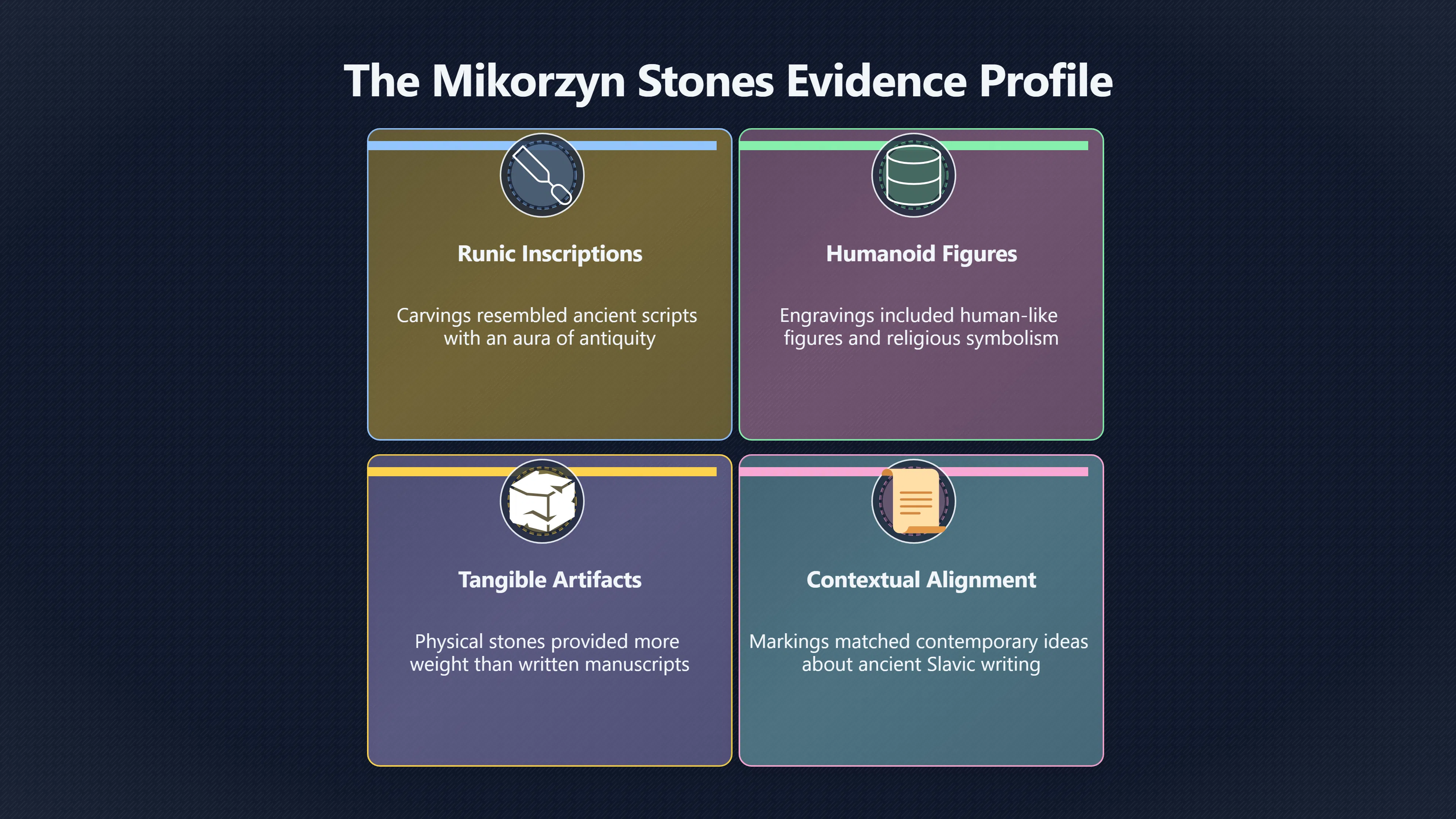
The stones were reportedly discovered near the village of Mikorzyn in Greater Poland and attracted attention because of the unusual carvings cut into their surfaces. The engravings included human-like figures and signs interpreted as runic inscriptions. Supporters claimed that these markings represented evidence of an indigenous Slavic writing system and perhaps even traces of a pre-Christian religious tradition.[Muzeum Archeologiczne w Krakowie]ma.krakow.plMuzeum Archeologiczne w KrakowieThe Mikorzyn stonesAt the same time, similar falsifications of pseudo Slavonic objects covered with runes…
At the time, the idea was enormously attractive. Historians across Central and Eastern Europe were debating whether the Slavs had possessed their own script before the arrival of Christianity and the later spread of the Glagolitic and Cyrillic alphabets. Genuine evidence was scarce, making any apparent discovery especially valuable. The Mikorzyn stones seemed to fill that gap by providing physical objects that could be displayed, examined and reproduced in publications.[Jagiellonian University Repository]ruj.uj.edu.plThe last attempt to revive the dying Slavic runology was…Read more…
The stones also appeared during a broader European fascination with ancient origins. Across the continent, scholars and enthusiasts searched for relics that could demonstrate the antiquity and uniqueness of particular nations. In that environment, an artefact claiming to reveal forgotten Slavic runes was bound to attract attention.[ResearchGate]researchgate.netResearchGate(PDF) Slavic Antiquities and Forgeries as Means for the…June 1, 2019 — 2 Jun 2026 — The study deals with the role of Slavi…
Why scholars and patriots found them persuasive
The appeal of the Mikorzyn stones cannot be understood without considering Poland’s political circumstances. During much of the nineteenth century, Poland existed only as a cultural and historical idea after being partitioned among neighbouring powers. Questions about national identity, language and historical continuity carried unusual emotional and political weight.[muzea.malopolska.pl]muzea.malopolska.plobjects listforgery going back 150 years; the creator of the engravings was induced to forge them by the depressing realities of the time when Poland…
If the stones were genuine, they would suggest that the Slavs possessed a written culture independent of Germanic and Christian influences. Such a conclusion would strengthen arguments that Slavic civilisation had deep and distinguished roots of its own. This was precisely the sort of evidence many national revival movements across Europe hoped to discover.[Jagiellonian University Repository]ruj.uj.edu.plThe last attempt to revive the dying Slavic runology was…Read more…
Several factors made the stones seem credible:
- They were tangible objects rather than mere stories or manuscripts.
- The inscriptions resembled runic writing, which already carried an aura of antiquity.
- Similar claims about ancient Slavic symbols and inscriptions were circulating elsewhere in Europe.
- Archaeology was still developing as a scientific discipline, and rigorous methods for identifying forgeries were less established than they are today.[krakow.pl]ma.krakow.plMuzeum Archeologiczne w KrakowieThe Mikorzyn stonesAt the same time, similar falsifications of pseudo Slavonic objects covered with runes…
Not everyone accepted the stones immediately, but the debate persisted because the objects appeared to answer a question many people genuinely wanted resolved. Some nineteenth-century scholars remained willing to consider the possibility that the inscriptions reflected a real Slavic script.[Jagiellonian University Repository]ruj.uj.edu.plThe last attempt to revive the dying Slavic runology was…Read more…
How comparison exposed the nineteenth-century forgery
The downfall of the Mikorzyn stones did not come from a dramatic confession or a single decisive discovery. Instead, the case gradually collapsed through comparison and scholarly criticism. Researchers began examining the inscriptions alongside other alleged examples of “Slavic runes” and noticed troubling patterns.[Muzeum Archeologiczne w Krakowie]ma.krakow.plMuzeum Archeologiczne w KrakowieThe Mikorzyn stonesAt the same time, similar falsifications of pseudo Slavonic objects covered with runes…
The symbols failed to demonstrate the consistency expected of a genuine writing system. Linguists and historians could not show that the signs formed a coherent alphabet or represented a plausible language. Rather than revealing an unknown script, the carvings appeared to borrow elements from various contemporary ideas about what ancient Slavic writing ought to look like.[Jagiellonian University Repository]ruj.uj.edu.plThe last attempt to revive the dying Slavic runology was…Read more…
Another problem was contextual. No convincing body of supporting evidence emerged. Archaeologists did not discover a wider network of comparable inscriptions that would confirm the existence of the proposed script. As knowledge of genuine runic traditions improved, scholars recognised that the Mikorzyn markings fit neither known Germanic runes nor a credible alternative Slavic system.[PAS Journals]journals.pan.plPAS Journalsrunic inscriptions in poland: do we need an inventory?Lelewel and Wacław Maciejowski believed that ancient Slaves used runes…
Over time, specialists increasingly concluded that the engravings were modern creations added to older stones. The Archaeological Museum in Kraków, which preserves the artefacts, now presents them as nineteenth-century falsifications created during an era when forged “Slavic” antiquities were appearing in several places and when enthusiasm for a glorious ancient past sometimes outran the available evidence.[Muzeum Archeologiczne w Krakowie]ma.krakow.plMuzeum Archeologiczne w KrakowieThe Mikorzyn stonesAt the same time, similar falsifications of pseudo Slavonic objects covered with runes…
What the stones reveal about forged national histories
The Mikorzyn stones are valuable today precisely because they failed. They show how historical forgeries often succeed not by inventing completely implausible stories but by attaching themselves to real scholarly uncertainties. The question of pre-Christian Slavic literacy was legitimate. What proved false was the claim that these particular stones supplied the answer.[Wikipedia]WikipediaPre-Christian Slavic writingPre-Christian Slavic writing is a hypothesized writing system that may have been used by the Slavs prior to C…
The episode also illustrates a wider pattern found across nineteenth-century Europe. National revival movements frequently sought ancient texts, monuments and artefacts that could demonstrate the depth of a people’s history. In some cases genuine discoveries emerged; in others, forged objects appeared to satisfy cultural desires more quickly than authentic evidence could.[ResearchGate]researchgate.netResearchGate(PDF) Slavic Antiquities and Forgeries as Means for the…June 1, 2019 — 2 Jun 2026 — The study deals with the role of Slavi…
Unlike some famous hoaxes that relied on newspapers, photographs or fabricated documents, the Mikorzyn stones exploited the authority of material evidence. A carved stone feels permanent and objective. That physical presence helped the forgery survive scrutiny longer than a simple written claim might have done.[Muzeum Archeologiczne w Krakowie]ma.krakow.plMuzeum Archeologiczne w KrakowieThe Mikorzyn stonesAt the same time, similar falsifications of pseudo Slavonic objects covered with runes…
The wider consequences of Mikorzyn Stones
Modern archaeology has largely settled the question of the Mikorzyn stones’ authenticity, yet the case remains relevant because debates about ancient origins never entirely disappear. Claims about forgotten civilisations, lost scripts and suppressed histories continue to attract attention, particularly when they reinforce cultural pride or identity.[Muzeum Archeologiczne w Krakowie]ma.krakow.plMuzeum Archeologiczne w KrakowieThe Mikorzyn stonesAt the same time, similar falsifications of pseudo Slavonic objects covered with runes…
The Mikorzyn stones therefore occupy an unusual place in Polish history. They are not important because they preserve evidence of an ancient Slavic alphabet. They are important because they preserve evidence of a nineteenth-century desire to find one. As museum objects, they document the history of archaeology, nationalism and historical imagination more effectively than they ever documented the distant past they purported to reveal.[Muzeum Archeologiczne w Krakowie]ma.krakow.plMuzeum Archeologiczne w KrakowieThe Mikorzyn stonesAt the same time, similar falsifications of pseudo Slavonic objects covered with runes…
Amazon book picks
Further Reading
Books and field guides related to Did These Stones Prove an Ancient Slavic Script?. Use these as the next step if you want deeper reading beyond the article.
Frauds, Myths, and Mysteries: Science and Pseudoscience in Ar...
Directly examines archaeological hoaxes and pseudoarchaeology.
The Demon-Haunted World
Rating: 4.5/5 from 43 Google Books ratings
Shows how attractive claims can outpace evidence.
Why People Believe Weird Things
Addresses belief in claims that confirm prior expectations.

Forbidden Archeology
Illustrates debates over extraordinary claims about the ancient past.
eBay marketplace picks
Marketplace Samples
Live-tested eBay searches with available results related to this page.
Endnotes
1.
Source: muzea.malopolska.pl
Title: objects list
Link:https://muzea.malopolska.pl/en/objects-list/1524
Source snippet
forgery going back 150 years; the creator of the engravings was induced to forge them by the depressing realities of the time when Poland...
2.
Source: Wikipedia
Link:https://en.wikipedia.org/wiki/Pre-Christian_Slavic_writing
Source snippet
Pre-Christian Slavic writingPre-Christian Slavic writing is a hypothesized writing system that may have been used by the Slavs prior to C...
3.
Source: researchgate.net
Link:https://www.researchgate.net/publication/339707613_Slavic_Antiquities_and_Forgeries_as_Means_for_the_Shaping_of_Canons
Source snippet
ResearchGate(PDF) Slavic Antiquities and Forgeries as Means for the...June 1, 2019 — 2 Jun 2026 — The study deals with the role of Slavi...
Published: June 1, 2019
4.
Source: son.uni.lodz.pl
Title: From the history of Polish archaeology
Link:https://son.uni.lodz.pl/info/article/UL83514d7ff5ff435591ec4ead1777e762/
Source snippet
Counterfeit relics...by A Szczerba · 2015 · Cited by 1 — Publication – From the history of Polish archaeology. Counterfeit relics of Sla...
5.
Source: Wikipedia
Title: Przybysław Dyjamentowski
Link:https://en.wikipedia.org/wiki/Przybys%C5%82aw_Dyjamentowski
6.
Source: Wikipedia
Title: Kensington Runestone
Link:https://en.wikipedia.org/wiki/Kensington_Runestone
7.
Source: ma.krakow.pl
Link:https://ma.krakow.pl/en/tour/the-mikorzyn-stones/
Source snippet
Muzeum Archeologiczne w KrakowieThe Mikorzyn stonesAt the same time, similar falsifications of pseudo Slavonic objects covered with runes...
8.
Source: ruj.uj.edu.pl
Link:https://ruj.uj.edu.pl/server/api/core/bitstreams/d558b5b6-1afd-412a-b4ce-10c041b808c1/content
Source snippet
The last attempt to revive the dying Slavic runology was...Read more...
9.
Source: journals.pan.pl
Link:https://journals.pan.pl/Content/96396/mainfile.pdf?handler=pdf
Source snippet
PAS Journalsrunic inscriptions in poland: do we need an inventory?Lelewel and Wacław Maciejowski believed that ancient Slaves used runes...
10.
Source: underwaterexpedition.uw.edu.pl
Title: uw.edu.pl Archaeology Just Add Water vol. II
Link:https://underwaterexpedition.uw.edu.pl/wp-content/uploads/sites/113/2020/04/Archaeology-Just-Add-Water-vol.-II.pdf
Additional References
11.
Source: youtube.com
Title: Konferencja popularnonaukowa “Wielka Lechia
Link:https://www.youtube.com/watch?v=HAI3GJLIEFs
Source snippet
Wideooprowadzanie po wystawie "Wielka Lechia - wielka ściema" cz. I...
12.
Source: youtube.com
Title: Wielka Lechia to bzdura. Kto cię oszukuje? | Natalia Kościńska
Link:https://www.youtube.com/watch?v=XB49WPtWQwQ
Source snippet
Imperium Wielkiej Lechii. Jak Polacy podbili kosmos, Indie i resztę świata...
13.
Source: youtube.com
Title: Wideooprowadzanie po wystawie “Wielka Lechia
Link:https://www.youtube.com/watch?v=CNEiXIM_G6Y
Source snippet
Wielka Lechia to bzdura. Kto cię oszukuje? | Natalia Kościńska...
14.
Source: youtube.com
Title: Imperium Wielkiej Lechii. Jak Polacy podbili kosmos, Indie i resztę świata
Link:https://www.youtube.com/watch?v=ukhrTaFY7KE
Source snippet
Great Lechia - the empire that never was...
15.
Source: academia.edu
Link:https://www.academia.edu/37078190/Archaeological_artifacts_from_the_Exhibition_of_antiquities_and_art_objects_organised_by_the_Imperial_Royal_Scientific_Society_in_Krak%C3%B3w_18581859_and_201_catalogue_notes_pp_41_119_in_Od_kolekcjonerstwa_do_muzealnictwa_160_lecie_pierwszej_wystawy_J_G%C3%B3rski_ed
16.
Source: x.com
Link:https://x.com/StefCvetkovic/status/1661382457252278272?lang=ar
17.
Source: academia.edu
Link:https://www.academia.edu/44902748/Dynastic_emblems_of_the_Rurikids_in_East_Central_and_Eastern_Europe_history_of_research_in_The_Sphinx_of_Slavic_sigillography_small_lead_seals_of_Drohiczyn_type_from_Czermno_in_their_East_European_context_Krak%C3%B3w_2019P_443_478_579_601_647_677_in_collaboration_with_S_Beletsky
18.
Source: academia.edu
Link:https://www.academia.edu/88329751/Forgery_of_Deities_or_Forgery_of_Science_On_the_Latest_Attempt_to_Discard_Slavic_Pagan_Religion
19.
Source: instagram.com
Link:https://www.instagram.com/p/DQKzdvEiLXs/
20.
Source: gelmir.com
Link:https://gelmir.com/compendium_item/the-eastern-route-stones/
Topic Tree