Within Lithuanian Hoaxes
Is the Surviving Seal of King Mindaugas Genuine?
The only supposed contemporary image of King Mindaugas remains disputed because its wax, fastening, lettering and heraldic design raise serious doubts.
On this page
- Why the seal matters to Lithuanian history
- Physical and heraldic evidence against authenticity
- Why scholars still disagree
Page outline Jump by section
Introduction
The surviving seal attributed to King Mindaugas occupies a unique place in Lithuanian history. Attached to a document dated October 1255, it is often described as the only contemporary image of Lithuania’s first and only crowned medieval king. Yet the same object is also one of the country’s most disputed medieval artefacts. Historians, heraldry specialists and document experts have spent more than a century debating whether the seal and the charter to which it is attached are genuine, altered or outright forged. The controversy matters because the seal is not merely a decorative relic: if authentic, it offers a rare direct glimpse of royal Lithuania in the thirteenth century. If forged, it would represent one of the most significant medieval documentary deceptions connected to Lithuanian history.[Wikipedia]WikipediaSeal of MindaugasSeal of Mindaugas

Why the seal matters to Lithuanian history
The seal is attached to a charter supposedly issued by Mindaugas in 1255 granting territory in Selonia to the Teutonic Order. The wider group of land grants associated with Mindaugas has long attracted suspicion because some appear unusually favourable to the military orders and may not accurately reflect political realities in Lithuania at the time.[Wikipedia]WikipediaSeal of MindaugasSeal of Mindaugas
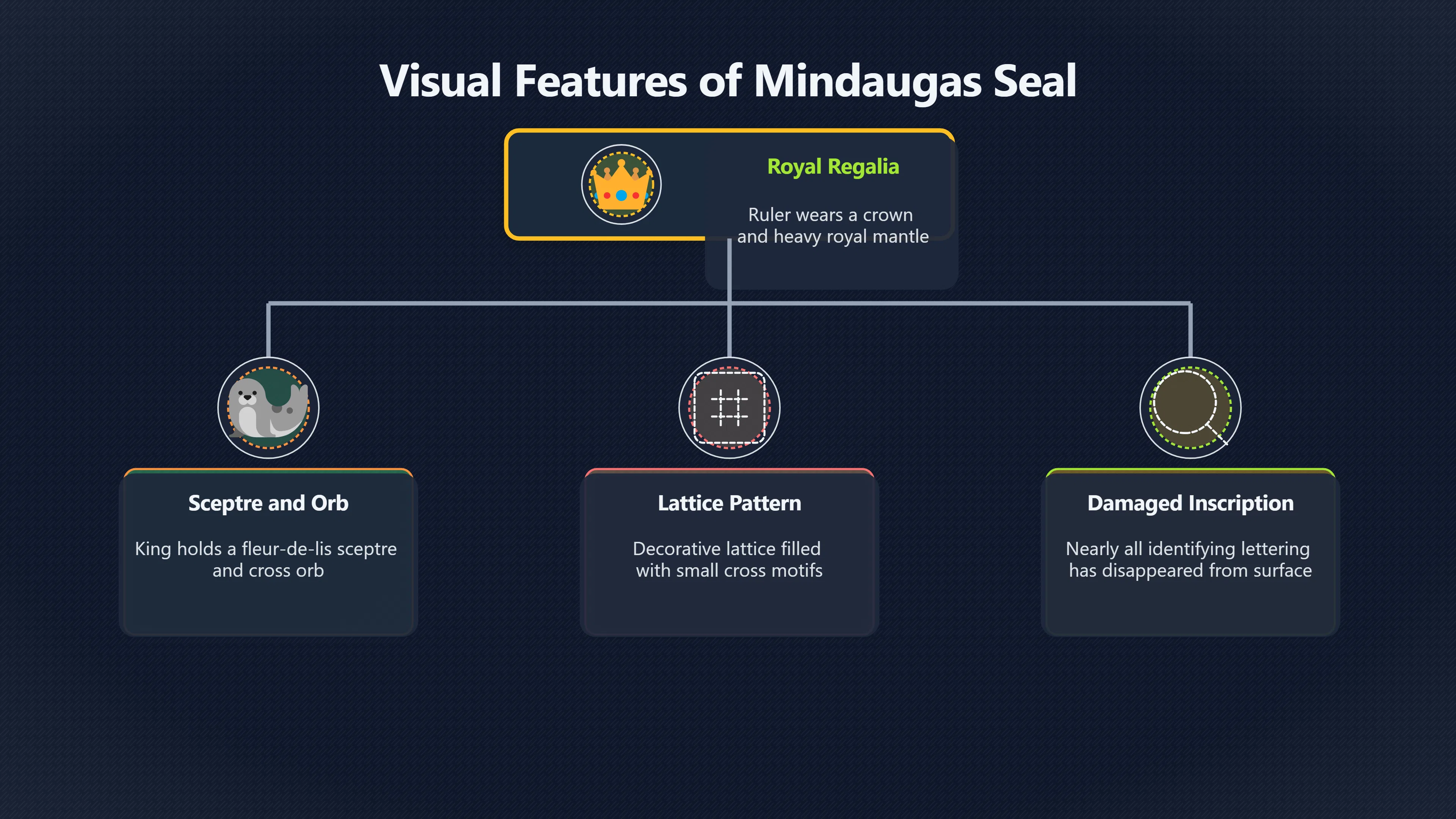
What makes this particular document exceptional is the seal itself. It depicts a crowned ruler seated on a throne-like bench, holding a sceptre and an orb, traditional symbols of medieval kingship. If genuine, it is the only surviving contemporary portrait of Mindaugas. The seal therefore serves not only as evidence for a land transaction but also as an important symbol of Lithuania’s brief medieval kingdom.[Wikipedia]WikipediaSeal of MindaugasSeal of Mindaugas
The document gained additional credibility because it was referred to in a papal bull issued by Pope Alexander IV in 1257. Supporters of authenticity have long argued that this reference makes wholesale invention less likely, since the grant was known within papal administration only a few years after the charter’s supposed creation.[Wikipedia]WikipediaSeal of MindaugasSeal of Mindaugas
What the seal actually shows
Although damaged, the seal remains large enough to reveal substantial details. The ruler wears a crown and royal mantle, carries a sceptre topped with a fleur-de-lis-like ornament and holds an orb surmounted by a cross. Around the figure is a decorative lattice pattern filled with small crosses.[Wikipedia]WikipediaSeal of MindaugasSeal of Mindaugas
The inscription that should identify the ruler is the most problematic part. Nearly all of the lettering has disappeared. According to a description made in 1393, the legend originally read “Mindaugas, by the grace of God, King of Lithuania”. Today only fragments survive, making independent verification impossible.[Wikipedia]WikipediaSeal of MindaugasSeal of Mindaugas
That loss of evidence lies at the centre of the debate. The inscription is precisely the element that would most clearly prove the seal’s identity, yet it is also the portion that has suffered the greatest damage. Critics have repeatedly questioned whether this is coincidence.[Wikipedia]WikipediaSeal of MindaugasSeal of Mindaugas
Physical and heraldic evidence against authenticity
The strongest arguments against authenticity come from the seal’s physical characteristics and artistic style rather than from the document’s wording.
Several historians noticed unusual features in the way the seal is attached to the parchment. One influential theory proposed that the charter itself may have been produced later while an authentic seal from another document was reused and attached to it. Supporters of this idea pointed to differences in the wax and fastening materials, suggesting that the seal may have been reattached at some point in its history.[Wikipedia]WikipediaSeal of MindaugasSeal of Mindaugas
Other critics went further. The nineteenth-century historian Wojciech Kętrzyński argued that the near-total destruction of the identifying inscription looked suspicious because the rest of the seal and document survived comparatively well. He suggested that the legend might have been deliberately damaged. In his reconstruction, the seal could even have originated from an entirely different ruler and later been adapted to support the disputed charter.[Wikipedia]WikipediaSeal of MindaugasSeal of Mindaugas
The most influential modern criticism came from Lithuanian heraldry expert Edmundas Rimša. Examining the seal’s artistic features, he focused on the Gothic lattice decoration surrounding the king. According to Rimša, this style is characteristic of royal seals from the fourteenth century rather than the mid-thirteenth century. If that assessment is correct, the seal’s design would post-date Mindaugas by several decades, making a contemporary origin highly unlikely. Rimša concluded that the seal was probably created at least fifty years after the date written on the charter.[Wikipedia]WikipediaSeal of MindaugasSeal of Mindaugas
This argument is particularly important because stylistic analysis cannot easily be explained away by later repairs. A reattached seal might still be genuine, but a design that belongs to a later artistic tradition would point towards manufacture in a different period altogether.[Wikipedia]WikipediaSeal of MindaugasSeal of Mindaugas
Could the forgery have come from the Teutonic Order?
The forgery debate is closely tied to wider disputes over land grants allegedly issued by Mindaugas. Historians have long suspected that some charters benefiting the Teutonic Order or related institutions may have been altered, expanded or fabricated to strengthen territorial claims.[Wikipedia]WikipediaOpen source on wikipedia.org.
One theory places the creation of the disputed document in the late fourteenth century, during conflicts over Samogitia and neighbouring territories. In this scenario, a charter granting land to the Order would have been politically useful. Medieval institutions frequently relied on documentary proof to defend rights and possessions, creating incentives to preserve, modify or occasionally manufacture records that supported their claims.[Wikipedia]WikipediaSeal of MindaugasSeal of Mindaugas
Importantly, few scholars argue that a medieval forger simply invented everything from nothing. The more sophisticated versions of the theory suggest a mixture of genuine and altered elements: perhaps an authentic royal seal attached to a later charter, or a real transaction documented in a form that was subsequently modified to strengthen legal arguments.[Wikipedia]WikipediaSeal of MindaugasSeal of Mindaugas
This makes the case less like a simple counterfeit and more like many medieval documentary controversies, where genuine materials, later repairs, political interests and incomplete evidence become difficult to untangle centuries afterwards.
Why scholars still disagree
Despite the criticisms, the seal has never been conclusively exposed as a forgery.
One reason is that evidence exists on both sides. The 1393 description of the seal corresponds closely to the object that survives today, suggesting continuity over many centuries. The charter’s contents were also known in papal circles relatively soon after the supposed grant, which complicates claims of a completely fabricated document.[Wikipedia]WikipediaSeal of MindaugasSeal of Mindaugas
Another reason is the condition of the artefact itself. Medieval seals frequently suffered damage, repairs and reattachment over long periods of storage and use. Differences in wax, cords or mounting techniques can indicate tampering, but they can also result from legitimate conservation or repair work carried out centuries ago.[Wikipedia]WikipediaSeal of MindaugasSeal of Mindaugas
The debate therefore hinges on interpretation. Critics view the heraldic style, damaged inscription and attachment anomalies as cumulative evidence of fabrication. Defenders argue that none of these points alone proves forgery and that contemporary references support at least some level of authenticity.[Wikipedia]WikipediaSeal of MindaugasSeal of Mindaugas
The result is an unusual historical limbo. The seal remains one of the most treasured artefacts associated with Mindaugas, yet many specialists continue to treat it cautiously. It is simultaneously a national relic and a case study in how medieval documents can become entangled in centuries of legal disputes, political interests and scholarly re-evaluation.[Wikipedia]WikipediaSeal of MindaugasSeal of Mindaugas
What the controversy reveals
The Mindaugas seal debate is not simply a question of whether one object is real or fake. It highlights the difficulties historians face when dealing with scarce evidence from the medieval Baltic world. Because so few contemporary Lithuanian royal artefacts survive, a single seal carries enormous historical weight. That importance increases both the temptation to use such objects for political purposes and the scrutiny applied to them by later researchers.[Wikipedia]WikipediaSeal of MindaugasSeal of Mindaugas
For Lithuania’s history of contested documents and possible forgeries, the seal stands as a particularly revealing example. The argument has lasted for generations because the evidence does not point cleanly in one direction. Instead, it sits on the boundary between authentic relic, altered document and possible medieval forgery—precisely the kind of grey area where some of the most enduring historical controversies survive.[Wikipedia]WikipediaSeal of MindaugasSeal of Mindaugas
Amazon book picks
Further Reading
Books and field guides related to Is the Surviving Seal of King Mindaugas Genuine?. Use these as the next step if you want deeper reading beyond the article.
The History of Lithuania
Explains the historical significance of Mindaugas and his reign.
The Demon-Haunted World
Rating: 4.5/5 from 43 Google Books ratings
Encourages careful evaluation of disputed evidence.
The Landmark Julius Caesar
Useful for readers interested in documentary evidence and historical authenticity.
eBay marketplace picks
Marketplace Samples
Live-tested eBay searches with available results related to this page.


Endnotes
1.
Source: Wikipedia
Title: Seal of Mindaugas
Link:https://en.wikipedia.org/wiki/Seal_of_Mindaugas
2.
Source: Wikipedia
Link:https://en.wikipedia.org/wiki/Mindaugas
3.
Source: Wikipedia
Title: Siegel von Mindaugas
Link:https://de.wikipedia.org/wiki/Siegel_von_Mindaugas
4.
Source: Wikipedia
Title: Datei:Seal of Mindaugas.jpg
Link:https://de.wikipedia.org/wiki/Datei%3ASeal_of_Mindaugas.jpg
Source snippet
Datei:Seal of Mindaugas.jpgEnglish: Seal of the Lithuanian King Mindaugas. The seal affixed to a 1255 treaty is possibly a forgery. Li...
5.
Source: picryl.com
Link:https://picryl.com/topics/seals%2Bof%2Bmindaugas/lithuania
6.
Source: proceedings.caa-international.org
Link:https://proceedings.caa-international.org/index.php/caa/article/view/1025
7.
Source: waxsealcollection.com
Link:https://www.waxsealcollection.com/heraldry
Additional References
8.
Source: iwt-bremen.de
Link:https://www.iwt-bremen.de/en/media/news/detail/mittelalterliches-wachssiegel-trifft-3d-druck
Source snippet
Medieval wax seal meets 3D printingThe Department of Lightweight Materials uses state-of-the-art analysis technology to make the finest l...
9.
Source: ldkistorija.lt
Link:https://www.ldkistorija.lt/the-last-medieval-kingdom-the-coronation-of-mindaugas/
Source snippet
Orbis Lituaniae -The last medieval kingdom: the coronation of MindaugasThe Lithuanian kingdom was in existence for 10 years only: from th...
10.
Source: reddit.com
Link:https://www.reddit.com/r/AskHistorians/comments/6rymol/were_wax_seals_known_to_have_been_copied_during/
Source snippet
Were wax seals known to have been copied during history...In short, yes, seals could be forged and often were, but whether a recip...
11.
Source: ratinger-restauratoren.de
Title: Ratingen Restoration Siegel Kaiser Friedrich I
Link:https://www.ratinger-restauratoren.de/paper-book/was-seal-siegel-kaiser-friedrich-i-barbarossa-urkunde-von-1153/
Source snippet
Barbarossa, Urkunde von 1153This seal had been mended earlier with new wax. It was cracked into several pieces while being on display. Th...
12.
Source: commons.wikimedia.org
Title: File:Seal of Mindaugas.jpg
Link:https://commons.wikimedia.org/wiki/File%3ASeal_of_Mindaugas.jpg
Source snippet
The seal affixed to a 1255 treaty is possibly a forgery. Lietuvių: Lietuvos karaliaus Mindaugo...Read more...
13.
Source: youtube.com
Title: Moscow’s Main Enemy, Whom They Forgot! (The History of Great Lithuania)
Link:https://www.youtube.com/watch?v=wRJbOjNNPRg
Source snippet
The History of Lithuania - Prehistory to Modernity...
14.
Source: youtube.com
Title: Mindaugas, the only king of Lithuania
Link:https://www.youtube.com/watch?v=IUCAhJ4iBt0
Source snippet
How Poland and Lithuania Defeated the Teutonic Order | Grunwald Explained...
15.
Source: researchgate.net
Link:https://www.researchgate.net/publication/228931893_Digging_the_Neolithic_stamp-seals_of_SE_Europe_from_archaeological_deposits_texts_and_mental_constructs
16.
Source: turkiyetoday.com
Link:https://www.turkiyetoday.com/culture/7500-year-old-stone-seal-discovered-in-eastern-turkiye-reshapes-elazigs-ancient-past-3212231
17.
Source: uni-giessen.de
Link:https://www.uni-giessen.de/en/faculties/f04/institute-en/art-history/research/thirdpartyfundingprojects/corporativeseals/corporativeseals
Topic Tree