Within Liechtenstein Deceptions
How a Bank Fraud Brought Down Liechtenstein's Government
A scheme promoted as national development diverted public bank funds into speculative ventures and triggered a political crisis.
On this page
- The lottery scheme sold as economic progress
- Embezzlement, political ties and failed oversight
- Arrests, convictions and government collapse
Page outline Jump by section
Introduction
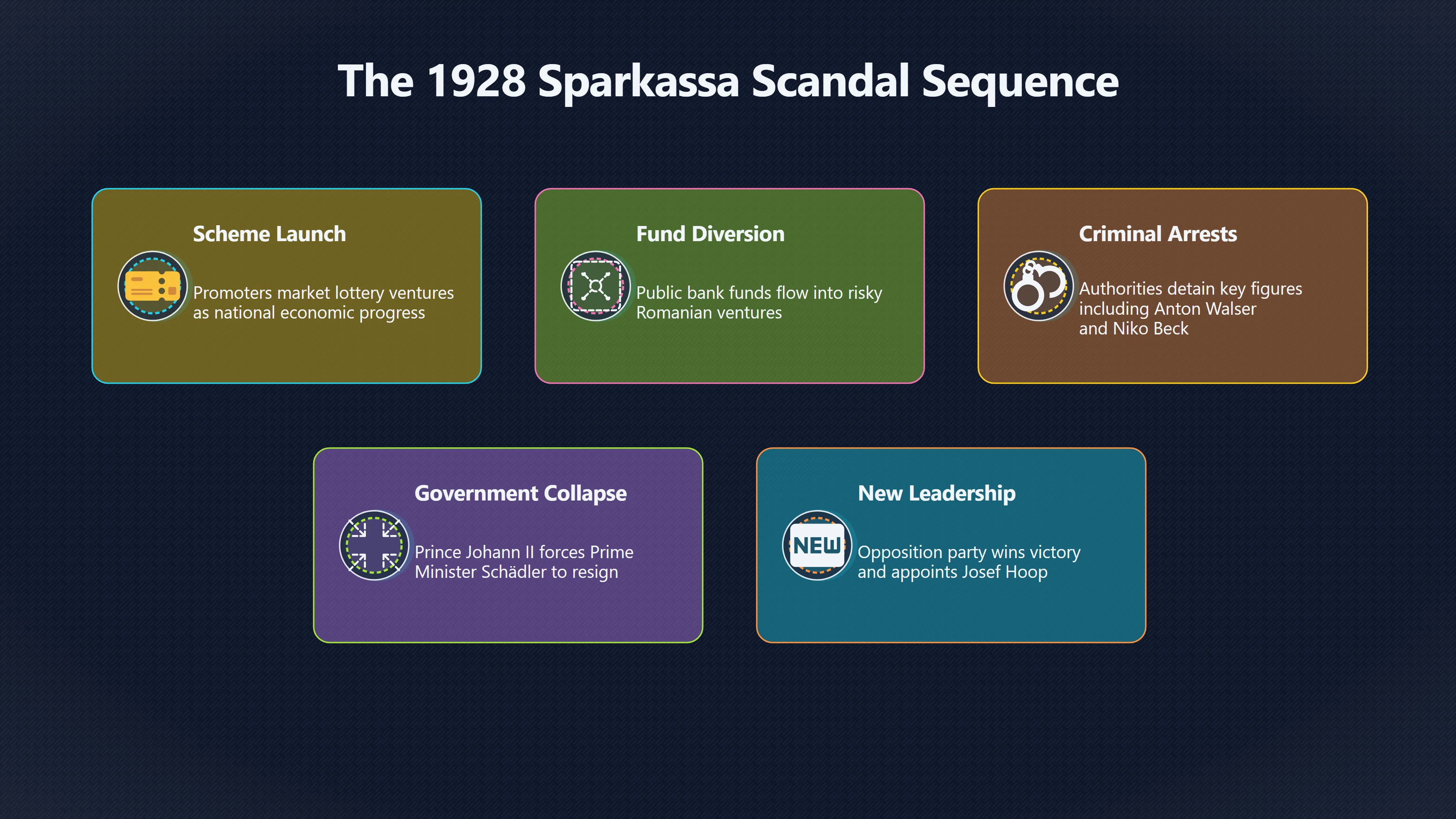
In 1928, Liechtenstein experienced the most damaging financial fraud in its modern history. What began as a scheme marketed as economic development and job creation ended with criminal convictions, a banking crisis, the collapse of a government, and a constitutional confrontation involving the ruling prince. The affair, known as the Sparkassa or savings-bank scandal, was not a spectacular swindle aimed at ordinary citizens. Instead, it was a case in which politically connected figures diverted funds from the state-backed savings bank into speculative ventures, particularly an ambitious lottery business linked to Romania. When the losses emerged, the scandal exposed weak oversight, conflicts of interest and the dangers of presenting risky speculation as a patriotic development project.[Wikipedia]Wikipedia1928 Liechtenstein embezzlement scandal1928 Liechtenstein embezzlement scandal
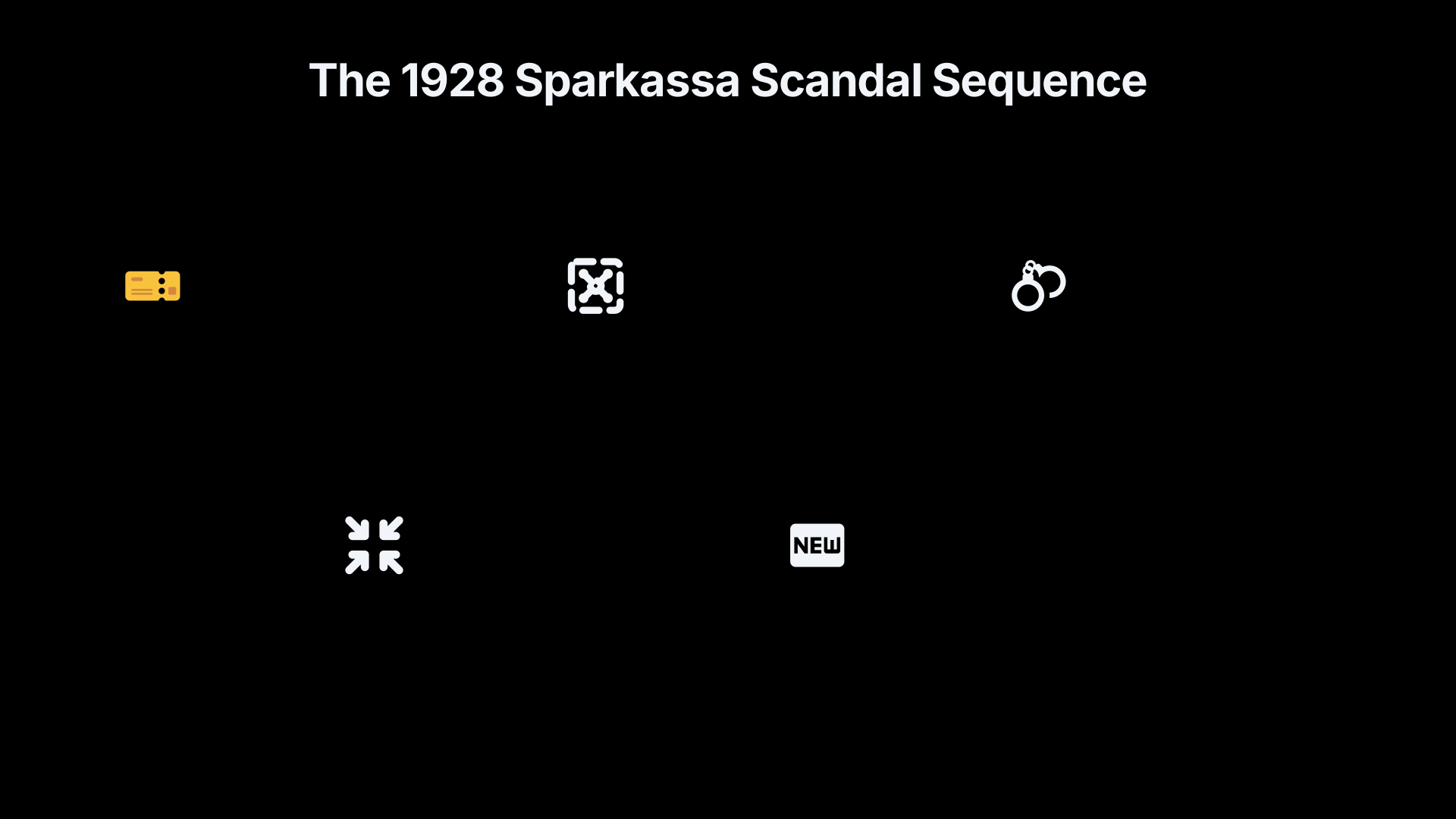
For a country as small as Liechtenstein, the consequences were enormous. The financial losses reached levels comparable to multiple annual state budgets, senior political figures were implicated, and the government of Gustav Schädler was forced from office. More than a banking scandal, the episode became a defining lesson about governance, accountability and public trust.[historisches-lexikon.li]historisches-lexikon.liSparkassaskandalEine Woche lang verpfändeten die Gemeinden ihren Boden, dann übernahm Fürst Johann II., der Liechtenstein zudem 1 Mio. Fr…
The Lottery Scheme Sold as Economic Progress
The fraud did not begin with an obviously criminal proposal. Its promoters argued that new commercial ventures could bring revenue, employment and international business to Liechtenstein. Central to these ambitions was the expansion of a class lottery operation, including plans in Romania. Supporters portrayed the enterprise as an opportunity for a small state with limited natural resources to generate income through innovative financial activity.[Wikipedia]Wikipedia1928 Liechtenstein embezzlement scandal1928 Liechtenstein embezzlement scandal
Among the leading figures were Franz Thöny, manager of the state savings bank, together with Anton Walser, Niko Beck and Rudolf Carbone. Walser spent extended periods in Bucharest developing contacts and establishing companies intended to support the lottery venture. The project acquired an aura of legitimacy because it was linked to influential political and financial figures and was discussed in terms of national economic advancement rather than personal enrichment.[Wikipedia]Wikipedia1928 Liechtenstein embezzlement scandal1928 Liechtenstein embezzlement scandal
This was one reason the scheme proved persuasive. The promise was not simply that investors would become rich. The claim was that Liechtenstein itself would benefit through employment, new business activity and increased state revenues. Such arguments made scepticism politically difficult, particularly in a period when small European states were searching for economic stability after the upheavals of the First World War.[Wikipedia]Wikipedia1928 Liechtenstein embezzlement scandal1928 Liechtenstein embezzlement scandal
How Public Bank Funds Were Diverted
Behind the rhetoric of economic development, funds were being channelled out of the National Bank of Liechtenstein and into speculative ventures. Between 1926 and 1928, substantial sums were embezzled and used for risky transactions connected to the lottery scheme and associated businesses. Estimates place the diverted amount at around four million Swiss francs, an enormous figure for Liechtenstein at the time.[Wikipedia]Wikipedia1928 Liechtenstein embezzlement scandal1928 Liechtenstein embezzlement scandal
The fraud succeeded partly because of the close relationship between politics and financial administration. Earlier restructuring of the bank had placed many politically aligned individuals in influential positions. Oversight mechanisms that should have questioned unusual transactions either failed to act or proved ineffective. As a result, speculative activities continued for years before the scale of the losses became impossible to conceal.[Wikipedia]Wikipedia1928 Liechtenstein embezzlement scandal1928 Liechtenstein embezzlement scandal
The affair illustrates a common pattern in financial scandals. The fraudsters did not rely on secretive offshore schemes or elaborate forged documents. Instead, they exploited public confidence in respected institutions. The appearance of official approval reduced scrutiny, while political connections weakened the normal safeguards intended to protect public funds.[Wikipedia]Wikipedia1928 Liechtenstein embezzlement scandal1928 Liechtenstein embezzlement scandal
Embezzlement, Political Ties and Failed Oversight
A central controversy was not only the embezzlement itself but also the question of responsibility. Critics argued that those charged with supervising the bank had failed in their duties. Particular attention focused on Wilhelm Beck, who served as chairman of the bank’s board while also occupying a prominent political position. Opposition politicians accused the leadership of gross negligence for allowing speculative activities to proceed unchecked.[Wikipedia]Wikipedia1928 Liechtenstein embezzlement scandal1928 Liechtenstein embezzlement scandal
The scandal revealed how difficult it can be for institutions to police themselves when political and financial networks overlap. Supervisory boards existed, yet they did not stop the losses. Political rivalries further complicated matters, as supporters and opponents of the governing Christian-Social People’s Party interpreted events through partisan lenses. What might have remained a financial scandal quickly became a wider crisis of confidence in the state’s governing structures.[Wikipedia]Wikipedia1928 Liechtenstein embezzlement scandal1928 Liechtenstein embezzlement scandal
For many observers, the key lesson was that good intentions and attractive promises were no substitute for independent oversight. The lottery project had been justified as a national opportunity, but the lack of effective controls allowed public money to be used in ways that were neither transparent nor accountable.[Wikipedia]Wikipedia1928 Liechtenstein embezzlement scandal1928 Liechtenstein embezzlement scandal

Arrests, Convictions and Government Collapse
The crisis reached its decisive phase in 1928 when arrests began. Anton Walser, Niko Beck and Franz Thöny were arrested in June 1928, while Rudolf Carbone was arrested the following year. Investigations confirmed the misuse of funds, and criminal proceedings followed. In November 1929, Walser received a four-year prison sentence, while the others were sentenced to three years.[Wikipedia]Wikipedia1928 Liechtenstein embezzlement scandal1928 Liechtenstein embezzlement scandal
Political consequences arrived even faster than the court judgments. The opposition Progressive Citizens’ Party demanded the resignation of Prime Minister Gustav Schädler’s government and the dissolution of parliament. The scandal had become so damaging that Prince Johann II intervened directly. He refused to support the existing government, demanded Schädler’s resignation and threatened to use emergency powers if necessary. Faced with that pressure, Schädler resigned on 15 June 1928. The following day, the Landtag was dissolved and new elections were called.[Wikipedia]Wikipedia1928 Liechtenstein embezzlement scandal1928 Liechtenstein embezzlement scandal
The subsequent election transformed the political landscape. The opposition Progressive Citizens’ Party won a commanding victory and Josef Hoop eventually became prime minister. The scandal therefore did not merely remove individual officials; it reshaped the balance of political power in Liechtenstein for decades.[Wikipedia]Wikipedia1928 Liechtenstein general election1928 Liechtenstein general election
Why the Scandal Became a Constitutional Crisis
The affair also triggered a debate about constitutional authority. Liechtenstein’s constitution clearly empowered the prince to appoint a government, but it was less explicit about dismissing one. Because Johann II effectively compelled Schädler’s resignation, some members of the governing party argued that the move exceeded constitutional limits. The prince, however, justified his actions as necessary to protect the country during an emergency.[Wikipedia]Wikipedia1928 Liechtenstein embezzlement scandal1928 Liechtenstein embezzlement scandal
This disagreement mattered because it transformed a banking fraud into a broader dispute about political legitimacy. Questions that began with missing money evolved into arguments about the relationship between elected institutions and princely authority. The controversy left lasting tensions between the prince and sections of the political establishment.[Wikipedia]Wikipedia1928 Liechtenstein embezzlement scandal1928 Liechtenstein embezzlement scandal
In that sense, the scandal occupies an unusual place in Liechtenstein’s history. Many financial frauds end with prosecutions and reforms. This one also tested the constitutional order and altered the country’s political trajectory.[Wikipedia]Wikipedia1928 Liechtenstein embezzlement scandal1928 Liechtenstein embezzlement scandal
The Cost to a Small State
The financial burden was severe because the savings bank enjoyed state guarantees. Once the losses became clear, Liechtenstein itself had to absorb much of the damage. According to historical accounts, municipalities temporarily pledged land as part of emergency measures, while Prince Johann II personally assumed liability for losses and contributed one million francs. The country also required a substantial Swiss loan to help restructure the bank. The total rescue effort cost roughly the equivalent of two annual state budgets.[historisches-lexikon.li]historisches-lexikon.liSparkassaskandalEine Woche lang verpfändeten die Gemeinden ihren Boden, dann übernahm Fürst Johann II., der Liechtenstein zudem 1 Mio. Fr…
For a larger nation, such losses would have been painful. For Liechtenstein, they threatened financial stability. The episode demonstrated how vulnerable a small state could be when public institutions became entangled with speculative ventures promoted as engines of national progress.[historisches-lexikon.li]historisches-lexikon.liSparkassaskandalEine Woche lang verpfändeten die Gemeinden ihren Boden, dann übernahm Fürst Johann II., der Liechtenstein zudem 1 Mio. Fr…
How Bank Scandal entered public memory
The savings-bank scandal remains one of Liechtenstein’s most important cautionary tales because it was not driven by a fantastical hoax or an obvious confidence trick. The deception was more subtle. Risky private speculation was presented as patriotic economic development, and trusted institutions gave the venture credibility.[Wikipedia]Wikipedia1928 Liechtenstein embezzlement scandal1928 Liechtenstein embezzlement scandal
Its lasting significance lies in the questions it raises about governance. How much scrutiny should accompany projects promoted as being in the national interest? What happens when political influence weakens financial supervision? How can small states balance ambition with accountability? The Sparkassa scandal provided painful answers. By exposing the consequences of unchecked optimism, weak oversight and political favouritism, it brought down a government and became one of the defining financial scandals in Liechtenstein’s history.[Wikipedia]Wikipedia1928 Liechtenstein embezzlement scandal1928 Liechtenstein embezzlement scandal
Amazon book picks
Further Reading
Books and field guides related to How a Bank Fraud Brought Down Liechtenstein's Government. Use these as the next step if you want deeper reading beyond the article.
The Smartest Guys in the Room
Shows how financial schemes and weak oversight can produce systemic crises.
The Big Short
Illustrates the dangers of speculative finance presented as opportunity.
The Ascent of Money
Rating: 4.5/5 from 6 Google Books ratings
Gives readers broader context for banking scandals and financial systems.
eBay marketplace picks
Marketplace Samples
Live-tested eBay searches with available results related to this page.



Endnotes
1.
Source: Wikipedia
Title: 1928 Liechtenstein embezzlement scandal
Link:https://en.wikipedia.org/wiki/1928_Liechtenstein_embezzlement_scandal
2.
Source: historisches-lexikon.li
Link:https://historisches-lexikon.li/Sparkassaskandal
Source snippet
SparkassaskandalEine Woche lang verpfändeten die Gemeinden ihren Boden, dann übernahm Fürst Johann II., der Liechtenstein zudem 1 Mio. Fr...
3.
Source: historisches-lexikon.li
Title: Liechtenstein, Johann II. von
Link:https://historisches-lexikon.li/Liechtenstein%2C_Johann_II._von
Source snippet
1928 den Landtag auf, zwang die Regierung um Gustav Schädler zur Demission und lieh dem Land grössere Gelder zur Sanierung der Sparkassa...
4.
Source: Wikipedia
Title: 1928 Liechtenstein general election
Link:https://en.wikipedia.org/wiki/1928_Liechtenstein_general_election
5.
Source: Wikipedia
Title: First Josef Hoop cabinet
Link:https://en.wikipedia.org/wiki/First_Josef_Hoop_cabinet
Additional References
6.
Source: liechtensteincollections.at
Link:https://www.liechtensteincollections.at/en/collections-online/prince-johann-ii-von-liechtenstein-1840-1929-honorary-member-of-the-austrian-society-for-numismatics-and-medal-studies4
Source snippet
Prince Johann II von Liechtenstein (1840–1929), honorary...Prince Johann II von Liechtenstein (1840–1929), honorary member of the Austri...
7.
Source: military-history.fandom.com
Title: Prince Alfred of Liechtenstein (1875–1930)
Link:https://military-history.fandom.com/wiki/Prince_Alfred_of_Liechtenstein_%281875%E2%80%931930%29
Source snippet
Historisches Lexikon des Fürstentums Liechtenstein (in German). Retrieved 18 May 2023. All or a portion of this article consists of text...
Published: May 2023
8.
Source: vaterland.li
Title: der sparkassa skandal von 1928 praegte die politik art 111561
Link:https://www.vaterland.li/liechtenstein/gesellschaft/vermischtes/der-sparkassa-skandal-von-1928-praegte-die-politik-art-111561
Source snippet
Über die Zeit von 1928 sprach im Rahmen des Senioren-Kollegs der bekannte Liechtensteiner...Read more...
9.
Source: cambridge.org
Link:https://www.cambridge.org/core/books/cambridge-handbook-of-foreign-judges-on-domestic-courts/foreign-judges-in-liechtensteins-courts/5819C770EEB0ECF10AB387A98759D742
Source snippet
Then, 14 days later, Parliament elected the first judges of the...Read more...
10.
Source: youtube.com
Title: Who Actually Banks in Liechtenstein? (The Royal Secret)
Link:https://www.youtube.com/watch?v=3i_3dfuRKfA
Source snippet
The Prince Who Doesn't Need Taxpayers: Liechtenstein's Money System...
11.
Source: de.numista.com
Title: com2 Kronen
Link:https://de.numista.com/11779
Source snippet
numista.com2 Kronen - Johann II - LiechtensteinDetaillierte Informationen über die Münze 2 Kronen, Johann II, Liechtenstein, mit Bildern...
12.
Source: youtube.com
Title: The Mighty Economy of Liechtenstein
Link:https://www.youtube.com/watch?v=ld2wZCC2rVs
Source snippet
Understand how LIECHTENSTEIN came about - The History of Liechtenstein - Episode I...
13.
Source: youtube.com
Title: The Prince Who Doesn’t Need Taxpayers: Liechtenstein’s Money System
Link:https://www.youtube.com/watch?v=kk1sH4IcnkA
Source snippet
How Liechtenstein Became So Rich?...
14.
Source: youtube.com
Title: Understand how LIECHTENSTEIN came about
Link:https://www.youtube.com/watch?v=XaD_cVRsgvM
15.
Source: youtube.com
Title: How Liechtenstein Became So Rich?
Link:https://www.youtube.com/watch?v=I905pus1WWE
Source snippet
The Mighty Economy of Liechtenstein...
Topic Tree