Within Philippine Hoaxes
How a Forged Law Became Official History
A fabricated pre-colonial law gained textbook authority, state honours and monuments before historians dismantled its provenance.
On this page
- What the code claimed
- How official recognition made it credible
- How historians exposed the forgery
Page outline Jump by section
Introduction
The Code of Kalantiaw is one of the most consequential historical forgeries in Philippine history, not because it briefly fooled scholars, but because it became official truth. For decades, Filipinos were taught that a ruler named Kalantiaw had issued a sophisticated legal code in 1433, centuries before Spanish colonisation. The code appeared in textbooks, inspired monuments and ceremonies, and even gave its name to a state honour for distinguished service in law. Only later did historians demonstrate that both the code and its supposed author rested on fabricated evidence.[Wikipedia]WikipediaCode of KalantiawCode of Kalantiaw

The episode is a remarkable case of how an invented tradition can move from dubious manuscript to national institution. It reveals not only the work of a forger, but also the power of official endorsement, educational repetition and national aspirations. Even after the forgery was exposed, its influence lingered in public memory, monuments and cultural life.[Wikimedia Commons]upload.wikimedia.orgCommonsdeclaring that code of kalantiaoWikimedia Commonsdeclaring that code of kalantiao - has no valid historical basisDecember 15, 2009 — the National Historical Institute de…
What the code claimed
The alleged Code of Kalantiaw was presented as a pre-colonial penal code issued by Datu Kalantiaw, described as a ruler in Panay during the fifteenth century. It contained a series of laws and punishments that portrayed an organised legal system long before European contact. The severity of the penalties made the text memorable and gave readers a vivid image of an ancient Filipino state enforcing moral and social order.[opinion.inquirer.net]opinion.inquirer.netRemember the Order of Kalantiaw?Inquirer OpinionJune 5, 2012 — 5 Jun 2012 — Considered the First Filipino Lawgiver, he promulgated about 1433 a penal code now known as C…
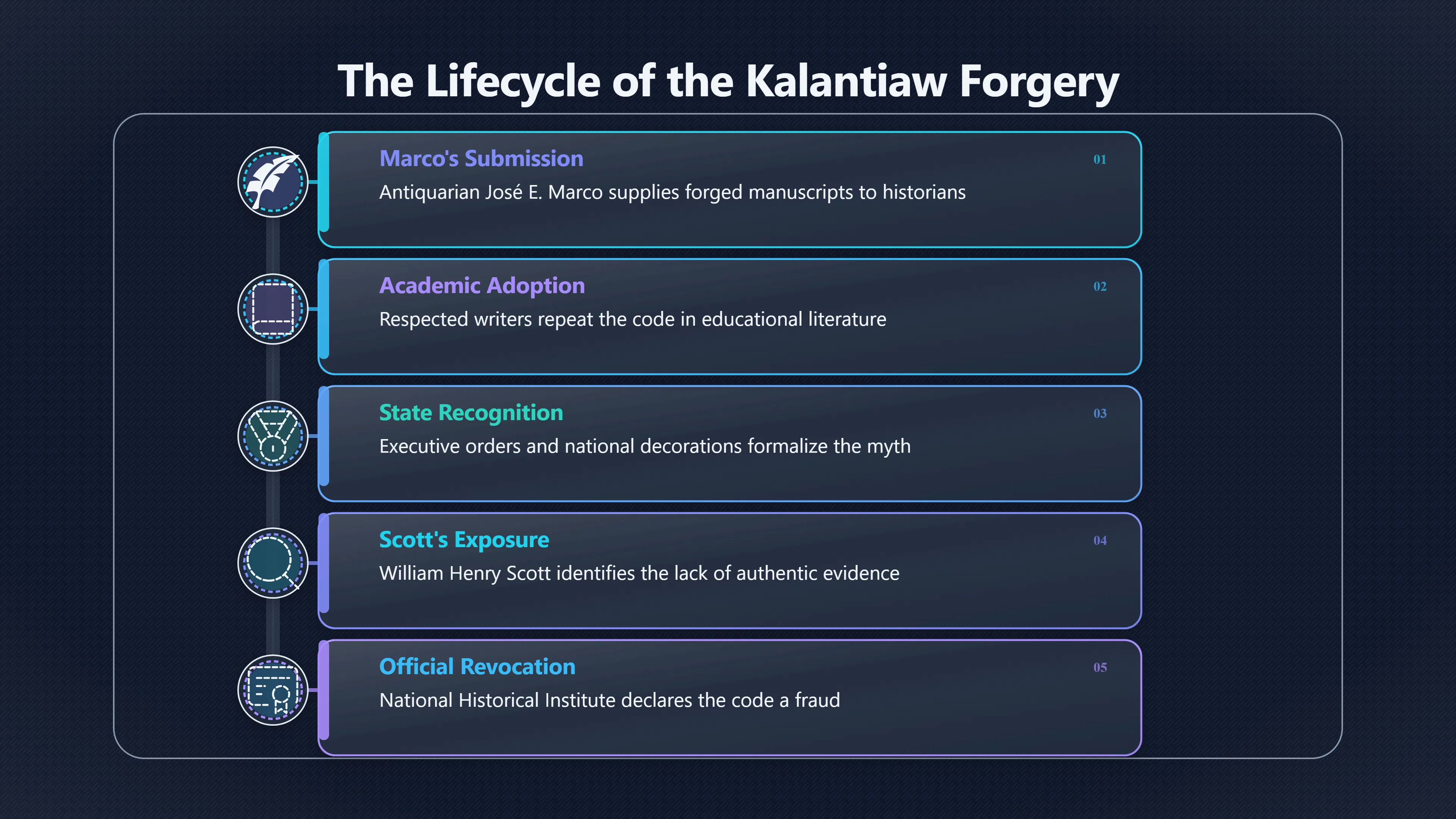
The code entered historical literature through the work of José E. Marco, an antiquarian who supplied numerous manuscripts and historical documents during the early twentieth century. Marco claimed that the code originated from older sources and eventually found its way into the hands of historians and collectors. Because pre-colonial written records from the Philippines are relatively scarce, the supposed discovery appeared enormously valuable.[Wikipedia]WikipediaCode of KalantiawCode of Kalantiaw
The story gained further legitimacy when respected historians and writers repeated it. Once it appeared in books and educational materials, the code came to be treated as evidence that sophisticated legal institutions existed in the archipelago before Spanish rule.[Wikipedia]WikipediaCode of KalantiawCode of Kalantiaw
Why the forgery seemed convincing
The Code of Kalantiaw succeeded partly because it filled a powerful historical desire. During much of the twentieth century, Filipino scholars and educators sought evidence of complex indigenous political and legal systems that predated colonial rule. A fifteenth-century law code appeared to answer that need perfectly.[opinion.inquirer.net]opinion.inquirer.netbibliographic ghostsInquirer Opinion17 Dec 2014 — In 2004 the National Historical Institute (NHI) declared the Code of Kalantiaw a hoax and recommended the d…
The forgery also benefited from a broader problem facing historians of the period: limited surviving source material. In an environment where authentic pre-Hispanic documents were rare, a seemingly detailed legal text attracted attention rather than immediate scepticism. Once respected authors cited it, later writers often accepted it without retracing its documentary origins.[Wikipedia]WikipediaCode of KalantiawCode of Kalantiaw
The code’s acceptance demonstrates how historical claims can gain authority through repetition. Its credibility increasingly rested not on the original evidence but on the fact that other books, lectures and official publications already treated it as genuine.[ScholarSpace]scholarspace.manoa.hawaii.eduScholar Space Jose EMarco's Kalantiaw Codeby M Justiniano · 2011 · Cited by 2 — Marcos instituted the 'Order of Kalantiaw,' an award 'for services to the cou…
How official recognition made it credible
What distinguishes the Kalantiaw forgery from many historical hoaxes is the scale of its institutional adoption.
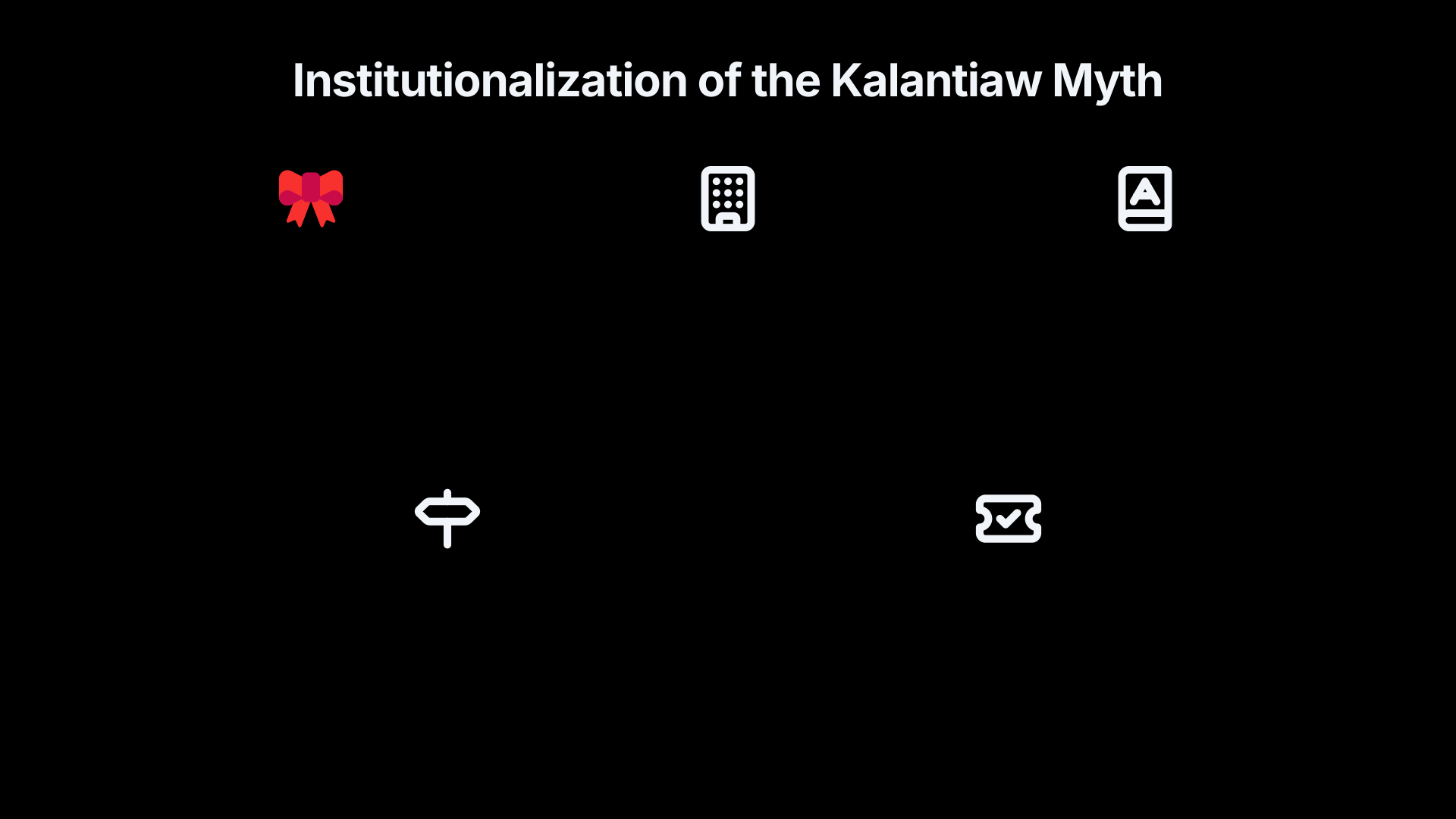
In 1957, Executive Order No. 234 recognised Datu Kalantiaw as the “First Philippine Lawgiver” and granted national recognition to a shrine associated with him in Batan, Aklan. This transformed a disputed historical figure into an officially endorsed national symbol.[Wikipedia]WikipediaCode of KalantiawCode of Kalantiaw
The process continued during the Marcos era. In 1971, President Ferdinand Marcos created the Order of Kalantiao, a national decoration awarded for exceptional service in law and justice. Recipients included prominent figures in the legal profession and public service. The existence of a state honour named after Kalantiaw reinforced the impression that his historical reality was beyond dispute.[Wikipedia]WikipediaCode of KalantiawCode of Kalantiaw
Other forms of recognition followed:
- Historical markers commemorated the code.
- A national shrine celebrated the site where the laws were supposedly proclaimed.
- School textbooks presented the code as authentic history.
- Cultural events, artworks and pageants invoked Kalantiaw as a symbol of ancient Filipino civilisation.[Wikipedia]WikipediaOpen source on wikipedia.org.
The result was an unusual feedback loop. Government recognition encouraged public belief, while widespread public belief made official recognition appear justified.
How historians exposed the forgery
The decisive challenge came from historian William Henry Scott. While researching pre-colonial Philippine sources for his doctoral work, Scott examined the documentary trail behind the Code of Kalantiaw and the broader collection of materials associated with José E. Marco.[Wikipedia]WikipediaOpen source on wikipedia.org.
Scott found that the evidence supporting the code collapsed under scrutiny. There was no reliable proof that Kalantiaw had existed, no authentic medieval manuscript containing the laws, and no independent historical record confirming the code’s supposed fifteenth-century origin. The chain of evidence ultimately led back to Marco’s questionable documents rather than to verifiable pre-colonial sources.[Wikipedia]WikipediaOpen source on wikipedia.org.
His findings were presented in doctoral research defended before leading Filipino historians and later published in his influential work on pre-Hispanic source materials. The exposure was not based on a single contradiction but on a broader examination of provenance, authenticity and documentary history. Scott showed that the code failed the basic tests historians use to establish whether a source is genuine.[Wikipedia]WikipediaOpen source on wikipedia.org.
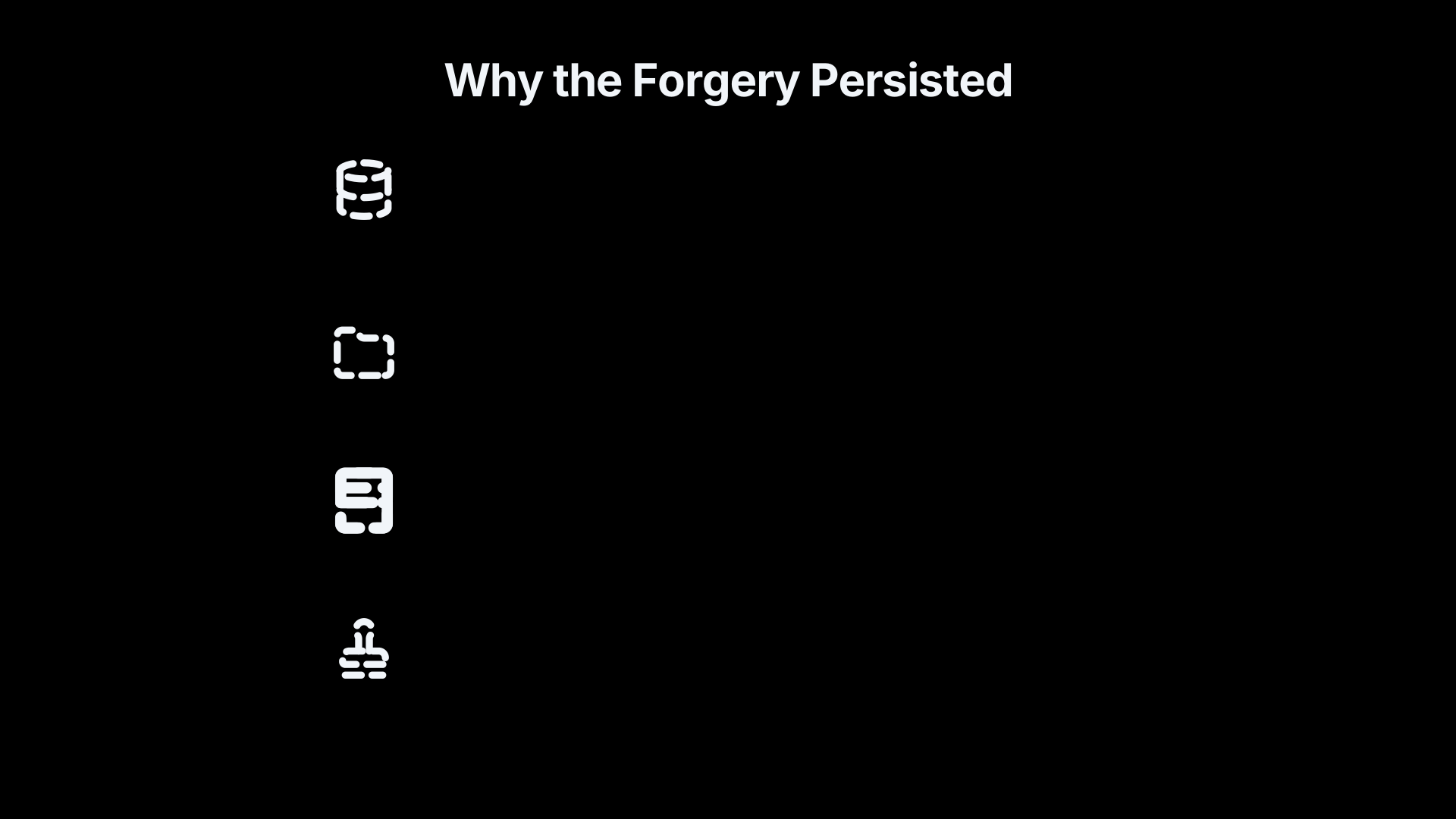
Yet the exposure did not immediately erase the myth. Textbooks continued to repeat the story, and public institutions continued to honour Kalantiaw for many years after the academic case against him had become strong.[Wikipedia]WikipediaCode of KalantiawCode of Kalantiaw
The long official afterlife
The most striking part of the Kalantiaw story is how long the forgery survived after its scholarly demolition.
Although Scott’s research was completed in the 1960s, official recognition persisted well into the late twentieth century. The Order of Kalantiao remained part of the honours system, the shrine remained recognised, and many educational materials continued presenting the code as historical fact.[Wikipedia]WikipediaOpen source on wikipedia.org.
A turning point came when questions about the award’s legitimacy reached government officials. Debate intensified after concerns were raised about honouring public figures with an award named after a person who may never have existed.[Pilipino Express News Magazine]pilipino-express.com3310 william henry scott and the new history3310 william henry scott and the new history
In 2004, the National Historical Institute formally declared that the Code of Kalantiao had no valid historical basis. The institute identified the code as a twentieth-century fraudulent work linked to José E. Marco and recommended ending official recognition connected to the legend.[Wikimedia Commons]upload.wikimedia.orgCommonsdeclaring that code of kalantiaoWikimedia Commonsdeclaring that code of kalantiao - has no valid historical basisDecember 15, 2009 — the National Historical Institute de…
The resolution called for:
- Official recognition that the code was a forgery.
- An end to the use of the Order of Kalantiao.
- Revocation of earlier government recognition associated with Kalantiaw.[Wikimedia Commons]upload.wikimedia.orgCommonsdeclaring that code of kalantiaoWikimedia Commonsdeclaring that code of kalantiao - has no valid historical basisDecember 15, 2009 — the National Historical Institute de…
Historical markers and shrine designations tied to the code were subsequently delisted or revoked. The National Historical Commission’s registry now records the Kalantiaw marker as removed because the code lacks historical validity.[Phil Historic Sites]philhistoricsites.nhcp.gov.phPhil Historic Sites The Code of Kalantiaw | Registry12, S. 2004 of the National Historical Institute (NHI) declared that the Code of Kalantiao has no valid historical basis.Read more…
Why the story still survives
The Code of Kalantiaw remains a useful case study because exposure alone does not automatically erase a historical myth.
For generations, the story appeared in classrooms, monuments, government publications and cultural works. Many Filipinos encountered Kalantiaw not through obscure manuscripts but through institutions that appeared authoritative. As a result, the legend continued to circulate even after professional historians rejected it.[Wikipedia]WikipediaOpen source on wikipedia.org.
The case also illustrates a broader challenge in historical memory. Corrections often spread more slowly than the original claim, especially when the claim supports an appealing national narrative. The idea of a sophisticated pre-colonial legal code was attractive because it seemed to provide tangible proof of indigenous statecraft and jurisprudence.[opinion.inquirer.net]opinion.inquirer.netbibliographic ghostsInquirer Opinion17 Dec 2014 — In 2004 the National Historical Institute (NHI) declared the Code of Kalantiaw a hoax and recommended the d…
Today, historians generally regard the Code of Kalantiaw as a textbook example of how forged documents can acquire legitimacy through repetition and official endorsement. Its importance lies not merely in the fraud itself but in the extraordinary journey from fabricated manuscript to state-sanctioned history—and the long effort required to reverse that process.[wikimedia.org]upload.wikimedia.orgCommonsdeclaring that code of kalantiaoWikimedia Commonsdeclaring that code of kalantiao - has no valid historical basisDecember 15, 2009 — the National Historical Institute de…
Amazon book picks
Further Reading
Books and field guides related to How a Forged Law Became Official History. Use these as the next step if you want deeper reading beyond the article.
Barangay
Scott's scholarship is closely associated with exposing the Kalantiaw forgery.
A History of the Philippines
First published 2010. Subjects: History, Philippines, history.
The Invention of Tradition
Directly relevant to official acceptance of forged histories.
eBay marketplace picks
Marketplace Samples
Live-tested eBay searches with available results related to this page.

Endnotes
1.
Source: Wikipedia
Title: Code of Kalantiaw
Link:https://en.wikipedia.org/wiki/Code_of_Kalantiaw
2.
Source: Wikipedia
Link:https://en.wikipedia.org/wiki/Kalantiaw
3.
Source: upload.wikimedia.org
Title: Commonsdeclaring that code of kalantiao
Link:https://upload.wikimedia.org/wikipedia/commons/2/29/National_Historical_Institute_Resolution_No._12%2C_S._2004.pdf
Source snippet
Wikimedia Commonsdeclaring that code of kalantiao - has no valid historical basisDecember 15, 2009 — the National Historical Institute de...
Published: December 15, 2009
4.
Source: opinion.inquirer.net
Title: bibliographic ghosts
Link:https://opinion.inquirer.net/81001/bibliographic-ghosts
Source snippet
Inquirer Opinion17 Dec 2014 — In 2004 the National Historical Institute (NHI) declared the Code of Kalantiaw a hoax and recommended the d...
5.
Source: opinion.inquirer.net
Title: Remember the Order of Kalantiaw?
Link:https://opinion.inquirer.net/30125/remember-the-order-of-kalantiaw
Source snippet
Inquirer OpinionJune 5, 2012 — 5 Jun 2012 — Considered the First Filipino Lawgiver, he promulgated about 1433 a penal code now known as C...
Published: June 5, 2012
6.
Source: Wikipedia
Title: Jose E. Marco
Link:https://en.wikipedia.org/wiki/Jose_E._Marco
7.
Source: pilipino-express.com
Title: 3310 william henry scott and the new history
Link:https://www.pilipino-express.com/history-a-culture/in-other-words/3310-william-henry-scott-and-the-new-history.html
8.
Source: Wikipedia
Title: National Historical Shrines in the Philippines
Link:https://en.wikipedia.org/wiki/National_Historical_Shrines_in_the_Philippines
9.
Source: scholarspace.manoa.hawaii.edu
Title: Scholar Space Jose E
Link:https://scholarspace.manoa.hawaii.edu/bitstreams/76d56a40-385d-4bf4-a896-368066502f43/download
Source snippet
Marco's Kalantiaw Codeby M Justiniano · 2011 · Cited by 2 — Marcos instituted the 'Order of Kalantiaw,' an award 'for services to the cou...
10.
Source: philhistoricsites.nhcp.gov.ph
Title: Phil Historic Sites The Code of Kalantiaw | Registry
Link:https://philhistoricsites.nhcp.gov.ph/registry_database/the-code-of-kalantiaw/
Source snippet
12, S. 2004 of the National Historical Institute (NHI) declared that the Code of Kalantiao has no valid historical basis.Read more...
11.
Source: scribd.com
Title: Code of Kalantiaw
Link:https://www.scribd.com/document/540904915/Code-of-Kalantiaw
Additional References
12.
Source: esquiremag.ph
Title: code of kalantiaw hoax history facts a00007 20230717 lfrm
Link:https://www.esquiremag.ph/long-reads/features/code-of-kalantiaw-hoax-history-facts-a00007-20230717-lfrm
Source snippet
What Is the Code of Kalantiaw, the Pre-Colonial Penal...17 Jul 2023 — The revocation of Executive Order 234, which recognized Datu Bonda...
13.
Source: scribd.com
Link:https://www.scribd.com/document/829179984/CODE-OF-KALANTIAW
14.
Source: facebook.com
Link:https://www.facebook.com/AklanPYDO/posts/in-the-famous-epic-story-of-maragtas-there-was-this-mythical-legal-code-called-t/193167770032512/
15.
Source: facebook.com
Title: 21 years ago nhi declares that code of kalantiao has no valid historical basisth
Link:https://www.facebook.com/TheAkeanon/photos/21-years-ago-nhi-declares-that-code-of-kalantiao-has-no-valid-historical-basisth/879589224406464/
16.
Source: quizlet.com
Title: debunking the code of kalantiaw hoax 6259aa41 0ac5 4c31 8026 0807d0b9a58c
Link:https://quizlet.com/study-guides/debunking-the-code-of-kalantiaw-hoax-6259aa41-0ac5-4c31-8026-0807d0b9a58c
17.
Source: scribd.com
Title: The Historical Importance of Text and Examination 1 2
Link:https://www.scribd.com/presentation/619587573/The-Historical-Importance-of-Text-and-Examination
18.
Source: buglas-writers.medium.com
Title: jose e marco fraud and trickster 1fffb41e44c
Link:https://buglas-writers.medium.com/jose-e-marco-fraud-and-trickster-1fffb41e44c
19.
Source: youtube.com
Link:https://www.youtube.com/watch?v=0czZF1z2ZVE
20.
Source: youtube.com
Link:https://www.youtube.com/watch?v=GtnysJUBTyI
21.
Source: youtube.com
Link:https://www.youtube.com/watch?v=R59bzpRPw00
Topic Tree