Within Niger
How Crude Forgeries Helped Make a War
Crude forged papers gained global authority because governments repeated their claims before the documents were properly checked.
On this page
- What the documents claimed
- How officials gave the story authority
- How the IAEA exposed the forgery
Page outline Jump by section
Introduction
The Niger uranium forgeries were among the most consequential fake documents of the early twenty-first century. They purported to show that Saddam Hussein’s Iraq had negotiated to buy uranium from Niger, one of Africa’s major uranium-producing countries. The papers themselves were crude and riddled with errors, yet the allegation travelled through intelligence channels, appeared in government statements, and became part of the public case that Iraq was rebuilding a nuclear weapons programme before the 2003 invasion. When international inspectors finally examined the underlying documents, they exposed them as forgeries within hours. The episode remains a striking example of how weak evidence can acquire enormous authority when repeated by powerful institutions before it is properly verified.[IAEA]iaea.orgstatus nuclear inspections iraq updatedocuments - which formed the basis for the reports of recent uranium transactions between Iraq and Niger - are in fact not authentic. We…

How the Documents Claimed to Link Iraq and Niger
The forged papers appeared to record diplomatic contacts and commercial agreements between Iraq and Niger concerning the sale of uranium ore concentrate, often called yellowcake. The central allegation was that Iraq had sought hundreds of tonnes of uranium from Niger, supposedly as part of an effort to revive a nuclear weapons programme.[Wikipedia]WikipediaNiger uranium forgeriesOctober 7, 2025 — The Niger uranium forgeries were forged documents initially released in 2001 by SISMI which seem to depict an attempt m…
The claim mattered because uranium procurement was viewed as a possible indicator of nuclear ambitions. In the tense atmosphere after the attacks of 11 September 2001, intelligence suggesting that Iraq was pursuing nuclear-related materials attracted exceptional attention. A report involving a known uranium exporter such as Niger therefore appeared plausible to policymakers already concerned about Iraqi weapons programmes.[SIPRI]sipri.orgtwenty years ago iraq ignoring expert weapons inspectors proved be fatal mistakeTwenty years ago in Iraq, ignoring the expert weapons…Mar 9, 2023 — Claims started circulating in around 2000 that Iraq was seeki…
Yet the documents contained obvious warning signs. Among the errors later identified were:
- References to officials who were no longer in office.
- Signatures and titles that did not match the period described.
- Administrative details inconsistent with Niger’s government structure.
- Chronological mistakes and implausible diplomatic procedures.
- References to agreements that would have been difficult to conceal given the international oversight of Niger’s uranium industry.[The New Yorker]newyorker.comThe New Yorker Who Lied to Whom?The New YorkerWho Lied to Whom?March 24, 2003 — Mar 24, 2003 — Security Council that the documents involving the Niger-Iraq uranium sale…
The significance of these mistakes is not simply that the papers were fake. It is that many influential figures accepted the allegation before the documents themselves were subjected to rigorous scrutiny.
How Officials Gave the Story Authority
The forged papers did not become influential because journalists or citizens carefully examined them. Most people never saw them. Instead, the allegation gained credibility through repetition by intelligence agencies and political leaders. Information about a supposed Iraqi attempt to acquire uranium from Africa circulated through intelligence reporting long before independent experts were given access to the actual documents.[National Security Archive]nsarchive2.gwu.eduNational Security ArchiveIraq and Weapons of Mass DestructionThe only publicly acknowledged evidence for the claim that Iraq had tried to…
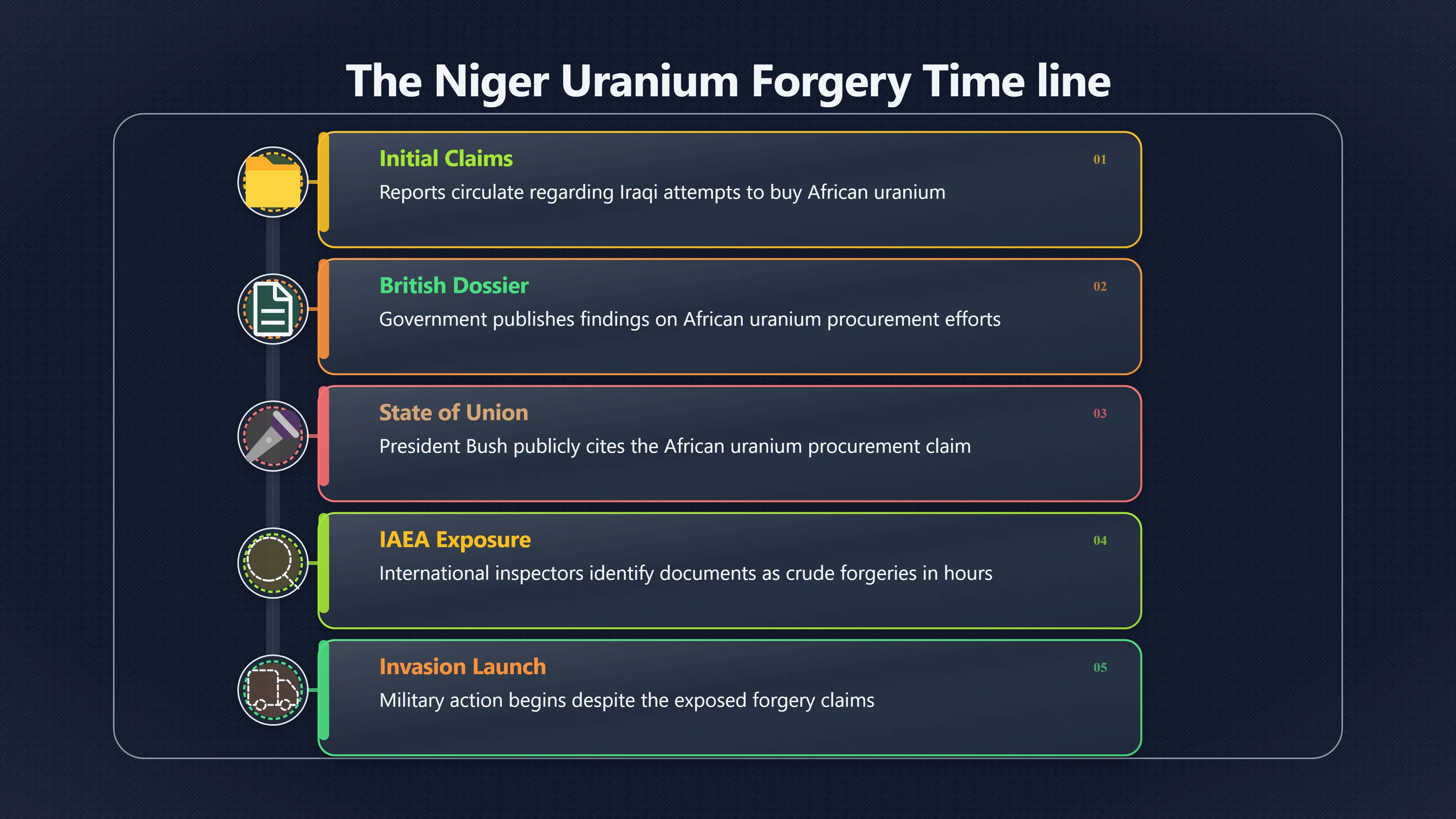
In September 2002, the British government published a dossier stating that Iraq had sought significant quantities of uranium from Africa. A few months later, President George W. Bush included the famous claim that the British government had learned that Saddam Hussein recently sought significant quantities of uranium from Africa in his January 2003 State of the Union address. These statements carried far more weight than the forged paperwork itself.[UK Parliament]publications.parliament.ukUK Parliament House of CommonsUK Parliament House of Commons
An important feature of the episode was the way authority accumulated. Different reports appeared to confirm one another, even when they often traced back to overlapping intelligence streams. To outside observers, the claim seemed supported by multiple sources. In reality, the evidential foundation was far weaker than it appeared.[Arms Control Association]armscontrol.orgArms Control Association Chronology of Bush Administration Claim that IraqArms Control AssociationChronology of Bush Administration Claim that Iraq…March 7, 2003: ElBaradei tells the Security Council that the…
The result was a classic information cascade. The allegation became politically important before the underlying evidence had been fully tested. By the time serious questions emerged, the story had already entered public debate about Iraq’s supposed weapons programmes.
How the IAEA Exposed the Forgery
The turning point came when the International Atomic Energy Agency (IAEA), the United Nations body responsible for nuclear verification, obtained the relevant documents and conducted a detailed examination.[IAEA]iaea.orgstatus nuclear inspections iraq updatedocuments - which formed the basis for the reports of recent uranium transactions between Iraq and Niger - are in fact not authentic. We…
The outcome was remarkably swift. On 7 March 2003, IAEA Director General Mohamed ElBaradei informed the United Nations Security Council that the documents underpinning the alleged Iraq–Niger uranium transaction were not authentic. He stated that the agency, working with outside experts, had concluded that the documents were forged and that the specific allegations were unfounded.[iaea.org]iaea.orgstatus nuclear inspections iraq updatedocuments - which formed the basis for the reports of recent uranium transactions between Iraq and Niger - are in fact not authentic. We…
What made the exposure so striking was the simplicity of some of the errors. The inspectors did not uncover an elaborate counterfeiting operation through years of forensic work. Instead, basic checks against publicly available information revealed inconsistencies in names, dates, offices and official procedures. According to later accounts, some defects were so obvious that experienced analysts identified them quickly once the papers were finally available for inspection.[newyorker.com]newyorker.comThe New Yorker Who Lied to Whom?The New YorkerWho Lied to Whom?March 24, 2003 — Mar 24, 2003 — Security Council that the documents involving the Niger-Iraq uranium sale…
The episode demonstrated the value of verification institutions. The IAEA approached the documents as evidence to be tested rather than claims to be accepted. Its findings directly contradicted one of the most widely cited pieces of intelligence concerning Iraq’s alleged nuclear ambitions.[IAEA]iaea.orgstatus nuclear inspections iraq updatedocuments - which formed the basis for the reports of recent uranium transactions between Iraq and Niger - are in fact not authentic. We…
Why the Exposure Did Not Stop the March to War
One of the most enduring questions is why the forgery mattered so much if it was exposed before the invasion of Iraq began.
The answer is that the uranium allegation was only one element in a broader argument about Iraqi weapons of mass destruction. By March 2003, political decisions, military planning and public narratives were already far advanced. Although the IAEA publicly dismantled the uranium claim, the correction arrived late in the policy process. The invasion began less than two weeks after ElBaradei’s announcement.[Arms Control Association]armscontrol.orgArms Control Association Chronology of Bush Administration Claim that IraqArms Control AssociationChronology of Bush Administration Claim that Iraq…March 7, 2003: ElBaradei tells the Security Council that the…
The exposure nevertheless damaged the credibility of the wider intelligence case. The uranium story became a symbol of larger failures in intelligence assessment, source evaluation and political communication. Investigations and public inquiries in subsequent years repeatedly returned to the episode as an example of how questionable evidence can survive long enough to influence major decisions.[Carnegie Endowment]carnegieendowment.orgniger uranium still a false claimCarnegie EndowmentNiger Uranium: Still a False Claim28 Aug 2004 — The primary evidence for the Niger uranium claim was a series of docume…
Why the Niger Forgeries Still Matter
The Niger uranium papers remain famous not because they were skilful forgeries, but because they were poor forgeries that achieved extraordinary influence. Their historical importance lies in the gap between the weakness of the evidence and the strength of the conclusions drawn from it.[The New Yorker]newyorker.comThe New Yorker Who Lied to Whom?The New YorkerWho Lied to Whom?March 24, 2003 — Mar 24, 2003 — Security Council that the documents involving the Niger-Iraq uranium sale…
The case highlights several recurring lessons about deception and public belief:
- Authority can outweigh evidence. Claims repeated by governments often gain credibility even when supporting documents remain hidden.
- Verification matters most before public claims are made. Once a narrative becomes established, later corrections may struggle to reverse its effects.
- Multiple reports do not necessarily mean multiple sources. Apparent corroboration can mask dependence on the same underlying material.
- Simple checks can expose major falsehoods. In this case, basic examination of names, offices and dates proved sufficient to unravel the story.[armscontrol.org]armscontrol.orgArms Control Association Chronology of Bush Administration Claim that IraqArms Control AssociationChronology of Bush Administration Claim that Iraq…March 7, 2003: ElBaradei tells the Security Council that the…
Within the history of Niger-related deceptions, the uranium forgeries occupy a unique place. They were not a local legend, a newspaper stunt or a commercial scam. Instead, they became one of the most influential forged document sets in modern political history, demonstrating how fragile evidence can help shape decisions with global consequences.[Wikipedia]WikipediaNiger uranium forgeriesOctober 7, 2025 — The Niger uranium forgeries were forged documents initially released in 2001 by SISMI which seem to depict an attempt m…
eBay marketplace picks
Marketplace Samples
Live-tested eBay searches with available results related to this page.
Endnotes
1.
Source: iaea.org
Title: status nuclear inspections iraq update
Link:https://www.iaea.org/newscenter/statements/status-nuclear-inspections-iraq-update
Source snippet
documents - which formed the basis for the reports of recent uranium transactions between Iraq and Niger - are in fact not authentic. We...
2.
Source: Wikipedia
Title: Niger uranium forgeries
Link:https://en.wikipedia.org/wiki/Niger_uranium_forgeries
Source snippet
October 7, 2025 — The Niger uranium forgeries were forged documents initially released in 2001 by SISMI which seem to depict an attempt m...
Published: October 7, 2025
3.
Source: sipri.org
Title: twenty years ago iraq ignoring expert weapons inspectors proved be fatal mistake
Link:https://www.sipri.org/commentary/essay/2023/twenty-years-ago-iraq-ignoring-expert-weapons-inspectors-proved-be-fatal-mistake
Source snippet
Twenty years ago in Iraq, ignoring the expert weapons...Mar 9, 2023 — Claims started circulating in around 2000 that Iraq was seeki...
4.
Source: publications.parliament.uk
Title: UK Parliament House of Commons
Link:https://publications.parliament.uk/pa/cm200203/cmselect/cmfaff/813/3062707.htm
5.
Source: publications.parliament.uk
Title: UK Parliament House of Commons
Link:https://publications.parliament.uk/pa/cm200203/cmselect/cmfaff/813/813we35.htm
6.
Source: archive.globalpolicy.org
Link:https://archive.globalpolicy.org/security/issues/iraq/unmovic/2003/0308someevid.htm
7.
Source: edm.parliament.uk
Title: uk IRA Q AND NIGER URANIUM
Link:https://edm.parliament.uk/early-day-motion/25887/iraq-and-niger-uranium
8.
Source: armscontrol.org
Title: Arms Control Association Chronology of Bush Administration Claim that Iraq
Link:https://www.armscontrol.org/factsheets/chronology-bush-administration-claim-iraq-attempted-obtain-uranium-niger
Source snippet
Arms Control AssociationChronology of Bush Administration Claim that Iraq...March 7, 2003: ElBaradei tells the Security Council that the...
Published: March 7, 2003
9.
Source: newyorker.com
Title: The New Yorker Who Lied to Whom?
Link:https://www.newyorker.com/magazine/2003/03/31/who-lied-to-whom
Source snippet
The New YorkerWho Lied to Whom?March 24, 2003 — Mar 24, 2003 — Security Council that the documents involving the Niger-Iraq uranium sale...
Published: March 24, 2003
10.
Source: carnegieendowment.org
Title: niger uranium still a false claim
Link:https://carnegieendowment.org/research/2004/08/niger-uranium-still-a-false-claim
Source snippet
Carnegie EndowmentNiger Uranium: Still a False Claim28 Aug 2004 — The primary evidence for the Niger uranium claim was a series of docume...
11.
Source: nsarchive2.gwu.edu
Link:https://nsarchive2.gwu.edu/NSAEBB/NSAEBB80/
Source snippet
National Security ArchiveIraq and Weapons of Mass DestructionThe only publicly acknowledged evidence for the claim that Iraq had tried to...
12.
Source: armscontrol.org
Title: Arms Control Association Chronology of Bush Claim that Iraq Attempted to Obtain
Link:https://www.armscontrol.org/act/2003-09/chronology-bush-claim-iraq-attempted-obtain-uranium-niger
13.
Source: nsarchive2.gwu.edu
Link:https://nsarchive2.gwu.edu/NSAEBB/NSAEBB215/def_ex/DX64.pdf
Additional References
14.
Source: spyscape.com
Link:https://spyscape.com/article/saddam-husseins-fake-uranium
Source snippet
The Uranium Hoax that Triggered the Iraq WarThe allegation was largely based on forged documents claiming Iraq tried to purchase...
15.
Source: youtube.com
Title: In re Grand Jury Subpoena, Judith Miller Case Brief
Link:https://www.youtube.com/watch?v=pGauxbAfleQ
Source snippet
WRAP Adds Annan at White House to Powell meeting...
16.
Source: youtube.com
Title: A Conversation with Ambassador Joseph Wilson, IV
Link:https://www.youtube.com/watch?v=wEp3hIKHi4s
Source snippet
In re Grand Jury Subpoena, Judith Miller Case Brief Summary | Law Case Explained...
17.
Source: youtube.com
Title: WRAP Adds Annan at White House to Powell meeting
Link:https://www.youtube.com/watch?v=u0bEbSb2qCE
Source snippet
Tom Bower and David Aaronovitch on WMDs and the Iraq War - Tony Blair on Trial...
18.
Source: nti.org
Link:https://www.nti.org/wp-content/uploads/2021/09/iraq_nuclear.pdf
19.
Source: leadingtowar.com
Link:https://www.leadingtowar.com/claims_facts_yellowcake.php
20.
Source: prospectmagazine.co.uk
Link:https://www.prospectmagazine.co.uk/essays/59338/niger-lies-and-uranium
21.
Source: medium.com
Link:https://medium.com/%40chelsealynnqueen94/the-uranium-hoax-that-sparked-the-iraq-war-87703fbbc7e2
22.
Source: reuters.com
Link:https://www.reuters.com/world/middle-east/road-war-an-ex-reuters-journalist-recalls-chase-wmd-iraq-2023-03-20/
23.
Source: youtube.com
Title: What Did the CIA REALLY Find in Iraq? (Ep5/6)
Link:https://www.youtube.com/watch?v=Y6Tb08vIVhk
Source snippet
A Conversation with Ambassador Joseph Wilson, IV...
Topic Tree