Within Timor Leste Deceptions
How Threats Became Propaganda in 1999
Militia threats, staged disorder and claims of spontaneous civil conflict sought to make independence appear both dangerous and unpopular.
On this page
- Warnings that doubled as threats
- How militia violence was presented as local conflict
- What the referendum result revealed
Page outline Jump by section
Introduction
The 1999 referendum in East Timor (now Timor-Leste) was not only a vote on independence. It was also the culmination of a sustained campaign designed to convince voters that choosing independence would bring chaos, civil war and economic ruin. The campaign blended propaganda with real violence. Threats were presented as predictions, militia attacks were portrayed as spontaneous clashes between rival Timorese groups, and organised intimidation was framed as evidence that society would collapse if Indonesia withdrew. The result was one of the clearest examples in modern Southeast Asian history of fear being used as a political tool. Subsequent investigations by the United Nations, human-rights organisations and Timor-Leste’s truth commission concluded that much of the violence surrounding the referendum was organised rather than spontaneous, and that the overwhelming vote for independence exposed the gap between the fear campaign and popular opinion.[ictj.org]ictj.orgEast TimorEast TimorMarch 24, 2009 — The report brings together the weight of four different sources, providing a massive amount of evidence th…
Warnings That Doubled as Threats
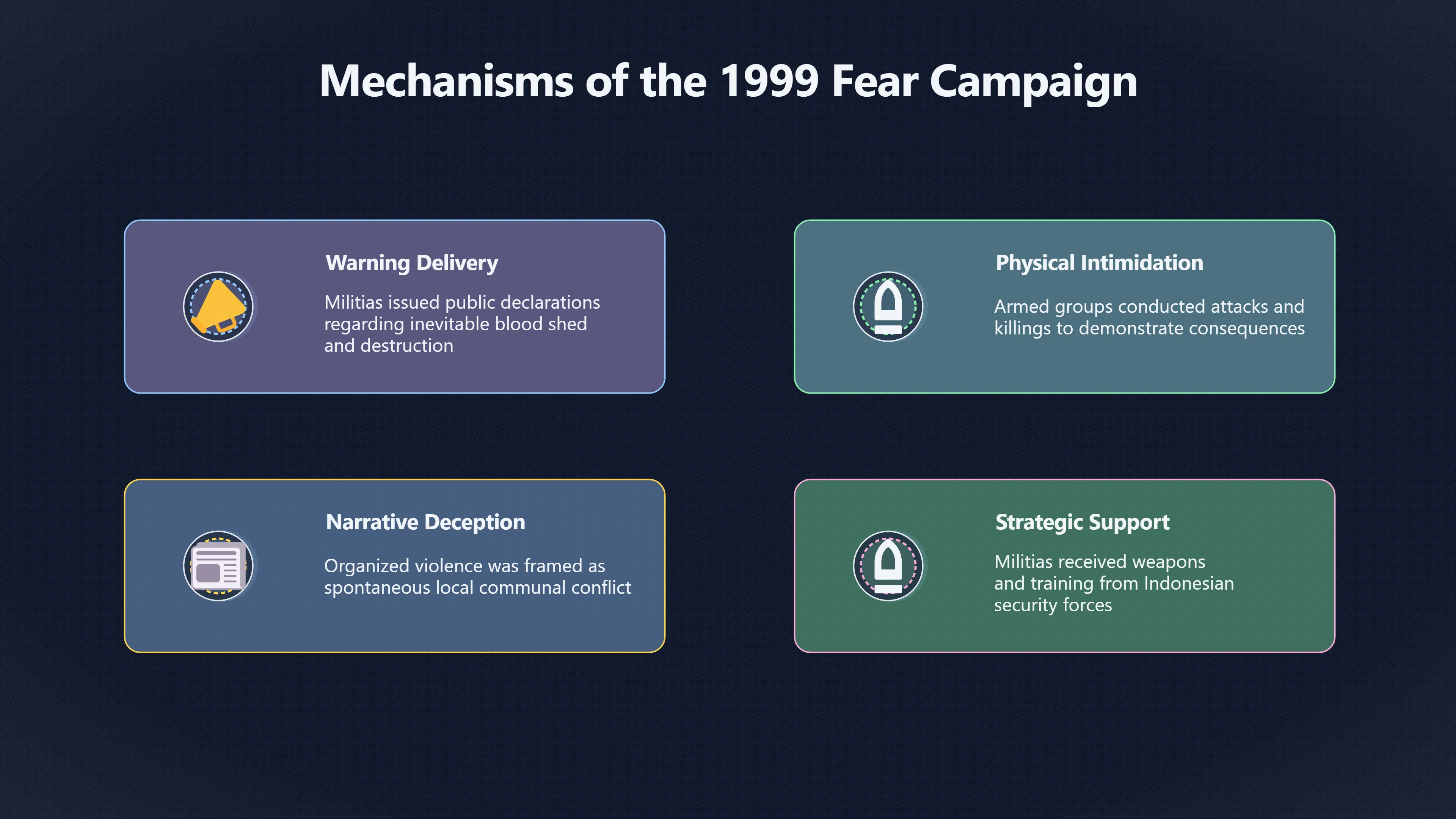
As the United Nations Mission in East Timor (UNAMET) prepared the August 1999 ballot, anti-independence militias repeatedly warned that an independence victory would lead to bloodshed. On the surface these statements appeared to be political predictions. In practice they often functioned as threats.
Militia groups publicly declared that separation from Indonesia would trigger violence, displacement and destruction. Human-rights organisations documented how intimidation, attacks and killings increased during the months before the vote. Rather than persuading voters through arguments about autonomy within Indonesia, many militia leaders relied on demonstrating the consequences of defiance. Violence itself became part of the campaign message.[reliefweb.int]reliefweb.intRelief Web Catastrophe in East TimorCatastrophe in East Timor - Timor-Leste9 Sept 1999 — It involved establishing a network of armed anti-independence militias and…
Observers from UNAMET reported widespread intimidation. Villagers were pressured to attend pro-integration rallies, independence supporters were threatened, and local communities were reminded that armed groups remained active. Walter Dorn, who served with UNAMET, later described witnessing numerous cases in which militias intimidated or attacked perceived opponents while operating with apparent confidence that they would not be stopped.[walterdorn.net]walterdorn.netMilitias in East Timor: Personal EncountersWalter DornWhile serving with UNAMET for two months leading up to the referendum, my colleagues and I witnessed and personally verified m…
The central claim behind the fear campaign was simple: independence would not bring freedom but catastrophe. This message gained power because it was reinforced by visible acts of violence. People did not merely hear warnings; they saw armed men demonstrating what those warnings meant.
How Militia Violence Was Presented as Local Conflict
One of the most important deceptions of 1999 concerned the nature of the violence itself. Supporters of continued integration with Indonesia often portrayed unrest as a natural conflict between East Timorese factions. The impression given was that the territory was descending into civil war because local communities were deeply divided.
Later investigations challenged that narrative. Evidence gathered by international inquiries, the Timor-Leste truth commission and other researchers found extensive links between militia groups and elements of the Indonesian security apparatus. Rather than representing a purely spontaneous grassroots movement, many militias received support, weapons, training or protection from powerful institutions.[ictj.org]ictj.orgEast TimorEast TimorMarch 24, 2009 — The report brings together the weight of four different sources, providing a massive amount of evidence th…
This distinction mattered enormously. If violence appeared to be a civil conflict between neighbours, then it could be presented as proof that East Timor was not ready for independence. If, however, much of the violence was organised and encouraged from above, then the unrest was not evidence against independence at all. It was part of a strategy to influence the referendum.
The United Nations-backed investigations that followed the vote concluded that militia violence was used in ways that created the appearance of internal communal conflict. The International Commission of Inquiry later found that intimidation, terror and destruction were closely connected to militia operations and their relationships with Indonesian security forces.[JSTOR]jstor.orgTHE EAST TIMOR CRISIS: A Test Case for Humanitarian…by LC Sebastian · 2000 · Cited by 31 — The report thus confirms that the mili…
The propaganda value of this presentation was significant. International audiences unfamiliar with East Timor could be persuaded that they were witnessing an ethnic or political civil war. That interpretation shifted attention away from questions about responsibility and towards a narrative of inevitable local disorder.

Fear on Voting Day
Despite months of intimidation, participation in the referendum was extraordinarily high. Almost all registered voters took part in the ballot, even though many knew violence could follow the result. UN officials considered reprisals such a serious possibility that ballot papers from different districts were mixed before counting so that specific communities could not easily be identified and targeted.[Australian War Memorial]awm.gov.auIn the face of intimidation of voters by anti-independence militias, UNAMET made the…Read more…
The very need for such precautions reveals how deeply fear shaped the atmosphere. Voters were not choosing between two abstract constitutional options. Many were making a decision while surrounded by armed intimidation and persistent warnings of future punishment.
Yet the turnout also demonstrated a limit to fear-based propaganda. Intimidation can influence behaviour, but it can also reveal the intentions of those using it. For many East Timorese, the threats themselves became evidence of what continued integration might mean.
What the Referendum Result Revealed
When the result was announced on 3 September 1999, 78.5 per cent of voters rejected the autonomy proposal and chose the path towards independence, while 21.5 per cent supported remaining within Indonesia under special autonomy arrangements. Turnout approached 98 per cent of registered voters.[un.org]digitallibrary.un.orgOpen source on un.org.
The outcome was devastating for the credibility of the fear campaign. For months, pro-integration forces had attempted to create the impression that independence lacked broad support and that ordinary people preferred continued association with Indonesia. The ballot demonstrated the opposite. Given the climate of intimidation, the scale of the independence vote suggested that threats had failed to produce the desired political result.[un.org]digitallibrary.un.orgOpen source on un.org.
The immediate aftermath reinforced another lesson. Violence escalated rapidly after the announcement, with attacks, killings, forced displacement and widespread destruction reported across the territory. Human-rights organisations and later inquiries concluded that much of this violence was organised rather than a spontaneous public reaction to the vote.[hrw.org]hrw.orgOpen source on hrw.org.
In effect, the referendum exposed two separate claims as misleading. First, that independence lacked popular support. Second, that the violence reflected uncontrollable local conflict. The ballot showed overwhelming support for independence, while subsequent investigations pointed towards organised intimidation rather than spontaneous civil breakdown.[un.org]digitallibrary.un.orgOpen source on un.org.
Why the Fear Campaign Matters
The 1999 referendum campaign occupies a distinctive place in Timor-Leste’s history of deception because it was not based on a forged document or fabricated photograph. Instead, it relied on a manipulation of perception.
Warnings were presented as forecasts when they were often tied to people capable of carrying them out. Organised violence was framed as spontaneous unrest. The possibility of future chaos was used to discourage democratic choice. In this sense, the campaign blurred the boundary between propaganda and coercion.
Its failure is also part of the story. The referendum result demonstrated that many East Timorese voters distinguished between genuine predictions and threats disguised as predictions. The overwhelming vote for independence remains one of the strongest pieces of evidence against the central message of the campaign: that the people of East Timor did not truly want independence, or would be too frightened to choose it when given the opportunity.[un.org]digitallibrary.un.orgOpen source on un.org.
Amazon book picks
Further Reading
Books and field guides related to How Threats Became Propaganda in 1999. Use these as the next step if you want deeper reading beyond the article.
Manufacturing Consent
Relevant to propaganda, public narratives and political persuasion.
eBay marketplace picks
Marketplace Samples
Live-tested eBay searches with available results related to this page.
Endnotes
1.
Source: ictj.org
Title: East Timor
Link:https://www.ictj.org/sites/default/files/ICTJ-TimorLeste-Unfinished-Truth-2009-English.pdf
Source snippet
East TimorMarch 24, 2009 — The report brings together the weight of four different sources, providing a massive amount of evidence th...
Published: March 24, 2009
2.
Source: jstor.org
Link:https://www.jstor.org/stable/27912244
Source snippet
THE EAST TIMOR CRISIS: A Test Case for Humanitarian...by LC Sebastian · 2000 · Cited by 31 — The report thus confirms that the mili...
3.
Source: reliefweb.int
Title: Relief Web Chega!
Link:https://reliefweb.int/report/timor-leste/chega-report-commission-reception-truth-and-reconciliation-timor-leste
Source snippet
The report of the commission for reception, truth...28 Nov 2005 — The executive Summary to the Final Report entitled Chega! contains exc...
4.
Source: reliefweb.int
Title: Relief Web Catastrophe in East Timor
Link:https://reliefweb.int/report/timor-leste/catastrophe-east-timor
Source snippet
Catastrophe in East Timor - Timor-Leste9 Sept 1999 — It involved establishing a network of armed anti-independence militias and...
5.
Source: walterdorn.net
Title: Militias in East Timor: Personal Encounters
Link:https://walterdorn.net/37-militias-in-east-timor-personal-encounters
Source snippet
Walter DornWhile serving with UNAMET for two months leading up to the referendum, my colleagues and I witnessed and personally verified m...
6.
Source: legal-tools.org
Link:https://www.legal-tools.org/doc/f7e999/pdf/
Source snippet
Legal ToolsDistr. GENERAL A/54/726, S/2000/5931 Jan 2000 — However, there were also reports that in late 1998 and early 1999, new militia...
7.
Source: mineaction.org
Title: East Timor
Link:https://www.mineaction.org/sites/default/files/past/unmiset/background.html
9.
Source: awm.gov.au
Link:https://www.awm.gov.au/collection/C1081032
Source snippet
In the face of intimidation of voters by anti-independence militias, UNAMET made the...Read more...
10.
Source: digitallibrary.un.org
Link:https://digitallibrary.un.org/record/279320
11.
Source: hrw.org
Link:https://www.hrw.org/legacy/backgrounder/asia/timor/timor-bck0908.htm
12.
Source: awm.gov.au
Link:https://www.awm.gov.au/collection/C960824
13.
Source: aph.gov.au
Link:https://www.aph.gov.au/parliamentary_business/committees/house_of_representatives_committees?url=jfadt%2Farmy%2Fet_ch1.pdf
14.
Source: timor-leste.gov.tl
Title: On the verge of National Liberation
Link:https://timor-leste.gov.tl/wp-content/uploads/2010/03/Crono_ultimos_passos_libert_nac_EN1.pdf
15.
Source: hrw.org
Title: EAS T TIMOR
Link:https://www.hrw.org/reports/pdfs/i/indonesa/indtm99d.pdf
16.
Source: easttimor.georgetown.edu
Link:https://easttimor.georgetown.edu/actor-profiles/international/
Additional References
17.
Source: bristoluniversitypressdigital.com
Link:https://bristoluniversitypressdigital.com/downloadpdf/display/book/9781529202212/ch004.pdf
Source snippet
Bristol University Press DigitalThe East Timor Humanitarian Crisisby L Southgate · 2019 · Cited by 4 — Amidst reports of violence in East...
18.
Source: youtube.com
Link:https://www.youtube.com/watch?v=UdIurkGpbuU
Source snippet
Independence Supporters Massacred at Suai, East Timor (1999)...
19.
Source: youtube.com
Title: The Bloody Price of East Timor’s Independence
Link:https://www.youtube.com/watch?v=AvtB2OYW5WY
Source snippet
How communications can stop a massacre: Lessons from Timor-Leste referendum | United Nations...
20.
Source: youtube.com
Link:https://www.youtube.com/watch?v=-7urjZ6rMus
Source snippet
etimor: violence during run-up to independence vote (2)...
21.
Source: ciaotest.cc.columbia.edu
Link:https://ciaotest.cc.columbia.edu/olj/sa/sa_mar01chs01.html
22.
Source: eujournal.org
Link:https://eujournal.org/index.php/esj/article/view/5735/5542
23.
Source: refworld.org
Link:https://www.refworld.org/reference/countryrep/hrw/1999/en/95471
24.
Source: truthcommissions.humanities.mcmaster.ca
Link:https://truthcommissions.humanities.mcmaster.ca/wp-content/uploads/2021/02/Report_Chega_A-Plain-Guide_Final-Report-of-the-Timor-Leste-Commission-for-Reception-Truth-and-Reconciliation_TRC.pdf
25.
Source: peaceaccords.nd.edu
Link:https://peaceaccords.nd.edu/provision/independence-referendum-agreement-between-the-republic-of-indonesia-and-the-portuguese-republic-on-the-question-of-east-timor
26.
Source: nsarchive.gwu.edu
Link:https://nsarchive.gwu.edu/briefing-book/indonesia/2019-08-28/us-sought-preserve-close-ties-indonesian-military-it-terrorized-east-timor-runup-1999-independence
Topic Tree