Within Sao Tome Deceptions
How a False Revolt Story Enabled Batepa
An unsupported communist revolt story turned resistance to forced labour into a pretext for arrests, torture and mass killing.
On this page
- Labour fears and rumours before the violence
- How the conspiracy claim mobilised repression
- The failed investigation and national memory
Page outline Jump by section
Introduction
The Batep Massacre of February 1953 is often remembered as one of the defining events in the history of So Tom and Prncipe. Less well known is the false story that helped make the violence possible. Colonial authorities claimed that local unrest was part of a communist-inspired conspiracy and impending revolt. That allegation gave officials a justification for mass arrests, armed mobilisation and brutal repression. Yet the investigation launched after the killings failed to find evidence of any organised communist plot. Instead, historians have shown that the crisis grew out of fears of forced labour, labour shortages on cocoa plantations, and rumours surrounding colonial policy. The supposed conspiracy was not the cause of the violence; it was the explanation used to legitimise it.[wikipedia.org]WikipediaBatep massacreBatep massacre

The episode remains one of the clearest examples in So Toman history of a fabricated political threat being used to transform social tensions into a campaign of repression. It also became a foundational memory for the later independence movement.[researchgate.net]researchgate.netResearchGate(PDF) The February 1953 Massacre in So TomPDF | In February 1953, on the orders of Governor Carlos Gorgulho the colonial po…
Labour Fears and Rumours Before the Violence
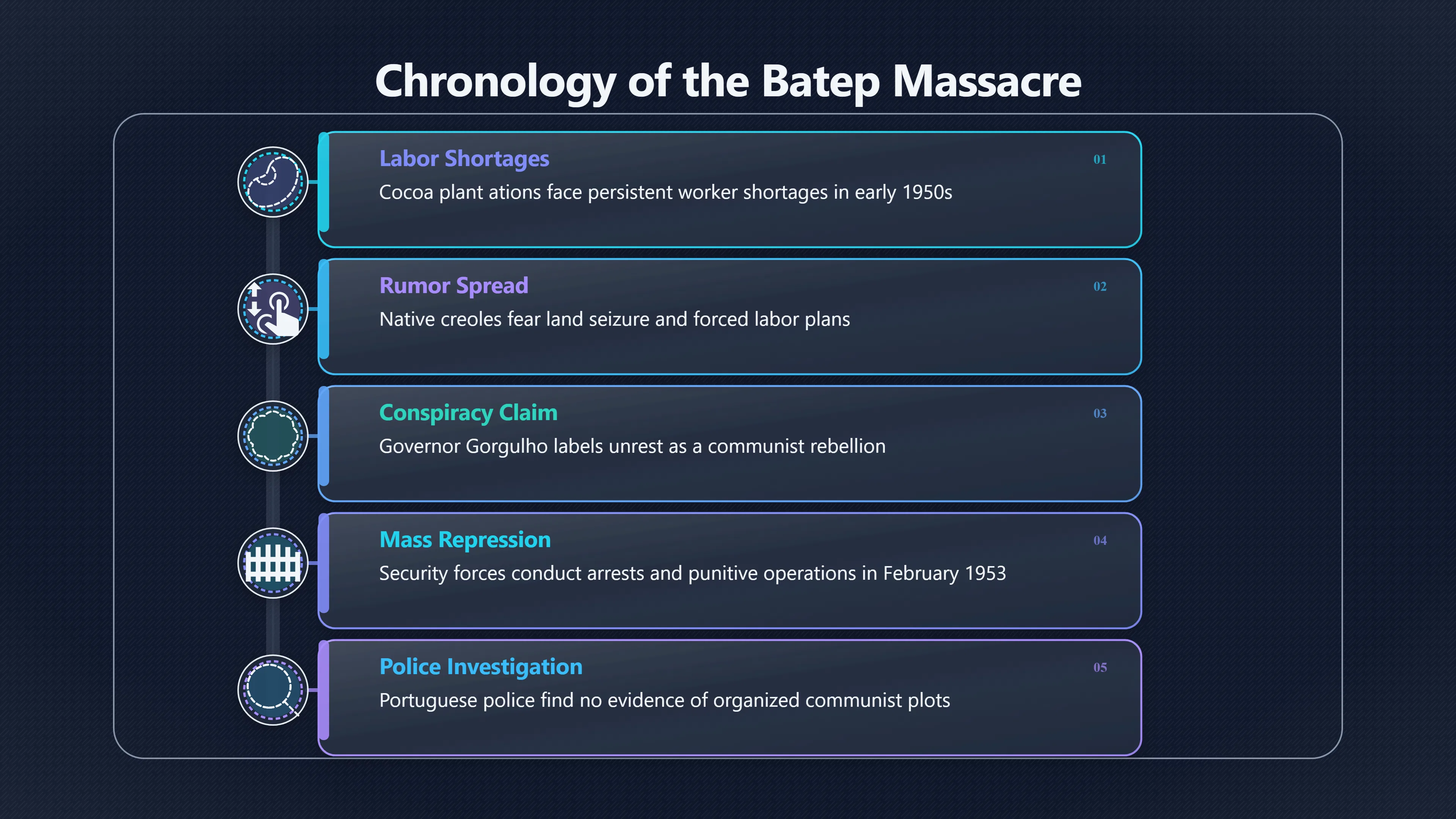
To understand why the conspiracy story gained traction, it is necessary to look at conditions on So Tom in the early 1950s. Cocoa plantations faced persistent labour shortages. Governor Carlos Gorgulho sought ways to increase the workforce and expand public works projects. At the same time, many native creoles, known as forros, fiercely resisted plantation labour because they associated it with earlier systems of coercion and servitude.[researchgate.net]researchgate.netResearchGate(PDF) The February 1953 Massacre in So TomPDF | In February 1953, on the orders of Governor Carlos Gorgulho the colonial po…
During 1952 and early 1953, rumours spread that the colonial administration planned to seize land from forros, settle large numbers of newcomers from Cape Verde, and ultimately force local people into plantation work. These fears were not irrational inventions. Colonial authorities had already used compulsory labour practices in public works projects, and police raids to recruit labourers had generated widespread resentment.[Wikipedia]WikipediaBatep massacreBatep massacre
As tensions grew, anonymous leaflets appeared and rumours circulated rapidly through the island. Rather than treating the unrest as a reaction to labour policies and social fears, the administration framed it as the work of agitators. Official statements warned that communists were spreading false information among the population. The label was politically useful in the early Cold War era, when anti-communism carried enormous weight throughout colonial empires.[Wikipedia]WikipediaBatep massacreBatep massacre
How the Conspiracy Claim Mobilised Repression
The crucial turning point came when Governor Gorgulho presented the unrest as evidence of an organised communist rebellion. According to contemporary accounts, he warned colonists that an uprising was imminent and encouraged them to arm themselves for protection. White settlers formed militias, while plantation interests mobilised additional supporters, including some contract labourers from elsewhere in Africa.[Wikipedia]WikipediaBatep massacreBatep massacre
The power of the conspiracy narrative lay not in evidence but in what it allowed authorities to do. Once unrest was defined as a revolutionary threat rather than a social dispute, extraordinary measures became easier to justify. Security forces conducted arrests, interrogations and punitive operations across the island. Individuals suspected of involvement were detained and tortured. In several documented incidents, prisoners died in custody or were killed outright. Bodies were buried in secret locations or disposed of at sea.[wikipedia.org]WikipediaBatep massacreBatep massacre
The repression quickly expanded beyond any identifiable organisers. The category of communist became a broad accusation applied to people who had little connection to political activism. Historians studying the events have found no convincing evidence that a coordinated revolutionary movement existed. Instead, the violence targeted a wider population already viewed by colonial authorities as troublesome, resistant to labour demands, or politically unreliable.[ResearchGate]researchgate.netResearchGate(PDF) The February 1953 Massacre in So TomPDF | In February 1953, on the orders of Governor Carlos Gorgulho the colonial po…
In this sense, the conspiracy claim functioned less as an intelligence assessment than as a political tool. It transformed labour resistance into a security emergency and gave official sanction to actions that would otherwise have been difficult to defend.[ResearchGate]researchgate.netResearchGate(PDF) The February 1953 Massacre in So TomPDF | In February 1953, on the orders of Governor Carlos Gorgulho the colonial po…

Why the Story Seemed Plausible
The false revolt narrative succeeded partly because it drew on several existing anxieties at once.
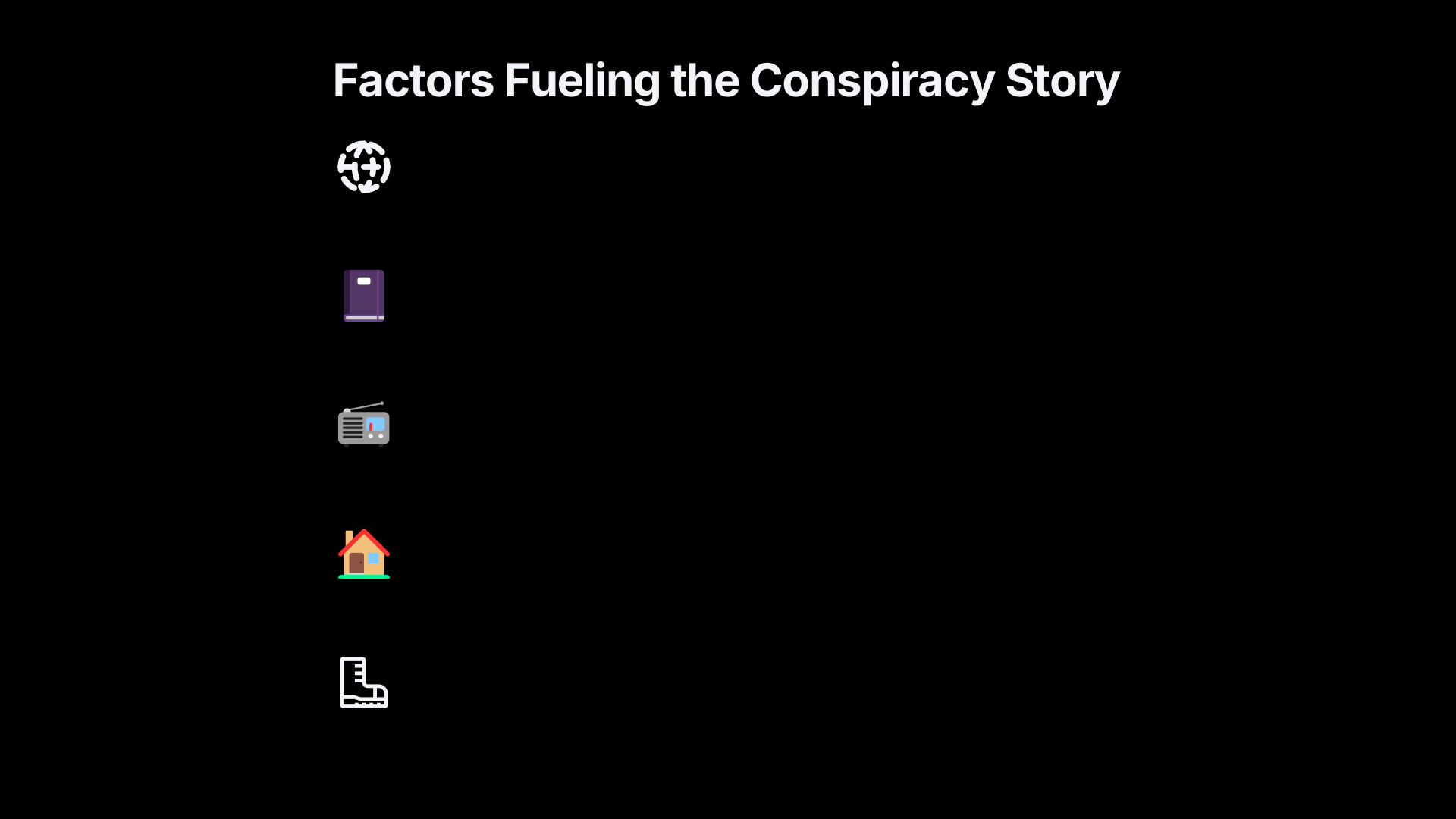
Cold War fears: Across the world in the early 1950s, governments frequently invoked communist subversion to explain unrest. Colonial officials understood that such claims would be taken seriously in Lisbon and among many settlers.[ResearchGate]researchgate.netResearchGate(PDF) The February 1953 Massacre in So TomPDF | In February 1953, on the orders of Governor Carlos Gorgulho the colonial po…
Labour conflict: Plantation owners genuinely faced labour shortages and viewed resistance to plantation work as a threat to the colony’s economy. This made it easier to portray opposition as organised sabotage rather than a social grievance.[ResearchGate]researchgate.netResearchGate(PDF) The February 1953 Massacre in So TomPDF | In February 1953, on the orders of Governor Carlos Gorgulho the colonial po…
Rumour and uncertainty: Because reliable information was scarce and tensions were already high, rumours travelled quickly. Authorities could present themselves as defenders of order while depicting critics as dangerous agitators.[Wikipedia]WikipediaBatep massacreBatep massacre
Colonial assumptions: Many Portuguese settlers and administrators already regarded forros as resistant to authority. Existing prejudices made allegations of rebellion easier for some audiences to accept.[CES - Centre for Social Studies]ces.uc.ptCentre for Social StudiesSO TOM: O MASSACRE DE BATEP (1953-2023)2 Feb 2023 Em 20 de abril de 1945, o coronel de artilharia, Ca…
The conspiracy story therefore did not emerge from a vacuum. It succeeded because it connected with fears that already existed, even though evidence for the alleged plot was lacking.
The Investigation That Found No Revolt
One of the most revealing aspects of the Batep story is what happened after the killings. In March 1953, investigators from Portugal’s political police apparatus arrived to examine the alleged communist conspiracy that had supposedly justified the crackdown. Their findings undermined the central claim.
The investigators concluded that there was no organised communist plot behind the unrest. No evidence emerged of a coordinated revolutionary network preparing an uprising against colonial rule. The official justification for the violence effectively collapsed under scrutiny.[Wikipedia]WikipediaBatep massacreBatep massacre
Yet the exposure of the claim did not produce accountability on the scale that might be expected. Governor Gorgulho was recalled to Lisbon, but the colonial system largely avoided a full reckoning. Public discussion remained constrained by censorship, and much of the wider world learned little about the massacre at the time.[Wikipedia]WikipediaBatep massacreBatep massacre
This gap between the weakness of the evidence and the scale of the repression is what makes the conspiracy allegation historically significant. The authorities had already achieved their immediate objective before the claim could be disproved.
From Colonial Propaganda to National Memory
Today, the Batep Massacre occupies a central place in So Toman historical memory. The event is commemorated annually on 3 February as the Day of the Martyrs of Freedom, and it is widely regarded as a catalyst for the development of modern So Toman nationalism.[wikipedia.org]WikipediaBatep massacreBatep massacre
The conspiracy story itself survives largely as an example of colonial propaganda. Historians examining surviving records have consistently emphasised the absence of evidence for the alleged communist uprising and the importance of labour conflicts and forced-labour fears in explaining the violence.[researchgate.net]researchgate.netResearchGate(PDF) The February 1953 Massacre in So TomPDF | In February 1953, on the orders of Governor Carlos Gorgulho the colonial po…
The lasting lesson of Batep is not that a secret rebellion was uncovered and defeated. It is almost the opposite. The episode demonstrates how an unsupported claim of conspiracy can acquire official authority, mobilise fear, and justify extraordinary violence. In the history of So Tom and Prncipe, few examples more clearly show the power of an invented threat to shape real events and leave consequences that endure for generations.[wikipedia.org]WikipediaBatep massacreBatep massacre
eBay marketplace picks
Marketplace Samples
Live-tested eBay searches with available results related to this page.



Endnotes
1.
Source: Wikipedia
Title: Batep massacre
Link:https://en.wikipedia.org/wiki/Batep%C3%A1_massacre
2.
Source: researchgate.net
Link:https://www.researchgate.net/publication/351091344_The_February_1953_Massacre_in_Sao_Tome_Crack_in_the_Salazarist_Image_of_Multiracial_Harmony_and_Impetus_for_Nationalist_Demands_for_Independence
Source snippet
ResearchGate(PDF) The February 1953 Massacre in So TomPDF | In February 1953, on the orders of Governor Carlos Gorgulho the colonial po...
Published: February 1953
3.
Source: ensina.rtp.pt
Link:https://ensina.rtp.pt/artigo/o-massacre-de-batepa/
Source snippet
RTP EnsinaO Massacre de BatepAssinala o episdio que tido como estando na origem do nacionalismo so-tomense. As vtimas da brutalidad...
4.
Source: ces.uc.pt
Title: massacre de batepa
Link:https://ces.uc.pt/en/agenda-noticias/agenda-de-eventos/2023/massacre-de-batepa
Source snippet
Centre for Social StudiesBatep Massacre - ces.uc.pt - Universidade de CoimbraIn this seminar, Gerhard Seibert and Ins Nascimento...
5.
Source: ces.uc.pt
Link:https://ces.uc.pt/ficheiros2/files/BATEPA_74_GERARD_SEIBERT.pdf
Source snippet
Centre for Social StudiesSO TOM: O MASSACRE DE BATEP (1953-2023)2 Feb 2023 Em 20 de abril de 1945, o coronel de artilharia, Ca...
6.
Source: persee.fr
Title: luso 1257 0273 1997 num 4 1 1089
Link:https://www.persee.fr/doc/luso_1257-0273_1997_num
Source snippet
PerseLe massacre de fvrier 1953 So Tom: raison d'tre du...by G Seibert 1997 Cited by 25 En fvrier 1953, sur ordre du gouv...
Additional References
7.
Source: nationaltoday.com
Title: National Today Commemoration of the Batep Massacre Feb
Link:https://nationaltoday.com/commemoration-of-the-batepa-massacre/
Source snippet
3, 202711 Jun 2026 This solemn day honors the hundreds of indigenous people murdered by colonists in 1953, a tragic event rooted in pro...
8.
Source: stories.workingclasshistory.com
Title: Working Class History Batep massacre
Link:https://stories.workingclasshistory.com/article/10174/batep%C3%A1-massacre
Source snippet
Working Class HistoryBatep massacre - WCH | Stories20 Jul 2022 The colony faced labour shortages. Plantation owners relied mostly on c...
9.
Source: youtube.com
Title: Mozambique Under Portuguese Rule | 400 Years of Colonialism
Link:https://www.youtube.com/watch?v=oDur3Yko3t0
Source snippet
"Batep" "Massacre" February 3, 1953: The Batep Massacre in So Tom and Prncipe Looking Back In Time...
Published: February 3, 1953
10.
Source: youtube.com
Link:https://www.youtube.com/watch?v=UA0ePxvqtXQ
Source snippet
Mozambique Under Portuguese Rule | 400 Years of Colonialism...
11.
Source: youtube.com
Title: Dark Forgotten History Facts About So Tom and Prncipe
Link:https://www.youtube.com/watch?v=_z5oYYAmB48
Source snippet
"Massacre de Batep 1953": SUN GLEZA - KW TEL...
12.
Source: facebook.com
Link:https://www.facebook.com/cacau.cultural/photos/o-massacre-de-batep%C3%A1-do-portugu%C3%AAs-coloquial-bate-p%C3%A1-teve-lugar-em-s%C3%A3o-tom%C3%A9-e-pr%C3%AD/1318329111523027/
13.
Source: academia.edu
Link:https://www.academia.edu/47728783/The_February_1953_Massacre_in_S%C3%A3o_Tom%C3%A9_Crack_in_the_Salazarist_Image_of_Multiracial_Harmony_and_Impetus_for_Nationalist_Demands_for_Independence
Published: February 1953
14.
Source: linkedin.com
Link:https://www.linkedin.com/posts/matthew-mcintosh-503783119_today-in-history-february-3-1953-the-activity-7292241936805937154-6eH7
15.
Source: thesaurus.ascleiden.nl
Link:https://thesaurus.ascleiden.nl/thes.php?cts=1&trm=Batep%EF%BF%BD+massacre
16.
Source: facebook.com
Title: feb 3 1953batepa massacre the massacre committed by portuguese colonial troops t
Link:https://www.facebook.com/munchie.keeton/posts/feb-3-1953batepa-massacre-the-massacre-committed-by-portuguese-colonial-troops-t/3902473576635249/
Topic Tree