Within Burundi Hoaxes
When Rumours Became Weapons in Burundi
During Burundi's crises, false or unverifiable claims could inflame fear, justify violence or help authorities silence scrutiny.
On this page
- How real events were reshaped into atrocity narratives
- Why crisis conditions made verification difficult
- When fake news claims became tools of control
Page outline Jump by section
Introduction
In Burundi, some of the most consequential false stories were not elaborate hoaxes but rumours, propaganda claims and competing narratives that flourished during moments of political crisis. During the unrest that followed President Pierre Nkurunziza’s controversial bid for a third term in 2015, reliable information became scarce, independent media outlets were attacked or closed, journalists fled into exile, and ordinary citizens often struggled to distinguish verified facts from fear-driven speculation. In that environment, rumours could trigger panic, justify repression, deepen ethnic suspicion or exaggerate atrocities. At the same time, authorities and political actors increasingly accused critics and journalists of spreading “fake news”, turning disputes over truth itself into part of the political struggle.[mediasupport.org]mediasupport.orgIMSRadio silenceBurundi's media during the 2015 election…Research for this report was conducted from 15 – 23 June 2015 and was based on interviews wit…

For a history of deception in Burundi, these episodes are important because they sit in a grey area between deliberate propaganda, sincere misunderstanding, political manipulation and genuine uncertainty. They reveal how difficult verification becomes when institutions are weak, violence is feared and access to independent information is restricted.
When Real Events Were Reshaped into Atrocity Narratives
Political violence creates fertile ground for rumours because some terrible events are real while details remain unclear. Burundi’s 2015 crisis produced exactly this situation. Protests, clashes, assassinations, disappearances and arrests were all occurring, but information often arrived through fragmented witness accounts, partisan networks and social media rather than through trusted national reporting.[Amnesty International]amnesty.orgburundi crisis the legacy of 2015 brings fear for 2020Amnesty InternationalBurundi crisis: The legacy of 2015 brings fear for 2020May 2, 2019 — 2 May 2019 — Since April 2015, real and perceiv…
In such circumstances, stories frequently grew larger as they travelled. A shooting could become a massacre. An arrest could become a disappearance. Reports of violence in one neighbourhood might be repeated elsewhere as evidence of a nationwide campaign. Some claims were later supported by investigations; others remained impossible to verify. The problem was not merely that people lied. It was that fear encouraged rapid transmission of unconfirmed information before evidence could catch up.[OHCHR]ohchr.orgCommission of Inquiry on BurundiThe Commission of Inquiry on Burundi outlines the serious human rights violations occurring in the c…
Burundi also carried the historical burden of earlier ethnic violence. Memories of past atrocities meant that many citizens interpreted new events through the lens of previous conflicts. Rumours therefore gained emotional credibility even when factual confirmation was lacking. A claim did not need proof to seem plausible if it resembled something people feared had happened before.[The Guardian]theguardian.comThe Guardian'Fake news' fuelled civil war in BurundiNow it's being used…28 Feb 2017 — Now they have to contend with their reporting branded as “fake” by the government, too. Though some…
This dynamic helps explain why political rumours in Burundi were rarely trivial. They could influence decisions about fleeing a community, joining a political movement or trusting state institutions. In extreme situations, rumours became part of the conflict rather than merely commentary about it.
Why Crisis Conditions Made Verification Difficult
The struggle over truth intensified because many of the institutions normally used to check claims were weakened during the crisis.
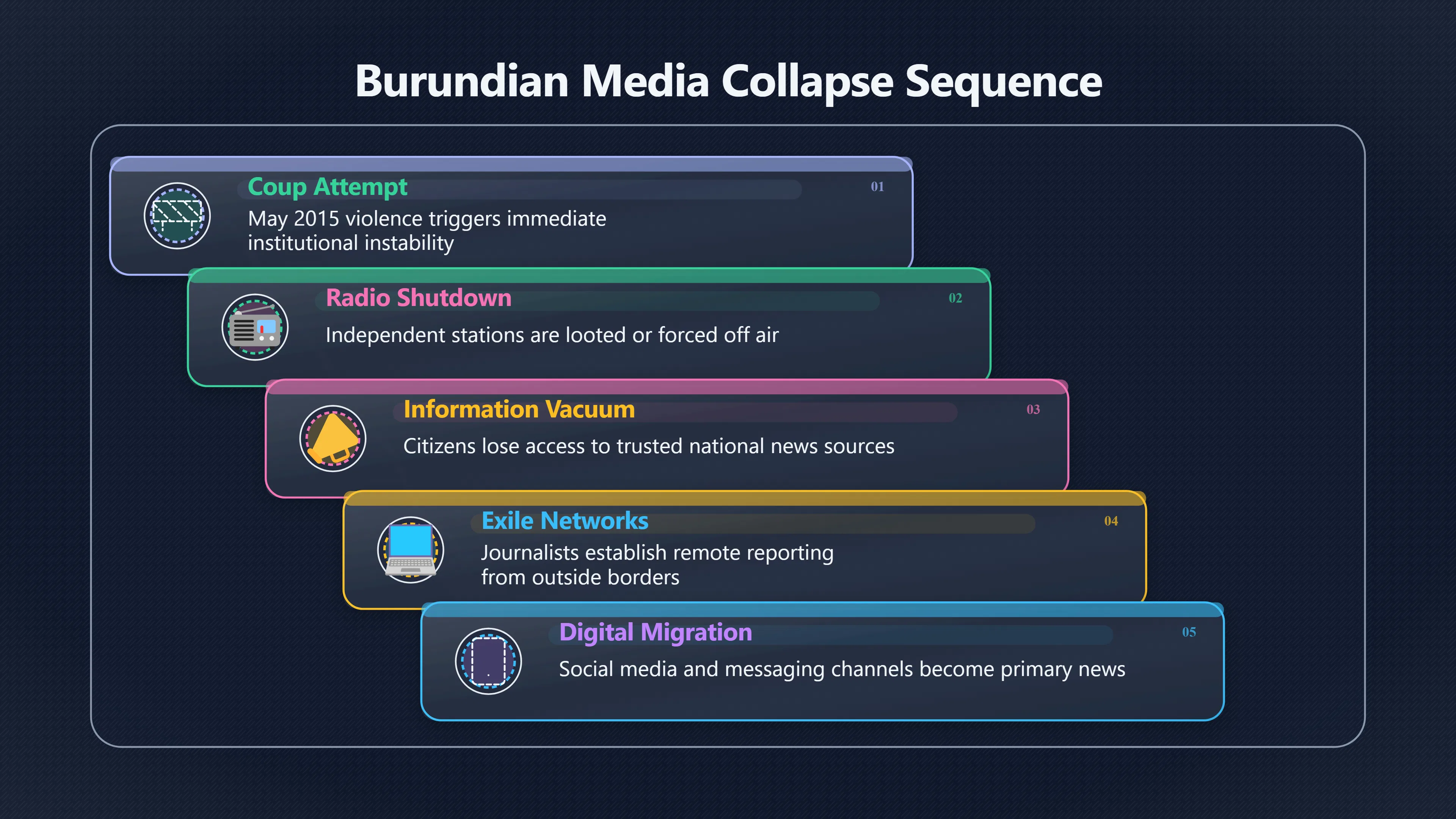
A crucial turning point came during and after the failed coup attempt of May 2015. Several major independent radio stations were attacked, looted or forced off the air. Burundi had long relied heavily on radio as a primary source of news, especially outside urban centres. When those stations disappeared, information vacuums emerged almost immediately.[Wikipedia]Wikipedia2015 Burundian coup attempt2015 Burundian coup attempt
The consequences were significant:
- Citizens lost access to familiar sources that could challenge rumours.
- Journalists had fewer opportunities to verify reports on the ground.
- Exiled media organisations increasingly relied on remote networks of informants.
- Social media and informal messaging channels became more influential.
- Competing political camps circulated their own versions of events.[mediasupport.org]mediasupport.orgIMSRadio silenceBurundi's media during the 2015 election…Research for this report was conducted from 15 – 23 June 2015 and was based on interviews wit…
The result was an environment where uncertainty itself became politically important. Even when nobody could prove a dramatic claim, the claim could still shape behaviour.
Researchers who study rumours note that uncertainty and high emotional stakes are ideal conditions for unverified stories to spread. Burundi’s crisis contained both. Citizens were making decisions about personal safety, political allegiance and possible displacement while lacking confidence in the available information. The speed of rumour transmission often exceeded the speed of investigation.[arXiv]arxiv.orgarXiv Detection and Resolution of Rumours in Social Media: A SurveyarXiv Detection and Resolution of Rumours in Social Media: A Survey
The Return of Ethnic Propaganda
One of the most worrying developments during the crisis was the reappearance of rhetoric that echoed earlier periods of ethnic division.
Many observers stressed that Burundi’s political conflict was not simply a replay of earlier Hutu–Tutsi violence. Nevertheless, journalists and human rights groups reported concern that inflammatory messages were reviving old fears and stereotypes. Rumours frequently framed political opponents as existential threats rather than rivals, encouraging audiences to see events through an ethnic lens.[The Guardian]theguardian.comThe Guardian'Fake news' fuelled civil war in BurundiNow it's being used…28 Feb 2017 — Now they have to contend with their reporting branded as “fake” by the government, too. Though some…
The danger of such propaganda was not necessarily that every claim was believed literally. Its power lay in reinforcing suspicion. Once people began assuming that hostile groups were secretly organising violence, almost any unverified report could appear credible.
This pattern has appeared in many conflict zones: rumours become persuasive not because evidence is strong but because audiences already expect the worst. Burundi’s experience illustrates how propaganda can exploit historical memory. Stories that fit established fears often travel further than stories that require careful verification.[The Guardian]theguardian.comThe Guardian'Fake news' fuelled civil war in BurundiNow it's being used…28 Feb 2017 — Now they have to contend with their reporting branded as “fake” by the government, too. Though some…
When “Fake News” Became a Tool of Control
A particularly revealing feature of Burundi’s information wars was the growing use of the language of “fake news”.
Around the world, governments and political actors have increasingly accused critics of spreading false information. In Burundi, press freedom organisations argued that authorities used such accusations not only to challenge inaccurate reporting but also to discredit independent journalism more broadly. Reporters Without Borders warned that the term was being deployed as a weapon against media organisations, while journalists described a climate in which critical reporting could be dismissed as fabrication regardless of the evidence.[Reporters Without Borders]rsf.orgfake news government weapon destroying independent mediafake news government weapon destroying independent media
This produced a paradox. Genuine misinformation certainly existed, yet the campaign against alleged misinformation could itself become a source of distortion.
When authorities portray unfavourable reporting as inherently false, citizens face a difficult choice:
- Trust official statements.
- Trust independent journalists.[time.com]time.comthreats press freedom marchthreats press freedom march
- Trust political opposition figures.
- Trust rumours circulating through personal networks.
In a healthy information environment, competing claims can be checked against multiple independent sources. In a restricted environment, that process becomes much harder.[hrw.org]hrw.orgHuman Rights Watch Burundi: Entrenched Repression of Civil Society, MediaHuman Rights Watch Burundi: Entrenched Repression of Civil Society, Media
The struggle therefore shifted from individual facts to the credibility of institutions. The question was no longer only whether a specific claim was true, but who had the authority to define truth.
Journalists, Exile Networks and Competing Realities
As media restrictions intensified, many Burundian journalists continued working from exile. New networks emerged to gather information from contacts inside the country and distribute it through websites, messaging platforms and social media. Organisations such as SOS Médias Burundi developed partly in response to the collapse of the traditional media landscape after 2015.[Wikipedia]WikipediaSOS Médias BurundiSOS Médias Burundi
These efforts helped preserve independent reporting, but they also faced challenges. Exiled journalists often had limited direct access to events. Governments could dismiss their reports as politically motivated. Audiences, meanwhile, had to decide which sources deserved trust.[Reporters Without Borders]rsf.orgfake news government weapon destroying independent mediafake news government weapon destroying independent media
The imprisonment and prosecution of journalists from independent outlets such as Iwacu became symbolic of the broader struggle over information. Human rights and press freedom groups argued that such actions contributed to a chilling effect in which reporters became more cautious and fewer independent voices remained available to verify contested claims.[amnesty.org]amnesty.orgInternational Burundi: Upholding journalists' conviction furtherInternational Burundi: Upholding journalists' conviction further
The practical consequence was that uncertainty persisted. The fewer independent observers available, the easier it became for rumours and propaganda to occupy the space where verified reporting would normally exist.
What These Episodes Reveal About Truth in Burundi
Burundi’s experience shows that political deception is not always a matter of a single fabricated story that can be neatly exposed and discarded. More often, the problem has been the erosion of conditions needed for reliable verification.
During periods of crisis, rumours spread because people urgently need information. Propaganda succeeds because it offers emotionally satisfying explanations. Claims of “fake news” become powerful because they attack trust itself. Once confidence in independent verification weakens, citizens can find themselves choosing among competing narratives rather than comparing established facts.[theguardian.com]theguardian.comThe Guardian'Fake news' fuelled civil war in BurundiNow it's being used…28 Feb 2017 — Now they have to contend with their reporting branded as “fake” by the government, too. Though some…
For historians of deception, Burundi provides a striking example of how falsehood can emerge from uncertainty as much as from fraud. The most important lesson is not that one side deceived and another told the truth. It is that when media pluralism collapses and fear dominates public life, rumours become political actors in their own right. In such circumstances, the struggle over truth becomes inseparable from the struggle over power.[mediasupport.org]mediasupport.orgIMSRadio silenceBurundi's media during the 2015 election…Research for this report was conducted from 15 – 23 June 2015 and was based on interviews wit…

Amazon book picks
Further Reading
Books and field guides related to When Rumours Became Weapons in Burundi. Use these as the next step if you want deeper reading beyond the article.
Manufacturing Consent
Provides background on information control and narrative framing.
eBay marketplace picks
Marketplace Samples
Live-tested eBay searches with available results related to this page.




Endnotes
1.
Source: mediasupport.org
Title: IMSRadio silence
Link:https://www.mediasupport.org/wp-content/uploads/2015/06/radio-silence-burundi-ims-2015.pdf
Source snippet
Burundi's media during the 2015 election...Research for this report was conducted from 15 – 23 June 2015 and was based on interviews wit...
Published: June 2015
2.
Source: Wikipedia
Title: 2015 Burundian coup attempt
Link:https://en.wikipedia.org/wiki/2015_Burundian_coup_attempt
3.
Source: amnesty.org
Title: burundi crisis the legacy of 2015 brings fear for 2020
Link:https://www.amnesty.org/en/latest/campaigns/2019/05/burundi-crisis-the-legacy-of-2015-brings-fear-for-2020/
Source snippet
Amnesty InternationalBurundi crisis: The legacy of 2015 brings fear for 2020May 2, 2019 — 2 May 2019 — Since April 2015, real and perceiv...
Published: May 2, 2019
4.
Source: ohchr.org
Link:https://www.ohchr.org/en/hr-bodies/hrc/co-i-burundi/co-i-burundi
Source snippet
Commission of Inquiry on BurundiThe Commission of Inquiry on Burundi outlines the serious human rights violations occurring in the c...
5.
Source: Wikipedia
Title: SOS Médias Burundi
Link:https://fr.wikipedia.org/wiki/SOS_M%C3%A9dias_Burundi
6.
Source: reliefweb.int
Title: Relief Web Burundian regime launches new media clampdown
Link:https://reliefweb.int/report/burundi/burundian-regime-launches-new-media-clampdown
7.
Source: arxiv.org
Title: arXiv Detection and Resolution of Rumours in Social Media: A Survey
Link:https://arxiv.org/abs/1704.00656
8.
Source: arxiv.org
Link:https://arxiv.org/abs/1804.03461
9.
Source: amnesty.org
Title: International Burundi: Upholding journalists’ conviction further
Link:https://www.amnesty.org/en/latest/news/2020/06/burundi-upholding-journalists-conviction-further-undermines-media-freedom/
10.
Source: time.com
Title: threats press freedom march
Link:https://time.com/5792232/threats-press-freedom-march/
11.
Source: state.gov
Link:https://www.state.gov/reports/2021-country-reports-on-human-rights-practices/burundi
12.
Source: theguardian.com
Title: The Guardian’Fake news’ fuelled civil war in Burundi
Link:https://www.theguardian.com/world/2017/feb/28/burundi-fake-news-fuelled-civil-war-used-again-resident-nkurunziza
Source snippet
Now it's being used...28 Feb 2017 — Now they have to contend with their reporting branded as “fake” by the government, too. Though some...
13.
Source: hrw.org
Link:https://www.hrw.org/news/2023/02/13/submission-human-rights-watch-united-nations-committee-against-torture-advance-its
Source snippet
Human Rights WatchSubmission by Human Rights Watch to the United Nations...13 Feb 2023 — This submission focuses on extra-judicial killi...
14.
Source: rsf.org
Title: fake news government weapon destroying independent media
Link:https://rsf.org/en/fake-news-government-weapon-destroying-independent-media
15.
Source: rsf.org
Title: predators press freedom use fake news censorship tool
Link:https://rsf.org/en/predators-press-freedom-use-fake-news-censorship-tool
16.
Source: hrw.org
Title: Human Rights Watch Burundi: Entrenched Repression of Civil Society, Media
Link:https://www.hrw.org/news/2021/05/26/burundi-entrenched-repression-civil-society-media
17.
Source: hrw.org
Title: cruel irony burundis media awards
Link:https://www.hrw.org/news/2020/05/07/cruel-irony-burundis-media-awards
18.
Source: hrw.org
Link:https://www.hrw.org/
Additional References
19.
Source: theadvocatesforhumanrights.org
Link:https://www.theadvocatesforhumanrights.org/News/A/Index?id=140
Source snippet
The Advocates for Human RightsBurundi: The Human Rights Crisis You May Not Have...17 Aug 2017 — Violence flared following President Pier...
20.
Source: youtube.com
Title: Burundi’s media vacuum
Link:https://www.youtube.com/watch?v=Ta85lKIh3cQ
Source snippet
Firebombed Media: Burundi on the Brink (Dispatch 3)...
21.
Source: youtube.com
Title: Fleeing to Rwanda: Burundi On The Brink (Dispatch 1)
Link:https://www.youtube.com/watch?v=y_7iwDiEgvE
Source snippet
The Spoils Of War: Burundi On The Brink (Dispatch 4)...
22.
Source: youtube.com
Title: Firebombed Media: Burundi on the Brink (Dispatch 3)
Link:https://www.youtube.com/watch?v=wbNSpmZTROg
Source snippet
Fleeing to Rwanda: Burundi On The Brink (Dispatch 1)...
23.
Source: youtube.com
Title: The Spoils Of War: Burundi On The Brink (Dispatch 4)
Link:https://www.youtube.com/watch?v=Je_1BonVfKY
Source snippet
Burundi coup attempt: How did the events unfold?...
24.
Source: facebook.com
Link:https://www.facebook.com/cgtnafrica/posts/burundi-had-hoped-that-by-promising-to-cooperate-fully-with-the-un-human-rights-/1504793282903539/
25.
Source: breakingburundi.com
Link:https://breakingburundi.com/burundian-journalists-face-arrests-censorship-and-hardship-says-2025-media-report/
26.
Source: researchgate.net
Title: 378540785 Fake news and peace journalism What are the implications
Link:https://www.researchgate.net/publication/378540785_Fake_news_and_peace_journalism_What_are_the_implications
27.
Source: GOV.UK
Title: human rights priority country update report july to december 2016
Link:https://www.gov.uk/government/publications/burundi-human-rights-priority-country/human-rights-priority-country-update-report-july-to-december-2016
Published: december 2016
28.
Source: humanrightsresearch.org
Title: truth and memory in burundi one journalist s challenge
Link:https://www.humanrightsresearch.org/post/truth-and-memory-in-burundi-one-journalist-s-challenge
Topic Tree