Within Yemen Hoaxes
How Fake Inscriptions Made Old Objects Valuable
Ancient objects could be newly made, falsely inscribed or given invented histories that made them seem more valuable.
On this page
- Three Ways an Antiquity Can Be Fake
- How Specialists Detect Added Inscriptions
- Looting, Dealers and Invented Provenance
Page outline Jump by section
Introduction
Ancient Yemen produced one of the richest inscriptional traditions in the ancient world. Thousands of texts survive in the distinctive South Arabian script, recording dedications, laws, construction projects, commercial transactions and royal achievements. That abundance created a paradox. The same prestige that makes genuine South Arabian artefacts valuable to historians and collectors also creates opportunities for forgery.

In the trade in Yemeni antiquities, an object does not have to be entirely modern to be deceptive. A genuine ancient object can be altered with a fake inscription, while an authentic artefact can be supplied with an invented ownership history that conceals looting or exaggerates significance. In many cases, the most profitable deception is not creating a fake object from scratch but making an ordinary object appear historically important. Museums, epigraphers and archaeologists have spent decades developing methods to detect such alterations and false provenance claims.[British Museum]britishmuseum.orgBritish Museumstatuette; forgery (the inscription)23 Jun 1992 — statuette; forgery (the inscription); Museum number: 1992,0623.3; Descr…
Three Ways an Antiquity Can Be Fake
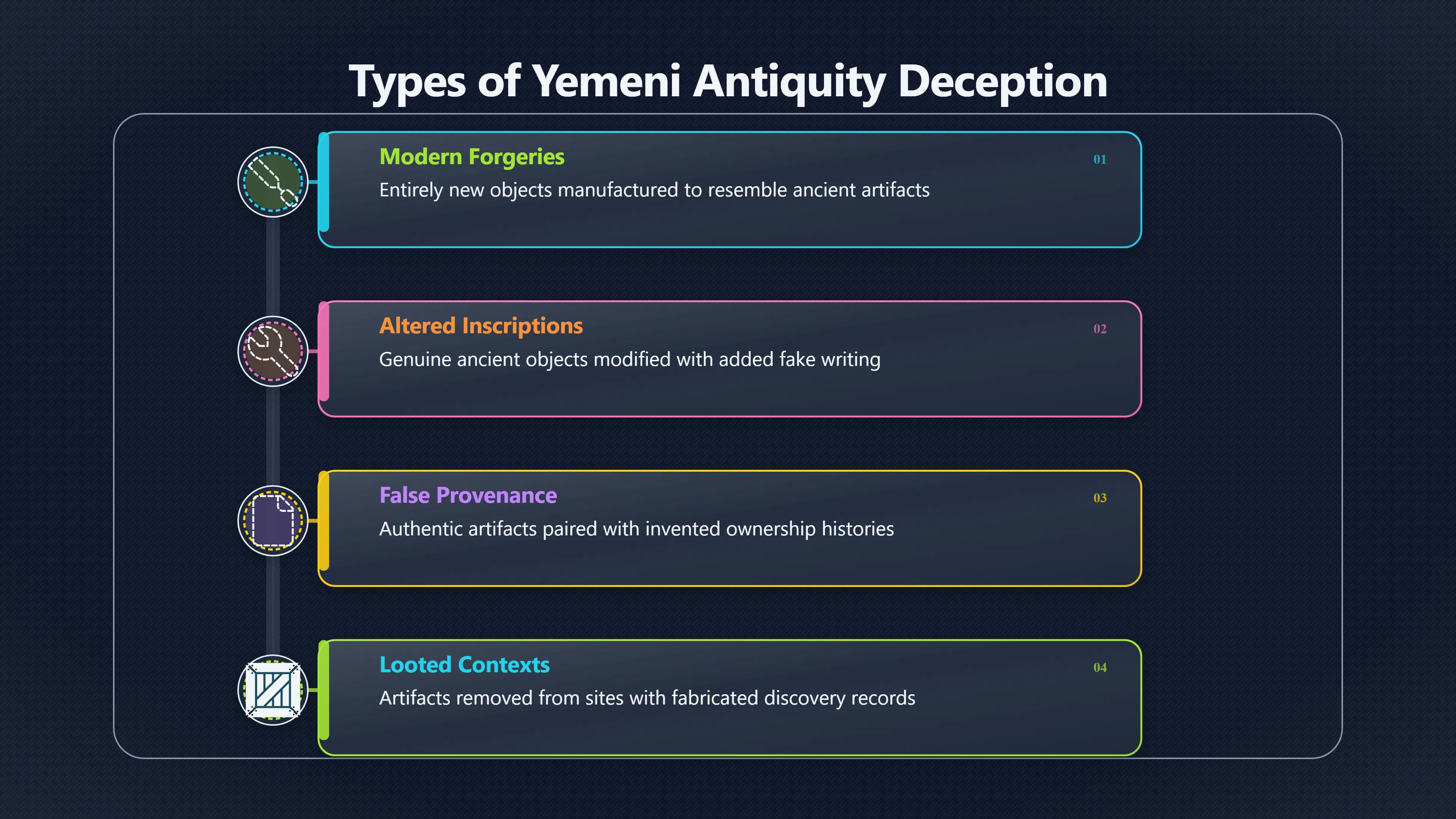
When people imagine forged antiquities, they often picture entirely modern copies. In practice, South Arabian antiquities can become deceptive in several different ways.
A completely modern forgery is the most straightforward case. A stone block, bronze figure or inscribed object is manufactured to resemble an ancient artefact. The British Museum holds a marble block carrying five lines of apparent South Arabian writing that is now catalogued simply as a nineteenth-century forgery. The object was created to look ancient, but specialists eventually recognised that neither the inscription nor the artefact itself was authentic.[British Museum]britishmuseum.orgBritish Museumblock; forgeryMuseum number: 117933; Description: Square marble block with 5 lines of inscription in South Arabian script…
An ancient object with a forged inscription is often more convincing. In this scenario, the underlying object may genuinely be old, but the writing was added later to increase value. The British Museum’s South Arabian camel statuette provides a clear example: the museum describes the inscription on the object as forged even though the statuette itself belongs to the ancient South Arabian tradition.[British Museum]britishmuseum.orgBritish Museumstatuette; forgery (the inscription)23 Jun 1992 — statuette; forgery (the inscription); Museum number: 1992,0623.3; Descr…
A genuine artefact with false provenance can be even harder to identify. The object may be authentic, yet the claimed discovery site, ownership history or collecting record is invented. Such stories can disguise recent looting, inflate rarity or create a misleading connection to a famous archaeological site. In the antiquities market, provenance often affects value as much as the object itself.[Hyperallergic]hyperallergic.comSale of Possibly Looted Yemeni Objects Raises Red FlagsSale of Possibly Looted Yemeni Objects Raises Red FlagsNovember 6, 2022 — 6 Nov 2022 — A Yemeni researcher alleges that doze…
The crucial lesson is that authenticity is not a single question. Archaeologists must ask whether the object is ancient, whether its inscription is ancient and whether its documented history is true.
How Fake Inscriptions Added Value
South Arabian inscriptions carry unusual prestige because they are historical documents as well as works of art. A plain bronze figure might be attractive, but a figure supposedly dedicated by a named ruler or associated with a known kingdom becomes much more desirable.
The attraction is strengthened by the nature of ancient Yemen’s written record. More than 10,000 South Arabian inscriptions are known, with many thousands digitised in modern databases. These texts preserve recognisable formulas, royal names, religious dedications and official language that can be copied by forgers.[cnr.it]dasi.cnr.itCorpus of South Arabian InscriptionsWith its over 15,000 inscriptions, it is the first-hand, written documentation of the culture that fl…
A forged inscription can therefore transform an anonymous artefact into an apparent historical document. Even a short text may suggest links to the kingdoms of Saba, Qataban, Hadramawt or Himyar. Buyers unable to read the script may assume that any convincing-looking inscription adds authenticity, while inexperienced collectors may mistake decorative carving for meaningful epigraphy. The visual authority of writing itself becomes part of the deception.[Wikipedia]WikipediaAncient South ArabianAncient South Arabian
Because ancient South Arabian scripts are unfamiliar to most people outside specialist circles, forged texts can sometimes circulate for years before attracting detailed scholarly scrutiny.
How Specialists Detect Added Inscriptions
Detecting forged South Arabian inscriptions rarely depends on a single dramatic discovery. Instead, specialists compare multiple kinds of evidence.
The Script Does Not Match Historical Usage
Ancient South Arabian writing followed established conventions that changed over time. Epigraphers study letter shapes, spelling habits, grammatical formulas and regional variations. An inscription that combines features from different centuries, uses impossible letter forms or imitates published examples too closely can raise immediate suspicion.[cnr.it]dasi.cnr.itCorpus of South Arabian InscriptionsWith its over 15,000 inscriptions, it is the first-hand, written documentation of the culture that fl…
Because thousands of authentic inscriptions are available for comparison, scholars possess a substantial reference corpus. Forgers may copy individual signs accurately yet still create texts that make little linguistic or historical sense.[dasi.cnr.it]dasi.cnr.itCorpus of South Arabian InscriptionsWith its over 15,000 inscriptions, it is the first-hand, written documentation of the culture that fl…
Tool Marks Reveal Modern Work
Stone and metal surfaces weather over centuries. Fresh carving often leaves traces that differ from ancient techniques.
Investigators examine:
- The sharpness of cut lines.
- Microscopic tool marks.
- Weathering patterns inside and outside the inscription.
- Corrosion layers on metal objects.
- Whether patina formed before or after carving.
If the inscription appears younger than the surrounding surface, suspicion increases. A genuinely ancient object can therefore be exposed as partially altered even when laboratory tests confirm the age of the underlying material.[British Museum]britishmuseum.orgBritish Museumstatuette; forgery (the inscription)23 Jun 1992 — statuette; forgery (the inscription); Museum number: 1992,0623.3; Descr…
The Archaeological Context Is Missing
An inscription excavated under controlled archaeological conditions carries far greater credibility than one that appears suddenly on the art market.
For this reason, provenance records are not a bureaucratic detail but part of the evidence. Specialists increasingly ask where an object was found, who owned it previously and whether documentation exists before recent decades. An impressive inscription with no reliable history may be treated cautiously regardless of its appearance.[Hyperallergic]hyperallergic.comSale of Possibly Looted Yemeni Objects Raises Red FlagsSale of Possibly Looted Yemeni Objects Raises Red FlagsNovember 6, 2022 — 6 Nov 2022 — A Yemeni researcher alleges that doze…
Looting, Dealers and Invented Provenance
False provenance became especially important as conflict and instability increased pressure on Yemen’s archaeological heritage.
Since the outbreak of conflict in the 2010s, international organisations and researchers have documented Yemeni artefacts appearing in overseas auctions and private sales. UNESCO reported that around one hundred objects believed to have been removed from Yemen after 2011 surfaced in European and American auction markets, illustrating how disrupted conditions can feed international demand.[Facebook]facebook.coman auction in the uk has sparked concerns over the sale of artefacts that researan auction in the uk has sparked concerns over the sale of artefacts that resear
In such circumstances, provenance can be manipulated in several ways:
- Inventing an old private collection that cannot be independently verified.
- Providing vague descriptions such as “acquired decades ago”.
- Omitting information about recent excavation or export.
- Attributing an artefact to a neighbouring country to avoid scrutiny.
- Combining fragments of genuine ownership histories into a misleading narrative.
These practices blur the line between forgery and trafficking. A genuine object with a fabricated history can become almost as misleading as a wholly fake artefact because researchers lose the contextual information needed to interpret it correctly.[hyperallergic.com]hyperallergic.comSale of Possibly Looted Yemeni Objects Raises Red FlagsSale of Possibly Looted Yemeni Objects Raises Red FlagsNovember 6, 2022 — 6 Nov 2022 — A Yemeni researcher alleges that doze…
Why False Provenance Matters to History
A forged inscription may deceive a collector, but false provenance can mislead entire fields of research.
Ancient South Arabian inscriptions are used to reconstruct political history, trade routes, religious practices and linguistic development. Scholars rely on where inscriptions were discovered as well as what they say. If an artefact is assigned to the wrong site, region or archaeological layer, it can distort historical conclusions.[dasi.cnr.it]dasi.cnr.itCorpus of South Arabian InscriptionsWith its over 15,000 inscriptions, it is the first-hand, written documentation of the culture that fl…
This is particularly important in Yemen because the inscriptional record is unusually large and detailed. Thousands of texts provide evidence for kingdoms, settlements and social networks across many centuries. Introducing forged texts or falsely provenanced artefacts into that record risks creating historical narratives based on manufactured evidence.[cnr.it]dasi.cnr.itCorpus of South Arabian InscriptionsWith its over 15,000 inscriptions, it is the first-hand, written documentation of the culture that fl…
The danger is not merely financial fraud. It is the possibility that invented objects or invented histories become mistaken for genuine pieces of the past.
Why the Problem Persists
The market for South Arabian antiquities combines several conditions that favour deception: valuable objects, a respected ancient civilisation, limited public familiarity with the script and ongoing demand from collectors.
At the same time, modern scholarship has become increasingly effective at exposing fraud. Large digital corpora of inscriptions, improved imaging techniques, detailed provenance research and collaboration between museums, archaeologists and epigraphers make it harder for forged texts to pass unchallenged.[dasi.cnr.it]dasi.cnr.itCorpus of South Arabian InscriptionsWith its over 15,000 inscriptions, it is the first-hand, written documentation of the culture that fl…
Yet the basic incentive remains unchanged. A few carved lines can appear to transform an ordinary object into a witness to the kingdoms of ancient Yemen. The history of forged South Arabian antiquities shows how easily writing, authority and rarity can be manufactured—and why specialists insist that authenticity depends not only on what an object looks like, but also on where it came from and how its story can be verified.[British Museum]britishmuseum.orgBritish Museumstatuette; forgery (the inscription)23 Jun 1992 — statuette; forgery (the inscription); Museum number: 1992,0623.3; Descr…
Amazon book picks
Further Reading
Books and field guides related to How Fake Inscriptions Made Old Objects Valuable. Use these as the next step if you want deeper reading beyond the article.
Archaeological Theory and the Politics of Cultural Heritage
Provides context for antiquities, provenance and heritage disputes.
The Oxford Handbook of the Archaeology of the Levant
Places South Arabian artefacts within the wider ancient Near Eastern world.
The Buried Book
Explores how ancient texts and artefacts are recovered and interpreted.
Fake? The art of deception
Directly addresses how fake artefacts and altered objects are identified.
eBay marketplace picks
Marketplace Samples
Live-tested eBay searches with available results related to this page.

Endnotes
1.
Source: dasi.cnr.it
Link:https://dasi.cnr.it/index.php?colId=0&corId=0&id=42&navId=876820445&prjId=1
Source snippet
Corpus of South Arabian InscriptionsWith its over 15,000 inscriptions, it is the first-hand, written documentation of the culture that fl...
2.
Source: hyperallergic.com
Title: Sale of Possibly Looted Yemeni Objects Raises Red Flags
Link:https://hyperallergic.com/sale-of-possibly-looted-yemeni-objects-raises-red-flags/
Source snippet
Sale of Possibly Looted Yemeni Objects Raises Red FlagsNovember 6, 2022 — 6 Nov 2022 — A Yemeni researcher alleges that doze...
Published: November 6, 2022
3.
Source: etana.org
Link:https://etana.org/node/7514
Source snippet
Corpus of South Arabian InscriptionsThe Ancient South Arabian epigraphic corpus will form a large database, with over ten thousand i...
4.
Source: Wikipedia
Title: Pre-Islamic Arabian inscriptions
Link:https://en.wikipedia.org/wiki/Pre-Islamic_Arabian_inscriptions
5.
Source: Wikipedia
Title: Ancient South Arabian
Link:https://en.wikipedia.org/wiki/Ancient_South_Arabian
6.
Source: Wikipedia
Title: Ancient South Arabian script
Link:https://en.wikipedia.org/wiki/Ancient_South_Arabian_script
7.
Source: facebook.com
Title: an auction in the uk has sparked concerns over the sale of artefacts that resear
Link:https://www.facebook.com/MiddleEastEye/posts/an-auction-in-the-uk-has-sparked-concerns-over-the-sale-of-artefacts-that-resear/525450356285074/
8.
Source: facebook.com
Link:https://www.facebook.com/100091249837062/posts/marble-inscription-from-yemen-dated-to-the-6th-century-ce-bears-text-in-ancient-/950609294657390/
9.
Source: facebook.com
Link:https://www.facebook.com/groups/restitutionmatters/posts/3558045917678428/
10.
Source: unesdoc.unesco.org
Title: pf0000374664 eng
Link:https://unesdoc.unesco.org/ark%3A/48223/pf0000374664_eng
11.
Source: britishmuseum.org
Link:https://www.britishmuseum.org/collection/object/W
Source snippet
British Museumstatuette; forgery (the inscription)23 Jun 1992 — statuette; forgery (the inscription); Museum number: 1992,0623.3; Descr...
12.
Source: britishmuseum.org
Link:https://www.britishmuseum.org/collection/object/W
Source snippet
British Museumblock; forgeryMuseum number: 117933; Description: Square marble block with 5 lines of inscription in South Arabian script...
13.
Source: ial.uk.com
Title: va agreement with yemen to care for ancient objects found in london shop
Link:https://ial.uk.com/va-agreement-with-yemen-to-care-for-ancient-objects-found-in-london-shop/
Source snippet
Institute of Art and LawV&A Agreement with Yemen to Care for Ancient Objects...27 Sept 2023 — the objects, dated to the second half of t...
14.
Source: middleeasteye.net
Title: researchers raise concerns over UK auction artefacts similar yemen ones
Link:https://www.middleeasteye.net/news/researchers-raise-concerns-over-UK-auction-artefacts-similar-yemen-ones
Additional References
15.
Source: youtube.com
Title: How the United States and Yemen Work Together to Combat Art Crime | WETA Arts
Link:https://www.youtube.com/watch?v=Dc0md2ivsOE
Source snippet
World heritage at risk in Yemen | Curator's Corner S1 Ep6 #CuratorsCorner...
16.
Source: youtube.com
Title: Colin Renfrew
Link:https://www.youtube.com/watch?v=Gpz3UBP3vU4
Source snippet
Press Conference: The Need for Prosecuting Participants in the Illegal Antiquities Trade...
17.
Source: youtube.com
Title: Yemen’s looted artefacts are turning up in global auction houses
Link:https://www.youtube.com/watch?v=niQBnrBnSdE
Source snippet
How the United States and Yemen Work Together to Combat Art Crime | WETA Arts...
18.
Source: youtube.com
Title: World heritage at risk in Yemen | Curator’s Corner S1 Ep6 #Curators Corner
Link:https://www.youtube.com/watch?v=fQNTEMgGT6c
Source snippet
Colin Renfrew - The issue of unprovenanced antiquities (61/79)...
19.
Source: researchgate.net
Link:https://www.researchgate.net/publication/369778415_Minaeans_in_the_Mediterranean_Reevaluating_two_Old_South_Arabian_inscriptions_from_Delos
20.
Source: academia.edu
Link:https://www.academia.edu/4107085/South_Arabian_Inscriptions_from_the_Faras%C4%81n_Islands_Saudi_Arabia_poster_
21.
Source: restitutionmatters.org
Link:https://restitutionmatters.org/news-item/yemen-identifies-looted-artifacts-at-british-museum/
22.
Source: ojs.unito.it
Link:https://ojs.unito.it/index.php/kervan/article/download/11451/9471/37850
23.
Source: youtube.com
Link:https://www.youtube.com/watch?v=VD-V-fEOUgQ
24.
Source: leidenislamblog.nl
Title: old weird arabia south arabian inscriptions and medieval islam
Link:https://www.leidenislamblog.nl/articles/old-weird-arabia-south-arabian-inscriptions-and-medieval-islam
Topic Tree