Which Lithuanian Stories Were Too Good to Be True?
Lithuania’s history of hoaxes is not dominated by carnival monsters or spectacular newspaper pranks. Its most revealing cases concern something more consequential: the manufacture of historical authority, the exploitation of institutional trust and the use of fabricated stories to weaken public confidence.
Page outline Jump by section
Introduction
These episodes are not all the same. The Roman-origin story was a political foundation myth rather than a modern confidence trick. Some documents associated with historian Teodor Narbutt remain disputed rather than conclusively exposed. Recent military stories, by contrast, were demonstrably fabricated and distributed as disinformation. Examining them together shows how falsehood becomes persuasive when it arrives in a familiar form: an ancient chronicle, an official-looking seal, a routine business invoice or a report apparently published by a trusted news organisation.
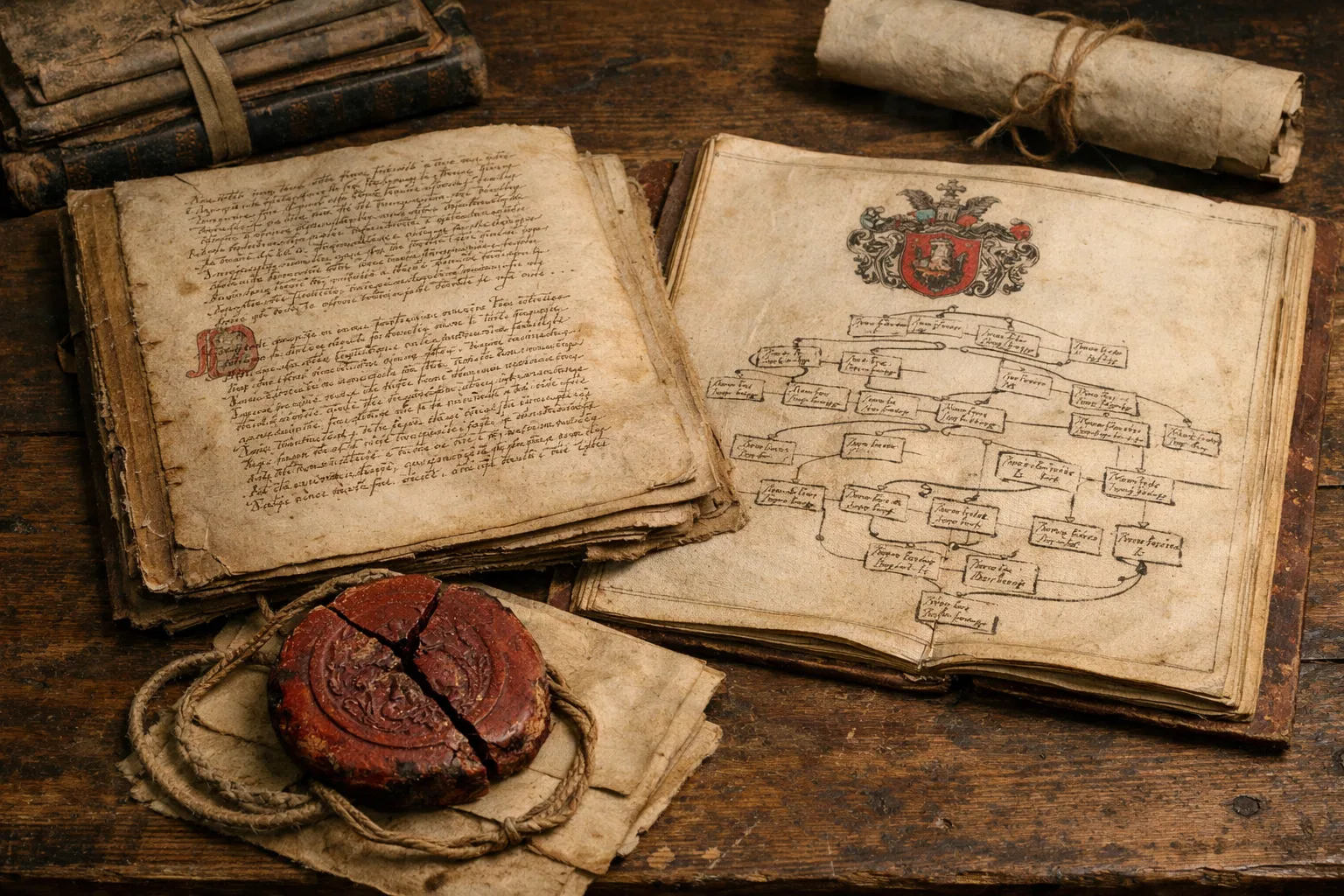
How Lithuania acquired imaginary Roman ancestors
One of Lithuania’s most durable invented traditions claimed that the country’s ruling elite descended from Romans led by a nobleman called Palemon. According to versions recorded in the Lithuanian chronicles, Palemon and hundreds of Roman families escaped imperial turmoil, travelled to the Baltic and established a dynasty from which Lithuanian rulers and noble families supposedly descended. The details varied: chroniclers moved the migration between different centuries and altered genealogies when the chronology became impossible to sustain.[ceu.edu]etd.ceu.eduTHE ROMAN MYTH: CONSTRUCTING COMMUNITY IN…May 19, 2016 — by M Shpakau · 2016 — This study is dedicated to the analysis of the Roman…
This was not a hoax in the simple sense of one fraudster planting a false object. It was a prestige-building origin story created in a period when ancestry carried political weight. The legend emerged in written form in the early sixteenth century, when the Grand Duchy of Lithuania’s elite was defending its status in relation to Poland and other neighbouring powers. A Roman lineage offered antiquity, civilisation and political dignity. It answered hostile portrayals of Lithuania as a recently Christianised and culturally inferior land by giving its nobility an ancestry as distinguished as anyone else’s.[wikipedia.org]WikipediaLithuanian ChroniclesLithuanian Chronicles
The story gained strength through repetition and elaboration. Noble families could attach their own genealogies to the supposed Roman settlers, turning a state myth into a source of family status. The Pac family, for example, developed a claimed connection to the Florentine Pazzi, while other leading houses traced themselves to Palemon or his companions. Such claims could assist diplomacy, social advancement and the performance of aristocratic rank, even when their factual foundations were absent.[llti.lt]llti.ltPACA S OR PAZZI?NEW INTERPRETATION OF…May 9, 2006 — Therefore, the aim of this article is to analyze the legend of presumed kinship between the. Lithu…
Modern historians treat Palemon as a legendary figure, not a historical founder. The contradictory dates and constantly adjusted family trees are evidence of literary construction rather than preserved memory. Yet dismissing the tale as merely foolish misses its importance. It reveals how early modern historical writing could function as political argument. The chroniclers were not simply filling a gap in knowledge; they were giving the Grand Duchy a usable past.
The Palemon story also demonstrates the difference between a legend and a forgery. No surviving Roman passenger list was counterfeited to prove it. Its authority arose from chronicle tradition, repetition and the desire for an honourable national genealogy. It circulated because it was culturally useful long before modern standards of source criticism made its weaknesses obvious.
Teodor Narbutt and the documents that knew too much
The most intriguing Lithuanian forgery controversy centres on Teodor Narbutt, a nineteenth-century writer whose nine-volume history attempted to reconstruct Lithuania’s distant past. Narbutt worked when surviving evidence for early Lithuanian history was limited and scattered. He collected folklore, copied documents and publicised chronicles, but he was also criticised for weak source criticism and for relying on manuscripts with suspicious histories. Scholars continue to distinguish between careless belief, creative reconstruction and deliberate fabrication in assessing his work.[ceeol.com]ceeol.comarticle detailarticle detail
The clearest problem is the so-called Chronicle of Rivius. Narbutt said that he had bought the German-language manuscript in Reval, now Tallinn, in 1808. He later used it as evidence for episodes and artefacts that appeared to fill major gaps in Lithuania’s history. Researcher Artūras Dubonis identified confused authorship, uncertain provenance, chronological errors, improbable events and drawings of apparently fictitious objects. These features led him to judge the chronicle most probably a forgery associated with Narbutt, while acknowledging that a final verdict would require further study.[lituanistika.lt]lituanistika.ltOpen source on lituanistika.lt.
The document’s convenience is part of what makes it suspicious. It seemed to preserve exactly the kinds of lost information that Narbutt needed, including material concerning medieval rulers, inscriptions and early Vilnius. Dubonis showed that some passages could be traced to works published during Narbutt’s own lifetime rather than to the period in which the chronicle was supposedly written. A description of a 1610 Vilnius fire, for example, appears to have drawn on a nineteenth-century history and then altered its details.[Academia]academia.eduOpen source on academia.edu.
Other sources promoted by Narbutt have also been questioned. They include a supposed account of Count Konrad von Kyburg’s journey through Lithuania in 1397, the Raudonė Chronicle and documents concerning Vilnius. Originals were sometimes missing, known only through Narbutt’s copies or translations, making independent testing difficult. This pattern encouraged the suspicion that scarce documentary evidence had been supplemented by invention.[Wikipedia]WikipediaTeodor NarbuttTeodor Narbutt
Yet the Narbutt affair contains an important warning against overconfident debunking. The Bychowiec Chronicle, which he published in full in 1846, was once suspected of being another of his inventions. Later evidence showed that portions had circulated before his publication, and in 2011 researchers found a substantial manuscript fragment in Kraków. The discovery supported the chronicle’s authenticity and showed that Narbutt’s bad reputation had encouraged scholars to doubt a genuine source.[llti.lt]llti.ltOpen source on llti.lt.
Narbutt therefore cannot be reduced to a stock image of a forger caught red-handed. His legacy is a mixture of valuable recovery, romantic nationalism, credulity and suspected fabrication. The case matters because it shows how reputational judgement can cut both ways: an unreliable historian may transmit false material, but assuming that everything he touched was fake can also lead investigators astray.
Is the seal of King Mindaugas genuine?
A second medieval controversy concerns the seal attached to a document dated October 1255, in which King Mindaugas supposedly granted territory to the Teutonic Order. If authentic, it would be the only surviving contemporary image of Lithuania’s first and only crowned king. That exceptional importance has made the object both a national treasure and a focus of long-running suspicion.[Wikipedia]WikipediaSeal of MindaugasSeal of Mindaugas
Doubts were raised as early as the nineteenth century. Critics noted that the wax and fastening appeared inconsistent, suggesting that a genuine seal might have been moved from another document or that the whole arrangement was assembled later. The inscription containing Mindaugas’s name is largely destroyed even though much of the rest survives, prompting suggestions that inconvenient lettering had deliberately been removed.[Wikipedia]WikipediaSeal of MindaugasSeal of Mindaugas
Heraldic analysis produced a particularly serious objection. Edmundas Rimša argued that the seal’s Gothic lattice pattern belonged to a later European style and therefore could not have been made in 1255. On that reading, the seal was fabricated at least several decades after the date claimed by the document. Other scholars have defended its authenticity, proposing that it was detached and subsequently reattached, which could explain some physical irregularities.[Wikipedia]WikipediaSeal of MindaugasSeal of Mindaugas
This is best described as a contested forgery, not a solved hoax. The document may have been produced or altered by the Teutonic Order during later territorial disputes, but scholarship has not produced a universally accepted reconstruction of exactly when, how or by whom. Its value as a case study lies in the investigative process: handwriting, heraldic fashion, wax, attachment methods and political advantage all become evidence.
It also illustrates why prestigious objects can survive serious doubts. The seal offers something emotionally and visually powerful: the apparent face of a foundational ruler. An uncertain medieval object can become culturally persuasive because it satisfies a desire that fragmentary written records cannot.

The false rape report aimed at NATO
On 14 February 2017, Lithuanian politicians and news organisations received messages alleging that German soldiers stationed near Jonava had raped an underage girl. The troops had recently arrived as part of NATO’s enhanced deployment in Lithuania. Police and other authorities rapidly checked the accusation and found that no such incident had been reported. Prosecutors opened an investigation into the source of the false claim.[reuters.com]reuters.comLithuania looking for source of false accusation of rape byLithuania looking for source of false accusation of rape by
The fabrication borrowed the structure of a potent moral panic. It combined a vulnerable child, foreign troops and an alleged institutional cover-up. Even without credible evidence, those ingredients could provoke anger before officials had time to respond. The timing also made the story strategically useful: NATO’s new presence depended partly on local acceptance, and a sexual-crime allegation could turn public opinion against German forces far more effectively than an abstract political argument.
NATO officials attributed the operation to Russia, although Lithuania’s defence minister initially noted that other actors had not been ruled out publicly. The Russian foreign ministry did not respond to Reuters’ request concerning NATO’s allegation. That distinction matters: the story was conclusively false, but public evidence identifying its author was less complete than the evidence disproving the alleged crime.[Reuters]reuters.comExpect more fake news from Russia, top NATO general saysExpect more fake news from Russia, top NATO general says
The attempt failed largely because officials, journalists and military personnel shared information quickly. The absence of a victim, complaint or police record was established before the claim could gain broad acceptance. Lithuania’s previous experience with hostile information operations also meant that institutions were prepared to treat an inflammatory anonymous message as something to verify rather than automatically amplify.[procon.bg]procon.bgOpen source on procon.bg.
The episode nevertheless became a model for later fabrications. The objective was not necessarily to persuade every reader that the alleged assault happened. It was enough to create suspicion, force denials and associate NATO troops with danger.
When hackers made fake stories look real
Later campaigns improved on the anonymous-email method by placing fabrications on genuine or convincingly imitated news websites. In June 2018, a report designed to resemble an article from the Lithuanian news outlet Delfi falsely claimed that a United States armoured vehicle had struck and killed a boy on a bicycle during military exercises. Lithuania’s defence minister publicly identified it as fake.[Reuters Japan]jp.reuters.comJapan Lithuania sees fake news attempt to discredit NATOJapan Lithuania sees fake news attempt to discredit NATO
Other stories claimed that NATO planned to invade Belarus, that German troops had desecrated a Jewish cemetery and that an American soldier had brought the first case of coronavirus into Lithuania. In several instances, attackers compromised legitimate publishing systems or used stolen credentials, briefly placing the stories inside familiar media environments. Photographic manipulation and spoofed emails then helped spread the links.[lrt.lt]lrt.ltOpen source on lrt.lt.
This technique, associated by researchers with the campaign known as Ghostwriter, solved one of the traditional problems faced by propagandists: an obscure fake-news site carries little authority. A false report appearing on an established local website inherits the publication’s branding, layout and accumulated reputation. Readers encountering a shared link may see the trusted domain and never notice that the newsroom did not create the article.[The Guardian]theguardian.comThe Guardian Russia-aligned hackers running anti-Nato fake newsThe Guardian Russia-aligned hackers running anti-Nato fake news
The subjects were chosen carefully. Dead children, infected soldiers, damaged graves and invasion plans are easy to understand and emotionally difficult to ignore. They also activate real sensitivities: fear of military accidents, memories of occupation, concern about foreign forces and the particular horror of antisemitic desecration. The fiction is therefore attached to circumstances that are genuine even though the reported incident is not.
These cases show why modern debunking cannot rely only on judging whether a story “looks professional”. Attackers can copy professional appearance or temporarily occupy the real platform. Verification instead depends on checking whether named institutions confirm the event, whether local authorities have records, whether photographs are authentic and whether several independent newsrooms can establish the same facts.

The invoice fraud that exploited routine trust
Lithuanian citizen Evaldas Rimasauskas carried out one of the best-known business email compromise schemes of the 2010s. Between 2013 and 2015, he and others impersonated a genuine Asian computer-hardware supplier that conducted business with major American technology companies. Using deceptive emails, forged contracts and false invoices, the scheme induced employees to transfer more than $120 million into accounts controlled by the fraudsters. Rimasauskas pleaded guilty to wire fraud and was sentenced in the United States to five years in prison in 2019.[Justice.gov]justice.govLithuanian Man Sentenced To 5 Years In Prison For TheftLithuanian Man Sentenced To 5 Years In Prison For Theft
The deception did not depend on an exotic technical exploit. It worked by copying the ordinary paperwork and communication patterns of a legitimate commercial relationship. The targets were expecting large invoices from the real supplier, so forged requests could be treated as routine rather than extraordinary. Money was routed through bank accounts in several countries, supported by fabricated documents intended to survive compliance checks.[Justice.gov]justice.govLithuanian Man Sentenced To 5 Years In Prison For TheftLithuanian Man Sentenced To 5 Years In Prison For Theft
The people processing the transfers were not persuaded by a bizarre tale. They were persuaded by familiarity: a known vendor, plausible sums, recognisable corporate language and documentation that appeared to fit an existing workflow. That makes the affair a useful counterpart to Lithuania’s historical forgery cases. The Roman genealogy and Rivius Chronicle borrowed the authority of historical writing; the Rimasauskas fraud borrowed the authority of accounts departments and supplier records.
The case also complicates popular images of online fraud. Enormous companies with advanced security systems can still be vulnerable when a request passes through a trusted administrative channel. Technical defences matter, but so do independent confirmation, separation of payment duties and scepticism when banking details suddenly change.
Why these stories remain persuasive
Lithuania’s best-documented hoaxes and disputed fakes share no single motive. Some offered noble ancestry. Some may have enhanced a historian’s reputation or supplied evidence for a preferred national story. Commercial fraud sought money, while anti-NATO fabrications sought political disruption. What joins them is their use of borrowed credibility.
The most effective Lithuanian cases did not ask people to believe something wholly unfamiliar. They inserted false material into systems already trusted:
- a chronicle supplied an ancient origin;
- a royal seal seemed to authenticate a medieval grant;
- a supposed lost manuscript filled holes in national history;
- a corporate invoice resembled legitimate business;
- a hacked news site made propaganda look like journalism.
Exposure likewise required more than declaring that a claim sounded unlikely. Historians compared manuscripts, sources and artistic styles. Prosecutors followed bank transfers and forged paperwork. Police checked whether alleged crimes had victims or records. Cybersecurity investigators examined stolen credentials, manipulated images and compromised publishing systems.[lituanistika.lt]lituanistika.ltOpen source on lituanistika.lt.
Lithuania’s recent response has included professional fact-checkers, state monitoring and volunteer groups commonly described as “elves”, who identify coordinated falsehoods and report fraudulent accounts. Their emergence reflects the frequency with which the Baltic information environment has been targeted, but it also carries a broader lesson: debunking works best when institutions can respond rapidly without treating every disputed claim as enemy action.[Time]time.comMeet the Lithuanian 'Elves' Fighting Russian DisinformationMeet the Lithuanian 'Elves' Fighting Russian Disinformation
The country’s hoax history is therefore not a catalogue of national gullibility. It is a history of contested authority. People believed, repeated or at least considered these claims because they arrived through forms associated with truth. The lasting question is not simply why anyone was fooled, but how the appearance of legitimacy was constructed—and how investigators learned to look behind it.
Amazon book picks
Further Reading
Books and field guides related to Which Lithuanian Stories Were Too Good to Be True?. Use these as the next step if you want deeper reading beyond the article.
The History of Lithuania
Covers the historical background behind many Lithuanian myths and controversies.
The Demon-Haunted World
Rating: 4.5/5 from 43 Google Books ratings
Relevant to myths, hoaxes and questionable historical claims.
eBay marketplace picks
Marketplace Samples
Live-tested eBay searches with available results related to this page.


Endnotes
1.
Source: Wikipedia
Title: Lithuanian Chronicles
Link:https://en.wikipedia.org/wiki/Lithuanian_Chronicles
2.
Source: researchgate.net
Title: Research Gate From imagination to political reality?
Link:https://www.researchgate.net/publication/333751399_From_imagination_to_political_reality_The_Grand_Duchy_of_Lithuania_as_a_successor_of_Rome_in_the_early_modern_historiography_15th-18th_centuries
Source snippet
The Grand Duchy of...13 Jun 2019 — According to subsequent chronicles, the founder of the new state was Palemon (Publius Libon, initiall...
3.
Source: llti.lt
Title: PACA S OR PAZZI?
Link:https://www.llti.lt/failai/e-zurnalai/SLL18/XVIIIrez167-168.pdf
Source snippet
NEW INTERPRETATION OF...May 9, 2006 — Therefore, the aim of this article is to analyze the legend of presumed kinship between the. Lithu...
Published: May 9, 2006
4.
Source: ceeol.com
Title: article detail
Link:https://www.ceeol.com/search/article-detail?id=1035248
5.
Source: Wikipedia
Title: Teodor Narbutt
Link:https://en.wikipedia.org/wiki/Teodor_Narbutt
6.
Source: researchgate.net
Link:https://www.researchgate.net/publication/351735333_At_the_Foundations_of_Narbutt%27s_Vision_of_Lithuania_and_the_Relations_Between_Poland_and_Lithuania
7.
Source: lituanistika.lt
Link:https://www.lituanistika.lt/content/20282
8.
Source: academia.edu
Link:https://www.academia.edu/107672097/The_Case_of_the_Chronicle_of_Rivius
9.
Source: Wikipedia
Title: Chronicle of Rivius
Link:https://en.wikipedia.org/wiki/Chronicle_of_Rivius
10.
Source: llti.lt
Link:https://www.llti.lt/failai/Kestutis%20Gudmantas%2C%20Nadezda%20Morozova%2C%20The%20Wawel%20Manuscript%20of%20the%20Lithuanian%20Chronicles.pdf
11.
Source: Wikipedia
Title: Seal of Mindaugas
Link:https://en.wikipedia.org/wiki/Seal_of_Mindaugas
12.
Source: reuters.com
Title: Lithuania looking for source of false accusation of rape by
Link:https://www.reuters.com/article/world/lithuania-looking-for-source-of-false-accusation-of-rape-by-german-troops-idUSKBN15W1L9/
13.
Source: reuters.com
Title: Expect more fake news from Russia, top NATO general says
Link:https://www.reuters.com/article/world/expect-more-fake-news-from-russia-top-nato-general-says-idUSKBN15X08U/
14.
Source: procon.bg
Link:https://procon.bg/article/why-fake-rape-story-against-german-nato-forces-fell-flat-lithuania
15.
Source: jp.reuters.com
Title: Japan Lithuania sees fake news attempt to discredit NATO
Link:https://jp.reuters.com/article/world/lithuania-sees-fake-news-attempt-to-discredit-nato-exercises-idUSKBN1J92GR/
16.
Source: hudson.org
Title: moscow s disinformation offensive during covid 19 the case of lithuania
Link:https://www.hudson.org/human-rights/moscow-s-disinformation-offensive-during-covid-19-the-case-of-lithuania
17.
Source: justice.gov
Title: Lithuanian Man Sentenced To 5 Years In Prison For Theft
Link:https://www.justice.gov/usao-sdny/pr/lithuanian-man-sentenced-5-years-prison-theft-over-120-million-fraudulent-business
18.
Source: time.com
Title: Meet the Lithuanian ‘Elves’ Fighting Russian Disinformation
Link:https://time.com/6155060/lithuania-russia-fighting-disinformation-ukraine/
19.
Source: academia.edu
Title: Virginijus SAVUKYNAS WHAT IS ENCODED IN THE THEORY OF LITHUANIAN DESCENT
Link:https://www.academia.edu/144409835/Virginijus_SAVUKYNAS_WHAT_IS_ENCODED_IN_THE_THEORY_OF_LITHUANIAN_DESCENT
20.
Source: etalpykla.lituanistika.lt
Link:https://etalpykla.lituanistika.lt/object/LT-LDB-0001%3AB.03~2019~1593176674659/B.03~2019~1593176674659.pdf
21.
Source: Wikipedia
Title: Archaeological forgery
Link:https://en.wikipedia.org/wiki/Archaeological_forgery
22.
Source: Wikipedia
Link:https://en.wikipedia.org/wiki/Palemonids
23.
Source: researchgate.net
Link:https://www.researchgate.net/publication/366426522_Disinformation_as_a_threat_and_challenge_for_municipalities_and_their_competencies
24.
Source: llti.lt
Link:https://www.llti.lt/failai/e-zurnalai/SLL17/XVIISum269.pdf
25.
Source: youtube.com
Title: EBU Lithuania probes fake news about German soldiers
Link:https://www.youtube.com/watch?v=mJx2-uw6vgE
Source snippet
Lithuanian Chronicles...
26.
Source: youtube.com
Title: Lithuanian Chronicles
Link:https://www.youtube.com/watch?v=Wnr1e4dGuXk
Source snippet
fighting disinformation in Lithuania - Elves vs Trolls...
27.
Source: etd.ceu.edu
Link:https://www.etd.ceu.edu/2016/shpakau_miraslau.pdf
Source snippet
THE ROMAN MYTH: CONSTRUCTING COMMUNITY IN...May 19, 2016 — by M Shpakau · 2016 — This study is dedicated to the analysis of the Roman...
Published: May 19, 2016
28.
Source: wilanow-palac.pl
Title: Wilanów Palace Museum Palemonian myth
Link:https://wilanow-palac.pl/en/knowledge/palemonian-myth
Source snippet
Wilanów Palace MuseumPalemonian myth - Museum of King Jan III's Palace at...17 Aug 2015 — The alleged history of Lithuania in the Old Po...
29.
Source: thelocal.de
Title: german army battles fake news campaign of rape reports in lithuania
Link:https://www.thelocal.de/20170217/german-army-battles-fake-news-campaign-of-rape-reports-in-lithuania
30.
Source: lrt.lt
Link:https://www.lrt.lt/en/news-in-english/19/1101632/more-fake-news-target-nato-s-presence-in-lithuania?srsltid=AfmBOopFfGx970-jEvBQ2c0r4gYS2USA-q-KUCbsQx-ZjkH4Cc5id-Ps
31.
Source: theguardian.com
Title: The Guardian Russia-aligned hackers running anti-Nato fake news
Link:https://www.theguardian.com/technology/2020/jul/30/russia-aligned-hackers-running-anti-nato-fake-news-campaign-report-poland-lithuania
32.
Source: theguardian.com
Title: phishing scam us tech companies tricked 100 million lithuanian man
Link:https://www.theguardian.com/technology/2017/mar/22/phishing-scam-us-tech-companies-tricked-100-million-lithuanian-man
33.
Source: lrt.lt
Link:https://www.lrt.lt/en/news-in-english/19/1202791/russia-aligned-hackers-conducted-anti-nato-fake-news-campaign-in-lithuania-report?srsltid=AfmBOopYSClGH81BoGuqS-ebLePyVKiPAOHZu1IlpQT7T07exCfkBlIf
Additional References
34.
Source: ldkistorija.lt
Link:https://www.ldkistorija.lt/where-we-came-from-the-myth-of-the-roman-lineage-of-lithuanians/
Source snippet
ten down for the first time in the Lithuanian Chronicles at the beginning of the 16th...Read more...
35.
Source: son.uni.lodz.pl
Title: From imagination to political reality?
Link:https://son.uni.lodz.pl/info/article/UL0072de21829b4b86b822af89b7251e26?lang=en&ps=20&r=publication&sort=2823&tab=&title=Publication%2B%25E2%2580%2593%2BFrom%2Bimagination%2Bto%2Bpolitical%2Breality%253F%2BThe%2BGrand%2BDuchy%2Bof%2BLithuania%2Bas%2Ba%2Bsuccessor%2Bof%2BRome%2Bin%2Bthe%2Bearly%2Bmodern%2Bhistoriography%2B%252815th%25E2%2580%2593%2B18th%2Bcenturies%2529%2B%25E2%2580%2593%2BUniversity%2Bof%2BLodz
Source snippet
The Grand Duchy of...by J Orzeł · 2018 · Cited by 8 — According to subsequent chronicles, the founder of the new state was Palemon (Publ...
36.
Source: youtube.com
Title: Ground Truth with Fact Check.LT: Stories from Project 4β
Link:https://www.youtube.com/watch?v=03yFL3Etd4E
Source snippet
Baltic Security Under Pressure | Lithuania's Nausėda Calls for Stronger EU Eastern Defences...
37.
Source: oecd.org
Link:https://www.oecd.org/content/dam/oecd/en/publications/reports/2020/08/governance-responses-to-disinformation_6285c78a/d6237c85-en.pdf
38.
Source: youtube.com
Title: fighting disinformation in Lithuania
Link:https://www.youtube.com/watch?v=KDsrwSX7piw
Source snippet
Ground Truth with FactCheck.LT: Stories from Project 4β...
39.
Source: instagram.com
Link:https://www.instagram.com/p/CS-EUmqB2pw/
40.
Source: facebook.com
Link:https://www.facebook.com/groups/GaeirasBench/posts/3536757476463602/
41.
Source: facebook.com
Link:https://www.facebook.com/groups/419707941845002/posts/1212430539239401/
42.
Source: x.com
Link:https://x.com/historigins/status/2075973395859075319
43.
Source: dbwv.de
Link:https://www.dbwv.de/aktuelle-themen/einsatz-aktuell/beitrag/vergewaltigungsgeruechte-fake-kampagne-gegen-bundeswehr-in-litauen
Topic Tree
Follow this branch
Related pages 192
- Albanian Hoaxes
- Algerian Hoaxes
- Antigua Deceptions
- Argentina Hoaxes
- Armenian Hoaxes
- +187 more in sidebar