Within French Hoaxes
How Prestigious Fakes Entered France's Great Institutions
From Vrain-Lucas's letters to the Saitaphernes tiara, prestigious fakes succeeded by flattering collectors and national pride.
On this page
- The forged letters sold to Michel Chasles
- Why the Saitaphernes tiara convinced the Louvre
- How experts exposed false provenance and anachronisms
Page outline Jump by section
Introduction
Some of France’s most revealing hoax stories were not newspaper pranks or occult deceptions but forged artefacts that entered the collections, debates and display cases of respected institutions. These episodes succeeded because the objects were not obviously ridiculous. They were often skilfully made, matched current scholarly expectations and appeared to confirm attractive historical narratives. In several cases, the forgers understood exactly what collectors and experts hoped to find.
Two of the most famous examples are the forged historical documents sold by Denis Vrain-Lucas to the mathematician Michel Chasles and the Tiara of Saitaphernes, a spectacular fake antiquity acquired by the Louvre in 1896. Together, they show how prestige, national pride and confidence in expert judgement could sometimes make deception easier rather than harder. They also helped transform the way French institutions approached provenance, authentication and scholarly scepticism.[Wikipedia]WikipediaDenis Vrain-LucasDenis Vrain-Lucas
The Forged Letters Sold to Michel Chasles
The Vrain-Lucas affair was technically a documentary forgery rather than an archaeological fake, but it belongs in the same family of prestigious deceptions because it involved the creation of apparently priceless historical artefacts that convinced one of France’s most respected scholars.
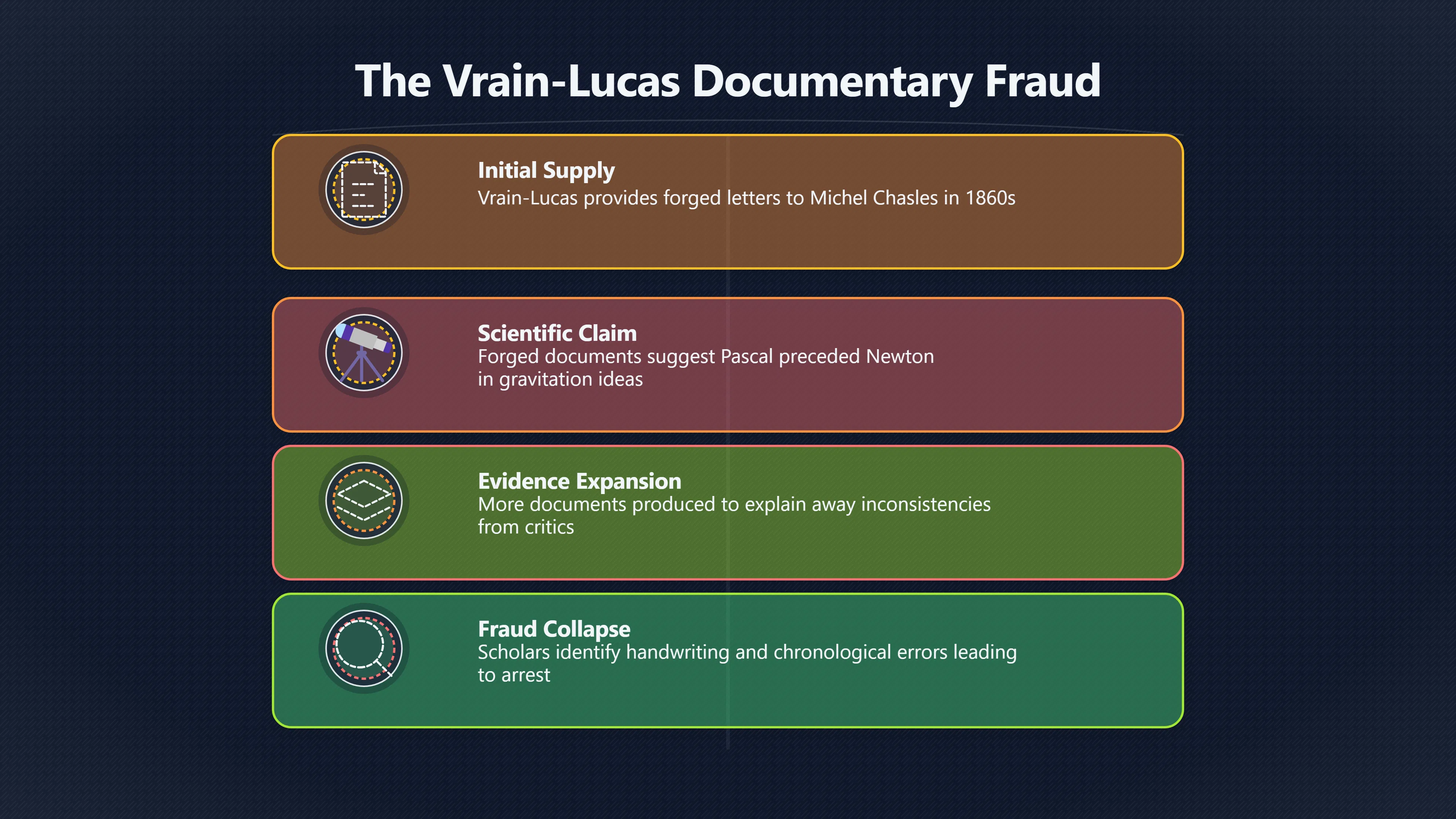
Denis Vrain-Lucas began supplying Michel Chasles with supposedly authentic historical letters in the early 1860s. Chasles was not a fringe enthusiast. He was a celebrated mathematician and member of the French Academy of Sciences. Vrain-Lucas understood that manuscripts carried enormous cultural value and that collectors were eager to discover documents capable of reshaping history.[Wikipedia]WikipediaDenis Vrain-LucasDenis Vrain-Lucas
The most famous forged documents claimed that Blaise Pascal had formulated ideas about gravitation before Isaac Newton. This was an especially tempting claim in nineteenth-century France because it appeared to give a French scientific hero priority over an English one. Chasles accepted the evidence and presented it publicly. When critics pointed out inconsistencies, Vrain-Lucas often responded by producing yet more “historic” documents that supposedly explained away the problems.[Wikipedia]WikipediaDenis Vrain-LucasDenis Vrain-Lucas
The scale of the fraud was extraordinary. Vrain-Lucas eventually supplied thousands of forged documents attributed to figures ranging from Newton and Pascal to Cleopatra, Judas Iscariot and Joan of Arc. Many were absurd on close inspection. Some were supposedly written centuries before modern French existed, yet appeared in nineteenth-century French. Nevertheless, the growing collection created an illusion of corroboration. Each forged item seemed to support the others.[Wikipedia]WikipediaDenis Vrain-LucasDenis Vrain-Lucas
The deception finally collapsed when scholars examined handwriting, chronology and provenance more carefully. Vrain-Lucas was arrested and convicted in 1870. The affair became a cautionary tale about the dangers of relying on authority, reputation and patriotic desire instead of rigorous authentication.[Wikipedia]WikipediaDenis Vrain-LucasDenis Vrain-Lucas
Why the Saitaphernes Tiara Convinced the Louvre
If the Vrain-Lucas letters showed how scholars could be deceived by documents, the Tiara of Saitaphernes demonstrated how museums could be fooled by physical objects.
In 1896 the Louvre announced the acquisition of an impressive gold tiara said to have belonged to the Scythian ruler Saitaphernes. The object appeared to confirm an ancient historical episode involving the Greek colony of Olbia and a powerful steppe king. Its inscription, imagery and craftsmanship seemed consistent with what many specialists believed about the ancient Black Sea world. The museum paid an enormous sum for the treasure and celebrated it as a major archaeological discovery.[wikipedia.org]WikipediaTiara of SaitaferneTiara of Saitaferne
Several factors made the forgery persuasive:
- The tiara was genuinely skilful metalwork rather than a crude imitation.
- Its imagery drew on authentic archaeological knowledge.
- The story attached to it filled gaps in historical understanding.
- The object arrived during a period of intense interest in spectacular ancient discoveries.[Wikipedia]WikipediaTiara of SaitaferneTiara of Saitaferne
Yet doubts emerged almost immediately. Some archaeologists noticed stylistic inconsistencies. Others questioned why such an important artefact lacked a convincing excavation history. German archaeologist Adolf Furtwängler was among those who argued that the object showed suspicious combinations of artistic styles and insufficient signs of age.[Wikipedia]WikipediaTiara of SaitaferneTiara of Saitaferne
For several years the Louvre defended the tiara’s authenticity. The institution had invested not only money but also prestige in the acquisition. Admitting error carried a significant reputational cost.[Wikipedia]WikipediaTiara of SaitaferneTiara of Saitaferne
How the Forgery Was Exposed
The tiara’s downfall came from an unexpected direction.
The object had been manufactured in Odessa by the talented goldsmith Israel Rouchomovsky. According to later accounts, he believed he was creating a decorative commission rather than participating in a museum fraud. Dealers who commissioned the work supplied archaeological details and inscriptions to help create a convincing ancient-style object.[Wikipedia]WikipediaTiara of SaitaferneTiara of Saitaferne
When news of the Louvre controversy reached him, Rouchomovsky travelled to Paris and identified himself as the maker. Museum experts initially doubted his claim. To prove it, he demonstrated his ability to reproduce elements of the workmanship. His technical knowledge and practical demonstration convinced observers that the celebrated antiquity was in fact a modern creation.[Wikipedia]WikipediaTiara of SaitaferneTiara of Saitaferne
The revelation embarrassed one of the world’s leading museums, but it also transformed Rouchomovsky’s reputation. Instead of being remembered merely as a forger, he became recognised as an exceptionally skilled craftsman. The quality of the work had been so high that many specialists had accepted it as ancient.[Wikipedia]WikipediaTiara of SaitaferneTiara of Saitaferne
What These Cases Reveal About Prestige and Belief
The Vrain-Lucas and Saitaphernes scandals differed in form, but they succeeded through similar mechanisms.
First, both offered desirable discoveries. The forged Pascal letters promised a French scientific triumph, while the tiara appeared to deliver a magnificent archaeological treasure worthy of the Louvre. People are often most vulnerable to deception when evidence seems to confirm something they already hope is true.[Wikipedia]WikipediaDenis Vrain-LucasDenis Vrain-Lucas
Second, both cases exploited gaps in provenance. Modern museums and archives place far greater emphasis on documented ownership histories and excavation records. In the nineteenth century, standards were often less systematic, making it easier for forged histories to accompany forged objects.[Wikipedia]WikipediaTiara of SaitaferneTiara of Saitaferne
Third, both show that expertise alone is not a guarantee against deception. Chasles was an eminent mathematician. Louvre specialists were leading authorities in art and archaeology. Yet expertise can sometimes create confidence that discourages basic sceptical questions. The most successful forgeries often target experts precisely because experts are the people most eager to evaluate important discoveries.[Wikipedia]WikipediaDenis Vrain-LucasDenis Vrain-Lucas

Why These Fakes Still Matter
Today neither the forged letters nor the Tiara of Saitaphernes are remembered simply as embarrassing mistakes. They have become historical artefacts in their own right.
The Vrain-Lucas affair remains a classic example of documentary forgery and of how fabricated evidence can grow into a self-supporting system. The tiara, meanwhile, survived its exposure to become one of the world’s most famous archaeological fakes. The Louvre eventually displayed it not as an ancient treasure but as evidence of the history of forgery itself.[Wikipedia]WikipediaDenis Vrain-LucasDenis Vrain-Lucas
These stories continue to circulate because they reveal a recurring pattern in the history of deception. Successful fakes rarely triumph through craftsmanship alone. They succeed when an object, document or discovery arrives at exactly the moment when respected people are ready to believe it.[Wikipedia]WikipediaDenis Vrain-LucasDenis Vrain-Lucas
Amazon book picks
Further Reading
Books and field guides related to How Prestigious Fakes Entered France's Great Institutions. Use these as the next step if you want deeper reading beyond the article.
The Map That Changed the World
Appeals to readers interested in how institutions validate knowledge.
eBay marketplace picks
Marketplace Samples
Live-tested eBay searches with available results related to this page.
Endnotes
1.
Source: Wikipedia
Title: Denis Vrain-Lucas
Link:https://en.wikipedia.org/wiki/Denis_Vrain-Lucas
2.
Source: Wikipedia
Title: Tiara of Saitaferne
Link:https://en.wikipedia.org/wiki/Tiara_of_Saitaferne
3.
Source: Wikipedia
Title: Michel Chasles
Link:https://en.wikipedia.org/wiki/Michel_Chasles
4.
Source: archive.archaeology.org
Title: Magazine Saitaphernes’ Golden Tiara
Link:https://archive.archaeology.org/online/features/hoaxes/saitaphernes_tiara.html
Source snippet
[image] Life magazine featured the tiara in its September 26...Read more...
5.
Source: Wikipedia
Link:https://de.wikipedia.org/wiki/Saitaphernes-Tiara
6.
Source: denis.com
Link:https://denis.com/index.php/milestones
7.
Source: Wikipedia
Link:https://en.wikipedia.org/wiki/Denis
8.
Source: guinnessworldrecords.com
Link:https://www.guinnessworldrecords.com/world-records/115161-greatest-goldsmith-fraud
Source snippet
Guinness World RecordsGreatest goldsmith fraudIsrael Rouchomowsky, tiara of Saitaphernes the Louvre bought it for a record 200,000 gold F...
9.
Source: lwl-landesmuseum-herne.de
Link:https://www.lwl-landesmuseum-herne.de/de/blog/tiara/
Source snippet
Die „Tiara des Saitaphernes“ - BLOGUnd so erscheint es aus zeitgenössischer Sicht nachvollziehbar, dass der Louvre am 28...
10.
Source: thebump.com
Link:https://www.thebump.com/b/denis-baby-name
Additional References
11.
Source: lwl.org
Link:https://www.lwl.org/pressemitteilungen/mitteilung.php?urlID=44111
Source snippet
Trügerischer Glanz: Die falsche Krone im LouvreAm meisten Aufsehen erregte eine Tiara, eine über 2.000 Jahre alte helmförmige Krone: D...
12.
Source: youtube.com
Title: Art of the forger: “60 Minutes” profiles master of fake paintings
Link:https://www.youtube.com/watch?v=qjKNt3MpL_0
Source snippet
Tiara of Saitaphernes Louvre The Turn Of The Century Scandal Of The Tiara Of Saitaphernes #jewelryhistory Moon Honey Jewelry...
13.
Source: sg.linkedin.com
Title: denis asia pacific pte ltd
Link:https://sg.linkedin.com/company/denis-asia-pacific-pte-ltd
Source snippet
Asia Pacific Pte LtdMaison Denis traces back its origin to 1862, as one of the most successful family owned company in the Far East, than...
14.
Source: youtu.be
Title: Indisputable with Dr. Rashad Richey
Link:https://youtu.be/L_asVaEYfm0
Source snippet
Wolfgang Beltracchi forgery France Art of the forger: "60 Minutes" profiles master of fake paintings...
15.
Source: britishmuseum.org
Link:https://www.britishmuseum.org/collection/object/H_1986-1021-1-a-b
Source snippet
British Museumtiara; caseIsrael Rouchomovsky. Production date: 1903-1909 (circa). Production place: Made... the tiara in the Louvre; a n...
16.
Source: instagram.com
Link:https://www.instagram.com/denisdailyyt/?hl=en
17.
Source: tiarayachts.com
Link:https://www.tiarayachts.com/
18.
Source: denisgroup.net
Link:https://denisgroup.net/
19.
Source: bewilderingstories.com
Link:https://www.bewilderingstories.com/issue55/goldtiara.html
20.
Source: reddit.com
Link:https://www.reddit.com/r/HistoryAnecdotes/comments/o9uqao/the_mockery_of_the_tiara_of_saitaferne_when_the/
Topic Tree