Within Paraguay Hoaxes
Did Vikings Really Build a Kingdom in Paraguay?
Claims of a lost Viking civilisation in Paraguay relied on ambiguous ruins and racial theories rather than secure archaeological evidence.
On this page
- What promoters claimed to have found
- Why the archaeological evidence falls short
- How racial ideology shaped the story
Page outline Jump by section
Introduction
Did Vikings really build a kingdom in Paraguay? The short answer is no. The idea that Norse explorers founded a powerful pre-Columbian civilisation in Paraguay is not supported by mainstream archaeology, history, linguistics, or genetics. Yet the claim became one of the country’s most persistent examples of pseudohistory: a story built from ambiguous archaeological features, speculative language comparisons, and racial theories that portrayed Indigenous societies as incapable of creating significant cultures on their own.[Wikipedia]WikipediaVicente PistilliVicente Pistilli
The legend matters because it was never just about Vikings. It reflected broader twentieth-century attempts to reinterpret South American history through the lens of European superiority. In Paraguay, the theory evolved from fringe historical speculation into a narrative that influenced public debate and continues to circulate in alternative-history circles long after its evidential foundations collapsed.[Wikipedia]WikipediaVicente PistilliVicente Pistilli
What Promoters Claimed to Have Found
The most influential versions of the theory emerged during the mid-twentieth century. Advocates argued that Vikings or other Nordic settlers had reached the Río de la Plata basin centuries before Columbus and established a kingdom somewhere within present-day Paraguay. According to these claims, traces of the settlement survived in rock carvings, unusual place names, local legends, and supposed runic inscriptions.[Wikipedia]WikipediaJacques de MahieuJacques de Mahieu
Among the best-known promoters were the French-born writer Jacques de Mahieu, a former collaborator who fled Europe after the Second World War and later settled in Argentina. In books including El Rey Vikingo del Paraguay (“The Viking King of Paraguay”), he argued that Nordic migrants had founded powerful states across South America and had left descendants among Indigenous populations. He claimed to identify Norse influences in Guaraní culture, language, settlement patterns, and folklore.[Wikipedia]WikipediaJacques de MahieuJacques de Mahieu
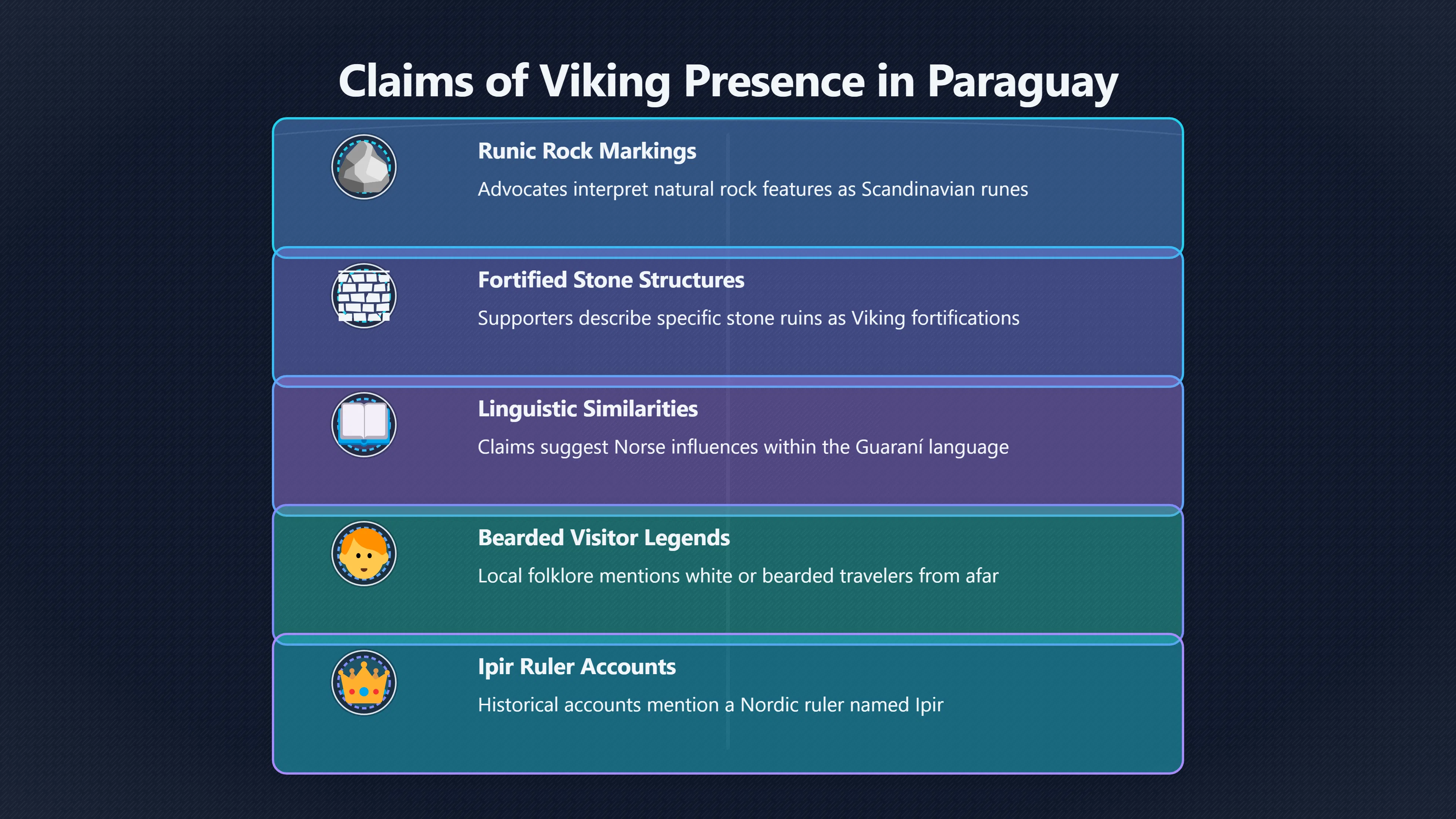
Supporters pointed to several kinds of supposed evidence:
- Rock markings interpreted as Scandinavian runes.
- Stone structures described as Viking fortifications.
- Legends involving white or bearded visitors.
- Similarities they claimed existed between Guaraní and Norse words.
- Accounts of a Nordic ruler sometimes presented under names such as “Ipir”.[templeparaguay.org]templeparaguay.orgVikings and Payaguas in ParaguayTaking as "hypothesis of the work" the possible influence of the Vikings we analyze the two pipes present…
Taken together, promoters argued, these fragments revealed a forgotten Viking presence deep in the Paraguayan interior centuries before European colonisation.[Wikipedia]WikipediaNazi racial theoriesNazi racial theories
Why the Archaeological Evidence Falls Short
The central problem with the Viking kingdom theory is that none of its key claims have produced the kind of evidence archaeologists would expect from an actual Norse settlement.
Known Viking sites elsewhere in the world contain recognisable artefacts: tools, weapons, building remains, metalwork, burials, and datable materials that can be independently verified. Archaeological interpretation relies on such material evidence rather than visual resemblance alone.[Vikingeskibsmuseet]vikingeskibsmuseet.dkArchaeological sources for the Viking AgeAn artefact is usually found in an ancient monument. It is a moveable object r…
In Paraguay, however, the alleged evidence largely consists of subjective readings of natural features or poorly documented markings. Claims of runic inscriptions have not achieved acceptance within professional archaeology or runology. The supposed inscriptions have not produced a coherent body of verified Norse writing, nor have excavations uncovered the broader material culture that would be expected if a Viking polity had existed in the region.[Wikipedia]WikipediaOpen source on wikipedia.org.
The linguistic arguments are similarly weak. Advocates often selected words that sounded vaguely similar across unrelated languages and treated those resemblances as proof of historical contact. Historical linguistics does not work this way. Demonstrating a genuine linguistic connection requires systematic sound correspondences, shared grammatical developments, and extensive comparative evidence rather than isolated look-alike words.[Wikipedia]WikipediaNazi racial theoriesNazi racial theories
Legends about white strangers also provide little support. Such stories exist in many cultures and can be reshaped by centuries of colonial contact, missionary influence, and retelling. Historians generally regard them as unreliable evidence for specific medieval Viking voyages unless supported by independent archaeological findings.[Wikipedia]WikipediaOpen source on wikipedia.org.
How Racial Ideology Shaped the Story
The Viking kingdom narrative cannot be separated from the racial ideas that helped sustain it.
Many versions of the theory emerged from intellectual traditions that assumed major civilisations must ultimately have been created by Europeans or by people imagined as racially European. Rather than explaining Indigenous achievements through Indigenous history, these theories sought outside founders—Phoenicians, Atlanteans, Celts, or Vikings. Paraguay’s Viking legend belonged to this wider pattern of pseudoarchaeology.[Wikipedia]WikipediaOpen source on wikipedia.org.
Jacques de Mahieu’s writings were particularly explicit. He connected supposed Viking migrations to theories of Nordic racial superiority and argued that white elites had founded or guided major South American civilisations. These ideas drew on scientific racism and post-war far-right interpretations of history rather than accepted archaeological research.[Wikipedia]WikipediaJacques de MahieuJacques de Mahieu
The broader historical setting is also significant. Paraguay had already attracted racial-utopian projects in the nineteenth century, most famously the German colony of Nueva Germania established by Bernhard Förster and Elisabeth Förster-Nietzsche. Although the Viking kingdom theory developed later and followed a different path, both episodes reflected attempts to project fantasies of Nordic or Aryan exceptionalism onto Paraguayan history and society.[docs.lib.purdue.edu]docs.lib.purdue.eduAn Introduction to Friedrich Nietzsche's Philosophyby PV Tongeren · 1999 · Cited by 129 — They nevertheless married and went to Paraguay…
Critics have argued that such narratives diminish Indigenous peoples by implying that notable cultural developments required European guidance or ancestry. This is one reason archaeologists treat the theory not merely as an innocent historical curiosity but as an example of how pseudohistory can reinforce harmful assumptions.[Wikipedia]WikipediaOpen source on wikipedia.org.
Why the Legend Continued to Spread
Despite the lack of convincing evidence, the story survived for decades because it possessed several features common to successful pseudohistorical claims.
First, it offered a dramatic alternative history. A lost Viking kingdom hidden in South America is inherently more exciting than the slower, more complex realities of archaeological research.
Second, the theory relied on evidence that ordinary readers could not easily verify. Photographs of rock carvings, sketches of symbols, and selective quotations from historical texts created an appearance of scholarship without meeting scholarly standards.[Wikipedia]WikipediaOpen source on wikipedia.org.
Third, believers could interpret any challenge as proof that orthodox historians were ignoring inconvenient facts. This pattern is common in pseudohistory, where the absence of evidence is reframed as evidence of suppression rather than a reason to doubt the claim.[Wikipedia]WikipediaOpen source on wikipedia.org.
Finally, the theory benefited from repetition. Once published in books, magazines, documentaries, and later internet forums, the claim acquired an aura of longevity. Readers encountering it decades later could mistake age for credibility.[Ancient Origins]ancient-origins.netAncient OriginsWere Vikings in South America Over 400 Years Before…10 May 2020 — So, to tie together this theory, using legend, possib…
What the Viking Claim Reveals About Paraguayan Pseudohistory
The Viking kingdom story occupies an unusual place in Paraguay’s history of contested truth. Unlike a straightforward fraud designed to steal money, it was primarily a pseudohistorical narrative: a speculative interpretation that gradually detached itself from reliable evidence.
Its lasting significance lies less in whether Vikings reached Paraguay—which remains unsupported—and more in how the claim was constructed. Ambiguous archaeological traces were transformed into certainty. Linguistic coincidences became proof. Indigenous histories were pushed aside in favour of a dramatic imported origin story.[Wikipedia]WikipediaOpen source on wikipedia.org.
As a case study, the legend demonstrates how weak evidence can be amplified by ideology, repeated through popular culture, and preserved long after professional researchers have rejected it. That combination of selective evidence, grand historical revision, and racial mythology makes the Viking kingdom claim one of Paraguay’s clearest examples of pseudohistory rather than genuine archaeological discovery.[Wikipedia]WikipediaOpen source on wikipedia.org.
Amazon book picks
Further Reading
Books and field guides related to Did Vikings Really Build a Kingdom in Paraguay?. Use these as the next step if you want deeper reading beyond the article.
Frauds, Myths, and Mysteries: Science and Pseudoscience in Ar...
Directly addresses claims resembling the Viking-Paraguay theory.
The Demon-Haunted World
Rating: 4.5/5 from 43 Google Books ratings
Useful framework for assessing pseudohistorical arguments.
eBay marketplace picks
Marketplace Samples
Live-tested eBay searches with available results related to this page.


Endnotes
1.
Source: Wikipedia
Title: Vicente Pistilli
Link:https://en.wikipedia.org/wiki/Vicente_Pistilli
2.
Source: Wikipedia
Title: Jacques de Mahieu
Link:https://en.wikipedia.org/wiki/Jacques_de_Mahieu
3.
Source: Wikipedia
Link:https://en.wikipedia.org/wiki/Pseudoarchaeology
4.
Source: Wikipedia
Link:https://en.wikipedia.org/wiki/Pseudohistory
5.
Source: templeparaguay.org
Link:https://www.templeparaguay.org/Web_Pistilli/Investigaciones/Pistilli-Artikel.pdf
Source snippet
Vikings and Payaguas in ParaguayTaking as "hypothesis of the work" the possible influence of the Vikings we analyze the two pipes present...
6.
Source: Wikipedia
Title: Nazi racial theories
Link:https://en.wikipedia.org/wiki/Nazi_racial_theories
7.
Source: ancient-origins.net
Link:https://www.ancient-origins.net/unexplained-phenomena/vikings-south-america-0013694
Source snippet
Ancient OriginsWere Vikings in South America Over 400 Years Before...10 May 2020 — So, to tie together this theory, using legend, possib...
Published: May 2020
8.
Source: vikingeskibsmuseet.dk
Link:https://www.vikingeskibsmuseet.dk/en/professions/education/archaeology-and-history/archaeological-sources-for-the-viking-age
Source snippet
Archaeological sources for the Viking AgeAn artefact is usually found in an ancient monument. It is a moveable object r...
9.
Source: docs.lib.purdue.edu
Link:https://docs.lib.purdue.edu/cgi/viewcontent.cgi?article=1010&context=purduepress_ebooks
Source snippet
An Introduction to Friedrich Nietzsche's Philosophyby PV Tongeren · 1999 · Cited by 129 — They nevertheless married and went to Paraguay...
Additional References
10.
Source: whc.unesco.org
Link:https://whc.unesco.org/en/tentativelists/6609/
Source snippet
UNESCO World Heritage CentreRock Art of Jsukaevnda and Cerro CoráThe first archaeological surveys in Cerro Corá National Park (Amambay) w...
11.
Source: youtube.com
Title: JACQUES DE MAHIEU Leonardo Castagnino y Hector Buela en LA GAZETA FEDERAL
Link:https://www.youtube.com/watch?v=QZb_bOlfzBg
Source snippet
"Jacques de Mahieu" "Vikings" Paraguay OR South America Los templarios en america Prof Jacques de Mahieu Revisionismo Historico...
12.
Source: youtube.com
Title: Did the Vikings arrive in South America before Columbus? Evidence in Argentina
Link:https://www.youtube.com/watch?v=UOwKYEUxJYw
Source snippet
Colon y el descubrimiento de America Jacques de Mahieu Colon el embustero...
13.
Source: youtube.com
Title: Colon y el descubrimiento de America Jacques de Mahieu Colon el embustero
Link:https://www.youtube.com/watch?v=6-2TTgbx600
Source snippet
JACQUES DE MAHIEU Leonardo Castagnino y Hector Buela en LA GAZETA FEDERAL...
14.
Source: youtube.com
Title: De Hitler a Perón: la increíble historia de Jacques de Mahieu
Link:https://www.youtube.com/watch?v=ZQHeAMIQ47I
Source snippet
Did the Vikings arrive in South America before Columbus? Evidence in Argentina...
15.
Source: youtube.com
Title: The Secret of the Vikings in Brazil: A Lost Story That Could Be True?
Link:https://www.youtube.com/watch?v=rEChn2cYqYc
Source snippet
De Hitler a Perón: la increíble historia de Jacques de Mahieu...
16.
Source: reddit.com
Link:https://www.reddit.com/r/Denmark/comments/gjvtul/evidence_of_vikings_in_south_america/
17.
Source: instagram.com
Link:https://www.instagram.com/reel/DMXlVJfu8UY/?hl=en
18.
Source: newdirection.online
Link:https://newdirection.online/2018-publications-pdf/ND-ThinkersVol1-2020f.pdf
19.
Source: instagram.com
Link:https://www.instagram.com/reel/DLkobRZOREP/
Topic Tree