Mexico's Strangest Fakes and Contested Discoveries
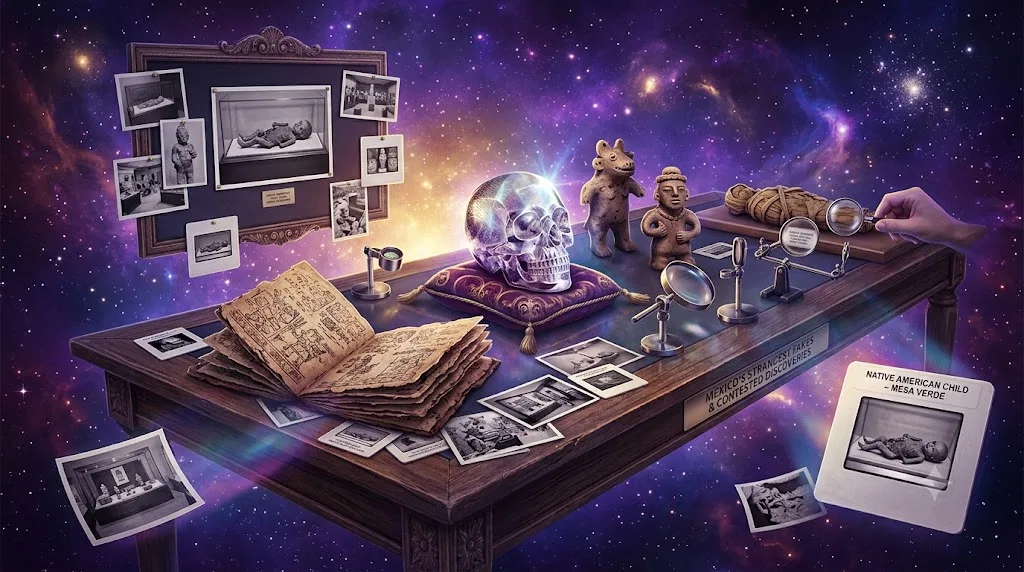
Mexico’s history of hoaxes is not a catalogue of national credulity. It is a history of markets, institutions and media systems learning—sometimes painfully—how to distinguish persuasive stories from reliable evidence.
Page outline Jump by section
Introduction
These episodes worked for different reasons. Forged antiquities exploited foreign demand for spectacular pre-Hispanic objects. Pseudoscientific claims borrowed the appearance of archaeology, laboratory testing or official hearings. Breaking-news errors spread because reporters and officials faced intense pressure to provide hopeful answers before facts were secure. In several cases, the eventual exposure did not destroy the legend: it simply became another chapter in a story sustained by tourism, television, online communities or distrust of established authorities.
The central lesson is that a convincing fake rarely depends on fabrication alone. It also needs an audience ready to reward novelty, institutions willing to lend authority and a story more emotionally satisfying than the available evidence.
Why forged antiquities became such a durable trade
Mexico’s archaeological heritage has long attracted collectors, museums and tourists. That demand created an obvious commercial opportunity: objects made recently could acquire extraordinary value when described as Aztec, Maya or belonging to another pre-Hispanic culture.
The forgery problem is not new. Research on Mexican antiquities indicates that workshops producing false archaeological objects were active around Mexico City by the nineteenth century. The French explorer Désiré Charnay complained in 1887 that private collections had become “infested” with counterfeits, while forged material continued moving through international markets during the early twentieth century.[resources.culturalheritage.org]resources.culturalheritage.orgosg014 09Faking pre-Columbian artifactsFebruary 16, 2015 — by C Sease · 2007 · Cited by 11 — century, there is good evidence that a trade in false…
These objects were persuasive partly because early collectors often lacked secure excavation records. An artefact purchased from a dealer might arrive with only a colourful account of where it had supposedly been found. Museums also faced a circular problem: they classified new objects by comparing them with existing collections, some of which already contained fakes. A skilful forger could copy genuine motifs, combine features from published discoveries and produce something that looked reassuringly familiar—or temptingly unique.
Scientific examination has improved detection. Investigators now look for modern abrasives, machine-tool marks, inappropriate pigments, artificial ageing, fresh surfaces and inconsistencies between an object’s claimed origin and its material composition. Yet provenance—the documented chain from excavation to owner—remains just as important. An impressive object without a credible history is not automatically false, but it presents a much greater risk.
The problem continues to affect the international art trade. Mexican authorities regularly challenge overseas auctions involving objects they judge to be either illicitly removed antiquities or modern imitations. Their stated concern is not only ownership: trafficking and forgery strip genuine archaeological material of its historical setting and turn cultural evidence into decoration.[Gobierno de México]gob.mxartefacts, and fakes, and deprive archaeological pieces of their historical, cultural and symbolic importance, "reducing them to decorati…
Crystal skulls: ancient masterpieces made with modern tools
Few supposed Mexican antiquities have travelled further into popular culture than the carved crystal skull. Dealers and later enthusiasts presented such skulls as Aztec or Maya ritual objects, repositories of supernatural power or relics of an unknown advanced civilisation.
The documented history tells a different story. Crystal skulls began appearing in European collections during the nineteenth century, when interest in Mexico’s ancient cultures was rising sharply. Several passed through the hands of the French antiquities dealer Eugène Boban, who had lived in Mexico and understood the appetite for dramatic pre-Columbian objects. No comparable skull has been recovered from a controlled archaeological excavation.[Smithsonian Magazine]smithsonianmag.comSmithsonian Magazine Why the Smithsonian Has a Fake Crystal SkullIn fact, she has become something of a specialist on the subject. “I didn't start out as a skeptic,” she says…Read more…
Close examination exposed manufacturing methods inconsistent with pre-Hispanic stoneworking. Studies of skulls held by the British Museum and the Smithsonian found marks left by rotary equipment and hard modern abrasives. Researchers also identified stylistic peculiarities, including rows of highly regular teeth unlike authenticated Mesoamerican carvings. The Smithsonian’s unusually large skull had been donated anonymously in 1992 with a purported connection to former president Porfirio Díaz, but microscopic analysis showed that it had been worked using modern materials and machinery.[sciencedirect.com]sciencedirect.comThey were summarized by Jones et al. (1990, pp. 296–297) in the exhibition catalogue Fake?Read more…
The skulls nevertheless survived as mystical objects because their appeal was never purely archaeological. They became part of occult publishing, New Age belief, museum folklore and adventure entertainment. Once invested with stories about healing, prophecy or lost civilisations, the absence of excavation evidence could be reframed as proof that conventional scholars were hiding something.
The case also shows that a fake artefact can become historically valuable in a different sense. Crystal skulls do not reveal secret Aztec technology, but they do reveal how nineteenth-century commerce, colonial collecting and romantic ideas about ancient Mexico shaped Western expectations of what an exotic relic ought to look like.
The Acámbaro figurines and the appeal of impossible history
In 1944, the German-born merchant Waldemar Julsrud began assembling thousands of clay figurines reportedly dug from land near Acámbaro in Guanajuato. Some resembled humans interacting with large reptiles or creatures interpreted as dinosaurs. Supporters claimed that the collection proved people and dinosaurs had coexisted, overturning conventional geology and evolutionary history.
The quantity was part of the spectacle. Eventually the collection was said to contain tens of thousands of objects, supposedly representing a previously unknown civilisation. Julsrud paid local people for each piece they delivered, however, creating a simple incentive to manufacture more. The stranger and more varied the figures became, the more attention the collection received.
Archaeologist Charles Di Peso investigated in the early 1950s and concluded that the objects were recent. He reported fresh-looking surfaces, little evidence of long burial and excavations in disturbed soil. The figures also combined styles from different periods with forms seemingly influenced by modern illustrations and popular ideas about prehistoric animals.[PIN–UP Magazine]pinupmagazine.orgPIN–UP Magazine ANCIENT ALIENS: What The Acámbaro Hoax Says About …While many believe the Acámbaro figures to be a hoax, the collectionPIN–UP Magazine ANCIENT ALIENS: What The Acámbaro Hoax Says About …While many believe the Acámbaro figures to be a hoax, the collection
Attempts to defend the collection have often relied on selective laboratory dates. Dating ceramics is not as simple as submitting a figurine and receiving an unquestionable age: contamination, sampling, firing conditions and the exact material tested all matter. A date that conflicts with the object’s physical condition, excavation history and cultural context requires replication and explanation, not automatic acceptance.
The Acámbaro story persists because it offers something more exciting than an ordinary archaeological discovery. It promises forbidden knowledge and a direct refutation of established science. Creationist and “ancient civilisation” writers have therefore treated the figurines as evidence that experts refuse to confront, while the circumstances of their production are recast as persecution of an inconvenient discovery.
This is an important distinction between evidence and anomaly collecting. A genuine archaeological challenge must fit into a wider body of material—settlements, tools, bones, environmental deposits and securely recorded layers. Thousands of unprovenanced figurines supplied for payment do not become stronger evidence merely through repetition.
When accusations of forgery are themselves mistaken
Mexico’s history of doubtful antiquities also contains a useful warning against excessive scepticism. The manuscript once known as the Grolier Codex was reportedly recovered under murky circumstances in the 1960s and shown publicly in New York in 1971. Critics suspected that a forger had painted invented Maya imagery on genuinely old bark paper, a technique capable of defeating a simple radiocarbon test.
The doubts were reasonable. The codex lacked a controlled archaeological provenance, its style differed from the few surviving Maya books, and its reported discovery involved looters rather than professional excavators. Some specialists considered the drawings crude or internally inconsistent.
Later investigation produced a stronger case for authenticity. Researchers found that the manuscript contained iconographic details that a supposed mid-twentieth-century forger would have struggled to reconstruct because relevant comparisons had not yet been discovered or published. Analysis of its pigments, calendrical information, damage and paper also supported a pre-Columbian origin. The manuscript is now generally recognised as the oldest surviving book from the Americas and is commonly called the Maya Codex of Mexico.[brown.edu]brown.eduUniversity13th century Maya codex, long shrouded in controversyUniversity13th century Maya codex, long shrouded in controversy
The codex matters to any history of hoaxes because it shows why authentication must be evidence-led rather than reputation-led. Suspicious provenance is a warning sign, not a verdict. Conversely, scientific-sounding claims of authenticity are not decisive unless the tests address the actual possibility of forgery. The best conclusions emerge when material analysis, artistic context, historical knowledge and provenance are considered together.
The “Roswell slides” and a human child misidentified as an alien
In May 2015, thousands of spectators attended a heavily promoted event in Mexico City at which two old photographic slides were presented as possible images of an extraterrestrial recovered after the 1947 Roswell incident. Mexican television personality and UFO promoter Jaime Maussan was among the leading figures behind the presentation.
The photographs showed a small desiccated body lying in a museum display case. Promoters emphasised its unusual proportions and the inability to read a blurred label visible beside it. The event converted ambiguity into spectacle: the audience was invited to treat an unclear photograph as evidence of an extraordinary secret.
The mystery collapsed within days. Independent researchers digitally processed the label and recovered wording identifying the body as the mummified remains of a Native American child. Archival material connected the display with remains once held at Mesa Verde in Colorado. Some UFO researchers involved in promoting the slides subsequently acknowledged the identification.[roswellslides.com]roswellslides.comthe child identifiedthe child identified
The episode was not simply a fake photograph. The slides themselves were genuine old images; the deception or failure occurred in their interpretation and presentation. Basic contextual clues had been neglected: the body lay openly in a display case, a descriptive card was visible and the scene resembled a museum rather than a secret military facility.
The case also raises an ethical issue often lost in arguments about aliens. The object of speculation was a dead Indigenous child whose remains had once been removed and exhibited. Treating the body as a prop in extraterrestrial entertainment repeated an older pattern in which Native American remains were collected, displayed and stripped of identity.
“Alien mummies” and borrowed institutional authority
A related controversy reached Mexico’s Chamber of Deputies in September 2023. During a public UFO session, Maussan displayed two small, three-fingered bodies said to have been found in Peru and described them as non-human beings. Images of the boxed specimens spread globally under headlines suggesting that the Mexican government or Congress had officially confirmed extraterrestrial life.
That interpretation was false. The event was a hearing hosted in a legislative building, not a scientific determination or endorsement by the Mexican state. Reuters’ fact-checking found that the presentation did not amount to official confirmation of aliens. Scientists criticised the lack of transparent provenance, peer-reviewed analysis and independent access to the specimens.[Reuters]reuters.comAlien bodies' presented in Mexican Congress panned asAlien bodies' presented in Mexican Congress panned as
The remains originated in Peru, making the episode transnational rather than a Mexican archaeological discovery. Peruvian officials and specialists have investigated similar objects and described some as manufactured figures assembled from human or animal material. The exact condition and composition of every specimen promoted under the broad “Nazca mummy” label cannot safely be assumed to be identical, which is one reason controlled custody and independent testing are essential.[Reuters]reuters.comExclusive: A close encounter with the 'alien bodies' in MexicoExclusive: A close encounter with the 'alien bodies' in Mexico
The presentation worked as media because it combined three sources of apparent authority:
- An official-looking venue. A chamber used by lawmakers can make invited testimony appear government-approved.
- Technical imagery. Scans, DNA percentages and radiocarbon dates sound decisive even when sampling methods and interpretations remain disputed.
- Restricted access. When only a small circle handles the objects, critics can be accused of dismissing evidence they have not examined, while independent researchers remain unable to verify it.
The critical question is not whether unusual remains deserve study. It is whether the evidence has been documented so that qualified, independent teams can reproduce the findings. Extraordinary specimens require especially careful archaeological provenance, ethical custody, anatomical analysis and open reporting. Public display before those conditions are met reverses the normal order of investigation.
The imaginary survivor beneath a collapsed school
Not all famous false stories in Mexico were deliberate commercial frauds. Some emerged from confusion, institutional failure and the emotional pressures of disaster.
After the earthquake of 19 September 2017, attention centred on the collapsed Enrique Rébsamen school in Mexico City. Television reports described a 12-year-old girl, widely called Frida Sofía, who was supposedly alive beneath the rubble. Reports claimed rescuers had communicated with her or detected signs of movement. For many viewers, she became a symbol of hope amid the deaths of children and staff.
The story unravelled when school records and families produced no missing pupil matching that identity. On 21 September, senior Mexican Navy officials said there was no evidence that the girl existed. Rescuers were still searching for an adult believed to be trapped, but the specific narrative broadcast for many hours had no confirmed foundation.[The Guardian]theguardian.comThe Guardian Frida Sofía, age 12: the Mexico City quake 'survivor' whoThe Guardian Frida Sofía, age 12: the Mexico City quake 'survivor' who
Calling the episode a straightforward hoax risks overstating what is known about intent. There is no need to imagine a single inventor directing the story. Fragmentary rescue information, unidentified sounds, misunderstood statements and competitive live broadcasting may have combined into a self-reinforcing error. Once major broadcasters reported a named child, each repetition made the claim appear independently confirmed.
The consequences were serious. Resources and public attention concentrated on one dramatic narrative while rescue operations continued elsewhere. The reversal also damaged confidence in officials and television journalism at a moment when trusted information was crucial.
Research into social-media use after the earthquake found that Mexican citizens developed their own methods for checking rescue requests, removing obsolete information and coordinating help. The same networks that circulated rumours could therefore also correct them.[arXiv]arxiv.orgOpen source on arxiv.org.
Frida Sofía illustrates a central rule of crisis reporting: specificity is not the same as verification. A name, age and vivid rescue detail can make a report feel authentic even when its source chain is unclear.

Monsters, misidentified animals and stories that cross borders
The chupacabra became prominent in Puerto Rico in the mid-1990s and quickly spread through Latin American and United States media, including reports from Mexico. It was blamed for dead livestock allegedly drained of blood and described variously as a reptilian, spined creature or a hairless canine.
These conflicting forms suggest that the name became a flexible label rather than a description of one consistent animal. Carcasses promoted as chupacabras have commonly proved to be dogs, coyotes or related animals affected by mange or genetic hairlessness. Ordinary predation can also leave puncture wounds and relatively little visible blood, particularly when descriptions are shaped after witnesses have heard the monster story.[nationalgeographic.com]nationalgeographic.com101028 chupacabra evolution halloween science monsters chupacabras picture101028 chupacabra evolution halloween science monsters chupacabras picture
It is more accurate to call the chupacabra a modern legend than a single organised hoax. Some individual photographs, carcasses or witness accounts may involve deliberate deception, but other reports are sincere misidentifications. Livestock owners confronted real animal deaths; journalists then supplied a dramatic explanatory frame.
This distinction matters. Folklore is not simply a lie awaiting exposure. It develops through retelling, adapts to local fears and gives a recognisable form to otherwise confusing events. The Mexican versions of the chupacabra story belong to a wider cross-border media culture in which sensational reporting, animal disease, science fiction imagery and rural anxieties continually reshape one another.
What Mexico’s hoax history reveals
The most famous Mexican cases differ in motive and method, but several recurring patterns explain why they travelled so widely.
Authority can be borrowed. A museum case, laboratory image, television studio or legislative chamber may make a weak claim appear officially validated. The correct question is not where something was presented, but who examined it, under what conditions and with what access to the evidence.
Missing provenance creates room for storytelling. Crystal skulls, Acámbaro figurines and alleged mummies arrived without secure professional excavation records. In that vacuum, dealers and promoters could substitute dramatic discovery narratives for documentation.
Scientific language can conceal an incomplete test. A carbon date may establish the age of sampled material without proving when an entire object was assembled. DNA described as “unknown” may reflect degraded samples, contamination or an unmatched database sequence rather than extraterrestrial biology. Technical results must be interpreted within the full archaeological and anatomical evidence.
Emotion accelerates unverified claims. The Frida Sofía story spread because it offered hope during a catastrophe. Monster reports spread through fear; alien revelations through wonder; spectacular antiquities through pride and fascination. Emotional appeal does not make a claim false, but it increases the pressure to repeat it before checking it.
Exposure rarely ends the story. Crystal skulls remain mystical icons, the Acámbaro figures still appear in alternative-history media, and alien-body claims return with new specimens or tests. Debunking may remove one piece of evidence without weakening the wider belief, especially when correction is reinterpreted as institutional suppression.
The most useful response is neither automatic belief nor automatic ridicule. It is disciplined curiosity: establish the original claim, trace who benefits from it, inspect the chain of custody, distinguish first-hand evidence from repetition and ask whether independent investigators can reproduce the result. Mexico’s famous fakes and contested discoveries show that scepticism works best not as cynicism, but as a method for protecting both history and the people whose remains, losses and cultural heritage are too often turned into spectacle.
Amazon book picks
Further Reading
Books and field guides related to Mexico's Strangest Fakes and Contested Discoveries. Use these as the next step if you want deeper reading beyond the article.
Frauds, Myths, and Mysteries: Science and Pseudoscience in Ar...
Explains famous archaeological hoaxes, disputed discoveries and pseudoarchaeology.
Archaeological Fantasies
Covers why sensational claims gain traction despite weak evidence.
The Oxford Handbook of Mesoamerican Archaeology
Provides context for evaluating claims about Mexican antiquities.
eBay marketplace picks
Marketplace Samples
Live-tested eBay searches with available results related to this page.


Endnotes
1.
Source: resources.culturalheritage.org
Title: osg014 09
Link:https://resources.culturalheritage.org/wp-content/uploads/sites/8/2015/02/osg014-09.pdf
Source snippet
Faking pre-Columbian artifactsFebruary 16, 2015 — by C Sease · 2007 · Cited by 11 — century, there is good evidence that a trade in false...
Published: February 16, 2015
2.
Source: archive.archaeology.org
Title: Magazine Legend of the Crystal Skulls
Link:https://archive.archaeology.org/0805/etc/indy.html
Source snippet
Archaeology MagazineLegend of the Crystal Skulls - Archaeology Magazine ArchiveI believe that all of the smaller crystal skulls that cons...
3.
Source: sciencedirect.com
Link:https://www.sciencedirect.com/science/article/abs/pii/S0305440308001052
Source snippet
They were summarized by Jones et al. (1990, pp. 296–297) in the exhibition catalogue Fake?Read more...
4.
Source: brown.edu
Title: University13th century Maya codex, long shrouded in controversy
Link:https://www.brown.edu/news/2016-09-07/mayacodex
5.
Source: news.yale.edu
Title: authenticating oldest book americas
Link:https://news.yale.edu/2017/01/18/authenticating-oldest-book-americas
6.
Source: colorado.edu
Title: solving case lost maya codex
Link:https://www.colorado.edu/today/2020/04/06/solving-case-lost-maya-codex
7.
Source: roswellslides.com
Title: the child identified
Link:https://www.roswellslides.com/the-roswell-slides/the-child-identified/
8.
Source: ibtimes.co.uk
Link:https://www.ibtimes.co.uk/roswell-hoax-ufo-researcher-admits-dead-alien-picture-was-mummified-body-child-1500792
9.
Source: reuters.com
Title: ‘Alien bodies’ presented in Mexican Congress panned as ‘
Link:https://www.reuters.com/world/americas/alien-bodies-presented-mexican-congress-panned-stunt-2023-09-14/
10.
Source: reuters.com
Title: aliens not confirmed by mexican government ufo hearing 2023 09 15
Link:https://www.reuters.com/fact-check/aliens-not-confirmed-by-mexican-government-ufo-hearing-2023-09-15/
11.
Source: reuters.com
Title: mexican congress holds hearing ufos featuring purported alien bodies 2023 09 13
Link:https://www.reuters.com/world/americas/mexican-congress-holds-hearing-ufos-featuring-purported-alien-bodies-2023-09-13/
12.
Source: reuters.com
Title: Exclusive: A close encounter with the ‘alien bodies’ in Mexico
Link:https://www.reuters.com/world/americas/close-encounter-with-alien-bodies-mexico-2023-09-16/
13.
Source: arxiv.org
Link:https://arxiv.org/abs/2007.05848
14.
Source: news.mongabay.com
Title: chupacabra story is a hoax likely a xolo dog breed
Link:https://news.mongabay.com/2007/09/chupacabra-story-is-a-hoax-likely-a-xolo-dog-breed/
15.
Source: reuters.com
Title: mexican congress holds second ufo session featuring peruvian mummies 2023 11 08
Link:https://www.reuters.com/world/americas/mexican-congress-holds-second-ufo-session-featuring-peruvian-mummies-2023-11-08/
16.
Source: reuters.com
Title: alien fever dreams fuel peruvian grave robbings 2024 04 06
Link:https://www.reuters.com/world/americas/alien-fever-dreams-fuel-peruvian-grave-robbings-2024-04-06/
17.
Source: ndl.ethernet.edu.et
Link:https://ndl.ethernet.edu.et/bitstream/123456789/46979/1/George%20M.%20Eberhart.pdf
18.
Source: history.com
Title: cottingley fairies altered photos hoax
Link:https://www.history.com/articles/cottingley-fairies-altered-photos-hoax
19.
Source: gob.mx
Link:https://www.gob.mx/sre/prensa/the-mexican-government-calls-for-halt-to-illegal-sale-of-pre-columbian-art
Source snippet
artefacts, and fakes, and deprive archaeological pieces of their historical, cultural and symbolic importance, "reducing them to decorati...
20.
Source: smithsonianmag.com
Title: Smithsonian Magazine Why the Smithsonian Has a Fake Crystal Skull
Link:https://www.smithsonianmag.com/history/the-smithsonians-crystal-skull-51638609/
Source snippet
In fact, she has become something of a specialist on the subject. “I didn't start out as a skeptic,” she says...Read more...
21.
Source: cen.acs.org
Title: Chemical & Engineering News Crystal Skulls Deemed Fake
Link:https://cen.acs.org/articles/91/i9/Crystal-Skulls-Deemed-Fake.html
22.
Source: pinupmagazine.org
Link:https://www.pinupmagazine.org/articles/article-[acambaro-figurines
23.
Source: theguardian.com
Title: The Guardian Frida Sofía, age 12: the Mexico City quake ‘survivor’ who
Link:https://www.theguardian.com/world/2017/sep/21/mexico-city-earthquake-frida-sofia-enrique-rebsamen-school
24.
Source: nationalgeographic.com
Title: 101028 chupacabra evolution halloween science monsters chupacabras picture
Link:https://www.nationalgeographic.com/culture/article/101028-chupacabra-evolution-halloween-science-monsters-chupacabras-picture
25.
Source: deas.inah.gob.mx
Link:https://deas.inah.gob.mx/pdf/publicaciones/publicaciones/publicacion%2834926%29-6786.pdf
26.
Source: repositorio.inah.gob.mx
Link:https://repositorio.inah.gob.mx/_flysystem/fedora/2023-12/issue_3048.pdf
27.
Source: Wikipedia
Title: Crystal skull
Link:https://en.wikipedia.org/wiki/Crystal_skull
28.
Source: Wikipedia
Title: Roswell incident
Link:https://en.wikipedia.org/wiki/Roswell_incident
29.
Source: Wikipedia
Link:https://en.wikipedia.org/wiki/Chupacabra
30.
Source: theguardian.com
Title: mayan ancient warrior fake mexico
Link:https://www.theguardian.com/world/2011/apr/03/mayan-ancient-warrior-fake-mexico
31.
Source: skeptoid.com
Link:https://skeptoid.com/episodes/810
32.
Source: traffickingculture.org
Title: grolier codex
Link:https://traffickingculture.org/encyclopedia/case-studies/grolier-codex/
33.
Source: smithsonianmag.com
Link:https://www.smithsonianmag.com/smart-news/alleged-aliens-corpses-displayed-to-mexican-congress-did-not-convince-scientists-180982900/
Additional References
34.
Source: history.northwestern.edu
Title: gillingham strange business
Link:https://history.northwestern.edu/documents/people/faculty/gillingham/gillingham-strange-business.pdf
Source snippet
The Strange Business of Memory: Relic Forgery in Latin...by P Gillingham · Cited by 20 — 5 Mark Jones, 'Why Fakes?' in Mark Jones (ed.)...
35.
Source: youtube.com
Title: From Ancient Mystery to Modern Fake | Legend of the Crystal Skulls | Full Doc
Link:https://www.youtube.com/watch?v=cq3b0G2Blo0
Source snippet
The 13 Crystal Skulls Of The Apocalypse | Myth Hunters on Odyssey...
36.
Source: youtube.com
Title: The 13 Crystal Skulls Of The Apocalypse | Myth Hunters on Odyssey
Link:https://www.youtube.com/watch?v=QMVXNzGCEV0
Source snippet
The Crystal Skulls: How Modern Fakes Fooled The World For Decades...
37.
Source: academia.edu
Link:https://www.academia.edu/69797403/Forgery_and_the_Science_of_the_Authentic_Mexican_antiquities_
38.
Source: researchgate.net
Link:https://www.researchgate.net/publication/260591732_Legend_of_the_Crystal_Skulls
39.
Source: dailymaverick.co.za
Link:https://www.dailymaverick.co.za/article/2023-10-27-what-scientific-investigation-says-about-the-existence-of-aliens-the-truth-isnt-so-vividly-out-there/
40.
Source: facebook.com
Link:https://www.facebook.com/mentalflossmagazine/posts/8-the-first-time-scientists-encountered-this-quirky-creature-they-thought-it-was/10159036912692365/
41.
Source: facebook.com
Link:https://www.facebook.com/NewsNationNow/posts/reality-check-with-ross-coulthart-a-mummy-mystery-takes-you-to-peru-is-this-anci/948709727536045/
42.
Source: facebook.com
Link:https://www.facebook.com/deutschewellenews/posts/at-a-ufo-hearing-alien-bodies-were-presented-before-mexicos-congress-are-the-wil/697449552410362/
43.
Source: reddit.com
Link:https://www.reddit.com/r/UFOs/comments/16hoius/beware_of_jaime_maussan/
Topic Tree
Follow this branch
Related pages 192
- Albanian Hoaxes
- Algerian Hoaxes
- Antigua Deceptions
- Argentina Hoaxes
- Armenian Hoaxes
- +187 more in sidebar