Within Chad Hoaxes
Were the Ancient Sao Really a Race of Giants?
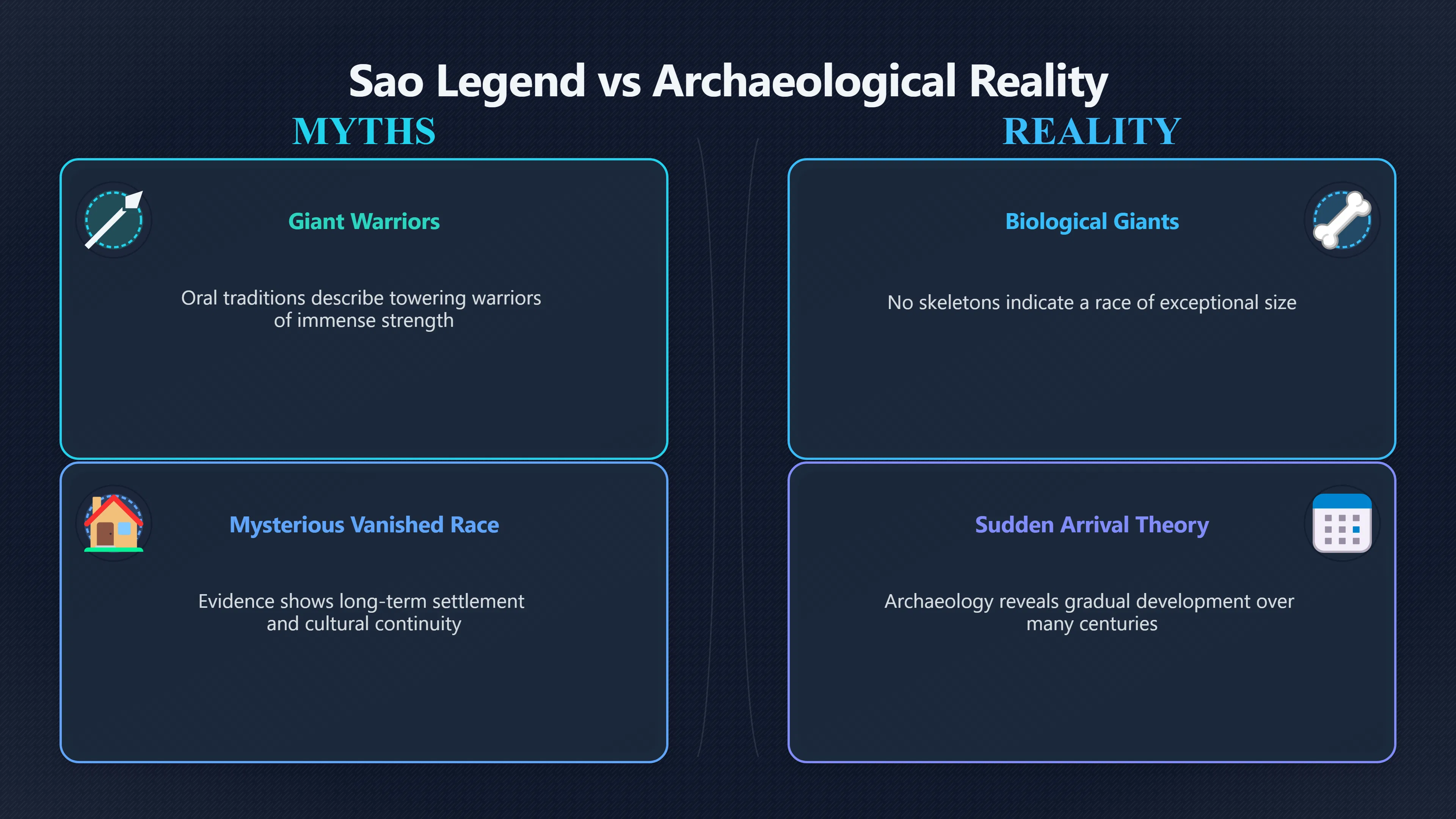
Stories of giant Sao warriors grew around real ruins, but archaeology supports changing Iron Age societies rather than a vanished race.
On this page
- What oral traditions claimed about the Sao
- What excavations actually found around Lake Chad
- How folklore and colonial scholarship enlarged the legend
Page outline Jump by section
Introduction
Stories about the ancient Sao people of the Lake Chad region often describe them as giants: towering warriors of immense strength who built impressive settlements and dominated their neighbours. These tales remain popular in Chad, Cameroon and neighbouring areas, and they are sometimes repeated as if they describe a lost race that truly existed.
Archaeology tells a different story. Excavations around Lake Chad have uncovered evidence of complex Iron Age societies, fortified settlements, skilled metalworkers and distinctive terracotta artists. What researchers have not found is evidence for a biologically distinct race of giants. Instead, the giant tradition appears to be a mixture of oral memory, folklore and later interpretation layered onto the remains of real ancient communities. Understanding how the legend grew helps explain one of Chad’s most enduring examples of how myth and archaeology can become intertwined.[wikipedia.org]WikipediaSao civilisationApril 27, 2026 — Today, several ethnic groups of northern Cameroon and southern Chad, but particularly the Sara and Kotoko, claim descent…
What Oral Traditions Claimed About the Sao
Across the southern Lake Chad Basin, oral traditions preserved by groups such as the Kotoko and others describe the Sao as extraordinary people who lived before later kingdoms rose to power. In many versions of the story, they are remembered as giant warriors, unusually strong, brave in battle and capable of feats beyond ordinary humans.[wikipedia.org]WikipediaSao civilisationApril 27, 2026 — Today, several ethnic groups of northern Cameroon and southern Chad, but particularly the Sara and Kotoko, claim descent…
The image of giant ancestors is not unique to Chad. Around the world, communities often portray earlier peoples as physically larger, stronger or more powerful than those living in the present. Such stories can serve several purposes:
- They explain impressive ruins whose builders are no longer remembered.
- They elevate the prestige of ancestral communities.
- They create a dramatic contrast between a heroic past and the present.
- They preserve memories of powerful groups through symbolic rather than literal descriptions.
In Sao traditions, the idea of giant stature became one of the most memorable features of the narrative. Over time, this symbolic image was often interpreted literally by outsiders who encountered the stories.[ResearchGate]researchgate.netSao Traditions of Makari South of Lake Chad | Request PDFThe present study tries to solve the enigma of the legendary Sao on…
What Excavations Actually Found Around Lake Chad
Archaeological research has revealed a rich and complex history south of Lake Chad. Researchers have documented settlement mounds, fortified towns, defensive earthworks, metalworking sites, decorated pottery, burial vessels and remarkable terracotta sculptures. These discoveries demonstrate that the region supported organised and technologically skilled societies for many centuries.[cambridge.org]cambridge.orgUniversity Press & Assessment15Cambridge University Press & Assessment15 - First Millennia BC/AD Fortified Settlements at Lake ChadDating to the first millennia BC/AD…
Particularly important are the fortified settlements identified around the Lake Chad Basin. Archaeological surveys have shown that some of these enclosed communities date back to the first millennium BC and first millennium AD, making them among the earliest known examples of large-scale communal defensive construction in sub-Saharan Africa.[Cambridge University Press & Assessment]cambridge.orgUniversity Press & Assessment15Cambridge University Press & Assessment15 - First Millennia BC/AD Fortified Settlements at Lake ChadDating to the first millennia BC/AD…
The material remains associated with the Sao include:
- Terracotta human and animal figures.
- Bronze, copper and iron objects.[unesdoc.unesco.org]unesdoc.unesco.orgAzania, Vol. 25, pp. 69-78. Watkins, T. 2005. From foragers to complex societies…Read more…
- Decorated ceramics.
- Large funerary urns and burial vessels.
- Evidence of trade and interaction with neighbouring societies.[Wikipedia]WikipediaSao civilisationApril 27, 2026 — Today, several ethnic groups of northern Cameroon and southern Chad, but particularly the Sara and Kotoko, claim descent…
What archaeologists have not uncovered are skeletons or biological remains indicating a population of exceptional giant size. The physical evidence supports the existence of sophisticated communities, not a separate giant race.[ResearchGate]researchgate.netThe Holocene History of the Southern Lake Chad BasinArchaeological evidence indicates a complex history of settlement of the…

Why the Archaeology Encouraged Giant Stories
The giant legend did not emerge from nothing. Several features of the archaeological record made such stories seem plausible.
One factor was the presence of large burial containers and substantial settlement earthworks. People encountering these remains long after their original purpose had been forgotten could easily conclude that only unusually large humans could have created or used them. Archaeologists have specifically noted that local giant traditions are associated with impressive material remains left by the societies later labelled as Sao.[Wikipedia]WikipediaBornu (historical regionBornu (historical region
Another factor was the sheer scale of some settlement mounds. These elevated sites were constructed and occupied over long periods, creating striking landmarks in an otherwise flat landscape. To later observers, such places seemed the work of legendary beings rather than ordinary communities building gradually across generations.[Cambridge University Press & Assessment]cambridge.orgUniversity Press & Assessment15Cambridge University Press & Assessment15 - First Millennia BC/AD Fortified Settlements at Lake ChadDating to the first millennia BC/AD…
The process is familiar elsewhere in the world. Ancient walls, earthworks and megalithic structures have frequently generated stories about giants because people seek explanations for impressive remains when historical knowledge has faded.
How Folklore and Colonial Scholarship Enlarged the Legend
The transformation of the Sao from an ancient population into a near-mythical race was accelerated during the colonial period. Early researchers, travellers and administrators collected oral traditions and attempted to fit them into broader theories about African history.
At the time, some scholars favoured migration theories that attributed major African achievements to supposedly foreign or exceptional peoples. In this intellectual climate, stories of giant Sao warriors could be interpreted as evidence of a mysterious vanished race rather than as folklore attached to local ancestors.[Wikipedia]WikipediaSao (civilisationSao (civilisation
Modern archaeological scholarship has become much more cautious. Researchers have argued that the conventional picture of a single, unified Sao civilisation can blur the distinction between excavated evidence and later legendary traditions. Some specialists have warned that the chronology of the Sao has suffered from the mixing of archaeological data with mythic accounts and that the term itself may have been applied to multiple populations over long periods.[Wikipedia]WikipediaBornu (historical regionBornu (historical region
This reassessment does not dismiss oral traditions. Instead, it treats them as historical sources that must be compared with archaeology rather than accepted literally.

Were the Sao a Single Lost Civilisation?
One reason the giant legend remains attractive is that it offers a simple story: a powerful race appeared, flourished and vanished. The archaeological picture is far more complicated.
Evidence from the Lake Chad Basin points to long-term settlement, environmental change, migration, cultural interaction and political development over many centuries. Rather than a single mysterious people appearing fully formed, archaeologists see a sequence of connected societies adapting to changing conditions around Lake Chad.[ResearchGate]researchgate.netThe Holocene History of the Southern Lake Chad BasinArchaeological evidence indicates a complex history of settlement of the…
Recent research increasingly views Sao culture as part of a broader regional history rooted in local development. Archaeological evidence suggests continuity with earlier cultures in the basin rather than the sudden arrival of a giant or exotic population.[Wikipedia]WikipediaSao (civilisationSao (civilisation
The result is a more complex but more convincing explanation: the impressive remains around Lake Chad were produced by real communities whose achievements became magnified through centuries of storytelling.
Why the Giant Story Still Circulates
The Sao giant legend survives because it connects genuine archaeological discoveries with memorable folklore. Unlike a straightforward fraud, it was never based on forged artefacts or fabricated ruins. Real settlement mounds, sculptures, fortifications and burial sites gave the stories a powerful foundation.[cambridge.org]cambridge.orgUniversity Press & Assessment15Cambridge University Press & Assessment15 - First Millennia BC/AD Fortified Settlements at Lake ChadDating to the first millennia BC/AD…
That combination of truth and embellishment is precisely what makes the legend durable. The archaeological evidence confirms that remarkable societies once flourished south of Lake Chad. The part that archaeology does not confirm is the existence of a vanished race of giants.
Viewed through the lens of Chad’s history of contested claims and misunderstood evidence, the Sao story is best understood as a case where folklore, oral memory and early scholarship enlarged a real past into something more mythical. The ruins are genuine, the people were real, but the giants belong to legend rather than archaeology.[wikipedia.org]WikipediaBornu (historical regionBornu (historical region
Amazon book picks
Further Reading
Books and field guides related to Were the Ancient Sao Really a Race of Giants?. Use these as the next step if you want deeper reading beyond the article.
Frauds, Myths, and Mysteries: Science and Pseudoscience in Ar...
Explains how giant-race stories and archaeological myths develop.
The Fate of Africa
Offers wider African historical context for readers exploring the region.
The Oxford Handbook of African Archaeology
Covers archaeological approaches relevant to Lake Chad societies.
The Archaeology of Africa
Provides archaeological context for claims about ancient societies around Lake Chad.
eBay marketplace picks
Marketplace Samples
Live-tested eBay searches with available results related to this page.



Endnotes
1.
Source: Wikipedia
Title: Sao civilisation
Link:https://en.wikipedia.org/wiki/Sao_civilisation
Source snippet
April 27, 2026 — Today, several ethnic groups of northern Cameroon and southern Chad, but particularly the Sara and Kotoko, claim descent...
Published: April 27, 2026
2.
Source: researchgate.net
Link:https://www.researchgate.net/publication/236160990_The_Holocene_History_of_the_Southern_Lake_Chad_Basin_Archaeological_Linguistic_and_Genetic_Evidence
Source snippet
The Holocene History of the Southern Lake Chad BasinArchaeological evidence indicates a complex history of settlement of the...
3.
Source: cambridge.org
Title: University Press & Assessment15
Link:https://www.cambridge.org/core/books/urbanisation-and-state-formation-in-the-ancient-sahara-and-beyond/first-millennia-bcad-fortified-settlements-at-lake-chad/7CE6CFFAB6A726A6ADC2B193AD123E89
Source snippet
Cambridge University Press & Assessment15 - First Millennia BC/AD Fortified Settlements at Lake ChadDating to the first millennia BC/AD...
4.
Source: researchgate.net
Link:https://www.researchgate.net/publication/351683567_Sao_Traditions_of_Makari_South_of_Lake_Chad
Source snippet
Sao Traditions of Makari South of Lake Chad | Request PDFThe present study tries to solve the enigma of the legendary Sao on...
5.
Source: Wikipedia
Title: Central Africa
Link:https://en.wikipedia.org/wiki/Central_Africa
6.
Source: Wikipedia
Title: Medieval and early modern Africa
Link:https://en.wikipedia.org/wiki/Medieval_and_early_modern_Africa
7.
Source: Wikipedia
Title: Sao (civilisation)
Link:https://fr.wikipedia.org/wiki/Sao_%28civilisation%29
8.
Source: Wikipedia
Title: Bornu (historical region)
Link:https://en.wikipedia.org/wiki/Bornu_%28historical_region%29
9.
Source: Wikipedia
Title: Sword Art Online
Link:https://fr.wikipedia.org/wiki/Sword_Art_Online
10.
Source: cambridge.org
Link:https://www.cambridge.org/core/books/power-and-landscape-in-atlantic-west-africa/internal-frontier-landscapes/2C5EF5CF27F33A249924A7D172548153
11.
Source: youtube.com
Title: Unveiling The Mysteries of the African Sao Civilization
Link:https://www.youtube.com/watch?v=e3Xjr5ZlDxw
Source snippet
Sao Culture | A Forgotten African Civilization...
12.
Source: youtube.com
Title: Sao Culture | A Forgotten African Civilization
Link:https://www.youtube.com/watch?v=jEfQg2n4dms
Source snippet
Sleep Story: Sao Civilization & Ancient Lake Chad Mysteries ASMR...
13.
Source: ethnicdesign.ch
Link:https://www.ethnicdesign.ch/fileadmin/Fichiers/Images/Documents/15.01-doc04_The_Ancient_Sao_Civilization_in_Central_Africa.pdf
Source snippet
Ethnic DesignThe Ancient Sao Civilization in Central AfricaAccording to their tradition, the Sao were a race of giants that used to inhab...
14.
Source: facebook.com
Link:https://www.facebook.com/historyoasis/photos/the-sao-civilization-flourished-in-central-africa-from-around-the-6th-century-bc/816458948155047/
Additional References
15.
Source: unesdoc.unesco.org
Link:https://unesdoc.unesco.org/ark%3A/48223/pf0000398388
Source snippet
Azania, Vol. 25, pp. 69-78. Watkins, T. 2005. From foragers to complex societies...Read more...
16.
Source: youtube.com
Title: Our Oldest Ancestor: the Toumaï Mystery
Link:https://www.youtube.com/watch?v=ANTFooeKe5A
Source snippet
This documentary on the Sao culture explicitly details how oral traditions surrounding a legendary race of giants in the Lake Chad region...
17.
Source: youtube.com
Title: Sleep Story: Sao Civilization & Ancient Lake Chad Mysteries ASMR
Link:https://www.youtube.com/watch?v=QRtZFtvBHKk
Source snippet
Toumaï, fossil and controversies | Mini documentary...
18.
Source: penn.museum
Link:https://www.penn.museum/sites/expedition/archaeological-reconnaissance-in-cameroon/
19.
Source: unesdoc.unesco.org
Link:https://unesdoc.unesco.org/ark%3A/48223/pf0000060262
20.
Source: ancient-origins.net
Link:https://www.ancient-origins.net/kotoko
21.
Source: scribd.com
Link:https://www.scribd.com/document/252034913/Nyame-Akuma-Issue-029
22.
Source: africanistarchaeology.net
Link:https://www.africanistarchaeology.net/s/Nyame-Akuma-Issue-060.pdf
23.
Source: netflix.com
Link:https://www.netflix.com/lu/title/70302573
24.
Source: rimakjournal.com
Link:https://www.rimakjournal.com/the-clay-and-mining-crafts-of-the-sao-people-on-the-border-of-lake-chad-basin_1044
Topic Tree