Which Deceptions Shaped Togo's Public Memory?
Togo does not have a large, well-documented catalogue of famous monsters, forged fossils or newspaper pranks comparable with those of some larger countries. Its clearest stories of deception concern political myth-making, imposture and modern visual misinformation.
Page outline Jump by section
Introduction
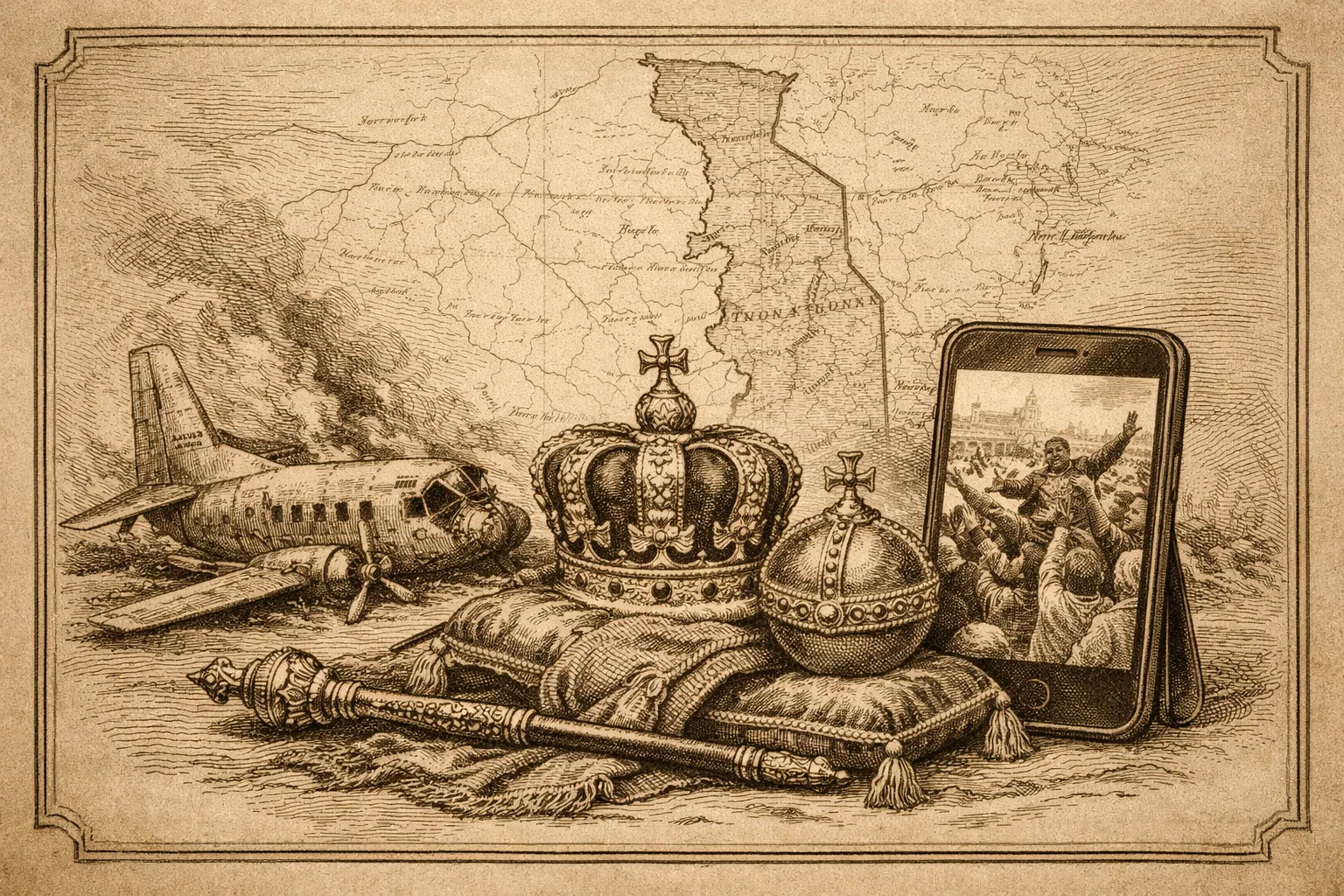
These cases matter because each exploited a different kind of authority. Eyadmas legend was reinforced by the state. Ayi used royal ceremony, religion and charitable claims to impress distant audiences unfamiliar with Togolese institutions. Online fabrications rely instead on emotionally powerful images, circulated faster than their origins can be checked. Together, they show that Togos history of contested truth is less a collection of harmless practical jokes than a study in how ceremony, prestige and political tension can make doubtful claims persuasive.
The Sarakawa crash became a political legend
On 24 January 1974, an aircraft carrying President Gnassingb Eyadma crashed near Sarakawa in northern Togo. Eyadma survived, while several other people aboard were killed. The government presented the disaster not simply as an aviation accident but as an attempted assassination connected with the presidents decision to nationalise the countrys important phosphate industry. The surviving ruler was portrayed as having defeated both death and foreign economic interference.[wikipedia.org]Wikipedia1974 Togolese Air Force C 47 crash1974 Togolese Air Force C 47 crash
The precise passenger and survivor record is surprisingly muddled. Some aviation records describe Eyadma as the sole survivor, while other historical accounts say that additional occupants survived and accuse the official story of removing them from the narrative. That disagreement makes it unsafe to reduce the case to a simple, fully proved lie about the number of survivors. What is much clearer is that the regime transformed an uncertain crash into an elaborate story of conspiracy, national deliverance and presidential invulnerability.[Wikipedia]Wikipedia1974 Togolese Air Force C 47 crash1974 Togolese Air Force C 47 crash
How the story was made believable
The alleged motive supplied the legend with political logic. Shortly before the crash, Eyadma had announced the nationalisation of the phosphate company that dominated one of Togos most valuable industries. According to the official version, foreign interests had therefore tried to remove him. The claim offered a ready-made villain and allowed the government to join personal survival, economic sovereignty and resistance to colonial influence in a single patriotic drama. No publicly established investigation demonstrated that French agents or a foreign company had sabotaged the aircraft.[Wikipedia]Wikipedia1974 Togolese Air Force C 47 crash1974 Togolese Air Force C 47 crash
The state then repeated the account through ceremonies, monuments and popular culture. Sarakawa became part of a calendar of official commemorations. A memorial placed Eyadma at the centre of the tragedy, while government-approved representations portrayed him as possessing exceptional strength or protection. A scholarly study of his political imagery describes an animated version of the crash in which the president emerges as the heroic survivor of a burning aircraft.[JSTOR]jstor.orgL'Homme de 13 JanvierWe see the crushed plane as it bursts into flames. The pilots are dead. After failing to find…
Eyadmas broader personality cult made the claim even easier to sustain. Portraits, public performances, songs, commemorative objects and a comic-book version of the ruler all encouraged the idea that he was not an ordinary politician. Contemporary and later profiles describe a political culture that presented him as uniquely resilient, almost superhuman, after repeated dangers.[wikipedia.org]WikipediaGnassingb EyadmaGnassingb Eyadma

Propaganda rather than a conventional hoax
Sarakawa is best understood as state-sponsored myth-making, not as a prank with a single moment of exposure. The crash itself was real. Eyadma really did survive. Togos phosphate dispute was also real. The deceptive element lay in turning uncertain or unsupported claims about sabotage and miraculous survival into an official national narrative whose repetition discouraged ordinary scrutiny.
The regime benefited in several ways. It converted a frightening accident into evidence that the president was destined to rule. It presented economic nationalisation as an anti-imperialist struggle embodied in one man. It also provided a symbolic explanation for political loyalty: if enemies outside Togo had tried and failed to kill Eyadma, opposition to him could be depicted as aligned with hostile foreign forces.
The legend outlived the immediate event because it was built into public space and political memory. Even accounts that reject the assassination story continue to repeat its most dramatic ingredients: the doomed aircraft, the ruler walking away and the accusation of foreign sabotage. This is a common strength of durable propaganda. Correcting the central claim does not necessarily erase the memorable scene that carried it.
The self-proclaimed king who impressed foreign audiences
A very different Togolese imposture developed outside the country. Franois Ayi, who was born in Togo and later travelled widely, presented himself in the United States and Israel as a figure of royal descent. Over time, his claims reportedly became more ambitious: he was described as a Togolese king, a ruler connected with African descendants of ancient Israelites and, in some circles, a figure with a special prophetic role.[The Forward]forward.comThe Forward Why Israeli Jews Crowned and Dethroned a 'Lost TribeThe ForwardWhy Israeli Jews Crowned and Dethroned a 'Lost Tribe'…October 8, 2016 7 Oct 2016 How a self-proclaimed "Lost Tribe king…
Ayi organised an elaborate enthronement ceremony in the United States in 1994. He raised money for activities said to benefit people in Togo and cultivated relationships with churches, religious leaders and charitable supporters. In 1996, doubts about his credentials became public after he received ceremonial treatment during a visit to Texas. The Togolese embassy questioned his claimed status, while people familiar with his earlier life said that he had not been recognised as a king in Togo.[The Forward]forward.comThe Forward Why Israeli Jews Crowned and Dethroned a 'Lost TribeThe ForwardWhy Israeli Jews Crowned and Dethroned a 'Lost Tribe'…October 8, 2016 7 Oct 2016 How a self-proclaimed "Lost Tribe king…
The claim was effective partly because it contained a grain of cultural plausibility. Togo is a republic, but it also has local chiefs and traditional authorities whose roles vary from community to community. A foreign audience might therefore accept the title king without asking what territory, lineage or legal recognition stood behind it. Ayi defended himself by arguing that critics misunderstood African traditions and that his authority concerned royal ancestry rather than control of the modern Togolese state.[Vaya con Gringos]vayacongringos.wordpress.comVaya con Gringos Meeting the Royalty of Togo | Vaya con GringosVaya con Gringos Meeting the Royalty of Togo | Vaya con Gringos
Ceremony did the work of evidence
Ayis story demonstrates how imposture can flourish when audiences treat impressive presentation as proof. Formal clothes, enthronement rites, references to lineage, religious language and charitable projects created a coherent public character. Each element reinforced the others. A supposed king could plausibly have access to chiefs; a man with access to chiefs could plausibly represent neglected communities; and someone representing such communities could plausibly need foreign donations.
The difficulty was that few supporters were in a position to verify his place within Togos complex local authority structures. The United States government did not recognise him as an official Togolese representative, and the Togolese embassy challenged his credentials. Reporting also found that the Texas attorney general had investigated a charity associated with him. These were substantial warnings, but they did not immediately destroy the persona because his authority rested as much on spiritual expectation as on documentary proof.[The Forward]forward.comThe Forward Why Israeli Jews Crowned and Dethroned a 'Lost TribeThe ForwardWhy Israeli Jews Crowned and Dethroned a 'Lost Tribe'…October 8, 2016 7 Oct 2016 How a self-proclaimed "Lost Tribe king…
In Israel, Ayi was welcomed by some religious figures who hoped that communities in Africa might represent descendants of the biblical tribes of Israel or play a role in future prophecy. He met prominent rabbis and was treated as an honoured visitor by organisations interested in rebuilding the ancient Jewish Temple. One self-appointed religious court reportedly called him King of Africa, an inflated title that was then able to circulate as though it were independent confirmation of his original claims.[The Forward]forward.comThe Forward Why Israeli Jews Crowned and Dethroned a 'Lost TribeThe ForwardWhy Israeli Jews Crowned and Dethroned a 'Lost Tribe'…October 8, 2016 7 Oct 2016 How a self-proclaimed "Lost Tribe king…
His standing collapsed within those circles after former supporters publicly rejected him. A rabbi who had previously embraced Ayi denounced him as a false prophet, while journalists traced the changing versions of his biography and interviewed people who disputed his royal identity. Ayi denied wrongdoing and threatened legal action, maintaining that his mission and lineage were genuine.[The Forward]forward.comThe Forward Why Israeli Jews Crowned and Dethroned a 'Lost TribeThe ForwardWhy Israeli Jews Crowned and Dethroned a 'Lost Tribe'…October 8, 2016 7 Oct 2016 How a self-proclaimed "Lost Tribe king…
What the case does and does not prove
It is reasonable to describe Ayi as a self-created royal and spiritual persona whose credentials were repeatedly challenged. It is harder to prove every allegation made in later retellings. Some websites call the entire affair a decades-long financial scam, but the strongest reporting is more careful: it documents disputed titles, government and embassy concern, a charity investigation, contradictory biographical accounts and the eventual rejection of his prophetic claims.[The Forward]forward.comThe Forward Why Israeli Jews Crowned and Dethroned a 'Lost TribeThe ForwardWhy Israeli Jews Crowned and Dethroned a 'Lost Tribe'…October 8, 2016 7 Oct 2016 How a self-proclaimed "Lost Tribe king…
The distinction matters. A disputed traditional title is not automatically criminal fraud, and charitable activity is not necessarily fictitious because its organiser exaggerates his status. The evidentially secure core is that Ayi used royal and religious claims to gain extraordinary access, that official Togolese representatives questioned those claims, and that important supporters eventually concluded that they had been misled.
The story still circulates because the fake king of Togo is an irresistible headline. Yet that shorthand can itself mislead. Togo does have genuine traditional leaders, even though it has no monarch ruling the republic. The deception worked not because kingship was completely alien to the country, but because outsiders lacked the knowledge needed to distinguish a locally recognised chief, a hereditary claimant, a ceremonial title and a self-appointed national sovereign.

Old images now create instant false histories
Togos most visible recent hoaxes are often not invented from nothing. They are genuine videos or photographs given a false place, date or political meaning. This form of deception is cheap and effective because the image supplies apparent eyewitness evidence while the caption tells viewers what they are supposedly seeing.
In July 2025, for example, social-media users shared footage claiming to show a large demonstration against Togos government. AFPs investigation found that the video had actually been recorded during protests in Nairobi, Kenya. The deceptive post did not fabricate the existence of Togolese unrest: protests and police repression had occurred in Togo. Instead, it enlarged the apparent scale of a real political crisis by attaching striking foreign footage to it.[AFP Fact Check]factcheck.afp.comOpen source on afp.com.
This mixture of truth and false attribution is harder to detect than a wholly imaginary story. A reader who already knows that demonstrations have taken place may see little reason to question a crowd scene. Buildings and clothing may look broadly plausible, while reposting strips away the original caption, upload date and account history. The clip becomes portable evidence, ready to be relabelled for another country.
Research into misinformation surrounding Togos 2024 elections identified manipulated narratives, attacks on public figures and misleading material distributed through social and traditional media. The study also found that women in political life were targeted with gendered allegations designed to damage their credibility rather than debate their policies. Such material belongs to a wider category of political deception: not one famous hoax, but a stream of claims whose cumulative purpose is to shape reputation and suppress participation.[The AWJP]theawjp.orgThe AWJPTrends in Gendered Disinformation during Togo ElectionsThe AWJPTrends in Gendered Disinformation during Togo Elections
The surrounding media environment affects how such claims are tested. Journalists and broadcasters in Togo have faced suspensions, prosecutions and other restrictions, while political tensions have encouraged both government accusations of misinformation and opposition fears that false news language can be used against critical reporting. That does not make every disputed report true or false. It means that verification takes place in a setting where access to information, media independence and trust in official statements are all contested.[AP News]apnews.comOpen source on apnews.com.
Scams that borrow Togos name
Not every deception associated with Togo is chiefly aimed at Togolese citizens. Foreign embassies have warned of advance-fee and business scams conducted by people claiming to be based in the country. The United States embassy in Lom has reported cases involving supposed companies, inheritances, contracts, romantic relationships and requests for money to release goods or resolve invented legal problems.[tg.usembassy.gov]tg.usembassy.govE-mail Scam AlertsE-mail Scam Alerts
These schemes use the same basic structure found in many international confidence tricks. The victim is offered an unusually profitable or emotionally urgent opportunity. A respectable identity is supplied: a lawyer, business executive, official, heir or charity worker. Once the victim is committed, an unexpected fee appears for customs, taxes, travel, certification, security or legal clearance. Paying does not complete the transaction; it produces another obstacle and another demand.
The location itself can become part of the deception. A distant country may seem difficult for a victim to verify, while official-looking letterheads, identity documents and telephone numbers create a false sense of local legitimacy. Togo is not uniquely responsible for this fraud model, and warnings about it should not be read as evidence that Togolese commerce is generally suspect. The relevant point is that scammers exploit gaps in cross-border knowledge in much the same way that a self-proclaimed king exploits uncertainty about foreign titles.
Large fraud cases investigated in Togo have also involved elaborate stories about investments and political access. In 2012, former French oil executive Lok Le Floch-Prigent was charged in Togo over an alleged scheme in which an Emirati businessman said he had lost tens of millions of dollars. Le Floch-Prigent denied complicity. The episode illustrates the scale that confidence schemes can reach when famous names and claims of access to powerful decision-makers are used to support a promised commercial arrangement.[reuters.com]reuters.comFormer Elf chief charged in Togo fraud caseFormer Elf chief charged in Togo fraud case
This was a criminal allegation rather than a neatly resolved public hoax, so it should not be retold as a simple tale with every participants guilt established. Its relevance lies in the mechanism: status, elite connections and the prospect of extraordinary profit made an implausible transaction appear credible.

Why Togo has few internationally famous hoaxes
The thin historical record does not mean deception was rare in Togo. It reflects which stories were preserved, translated and circulated internationally. Colonial archives and foreign newspapers often recorded political crises or crimes but paid less attention to local rumours, comic impostures and short-lived media stunts. Material published in local newspapers or passed through radio and oral networks can also be difficult to locate in searchable digital archives.
Political conditions matter as well. Under Eyadma, the states control of public narrative left little room for an independent press to investigate official legends in the manner of a classic newspaper expos. In later decades, restrictions on journalists and disputes over broadcasting have continued to complicate the production of a shared, trusted record.[state.gov]2009-2017.state.govDepartment TogoDepartment Togo
There is also a classification problem. A spiritual claim may be sincere belief, commercial performance or calculated fraud. A traditional rulers title may be meaningful in one community but overstated abroad. A crash story may combine real deaths, genuine economic conflict, uncertain technical evidence and deliberate political embellishment. Calling everything a hoax can hide these distinctions.
The most defensible Togolese examples therefore fall along a spectrum:
- The Sarakawa narrative was a real accident transformed into an unsupported story of foreign sabotage and presidential destiny.
- Franois Ayis kingship was an imposture or highly contested identity claim strengthened by ceremony, charity and religious expectation.
- Relabelled protest footage is straightforward visual misinformation: authentic imagery attached to the wrong event.
- Advance-fee and elite-access schemes are commercial frauds that use invented identities, documents and obstacles rather than public spectacle.
What these stories reveal
Togos deception history is ultimately a history of borrowed authority. Eyadma borrowed the authority of national liberation and turned it into proof of personal invulnerability. Ayi borrowed the outward forms of royalty, biblical ancestry and philanthropy. Online propagandists borrow the emotional force of real photographs and videos. Commercial fraudsters borrow the language of banks, ministries, lawyers and international business.
Exposure begins by separating appearance from the institution supposedly standing behind it. Was the royal title recognised by a defined community or government? Did an independent aviation inquiry support the sabotage allegation? Where and when did a viral image first appear? Does a company exist in an official register? Can a supposed official be reached through contact details obtained independently rather than those contained in the original message?
The recurring lesson is not that Togolese people or institutions are unusually vulnerable to deception. These cases succeeded because they used familiar human shortcuts: respect for ceremony, trust in authority, attraction to secret access and belief in images that seem to confirm what viewers already suspect. Togos most memorable disputed stories are compelling precisely because the false or exaggerated claim was wrapped around something reala crash, a traditional title, a political protest or an international transaction.
Amazon book picks
Further Reading
Books and field guides related to Which Deceptions Shaped Togo's Public Memory?. Use these as the next step if you want deeper reading beyond the article.
Imagined Communities
Explores how collective identities and public memory are constructed.
Africa Since Independence
Provides context for post-colonial political narratives including West Africa.
eBay marketplace picks
Marketplace Samples
Live-tested eBay searches with available results related to this page.


Endnotes
1.
Source: Wikipedia
Title: 1974 Togolese Air Force C 47 crash
Link:https://en.wikipedia.org/wiki/1974_Togolese_Air_Force_C-47_crash
2.
Source: jstor.org
Title: L’Homme de 13 Janvier
Link:https://www.jstor.org/stable/41807053
Source snippet
We see the crushed plane as it bursts into flames. The pilots are dead. After failing to find...
3.
Source: Wikipedia
Title: Gnassingb Eyadma
Link:https://en.wikipedia.org/wiki/Gnassingb%C3%A9_Eyad%C3%A9ma
4.
Source: forward.com
Title: The Forward Why Israeli Jews Crowned and Dethroned a ‘Lost Tribe’
Link:https://forward.com/news/351238/why-israeli-jews-crowned-and-dethroned-a-lost-tribe-king-from-africa/
Source snippet
The ForwardWhy Israeli Jews Crowned and Dethroned a 'Lost Tribe'...October 8, 2016 7 Oct 2016 How a self-proclaimed "Lost Tribe king...
Published: October 8, 2016
5.
Source: forward.com
Title: lost tribe king from togo embraced by orthodox rabbis in israel
Link:https://forward.com/news/340915/lost-tribe-king-from-togo-embraced-by-orthodox-rabbis-in-israel/
6.
Source: factcheck.afp.com
Link:https://factcheck.afp.com/doc.afp.com.67CQ8CQ
7.
Source: theawjp.org
Title: The AWJPTrends in Gendered Disinformation during Togo Elections
Link:https://theawjp.org/wp-content/uploads/2024/11/AWJP_-Trends-in-Gendered-Disinformation-During-Togo-Elections_Report.pdf
8.
Source: tg.usembassy.gov
Title: E-mail Scam Alerts
Link:https://tg.usembassy.gov/e-mail-scam-alerts/
9.
Source: reuters.com
Title: Former Elf chief charged in Togo fraud case
Link:https://www.reuters.com/article/world/former-elf-chief-charged-in-togo-fraud-case-idUSBRE88H0VO/
10.
Source: 2009-2017.state.gov
Title: Department Togo
Link:https://2009-2017.state.gov/j/drl/rls/hrrpt/1999/276.htm
11.
Source: GOV.UK
Link:https://www.gov.uk/report-suspicious-emails-websites-phishing
12.
Source: factcheck.afp.com
Title: fact checking search results
Link:https://factcheck.afp.com/fact-checking-search-results?keywords=Biden&page=69
13.
Source: factcheck.afp.com
Title: fact checking search results
Link:https://factcheck.afp.com/fact-checking-search-results?keywords=queen&page=70
14.
Source: factcheck.afp.com
Title: no video does not show waterfall pouring down sky
Link:https://factcheck.afp.com/no-video-does-not-show-waterfall-pouring-down-sky
15.
Source: factcheck.afp.com
Title: these images show delivery chinese medical supplies ghana
Link:https://factcheck.afp.com/these-images-show-delivery-chinese-medical-supplies-ghana
16.
Source: factcheck.afp.com
Link:https://factcheck.afp.com/doc.afp.com.36MK7B4
17.
Source: factcheck.afp.com
Title: busting coronavirus myths
Link:https://factcheck.afp.com/busting-coronavirus-myths
18.
Source: factcheck.afp.com
Title: false claims patents fuel novel coronavirus conspiracy theories online
Link:https://factcheck.afp.com/false-claims-patents-fuel-novel-coronavirus-conspiracy-theories-online
19.
Source: factcheck.afp.com
Link:https://factcheck.afp.com/nigerian-pastor-falsely-claims-covid-19-jabs-are-death-warrants-and-mandatory-country
20.
Source: factcheck.afp.com
Link:https://factcheck.afp.com/doc.afp.com.9MX8DT
21.
Source: factcheck.afp.com
Title: principles nuremberg code are compatible vaccination
Link:https://factcheck.afp.com/principles-nuremberg-code-are-compatible-vaccination
22.
Source: factcheck.afp.com
Link:https://factcheck.afp.com/no-tourists-have-been-allowed-visit-new-zealand-march-2020-photo-has-circulated-online-2016
Published: march 2020
23.
Source: factcheck.afp.com
Title: fact checking search results
Link:https://factcheck.afp.com/fact-checking-search-results?keywords=bill+gates&page=429
24.
Source: factcheck.afp.com
Link:https://factcheck.afp.com/retired-italian-doctors-false-claims-about-covid-19-tests-and-vaccines-circulate-globally-online
25.
Source: Wikipedia
Title: Archaeological forgery
Link:https://en.wikipedia.org/wiki/Archaeological_forgery
26.
Source: Wikipedia
Title: Kingdom of Israel (united monarchy)
Link:https://en.wikipedia.org/wiki/Kingdom_of_Israel_%28united_monarchy%29
27.
Source: Wikipedia
Title: List of unproven methods against COVID 19
Link:https://en.wikipedia.org/wiki/List_of_unproven_methods_against_COVID-19
28.
Source: ncsc.gov.uk
Title: report scam website
Link:https://www.ncsc.gov.uk/collection/phishing-scams/report-scam-website
29.
Source: reportfraud.police.uk
Link:https://www.reportfraud.police.uk/collection/newsroom/
30.
Source: travel.state.gov
Link:https://travel.state.gov/en/international-travel/travel-advisories/scams.html
31.
Source: afro.who.int
Link:https://www.afro.who.int/aira
32.
Source: thetimes.com
Title: gnassingbe eyadema 5x68hx5br5v
Link:https://www.thetimes.com/travel/destinations/africa-travel/south-africa/cape-town/gnassingbe-eyadema-5x68hx5br5v
Source snippet
The TimesGnassingbe Eyadema8 Feb 2005 Eyadema attempted to build a personality cult at home based around his surviving a plane crash...
33.
Source: vayacongringos.wordpress.com
Title: Vaya con Gringos Meeting the Royalty of Togo | Vaya con Gringos
Link:https://vayacongringos.wordpress.com/2016/11/07/meeting-the-royalty-of-togo/
34.
Source: apnews.com
Link:https://apnews.com/article/1816c11e1562c630f05daf800c850354
35.
Source: apnews.com
Link:https://apnews.com/article/38db0a35046c106b02c3fe51359be71c
36.
Source: modernghana.com
Title: ex elf chief charged over fraud probe in togo lawyer
Link:https://www.modernghana.com/news/418334/ex-elf-chief-charged-over-fraud-probe-in-togo-lawyer.html
37.
Source: factcheck.org
Link:https://www.factcheck.org/fake-news/
38.
Source: sk.sagepub.com
Link:https://sk.sagepub.com/ency/edvol/journalism/chpt/hoaxes
39.
Source: consumer.ftc.gov
Link:https://consumer.ftc.gov/scams
40.
Source: wiseafri.wordpress.com
Link:https://wiseafri.wordpress.com/tag/eritrea/page/3/
41.
Source: archive.archaeology.org
Link:https://archive.archaeology.org/0101/abstracts/africa.html
Additional References
42.
Source: aviation-safety.net
Link:https://aviation-safety.net/wikibase/329968
Source snippet
Aviation Safety NetworkAccident Douglas C-47A-35-DL (DC-3) 5V-MAG, Thursday...Narrative: The President of Togo, Gnassingbé Eyadéma (19...
43.
Source: theguardian.com
Link:https://www.theguardian.com/news/2005/feb/07/guardianobituaries
Source snippet
The GuardianGnassingbe Eyadema6 Feb 2005 Gnassingbe Eyadema, President of Togo for 38 years, has died at the age of 69. He took power d...
44.
Source: gsaig.gov
Link:https://www.gsaig.gov/news/scam-alert-beware-fake-websites-mimic-legitimate-official-us-government-websites
45.
Source: usa.gov
Link:https://www.usa.gov/scams-and-fraud
46.
Source: youtube.com
Title: The Sarakawa Crash // HISTORY ep1
Link:https://www.youtube.com/watch?v=c4CtjfaTvNs
Source snippet
38 Years as President: How Gnassingbe Eyadema of Togo Rose to Power Through a Bloody Military Coup...
47.
Source: flickr.com
Title: chuck j
Link:https://www.flickr.com/photos/chuck_j/4094827928
Source snippet
Statue of Gnassingb Eyadma11 Nov 2009 In 1974, the Togo president Gnassingb Eyadma was the only person surviving a plane cras...
48.
Source: youtube.com
Link:https://www.youtube.com/watch?v=gO5Ixk8N7yA
Source snippet
King Ayi from Togo - AGTV Show...
49.
Source: facebook.com
Link:https://www.facebook.com/61564187565631/posts/rushed-out-in-a-presidential-jet-brought-back-in-a-casket-the-demise-of-gnassing/122193105656472918/
50.
Source: facebook.com
Link:https://www.facebook.com/HealthZA/posts/factcheck-during-outbreaks-misinformation-can-spread-rapidly-undermine-public-he/1438950061611396/
51.
Source: researchgate.net
Link:https://www.researchgate.net/publication/290997927_Combating_Illegal_trafficking_In_African_Cultural_Goods
Topic Tree
Follow this branch
Related pages 192
- Albanian Hoaxes
- Algerian Hoaxes
- Antigua Deceptions
- Argentina Hoaxes
- Armenian Hoaxes
- +187 more in sidebar