Within Venezuela Hoaxes
What Did the Llaguno Bridge Footage Prove?
Real footage of armed civilians became politically explosive because cropping, chronology and unseen targets changed what viewers thought it proved.
On this page
- How broadcasters framed the gunfire
- How documentaries challenged that account
- Why the full chronology remains contested
Page outline Jump by section
Introduction
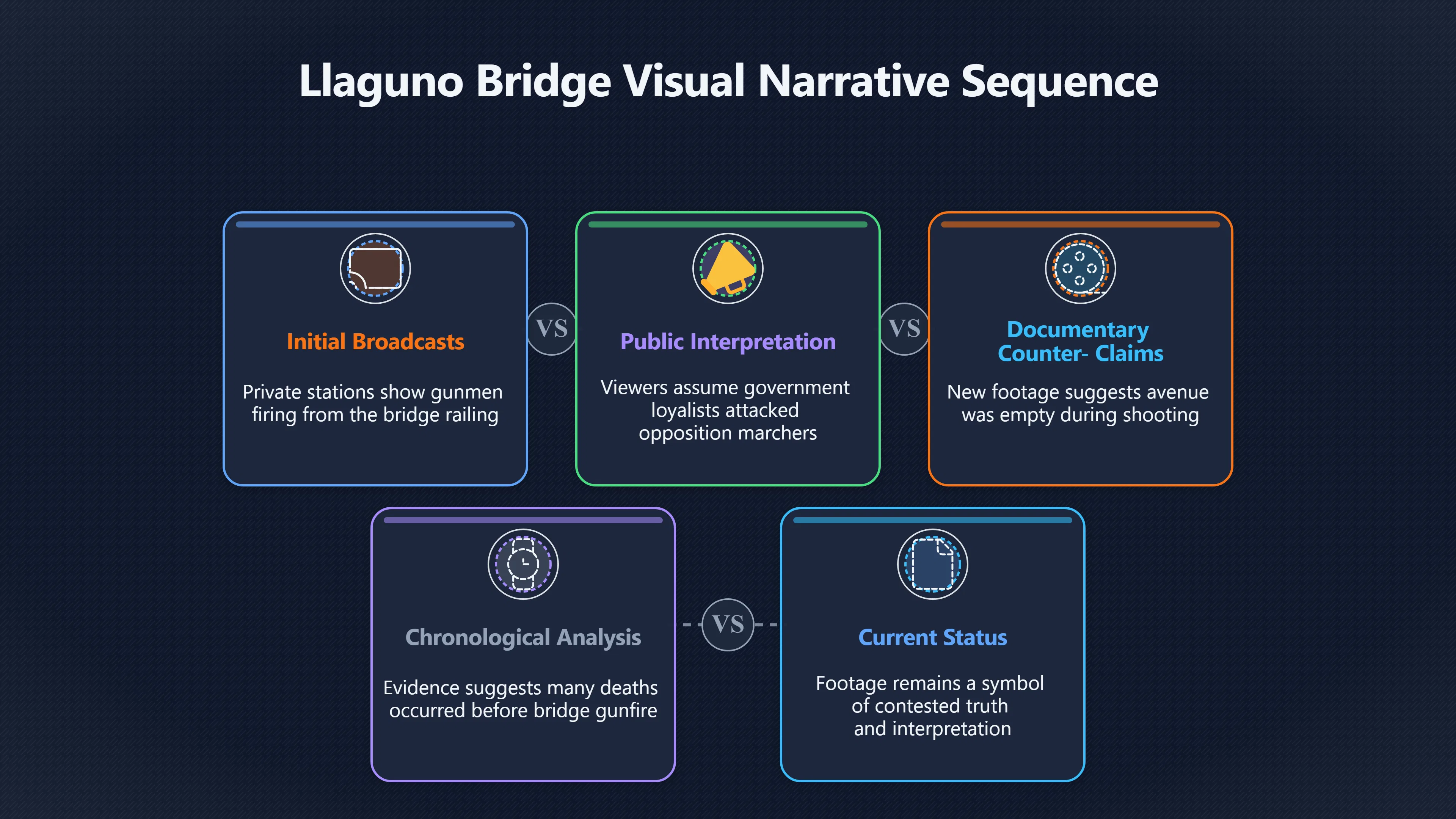
The footage shot at Caracas’s Llaguno Bridge on 11 April 2002 is one of the most disputed pieces of political video in modern Venezuelan history. Unlike a classic hoax involving fabricated evidence, the controversy centred on real images that were presented in radically different ways. Television viewers around the world saw armed supporters of President Hugo Chávez firing pistols from the bridge during the violence that preceded the failed coup attempt against him. To many observers, the images appeared to show government loyalists shooting at opposition demonstrators. Later investigations, documentaries and court cases argued that the footage lacked crucial context: the camera angle concealed who was being shot at, when the shooting occurred, and what was happening elsewhere on the street.[Venezuelanalysis]venezuelanalysis.comAcquitted of all charges men accused of shooting against…September 18, 2003 — 18 Sept 2003 — A group of Government civ…
The result was a lasting battle over interpretation. The images became a case study in how genuine footage can acquire different meanings through editing, chronology, framing and selective broadcasting. More than two decades later, the Llaguno Bridge recordings remain central to competing narratives about the April 2002 crisis and are frequently cited as an example of how visual evidence can both reveal and obscure the truth.[Wikipedia]Wikipedia2002 Venezuelan coup attempt2002 Venezuelan coup attempt
How Broadcasters Framed the Gunfire
The most influential images from 11 April showed several Chávez supporters on the bridge firing handguns over a railing toward Baralt Avenue below. Venezuelan private television stations repeatedly broadcast these scenes during the unfolding political crisis. The implication presented to many viewers was straightforward: armed government supporters were shooting at a large opposition march approaching the presidential palace.[Venezuelanalysis]venezuelanalysis.comAcquitted of all charges men accused of shooting against…September 18, 2003 — 18 Sept 2003 — A group of Government civ…
The footage had enormous persuasive power because it appeared self-explanatory. Viewers could clearly see men with guns. What they could not see was equally important. The camera did not show the targets of the gunfire, the broader geography of the area, or the sequence of events leading up to the shooting. In a fast-moving political emergency, those omissions mattered less than the apparent simplicity of the image. The recording quickly became one of the defining visual symbols of the attempt to remove Chávez from power.[Venezuelanalysis]venezuelanalysis.comAcquitted of all charges men accused of shooting against…September 18, 2003 — 18 Sept 2003 — A group of Government civ…
Supporters of Chávez later argued that the broadcasts transformed an ambiguous scene into an apparently conclusive one. According to this interpretation, television coverage encouraged audiences to believe that the bridge gunmen had directly attacked peaceful opposition marchers, even though the available footage did not actually show who was being fired upon.[Venezuelanalysis]venezuelanalysis.comAcquitted of all charges men accused of shooting against…September 18, 2003 — 18 Sept 2003 — A group of Government civ…
Why Alternative Footage Changed the Debate
The argument shifted when additional video from different angles emerged. The best-known challenge appeared in the documentary The Revolution Will Not Be Televised, which contended that television channels had shown only part of the story. The filmmakers presented footage suggesting that the avenue beneath the bridge was largely empty of opposition marchers at the moment some of the shooting occurred. They argued that the armed Chávez supporters were firing in response to attacks from other directions rather than into the opposition march itself.[Wikipedia]Wikipedia2002 Venezuelan coup attempt2002 Venezuelan coup attempt
This counter-narrative was later reinforced by the Venezuelan documentary Puente Llaguno: Claves de una Masacre (Llaguno Bridge: Keys to a Massacre). The film assembled photographs, timestamps and witness accounts to argue that key deaths had already occurred before the bridge gunmen opened fire. According to the documentary, chronology was the missing element in much public discussion: images from different moments had been mentally merged into a single event by audiences watching television coverage.[Wikipedia]WikipediaPuente Llaguno: Claves de una MasacrePuente Llaguno: Claves de una Masacre
These productions did not claim that no shooting occurred from the bridge. Rather, they argued that the widely circulated interpretation of the shooting was misleading because viewers lacked information about timing, police movements, sniper allegations and the location of demonstrators. The dispute therefore moved from the question “Did the gunmen fire?” to the more complicated question “At whom, and when?”[Wikipedia]Wikipedia2002 Venezuelan coup attempt2002 Venezuelan coup attempt
The Battle Over Chronology
Chronology became the most important technical issue in the debate. Critics of the original television narrative argued that footage from different times of the afternoon had been compressed into a single dramatic story. If the bridge gunmen fired after many casualties had already occurred, then they could not have been responsible for all the deaths attributed to them.[Venezuelanalysis]venezuelanalysis.comThe Venezuelan Coup Revisited: Silencing the Evidence2 Jul 2009 — The documentary provides strong, credible evidence that…
Opponents of that interpretation responded with their own analyses. Researchers such as Brian Nelson assembled photographic timelines and argued that armed Chávez supporters were present and active earlier than the documentaries suggested. Critics also accused some pro-Chávez documentaries of using selective editing, obscuring parts of the street scene, or presenting an incomplete picture of the violence.[brianandrewnelson.com]brianandrewnelson.comshooting from the bridge could have killed or injured…
What emerged was not a simple dispute over facts but a dispute over sequencing. Both sides accepted that violence occurred, that civilians were armed, and that the bridge was a significant location. The disagreement concerned the relationship between specific acts of gunfire and specific casualties. Because the available video record was fragmented and shot from multiple positions, establishing an uncontested minute-by-minute reconstruction proved difficult.[Wikipedia]WikipediaSucesos de Puente LlagunoSucesos de Puente Llaguno
Why the Full Chronology Remains Contested
The enduring controversy reflects a broader problem in interpreting visual evidence. Video creates a powerful impression of certainty, yet cameras capture only limited perspectives. The Llaguno recordings showed armed men firing, but they did not automatically reveal who was shooting, who was being targeted, who had fired first, or how events unfolded across the surrounding streets.[Wikipedia]WikipediaThe Revolution Will Not Be Televised (filmThe Revolution Will Not Be Televised (film
Investigations were also complicated by the chaotic circumstances of the day. Multiple armed actors were alleged to have been involved, including civilians, police officers and possible snipers. Later legal proceedings, competing inquiries and political polarisation produced sharply different accounts of responsibility. Evidence collection was criticised as delayed, and much of the reconstruction relied heavily on photographs, television recordings and eyewitness testimony gathered after the fact.[wikipedia.org]WikipediaSucesos de Puente LlagunoSucesos de Puente Llaguno
As a result, the footage remains a symbol of contested truth rather than a universally accepted piece of evidence. For Chávez supporters, it is often cited as proof that television networks created a misleading narrative that helped justify a coup. For many opponents of Chávez, it remains evidence that armed government loyalists participated in deadly violence. The same images continue to support conflicting interpretations because viewers bring different assumptions about what happened outside the camera frame.[venezuelanalysis.com]venezuelanalysis.comAcquitted of all charges men accused of shooting against…September 18, 2003 — 18 Sept 2003 — A group of Government civ…
What the Llaguno Footage Ultimately Proved
The strongest historical lesson from the Llaguno Bridge recordings is not that one side successfully fabricated evidence. The footage was real. The controversy arose because real footage was treated as if it were self-explanatory when, in reality, it required context that many viewers never saw.[Venezuelanalysis]venezuelanalysis.comAcquitted of all charges men accused of shooting against…September 18, 2003 — 18 Sept 2003 — A group of Government civ…
Within the broader history of Venezuelan political misinformation and disputed narratives, the episode stands as a warning about visual certainty. Cropping, camera position, missing chronology and selective broadcasting can transform authentic recordings into evidence for competing stories. The Llaguno Bridge images became famous precisely because they occupied the uncomfortable space between proof and interpretation: they showed something undeniable, yet did not conclusively settle what that something meant.[Wikipedia]Wikipedia2002 Venezuelan coup attempt2002 Venezuelan coup attempt
Amazon book picks
Further Reading
Books and field guides related to What Did the Llaguno Bridge Footage Prove?. Use these as the next step if you want deeper reading beyond the article.
The Demon-Haunted World
Rating: 4.5/5 from 43 Google Books ratings
Encourages careful assessment of evidence and claims.
eBay marketplace picks
Marketplace Samples
Live-tested eBay searches with available results related to this page.
Endnotes
1.
Source: venezuelanalysis.com
Link:https://venezuelanalysis.com/news/106/
Source snippet
Acquitted of all charges men accused of shooting against...September 18, 2003 — 18 Sept 2003 — A group of Government civ...
Published: September 18, 2003
2.
Source: Wikipedia
Title: The Revolution Will Not Be Televised (film)
Link:https://en.wikipedia.org/wiki/The_Revolution_Will_Not_Be_Televised_%28film%29
3.
Source: Wikipedia
Title: 2002 Venezuelan coup attempt
Link:https://en.wikipedia.org/wiki/2002_Venezuelan_coup_attempt
4.
Source: Wikipedia
Title: Golpe de Estado en [Venezuela]({{ ‘venezuela/’ | relative_url }}) de 2002
Link:https://es.wikipedia.org/wiki/Golpe_de_Estado_en_Venezuela_de_2002
5.
Source: Wikipedia
Title: Puente Llaguno: Claves de una Masacre
Link:https://en.wikipedia.org/wiki/Puente_Llaguno%3A_Claves_de_una_Masacre
6.
Source: venezuelanalysis.com
Link:https://venezuelanalysis.com/analysis/4580/
Source snippet
The Venezuelan Coup Revisited: Silencing the Evidence2 Jul 2009 — The documentary provides strong, credible evidence that...
7.
Source: brianandrewnelson.com
Link:https://www.brianandrewnelson.com/Venezuela/Photographic_Chronology.html
Source snippet
shooting from the bridge could have killed or injured...
8.
Source: Wikipedia
Title: Sucesos de Puente Llaguno
Link:https://es.wikipedia.org/wiki/Sucesos_de_Puente_Llaguno
9.
Source: justice.gov
Link:https://www.justice.gov/sites/default/files/eoir/legacy/2013/06/07/venezuela.pdf
10.
Source: Wikipedia
Title: Llaguno Overpass events
Link:https://en.wikipedia.org/wiki/Llaguno_Overpass_events
11.
Source: venezuelanalysis.com
Link:https://venezuelanalysis.com/multimedia/6923/
12.
Source: venezuelanalysis.com
Link:https://venezuelanalysis.com/analysis/10926/
13.
Source: lostinthemovies.com
Title: the revolution will not be televised
Link:https://www.lostinthemovies.com/2019/03/the-revolution-will-not-be-televised.html
Additional References
14.
Source: caracaschronicles.com
Title: the untold story of venezuelas 2002 april crisis
Link:https://www.caracaschronicles.com/2004/04/14/the-untold-story-of-venezuelas-2002-april-crisis/
Source snippet
footage of Puente Llaguno was a blatant manipulation. Amateur video taken from a different angle and made public later showed no proteste...
15.
Source: youtube.com
Title: Video Foro “Puente llaguno Claves de una Masacre”
Link:https://www.youtube.com/watch?v=UheUxKe86dw
Source snippet
Chavistas se congregan para recordar fallido golpe de Estado contra Chávez...
16.
Source: youtube.com
Link:https://www.youtube.com/watch?v=DzSQ6eCfAfo
Source snippet
Video Foro "Puente llaguno Claves de una Masacre"...
17.
Source: refworld.org
Link:https://www.refworld.org/reference/annualreport/rsf/2003/en/48901
Source snippet
Reporters Without Borders Annual Report 2003 - Venezuelaers on 11 April. Footage taken by a TV cameraman supposedly showed him fi...
18.
Source: ejumpcut.org
Link:https://www.ejumpcut.org/archive/jc52.2010/vasquezVenezuela/2.html
19.
Source: amazon.com
Link:https://www.amazon.com/-/es/Llaguno-Massacre-Documentary-Caracas-Venezuela/dp/B01M3TO5MC?tag=searcht-20
20.
Source: youtube.com
Title: Puente Llaguno Claves para una masacre
Link:https://www.youtube.com/watch?v=cZ9jE1c0XPE
Source snippet
The Revolution Will Not Be Televised: Venezuela 2002...
21.
Source: youtube.com
Title: The War On Democracy [Full John Pilger documentary]
Link:https://www.youtube.com/watch?v=F_l9MPSKeFM
Source snippet
Puente Llaguno Claves para una masacre...
22.
Source: youtube.com
Title: Chavistas se congregan para recordar fallido golpe de Estado contra Chávez
Link:https://www.youtube.com/watch?v=nXRBUTo95-0
23.
Source: hrw.org
Title: venezuela investigate killings demonstrators
Link:https://www.hrw.org/news/2002/04/15/venezuela-investigate-killings-demonstrators
Topic Tree